Desert Online General Trading LLC
Dubai, United Arab Emirates
Desert Online General Trading LLC
Dubai, United Arab Emirates


🌐 Tune into the world’s stories—anytime, anywhere.
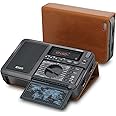
The Elite Traveler is a compact, battery-powered international radio featuring AM, FM, Longwave, and Shortwave bands with 500 station memory. It boasts a high-contrast orange LCD with RDS for rich station info, precision dial tuning, customizable sound controls, and a travel-friendly leather case. Perfect for professionals who demand global connectivity and premium audio clarity on the move.


| Item Weight | 0.37 Pounds |
| Item Dimensions L x W x H | 6.3"L x 1.72"W x 4.76"H |
| Material | Plastic |
| Style | Radio |
| Color | Orange,Red |
| Hardware Interface | 3.5mm Audio |
| Frequency | 108 MHz |
| Compatible Devices | Earphone, Headphone |
| Speaker Maximum Output Power | 10 Watts |
| Voltage | 100240 Volts |
| Display Type | LCD |
| Power Source | Battery Powered |
| Radio Bands Supported | AM/FM/LW/SW |
| Display Technology | LCD |
| Special Features | Portable |
| Connectivity Technology | Shortware Radio |
| Tuner Type | AM |
K**P
Great radio, also for international travellers
We wanted some contact with the outside world during a power outage (California), so I did quite some research to find a radio with good specs and good reviews.. Thought I had figured it out when I read up on differences in FM and AM transmissions internationally. My wife and I are both from Europe, so we do travel there now and then and might want to take the radio with us.. Anyway, This radio has AM/MW, LW and all Shortwave bands. Additionally, you can completely configure it for international differences for the FM and AM transmissions. It is small, feels very solid, has plenty of config options, tuning and fine tuning options, enough volume and good reception on FM. AM reception is so so..We live in the foothills and have no direct line of sight with towers and I have not set up a special antenna for SW/LW reception (or AM for that matter), so my cursory scanning did not get any stations at all on LW/SW...However, that weas not my primary intent anyway.. The radio works on both 4 AA batteries, and I hooked up a universal multi-voltage power supply, and that works fine. Apart from the tuning wheel and volume control, it has no moving parts to break, and comes with a nice and stylish leather 'holster'. All in all, very happy with our purchase...
C**E
Great little radio
Low level hiss, so not for headphone listening! Everything else is 100% as are most eton products! This is most useful for traveling DXers as per the name! The look and feel is top class as is the interface. RDS is standard on this model and hooked me since my fave stations take advantage. The speaker has great sound for its tiny size. The only feature I felt was missing is charging rechargeable batteries! It does support an optional power supply for saving those batteries!
I**D
Good quality radio designed around one who travels the world.
The reason I purchased this particular radio is that I owned an old Grundig YP400e that was so old and beat up it was time to replace it. However, I could only spend about fifty dollars. I knew the quality of Grundig radios and this one had the very stable digital shortwave frequency range that I wanted. So far, I'm happy with the purchase. The physical quality is just the level of quality that I expected from them. It is a radio that, even with just the whip antenna, is sensitive enough to reach out and grab FM, AM, and Shortwave stations.The Bad: I only said it would reach out and grab FM, AM, and SW stations. Only those three because, for whatever reason, I cannot get mine to go into Longwave no matter how many times I press the AM/LW button. Is it just mine or the entire production? I don't know. I don't listen to LW and, as far as I know, there isn't really anything down there except beacons. So, I don't miss it and I didn't get it for that, so I'm not disappointed. I think it might be the software, or programming, or whatever because sometimes it takes three or four presses of a button for the radio to switch over or to turn on. It won't do anything unless the screen is lit. Odd, but alright.The Good: Other than the two Bad issues, the radio works just fine. The FM and local AM reception is very good. Listening to a FM station about twenty to thirty miles away isn't a problem. In my West Texas house here in the high plains I can get WBAP 820 from Dallas, TX just fine after the sun goes down. It is a very sensitive radio. Everything else in the radio works just fine as it was designed to do. For the world traveler, the time zone knob is an easy way to change the radio's clock to the local time zone. Just open it up and turn the knob to the appropriate time zone and you're good to go. Just make sure to set the clock to the local time zone first by reading the manual. The physical build of the radio, as in the outside case itself doesn't seem to be fragile to me. It's built tougher than you think. Because it's designed to be used by a traveler it's built to take a little bit of a beating.Shortwave Reception: I put this in a separate section. This is a very sensitive radio that will pick up stations even with the short whip antenna. Reason is, and this is just a guess, is due to the DSP and some type of signal amp inside. Again, just a guess. Because the radio seems to be adjusting itself for the best reception. The volume will lower, or detune, during frequency changes. When it settles on a frequency, the signal will come back as if you're increasing the volume. So, that's why I say that. I could be wrong. But it is very stable. There is no drifting in the signal. So, you will get stations with just the whip antenna. However, there are some things to keep in mind about shortwave reception. Shortwave is AM, or Amplitude Modulation. Same as local AM, just higher frequencies. Therefore, shortwave is susceptible to interference from other electronics, or RFI. Such as: Computers, power strips, wall warts, fluorescent lights, TV's, power lines, etc. If you are in a metal building it will effect the incoming signal and not for the better. Such RFI interference will increase the background static, so turn off everything you don't need while listening to shortwave. It will help. Another thing to keep in mind is atmospheric propagation. Good stations to start off with is WWCR and WRMI, in my opinion. I say that because both of them have day time and night time frequencies that are transmitted specifically for North American listeners. Shortwave station antennas aren't omnidirectional, normally. They usually point in either one direction or two directions such as East and West or North and South. Take BBC for example. I can't here it in the USA because they don't transmit in my direction. So, no matter how good of an antenna I put up I can't receive a station that's not pointed in my direction. Normally. That's why stations such as WRMI have maps on their website which shows transmitter direction and signal strength. Shortwave radio signals are susceptible to the time of day, atmosphere conditions, and even sun cycles. Some stations will work better at night while some work better during the day. I would suggest for anyone wanting this radio, or any radio for receiving shortwave, to do research regarding shortwave propagation. Another to look up is RFI and why such electronics can add static to an AM radio.With that said, let me say this. Because this radio doesn't have an external antenna jack it helps to use a clip-on antenna. Like the CCrane roll-up portable. Personally, I made one from a long length of 18 gauge wire and an alligator clip. A length of wire of about twenty to twenty-five feet crimped to an alligator clip then attached to the whip antenna will definitely help the reception. When not in use, just roll it up and put the antenna away in your pocket along with the radio. Keep in mind that when adding antenna length, not only will it increase the radio signal but also the static. So, it may not seem like it's working. But if you change the display to show dBu and dB you can see the difference. I have a simple wire antenna strung out on my roof and when I clip that to the radio the signal can jump from a 40 dBu to around 70 or 80 dBu on the display. But it also increases the static to 25 dB as well.If you are just starting out in shortwave listening: For starting out, this is a good quality very stable non-drifting digital radio. It would help to research AM Shortwave propagation and RFI electronic interference. It will help someone just starting out to understand why you might not be able to get a station even if you are on the correct frequency. For example: Where I am in West Texas panhandle I'm at 3200 ft. above sea level. Out here the land is just like the people and the language...flat straight and goes on forever. So, with an elevation around 3200 ft. I could get signals better than someone who lives in a valley surrounded by mountains close to sea level. And to understand why turning off electronics will help reception by decreasing the level of static the radio receives thus being able to hear the station better. And be inventive with your antenna. Almost any length of wire crimped to an alligator clip will work as an antenna. Remember Slinky? Look up Slinky antennas on Youtube. Or a metal tape measure screwed onto the alligator clip. Be creative, do research, and happy listening.Update 2-7-21: I got the radio on the 26th of January and immediately put in the batteries. With the radio on for a good few hours each day and the display light on constantly half the time the batteries lasted ten days.Update 3-20-22: I've had this for a year and I've found out something about this radio. It's about the tuning knob and how it changes frequencies. The way you change frequencies quickly is by turning the tuning knob quickly. If you want to change the frequencies slowly then you turn the tuning knob slowly. Well, we have a saying in our household. "Nice in theory, horrible in practice." That method of fast scrolling through frequencies is a nice idea but for one problem. It doesn't work that well after the tuning knob gets worn in. At first it worked just fine, however, as the tuning knob gets used and worn, the programming has a hard time defining when is slow tuning and when is fast tuning. Because it gets worn the system will often see the knob and halfway between notches and will rapidly change frequencies. Even when tuning slowly, the system will think you want to fast scroll through frequencies. There's nothing really wrong with the tuning knob itself even as it wears in with use. The problem is how that worn in knob interacts with the auto slow to fast frequency change feature. This makes getting to the frequency that you want almost like rolling the dice. Sometimes you'll get to it just fine and other times it will keep fast scrolling with no way to slow it down to get to the one you want. So, in my opinion, it was a nice idea but after a while, after a bit of use, it almost becomes unusable because the system is scrolling through frequencies too fast that you can't land on the one you want to listen to. The radio itself is fine, but it would have been better to put a button that selects fast or slow scrolling rather than an automatic feature that is problematic the more it gets used.
J**A
A very enjoyable little radio, great performance.
I really like this radio and enjoy using it every time. It is versatile and easy to use. You just need to sit with the small manual for about 30 minutes and you will be ready to get most out of it.AM and FM performance is great. Shortwave was good and I was not able to get Longwave which is scarce around here. Battery performance so far has been great too.Audio quality is surprising considering such a small speaker, great clarity without been shrill. It works best if used indoors in a quite place of the house. It will feel the space adequately.The only thing that it does not gives me and I really wish it would is the NOAA weather band. All in all it is a great buy, I got mine for 39.99 on a special sale date and at that price is a home run hands down.Lastly it’s handsome looks only adds to the substance of its performance.
E**L
I don't know how to easily find and store AM and FM radio stations after owning the radio 1 year.
This radio is extremely difficult to use, although it does a nice job at receiving random short wave stations. I'm a college-educated engineer and feel like a total idiot because I can't figure out how to use the scan feature, find the station I want, store it into memory and recall it. Instead I have to use the manual dial (slow mode 1 kHz at a time) because I don't know how to shift out of slow to fast and back again. The manual dial also reverses spontaneously for some reason, so if you're increasing the frequency by rotating the dial suddenly the frequency starts decreasing and you have to start rotating the dial the other way. I have no idea why. Don't know how to get in and out of sleep mode either. Can't shut off the display light either, which drains the batteries. I've tried to read the manual several times. It's too confusing. I understood The Matrix but not this. By the way, it has a nice plastic cover, which completely covers the speaker and muffles the sound. Who designed that?? Perhaps a young person with a lot of experience with electronic gadgetry might be more successful with this. As for me, I've decided this thing is going in the trash and I'm going to just replace it. I just hate this product. Good riddance.
Trustpilot
2 weeks ago
3 weeks ago