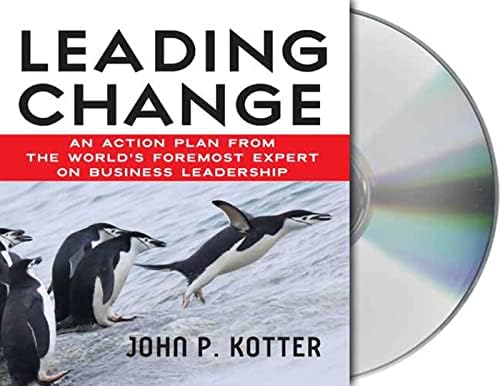
Leading Change: An Action Plan from The World's Foremost Expert on Business Leadership Audio CD – Unabridged, August 21, 2007
Product ID: 8804978
Desertcart purchases this item on your behalf and handles shipping, customs, and support to USA.
Full description not available
W**E
Change - Ya Gotta Love It. REALLY.
What does it mean to be a change leader? In times of fiscal upheaval, can a state agency stay true to its mission and vision? Or, must these be sacrificed on the altar of efficiency to the (presumably) lean God of Economy? These are the challenges that confront our elected representatives, agencies that serve the public, unions that represent the workforce, and their constituencies.In "Leading Change," John Kotter reveals his Eight-Stage Process of Creating Major Change:1. Establishing a Sense of Urgency2. Creating the Guiding Coalition3. Developing a Vision and Strategy4. Communicating the Change Vision5. Empowering Broad-Based Action6. Generating Short-Term Wins7. Consolidating Gains and Producing More Change8. Anchoring New Approaches in the CultureIn Kotter's experience, neglecting any one stage undermines and imperils the entire change effort.So it is clear that change is coming. It always does. Particular change can be envisioned in an instant but implementation can take some time. This is especially true in large, complex organizations like government bureaucracies, with highly interdependent structures and systems. Serving the public is a process and jobs are maintained to provide the service. Nearly every process in one system is connected to many other systems, and one change will, of necessity, affect changes to hundreds or thousands of processes. To say that change requires hard work and sacrifice in this environment is an understatement.Change in a government bureaucracy requires a seismic shift in thinking by those who have been working at the same agency for decades, especially those who really believe they have made a difference for the public good. "We have always done it this way so why change now?" Their contributions provide valuable lessons but time marches on. Not only are policies and procedures not cast in stone, but future generations deserve the right to have them evolve. Whether they evolve for the better -or not--is the responsibility of the change agent... basically, you and I.By definition, government services "serve" the public. The way government serves the public today could not have been envisaged at its founding. America has had some time to think about and see some good ideas become reality. We have codified them, managed them, regulated them, raised revenue from them, underwritten, audited, overseen the audit, re-codified, re-managed, re-regulated, created increasingly complex financing mechanisms, then audited everything again.... It is only natural that before long, the original idea... the "mission" and "vision" becomes lost in the risk averting, litigious-avoiding (though interconnected) world of bureaucratic government. How do you empower interdependent agencies with different functional missions to work seamlessly together? What can a workforce do when it is saddled with legally mandated interconnected systems that do not fulfill the mission or vision of the agency but are relics of an earlier era, or simply symptoms of jurisdictional overreach?For change to really happen and take hold in a governmental bureaucracy, with organizational structures and personnel performing different functions and serving different (sometimes opposing) constituencies, and systems of supports and services serving a large and growing base of populations, the change must produce benefits and personal satisfactions that are superior to the way things are today.Today it will take more than the desire to "do more with less," or even to "do more, better." Indeed, the organizational culture itself must be changed. Purging unnecessary interconnections can ultimately make a transformation not only possible, but easier. It may not be necessary to consolidate agencies when it would be more efficient to coordinate them instead. Streamline procedures and approval processes by putting systems in place that satisfy regulatory requirements and align with the agency's mission. Government and unions can be powerful allies to responsibly empower a highly trained public workforce. The wins must be real, and they must come soon. Paraphrasing Kotter, "Truly adaptive governmental bodies with adaptive cultures are awesome competitive machines."At a visceral level, you have to appreciate change, respect it, embrace it... lead it. "Leading Change" reminds us that change starts with you and me.
B**S
Highly readable, useful, and even inspiring
What happens when an organization needs to change (if it hopes to be successful in the future) but hasn't put much thought into what the process of change itself looks like? More than likely: failure.John Kotter outlines here a critical difference between change efforts that have been successful, compared to change efforts that have failed. Drawing on decades' worth of experience consulting with firms and coaching leaders, and attentive to ever-increasing globalization of markets and competition, Kotter offers an eight-stage change process. The eight stages are:1. Establishing a sense of urgency2. Creating the guiding coalition3. Developing a vision and strategy4. Communicating the change vision5. Empowering broad-based action6. Generating short-term wins7. Consolidating gains and producing more change8. Anchoring new approaches in the cultureSuccessful change, Kotter argues, "is 70 to 90 percent leadership and only 10 to 30 percent management. Yet for historical reasons, many organizations today don't have much leadership." Kotter articulates what effective leadership -- not management -- actually looks like.Kotter provides a helpful, clear, and concise chapter devoted to each of the eight stages. He articulates precisely what is needed at each critical moment in the transformation process. He provides numerous examples of what happens when any stage is ignored (basically, he suggests that to ignore any of the eight stages will likely lead to failure). Specific guidance and steps are offered at every point along the way. A useful summary of the whole process is provided on page 21.The final couple chapters provide a glimpse into the organizations and leaders of the future. "The rate of change in the business world is not going to slow down anytime soon. . . . The typical twentieth-century organization has not operated well in a rapidly changing environment. . . . If environmental continues to increase, as most people now predict, the standard organization of the twentieth century will likely become a dinosaur." The winning enterprise of the twenty-first century will have a persistent sense of urgency, teamwork at the top, people who can create and communicate vision, broad-based empowerment, delegated management for excellent short-term performance, no unnecessary interdependence, and an adaptive corporate culture. Leaders of the future are going to be people with high standards and a strong willingness to learn. Arguing that leadership traits can be learned, Kotter provides examples of people he has known over an extended period of time who once upon a time showed little promise, but who developed superlative leadership skills and have become highly effective, successful, influential leaders. Just as organizations need to continue to continue to change and grow, so too will organizations' future leaders.Overall, this is a highly readable, useful book. It is obviously useful for leaders in the corporate world. I would argue that it is also highly useful for leaders in ANY organization that is trying to thrive in the twenty-first century. I wish I had read it years ago!
A**J
Good starting point
I purchased this book primarily for reference purposes whilst undertaking research for a leadership and management module. Kotter takes a common sense approach and his model is logical and written in a practical sequence. He also presents his own experiences well through use of case study examples. This makes for an easy read and offers a basis for understanding organisational behaviour and development. However, whilst I appreciate that this book was a best seller, I was hard pushed to find validation of the full eight step process. The book does not even contain references to any external sources, and the majority of `evidence' is presented by Kotter himself in follow up articles or books.Despite the lack of validity, I do value Kotter's ideas. However, whilst I am certainly no match for a Harvard professor, I do not think leading change is as linear a process as Kotter's model suggests. Evidence from my own practice in social services suggests that the development and communication of a vision is of primary importance. This establishes a rationale for urgency by affording individuals opportunity to see what change can actually offer them which, in turn, can nurture their own leadership and team working skills. Urgency, without a purpose, can only be false and unsustainable. Contextual variables, therefore, must be accounted for, and I have found it more constructive to adapt Kotter's framework and consider it alongside other models and theories..
J**S
Certainly a classic and a must read for serious project managers
Well written with plenty of stories, anecdotes and analogies. Its as if John Kotter was present in every company I ever worked for and on every project I managed ! 'Do your people believe the status quo is unacceptable ?' 'Do they really feel a sense of urgency?' 'Do you have a compelling vision for the future and strategies for getting there?'Kotter explains why 'Snakes, big egos and reluctant players are the enemy of change and what you can do to win them over ...or get rid of them! Thanks for some great ideas John P. Kotter.
P**R
Leadership not Management
Great book that will get you thinking about the communication of and the ownership of change and new working methods in any organisation as well as the importance of vision. Whilst it could have suffered from the 8 stages feeling a little too 'off the shelf' rather than responsive to real situations, actually the stages offer a sense of sustained focus that is often lacking in this kind of book. The stages feel surprisingly as useful for the linear as the abstract thinkers. Kotter's understanding of change leadership rather than management seems to stand head and shoulders above the other writers in this area. If I have a criticism (it is either a criticism or a suggestion for another book) it is that Kotter's plan for change management could do with asking how it might work in an organisation where the new vision is coming from the bottom up rather than the top down. On the whole, if you are facing change in your organisation and you haven't read this book then I would simply ask you why on earth not?
M**K
Recommended
John Kotter's work is a classic volume on change leadership. The book is readable and the steps which he describes make sense to me. I have found the ideas helpful in my workplace and they have formed part of a leadership course which I recently attended. The hard-back binding which I purchased also makes the book durable and more of a pleasure to handle and read.
M**I
A true classic - over five stars
This is simply a great book and a very rewarding reading!Kotter gives us two key lessons: companies risk to be overmanaged and underled, while change needs to be led more than managed.The proposed 8 step change model is a very powerful tool to lead a company transformation.
Trustpilot
3 weeks ago
1 month ago