

Desert Online General Trading LLC
Dubai, United Arab Emirates
Desert Online General Trading LLC
Dubai, United Arab Emirates


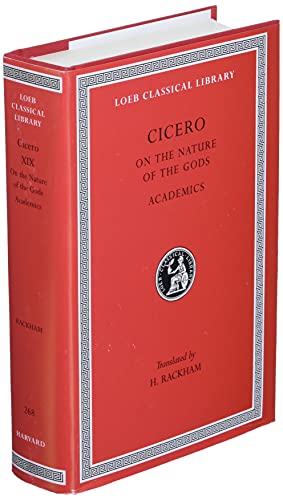

On the Nature of the Gods. Academics
F**R
Loeb Classical Library Cicero On the Nature of the Gods
Loeb (Harvard) Classical Library editions are nicely bound cloth covered hardbound books, printed on acid-free paper, and small enough to fit in a coat pocket (about 4.5 by 6.5 inches). This book is printed with the Latin on the left page and English translation on the right.I found the reported sighting of the Roman gods Castor and Pollux having been seen fighting alongside Romans at the battle of Lake Regillus fascinating. (page 127) It is no wonder that the Romans persecuted early Christians--after all, the Christians were atheists who refused to honor the gods that made Rome a great nation! I doubt the Romans would have converted to Christianity had they not been forced by Roman emperors Constantine, Theodosius and Justinian.If you would like to read personal testimony regarding the existence of the gods, you might also want to purchase the Loeb edition of Marcus Aurelius. This Roman emperor testifies to his personal experience of the gods in his life and his deep reverence for them.
D**S
A CLASSIC SERIES
The Loeb Editions always make a "return engagement" ... a series that is excellent! While the translations tend to be as archaic as the texts they translate, there's something about the LOEB "traditio"!
J**D
Five Stars
A must for anyone's library
F**D
Five Stars
The book is by Cicero. Items is as stated. Thanks.
V**S
Past Times Present
Accepting something merely because it has always been that way - whether in a religious sense or any other - has always been the easiest thing a person can do. Discussion, on the other hand, is difficult, especially when the discussion takes place between people of different opinions, different beliefs, different cultural backgrounds.To understand much of the present day arguments about religion it is necessary to go back through time and see how some of these beliefs began, where they have their roots, what makes people follow one specific belief over another. It is necessary to look critically at what is propounded by modern-day religions, and where they stem from, how they came to be in the present form, what appeals to people who follow these religions, this form of faith.Cicero's book, written in the final years of his life, takes three differing aspects of the subjects 'gods' and 'belief' and allows his characters to explain why they follow a certain train of thought, why their own belief is based within a specific area. His characters discuss three differing schools of thought during the pre-Christian era, thoughts which have influenced us whether we know it or not.His carefully constructed discussion is a masterpiece of poetic language as much as a revelation about our past. How the philosophical schools of his time came to terms with the idea of a god, or many gods, or even the lack of a supreme being. How daily life was governed by their perceived rule, by their actions or inaction, by the messages they are purported to have passed down to mortal man. On the Nature of the Gods gives us a valuable insight into the thinking of his times and the first constructs which would, in coming centuries, be adapted and forced into the belief in one single god. Coupled with many other writings, both from Cicero and other great thinkers of the past, it casts a light into the depths of a subject few are able to discuss without acrimony and hate, and where few are capable of proving that one system or another is the right path to follow.
A**R
"I am no new convert to the study of philosophy."
This volume (#268) in the Loeb Classical Libraryeditions of Greek and Latin works -- contains twomajor philosophical works by Cicero {Marcus TulliusCicero -- sometimes referred to as "Tully" by laterwriters of the 17th and 18th centuries). The twoworks are: -De Natura Deorum-, and, -Academica-. There are, in his life and in his writings, twodifferent Ciceros, according to the implications inCicero's writings. There was the public man Cicero--the lawyer in the courts (whether prosecuting ordefense), the Consul, the politcal activist, themanipulator and manipulated man. Then there wasthe retiree from public life, the father cast intosorrow by the grief over the loss of his daughter,the man seeking consolation and engagement withphilosophy. It is the second of these two menwho is the author and thinker in these two works. Both works are cast as dialogues...discourses,or gentlemanly "arguments" about the schools ofphilosophy and the approaches of philosophicalthought which were available in Cicero's time.They mainly concern what had happened to philo-sophical thought after the death of Plato, andthe fate of his school (the Academy) and itsteachings were passed down to various "stewards"of thought. Each of the succeeding masters ofthe school took a different approach towardphilosophical investigation and interest, dependingon how they interpreted Plato's emphases. Onegroup decided that it was impossible to be positiveabout any knowledge concerning the external world;another group decided that while a certain healthyskepticism should be held concerning sense impressionsand the rational deductions which could be based onthem, still there was plenty of room for rational,productive insight to be developed. Cicero begins -De Natura Deorum- with a Prefacewhich is addressed to his friend Brutus. In this"Preface," Cicero says that the various philosophicalgroups have argued over the nature of the gods. Hesays that it is important to try to discover whichmight be the true view, since if the gods "haveneither the power nor the will to aid us" [henever presents the option that there are no godsat all], then that will lead to one way of lookingat the gods and will have certain repercussions onthought and social life and the life of the country,but if there is another side, and the gods do, infact, concern themselves in men's affairs andperhaps even intervene or let their wills beknown, then that should lead to a differentresponse on the part of man. For, as Cicerosays, "Piety however, like the rest of the virtues,cannot exist in mere outward show and pretence;and [without] piety, reverence and religion mustlikewise disappear. And when these are gone,life soon becomes a welter of disorder and confusion;and in all probability the disappearance of pietytowards the gods will entail the diappearance ofloyalty and social union among men as well, andof justice itself, th queen of all the virtues." Those are important ideas to consider, especiallyin these, our own times. Cicero says that thereare two main reasons why he has turned to philos-ophy: he thought to expound philosophy to hisfellow-countrymen as a duty in the interests ofthe commonwealth since it would greatly contributeto the honour and glory of the state to havethoughts so important and so lofty enshrined inLatin literature (rather than only Greek); and,secondly, he has taken to the writing of philosophybecause of the dejection of spirit occasioned bythe heavy and crushing blow from the death of hisdaughter, Tullia (45 B.C.). In Book I of -De Natura Deorum-, the theologyof the philosopher Epicurus is expounded byVelleius, who attacks the theology and cosmologyof Plato and the Stoics, and refutes the theologyof the other schools from Thales downward [thisis from the relation by H. Rackham in his "Intro-duction" to the work]. "He is answered by theAcademic Cotta, who demolishes the Epicureantheology, and pronounces Epicureanism to bereally fatal to religion." In Book II, the Stoic theology is set out byBalbus. Cotta again replies, in Book III,giving the Academic criticism of the Stoictheology in the same four areas covered byBalbus. In the actual "debate," Cicero isa somewhat silent observer, but at the endhe notes the impression of the debate on hisown mind. In -Academica-, there is another dialogue, ordebate. There were two different versions ofthis work written by Cicero; and we have partsof both, but not the complete version of eitherthe first or second edition (and Cicero madesome changes between the two versions). Sowe have a work which is a part of one edition,some fragments, and a part of the other editionput together to form a "whole." Again, thedebate is over the approaches of philosophersoutside the Academy, and the various groupswhich inherited and put their own stamp onthe Academic thought -- the Old Academy andthe New Academy. This work is dedicated andhas as one of its interlocutors the great Romanscholar and librarian, Marcus Terentius Varro.Varro says that he has written nothing in philosophybecause he thinks that Romans will eitherread the Greek, rather than any Latinversion or imitation, or they won't be interestedin philosophy at all, and so won't read anything,Greek or Latin. Cicero, disagrees with Varro.He says that Romans, even those who can readGreek works of philosophy, would also be interestedin Latin works as well. And he says that works ofphilosophy in Latin might be of value for thosewho would have no interest in the Greek ones. In these two excellent translations intoEnglish by H. Rackham, the English reader willalso find interest, pleasure, and insight ininvolvement with Cicero's presentation of thesearguments and refutations of the various philo-sophical approaches to ideas, values, virtues,divinities, and schools of thought.
J**O
Cicéron traité philosophique.
Édition de référence latin-anglais pour lecteurs avertis. Maîtrise de l'anglais indispensable. Valable surtout pour le texte latin quasiment introuvable. Le stoïcien Cicéron réfléchit au sujet de la nature des dieux et évoque l'académisme dans un autre traité. Pour amateurs motivés et spécialistes pas trop regardants, pas d'apparat critique, peu de notes ou commentaires. Nous, on aime bien. Bonne lecture. Ouvrage étranger.
P**S
Five Stars
impeccable
Trustpilot
2 months ago
2 weeks ago