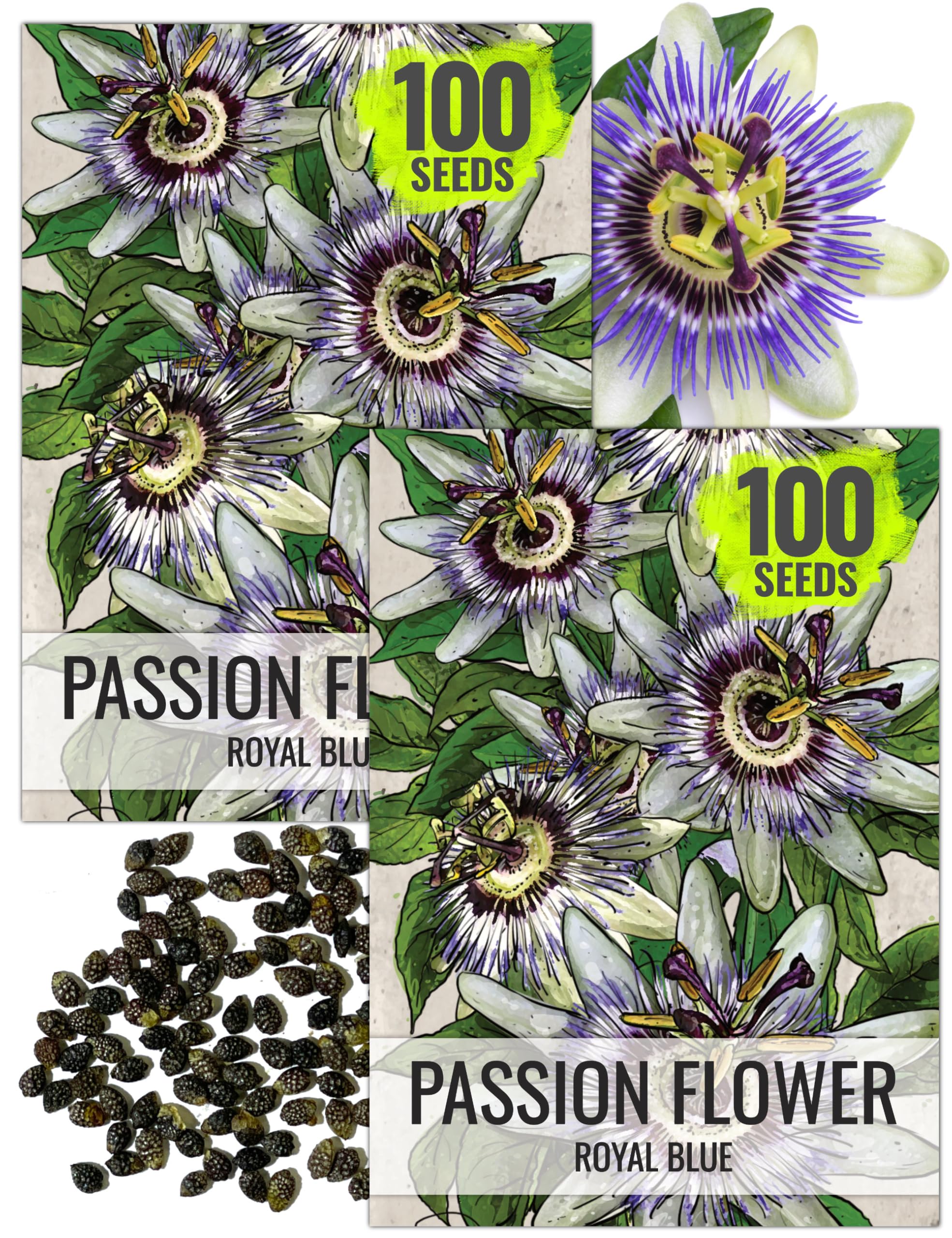


🌸 Cultivate Passion, Grow Prestige — Your Garden’s Next Iconic Statement
Seed Needs Royal Blue Passion Flower Seeds offer 100 heirloom, open-pollinated seeds per pack, delivering fast-germinating, hardy tropical vines with striking blue and white flowers. Packaged fresh in moisture-resistant materials, these seeds thrive in full sun and well-drained soil, perfect for adding exotic beauty and low-maintenance greenery to any garden.


T**7
The seeds work. The product is real. It does not come with gardening instructions.
My grandmother is a hard-core gardener so for Christmas I thought “what is a unique flower I could get her?”My first thought was a Japanese bat lily or a cherry blossom tree. Obviously I don’t know anything about plants, cause those would never grow in a Cleveland suburb.So I found a blue Passion flower. And I thought perfect! Well then I realized I should probably check the reviews before I buy it online, ya know, so I don’t get corn or day Lily’s. Well 10 websites later I found it on amazon!After lots of research I found out that it even grows fruit after a couple of years. And you eat it the way you would a pomegranate. And since my grandparents are 80+ my mom says that would be a good thing for selling the house. And that it could be a focal point on the real estate once they pass.Well the shipment comes. And there’s no instructions. So naturally I freak out since I don’t know anything about gardening and my grandmother has never raised Passion flowers before. So I had to do some research. I literally complied all this information then printed it out and handed it to her as a gift in a separate envelope.So for the next person who buys Passion flowers and has no clue.....Your welcome stranger.———————————————Royal Blue Passion FlowerPassiflora caerulea – “Blue-crowned” passiflora with five-parted leaves and flowers in blue, rose, and pale green. The egg-shaped yellow fruit is edible. This is one of the more hardy species. Its variety, grandiflora, has larger flowers.It’s fruit is edible. The relatively winter-hardy Passiflora caerulea often produces egg-shaped orange fruits in warm summers. They can be eaten when fully ripe, but please be aware that under-ripe fruits (yellow) can cause stomach upsets. However the foliage and roots are toxic.Sun RequirementsFull sun, with some afternoon shade in hot summer climatesBloom Period and Seasonal ColorMost passion flowers repeat bloom from mid summer until fall. July till September.The “Blue Passion Vine” is pretty cold hardy and salt tolerant but the plant does not grow well in intense summer heat.The Passion Flower is a quick-growing perennial plant which spreads via root suckers. It is a climbing vine and can cover large areas above ground and spread far and wide below ground.In climates that experience warm winter temperatures, it is a woody plant. In very cold temperatures, the above-ground vegetation dies off during winter and the plant is herbaceous.The vines grow in many soil types but make sure the plant gets excellent drainage.A well-drained soil is still the best. Also, passion flowers grow excellently on soils with pH levels of 6.5 to 7.5.If you want to keep the vines flowering almost continuously, regular water is necessary.The vines are shallow-rooted and will benefit from a thick layer of organic mulch in the soil.prune the fast-growing vine to keep it in control and to encourage branching. Prune in early spring as this serves as the perfect time when new growth appears. Avoid cutting the main stems, just remove those unwanted twining stems.Passiflora vines are vigorous growers and require regular fertilizing. Stay away from just using a 20-20-20 liquid fertilizer. This may promote good growth but possibly too much green and not enough flower. Use a solid fertilizer with a ratio more along the lines of a 2-1-3.The Passion Flower is listed as hardy in USDA hardiness zones 5-9; however, it may actually struggle in zone 5 and may not survive very cold winters. If you live below zone 6 you should plant Passion Flower in a sheltered area near a wall so and provide the roots with protection against the cold in the wintertime. Luckily, we’re in zones 6a and 6b (Cleveland) but it looks like Athens (Ohio) might be a zone 5?MATURE HEIGHT x SPREAD15 to 30 feet tall and 6 to 8 feet wide, depending on the varietyPassion flowers have a look and reputation for being exotic and hard to grow. However, this perennial vine is widely adapted in USDA zone 6 to 10 gardens, flowering from mid-summer until frost. Passion flowers are also called passion vines because of their growth. But there are some passion flowers that are more like shrubs than vines. Some passion flower produce edible fruits as well.The exotic, fragrant flowers on all passion flowers are open for only one day. But the flowers are so complex, colorful and stunning that it’s always a delight even if you only get a few flowers per vine.The climbing vine attaches itself to structure, wire and string with tendrils making this a good plant for pergolas, trellises and fencesWhen, Where and How to PlantPlant passion flowers in spring on fertile, well-drained soil. Although you can start passion flowers from seed or cuttings from a friend, it’s easiest to purchase plants from a nursery.Plant vines in a hole dug three times the diameter of the root ball. Remove the plant from the pot and wash off the potting soil revealing the root system. Prune off any circling or errant roots and plant, add water and the native soil to the hole. Keep passion flowers well watered.Passion flowers can also be grown in containers, especially in cold areas. Bring them outdoors in summer into a sunny, warm spot. Overwinter the plants indoors in a sunny window. With some luck you’ll get flowers forming in late summer.Growing TipsPassion flowers can be rampant growers. In fact, in some areas of the South they are considered invasive. Plant where their size can be maintained with annual pruning or grow them in containers. Even in marginal areas, such as USDA zone 6, where passion flower may dieback to the ground each winter, they will grow back from their root system in spring and flower that late summer.Grow passion flowers in full sun, on well-drained soil and fertilize in spring and mid-summer to get the best growth and blooms. Keep the soil moist with mulch. The mulch also can protect the roots in winter in cold areas.Plant CarePassion flowers usually don’t need much attention to deadheading and pruning. You can remove spent flowers to keep the plant tidy and pruning should be done in early spring to keep an aggressive plant in bounds.In areas where passion flowers thrive, so do their pests. Control aphids, white flies and spider mites with sprays of insecticidal soap whenever you see damage. Clean up dropped leaves in fall to reduce fungal diseases on the flowers and foliage.Companion Planting and DesignGrow passion flowers vines up trellises as a focal point in your landscape. Passion flowers dazzle when grown in entry way gardens or in front door areas. Passion flowers pair well with other butterfly attracting plants such as butterfly bush, butterfly weed, pentas and Joe Pye weed. The butterflies enjoy the exotic flowers as much as we do.WHY THE FLOWER MAY NOT BE BLOOMINGAge of The PlantLike many types of plants, some Passion Flowers need several years to become established and bloom. This is especially true if you grow your plant from seed.Depending upon your climate, passion flower may grow as a woody plant or a tender perennial. Woody plants often have a “juvenile stage” which precedes maturity.During this phase, the plant will not flower. Instead, it will produce lots of leaves and shoots.This may go on for a couple of years, but if you will just be patient with your plant and continue to care for it, you will eventually be rewarded with flowers.Too Much FertilizerRemember the passion vine flower is basically a wildflower. They do better with less care and less nutrition.Pampering and excessive fertilizing can lead to lots of leaves and no flowers. This is especially true if you feed a high nitrogen fertilizer, which encourages vegetative growth.Your best bet is to stop fertilizing and water your plant thoroughly to wash away as much nitrogen as possible.Adding phosphorus (i.e. bone meal) to the soil may also help balance nitrogen levels.Not Enough SunlightLike most flowering, fruiting plants, Passion Flower needs lots of sun in order to produce. Keeping the plant in the shade may result in lots of leaves and few or no flowers.Not Enough WaterThese plants are drought tolerant, but that doesn’t mean that they do their best in drought conditions.If you want a plant with plenty of pretty flowers and fruit, you must plant it in well-draining soil and give it plenty of water.Ample water helps deliver nourishment to the leaves and other plant structures so the plant can thrive and flowers and fruit can grow.These four considerations usually account for lack of flowering in Passion Flowers vines and many other natives, and flowering plants.When you keep your climate and the plant’s growth habits in mind and take care to provide the right amount of nourishment, water and light, your plant will surely produce pretty blossoms in good time.
D**
Terrible
The packaging is beautiful. Instructions were clear. After reading reviews I’m not feeling so confident.There were 90 seeds in my pack, a few broken. So I’m disappointed there were less than 100.I have started them using the paper towel method and have stuck them in my puppy incubator at 85 degrees. Hopefully they’ll sprout.It is currently 9.13.24Update: not a single seed did anything. In fact they all molded. I went above and beyond to provide the perfect atmosphere.
E**A
[Edit] Nothing’s growing … yet
I might have a bad batch or simply unlucky but I followed the instructions. Out of 200 seeds, I’ve only got one sprout to show for my work.Edit: something to know about Passionflowers, they are DIFFICULT to germinate (sprout from seed). It took a whole year for them to eventually sprout but they did the next summer.Word of caution, they’re difficult to grow from seed but once they do, they’re some hardy AF MFOs. Be prepared to prune regularly and don’t plant multiple seeds when the first set don’t seem to grow at first
K**S
Can be invasive
I planted this in zone 7b. Took a few years to get established but now it is spreading too enthusiastically, even in middle of Winter. It spread up smaller trees, trying to reach the lower branches of taller trees. I pulled it up yesterday. I’ll be sure to monitor it to make sure I got all of it pulled up. The flowers are beautiful but I will stick with varieties native to my area from now on. I think I previously left a 5 star review back when I was foolishly excited to see it get established. If you plant it, make sure it’s appropriate for your area.
L**Y
Sprouted
wouldn't grow then died within a week
R**N
More than half grew.
I started them inside with a lamp in a seed starting grid. Half of them grew, but then died off. I think I messed up and that's why they died, but the germination rate was OK, it was about 50%
A**R
It worked. It is accomplished.
Well, I give this a five star rating but I must tell the story about this. I hope you get some value from it. I received a generous quantity of “Passiflora caerula” seeds in 2 packets (I still have most of the seeds in my seed bank.) I sprouted them indoors along with a bunch of other seeds over 2 years ago. This was on an heated seedling mat indoors under a fluorescent tube light. Actually, I didn’t think it had worked, because I did not notice them coming up at the time. As I was up-potting all the seedlings in my starter tray to the red solo cups I use as planters, I noticed one of the seedlings had a trilobe shaped leaf with a a long center lobe. I said “aha” to myself, “this is special.” Sure enough, it became a vine with tendrils. I put it in the outdoor bed you see that following summer and it grew magnificently with a lot of leaves. I had free range chickens and they didn’t bother it. That fall the chickens were murdered by raccoons and the leaves of the plant (there were more than you see now) had been frozen dark green over winter, reducing the bush size. This year (summer) I noticed that earwigs were eating as much of it as they could, hence a lot fewer leaves. I applied diatomaceous earth and so the vine recovered a bit and you can see the white powder on the leaves. In the end though, this IS THE PLANT as promised, and I love it. I am able to clone it from the shoots/tendrils successfully, so I haven’t had the need to plant more seeds, but maybe I should? I also bought a may pop plant recently (very closely related which I plan to establish adjacent to this vine so hopefully I will start getting fruit from that vine as well.) in any case, the coloration of these flowers is OUTSTANDING.” And yes, GOD BLESS!
R**K
Dissapointed
Not one showed up in soil
Trustpilot
1 week ago
1 week ago