Desert Online General Trading LLC
Dubai, United Arab Emirates
Desert Online General Trading LLC
Dubai, United Arab Emirates

Full description not available
K**D
A fascinating portrait of an intriguing figure, by one of the great writers & historians of all time. Very highly recommended
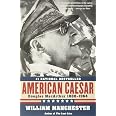
It's a wee bit difficult for me to be completely objective when reviewing any of William Manchester's books, because he's in my top 3 of best writers of all time. This is because he's a meticulous researcher and brilliant yet eminently readable writer, and he entertains even when writing what one might expect to be a dry subject (& I'm basically not a big fan of biographies).MacArthur was one of the most fascinating, loved, & hated figures of the twentieth century, and this bio does an outstanding job of portraying him --his massive ego, military brilliance (mostly), his paranoia, adoration of his son, bravery to the point of being suicidal. Manchester presents his genius, his numerous faults, and his considerable impact on this country and the world. MacArthur is one of the few people one can truly say changed the world; if he'd not been born, great huge swaths of the world, its people, countries & histories would be completely different. He doesn't sound at all like a particularly likable person (though he had a talent for spawning sycophants), but his impact was truly global & profound.Although Manchester doesn't shy away from detailing MacArthur's failings, I think the process of delving so deeply into his life had an impact on the writer. I've also read Manchester's "The Glory and the Dream: A Narrative History of America, 1932-1972," originally published in 1974, and notice that his attitude toward MacArthur seemed to have undergone a bit of change between that book and this one. For example, in "Glory" he goes into the events of the "Bonus Expeditionary Force" in considerable detail. The BEF consisted of thousands of destitute WWI veterans who camped peacefully in Washington DC in 1932, many with their wives & children. They were trying to get Congress to award them the bonus which they'd already been promised by Congress, but it was not scheduled to be given until 1945. They needed it THEN, it being nearly the height of the Great Depression. President Hoover was completely in the pockets of the business moguls of the age and had zero sympathy toward the starving veterans and ordered MacArthur to disperse (not attack) them. MacArthur's response was beyond appalling; he rolled on them with tanks, tear gas, and thousands of armed soldiers. Two babies died, a seven year old boy was bayoneted in the leg, and numerous veterans and their wives were injured. They all were sent fleeing in panic & chased out of DC.In "Glory," Manchester's disgust with MacArthur's behavior vis a vis the BEF incident is clearly evident. In "American Caesar" however, though he clearly doesn't actually approve of it, Manchester goes into the incident in much less detail --which seems odd, given that AC is an 846 page book on MacArthur only, while "Glory" is a two-volume work that covers 40 years of the entire country. I suspect that Manchester, great historian and fanatical researcher though he was*, sort of 'fell in love' with MacArthur in the process of exhaustively covering his life.There are a few other points where Manchester seems to have mellowed his view of MacArthur's behavior at times but in no way does he gloss over the man's faults...of which he had quite a few. His ego was nearly incomprehensible in its scope; he referred to himself in the third person for most of his life, and his dispatches from the various fronts almost all mentioned one person --MacArthur-- no matter which other officers were actually involved in the battles or strategic planning. On more than one occasion, MacArthur flatly disobeyed orders from his superiors, including several Commanders in Chiefs (which ultimately lead to his disgrace & dismissal from the Army).He was unquestionably a brilliant military strategist & tactician, though there was one occasion when he completely failed; for reasons no one will ever know, he totally blew it in the Philippines in the hours after Pearl Harbor was attacked. He had over 8 hours warning before the Japanese attacked in the Philippines but MacArthur apparently went catatonic and failed to do anything to protect the airfields, harbors, or anything else, which resulted in the near complete destruction of the military capacity there and led inexorably to the loss of those islands, the tragedies at Bataan and Corregidor, the Bataan Death March, and the deaths of thousands of US & Filipino servicemen and civilians who might otherwise have survived. (Manchester also gives MacArthur's lapse in the first hours after Pearl a bit shorter shrift here than he did in "Glory." Again, though, he doesn't just let MacArthur off).MacArthur's administration of the rebuilding & restructuring of Japan after the end of the war is probably one of the greatest achievements of his superlative-filled life. He used his considerable understanding of their culture and attitudes to convert one of US's bitterest enemies into one of its greatest allies, turned a repressive, feudalistic society with rigid near-castes and near total illiteracy into a fair, flexible, and highly literate democracy, and demilitarized one of the more belligerently militaristic cultures, turning it into a peace-loving, gentle society. It was a nearly unimaginable change and MacArthur did it nearly on his own, despite what his notional superiors in Washington had planned. It's rather fascinating that such a liberal document as Japan's new constitution --which MacArthur pretty much wrote himself-- came from a man who was a darling of the Right (up to that point) and a career soldier from a line of career soldiers.One of the many things I love about Manchester's writing is his tendency to sprinkle in wry little witticisms that make his subject spring to life. Some examples from this book (page numbers from the 1978 paperback edition):-"In MacArthur martial ontogeny had recapitulated martial phylogeny." (p25; for biology fans...Manchester also had an incredible breadth of knowledge).-"Missionary Ridge [Tenn] overlooks Chattanooga, and few will envy it." (p 26)-(in reference to MacArthur's tendency to stroll around battlefronts without even a helmet) "Certainly he was one of the worst life-insurance risks on the Western front..." (p 104)-(In reference to Filipinos kissing his hand, pressing wreaths around his neck, and trying to touch his uniform after he returned & liberated the Philipines...MacA's ego was an awesomely massive thing): "In [MacArthur's] 'Remembrances' he writes: 'It embarrassed me no end." One doubts it embarrassed him no end." (p 477)In all, this is an absorbing, fascinating look at one of the most influential Americans of the 20th century. And I strongly recommend any of Manchester's other books; those interested in military history or memoirs, or WWII in general definitely should read "Goodbye Darkness," his memoirs of his service as a Marine in the Pacific. "The Glory & the Dream" is an outstanding look at 40 years of US history. "A World Lit Only By Fire" is Manchester's portrait of life in the Middle Ages & is equally outstanding. Basically, I'm saying Manchester is a great writer & all of his books are terrific. I was devastated when he died in 2004, because I knew I'd never get to read another book by him.*"Caesar" has 15 footnotes in the preamble alone, & 1442 in total --at the end, they're not intrusive. The bibliography runs to 26 pages...in EXTREMELY small font, & includes many, many books, papers, military & other records, personal papers & letters, diaries, etc. The man did his homework!
B**R
Fantastic Book About a Giant of History
Douglas MacArthur is a complicated man whose career stretched over America's rise to world power status, a story which also includes his father as a Medal of Honor combat hero in the Civil War. William Manchester's book is really amazing, and he was a Marine in WW2 so he writes with that knowing hand about combat in the Pacific in WW2. My Grandfather fought with MacArthur in the First World War, with the 42nd Rainbow Division, and my Great Uncle fought for him in New Guinea and the Philippines with the 32nd Red Arrow Division in Second World War.Great book about a complicated and many sided American hero, one whose story is great as it is controversial.
B**M
Bread & Butter Bio
This is a very good biography. It delivers exactly what it promises - a thorough account of MacArthur's life and exploits - with satisfying prose that makes the 1100 pages go by very quickly.Manchester's prime assertion is that MacArthur was a paradoxical figure whose actions and persona defy any logical pattern. He succeeds admirably in advocating this view. MacArthur emerges from this account as an elusive, difficult-to-pin character. The genius of his mental apparatus is undeniable; after reading this book, I had difficulty imagining how anybody could've been designed more perfectly to lead the US effort in the Pacific. However, in certain other arenas such as politics and the homeland military bureaucracy - arenas which may be considered easier to navigate - MacArthur seemed to make the most obvious blunders, and was clearly his own worst enemy.William Manchester was absolutely correct in saying that the only constant in MacArthur's life was his worship of MacArthur; this narcissism was both his greatest asset and his greatest liability. The Caesar analogy is very appropriate.This book is not without it's faults - Manchester's account of MacArthur's role in the Korean War and his post-military activities have an expedited feel. I also found myself wanting to read more about MacArthur's personal life and pastimes, or anything else that would reveal the private MacArthur whom MacArthur himself didn't want us to see. However, that such details are lacking may underscore how wholly and completely MacArthur was driven by his work.My expectations were met by this book. There is nothing exceptional or groundbreaking about this biography, so the prospective reader should know that they will receive precisely what they're looking for. Nothing more, nothing less.
Trustpilot
5 days ago
4 days ago