We remain fully operational. Our teams are working around the clock to ensure your deliveries continue safely.

DOWNLOAD THE APP


Customer Services
Copyright © 2025 Desertcart Holdings Limited
DOWNLOAD THE APP
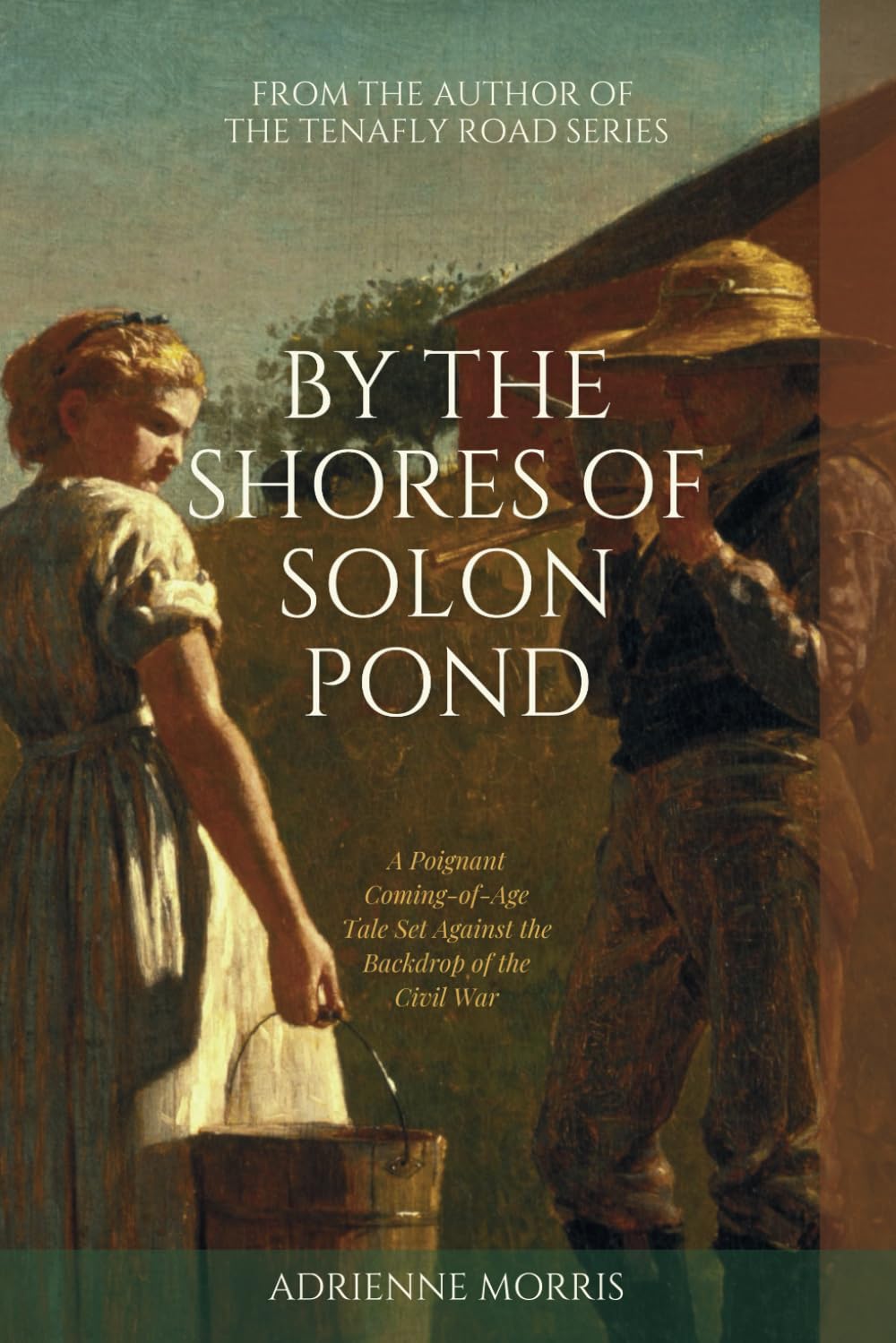
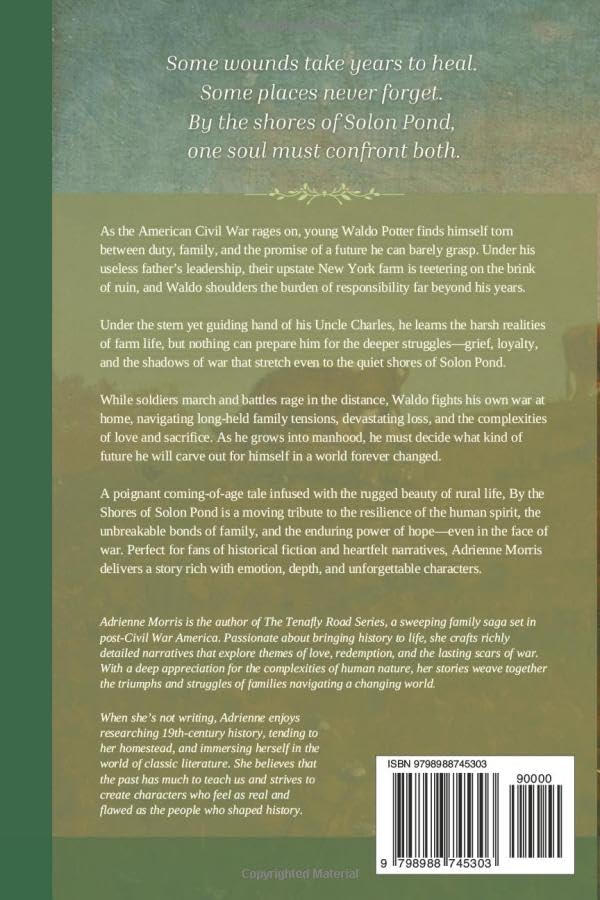
Full description not available
J**Y
A Noble experiment the poor performed for the rich
I recently finished another wonderful book written by Adrienne Morris. This is her newest book called By the Shores of Solon Pond. Adrienne’s books are set around the time of America’s Civil War (some start before or end after this time period). Go with what you know. Adrienne knows and is immersed in this period of U.S. History. What I like about Adrienne’s books are that they do a great job of depicting what life was like for the average person during this time period. For those of us that fell asleep during U.S. History, back in high school, you can redeem yourself by reading her books. Adrienne mentions the major historical figures and battles, during this time period, to give us context. However, she is mainly interested in the lives and struggles of ordinary people during that time. Some people might read this and think “how boring”. After reading her books, I would have to completely disagree. There are many things that struck me while reading her books. These everyday people were tough and resourceful- they had no other choice. My Finnish-American paternal Grandmother would say that they had “Sisu”. Most of us couldn’t do what these people did. Adrienne shows us how difficult life was in her descriptions of daily existence back then. She talks about many of the things people had to do without mechanization. This story is mostly set in rural upstate New York, where Adrienne lives, while raising a variety of animals on her farm. Her story is replete with descriptions of the local flora and fauna, which was very important to these farmers and also enhances the feeling of time and place, for us the readers. Unlike the large Southern plantations, which relied on slave labor, the Northerners had only themselves, plus their horses and oxen, for muscle power. The main character is a boy named Waldo Potter. He has a father that suffers with arthritis and other ailments, making it hard for him to work. He has a sickly bother named Dan, a somewhat handicapped brother named Albertus and a sister named Almira. Farm work is strenuous, even when you are physically fit. Waldo Potter’s family really struggles to get by due to sickness, injury, bad luck, lack of agency plus a host of other reasons. In Adrienne’s first book, the protagonist is a man suffering from morphine addiction, due to wounds incurred during a Civil War battle. That character was taciturn and stoic, making him hard to get to know. In her latest book, Waldo Potter is a much different character. He is young and shows his feelings and vulnerabilities, so that I find him to be more fully realized. At 499 pages, this is one of her shorter books. Adrienne does not get sentimental or try to romanticize the past. In her books, women die during child birth. People get hurt badly. People get venereal diseases. People die from numerous diseases that we don’t have to worry about today. We have Novocain. Life was often short and brutal back then (somewhere a caveman is saying-hold my beer). Although most of us (at least in the Western world) don’t have to worry about dying from communicable diseases, Tuberculosis and other disease are evolving to resist many of our antibiotics- we may end up facing the same problems people from the past faced, in our near future. Back then, most people were involved in food production. One Google search estimated that about 64% of Americans were farmers (or in related industries) around the time this story was set. This book represents the “American Experience” for most people, at that time. Aside from being quarantined during COVID, there is nothing close to a unified “American Experience” today. One thing people had back then was a more cohesive sense of local community. I say local, because the book begins just before our Civil War breaks out. The North and South were not cohesive with each other. One of their biggest divisions was over slavery. People back then had a variety of opinions concerning slavery and the war. Waldo’s father Joel thought that we should just let the South separate. Some people found slavery abhorrent but didn’t want their sons to die fighting to end it. Some people say the fight was just over States rights and not slavery. Some people were ardent abolitionists. Waldo, and other local farm boys, joined the Union Army to prove their manhood, provide funds to support their families, escape a bad home life, have an adventure etc… rather than any ideological reasons. In the story, right after Waldo joins the Army, he realizes that he has just given three years to a government and a cause that he had only minimal allegiance to. Waldo lied about his age and joined the Army before he was 16. There is no revisionist nonsense in Adrienne’s story. As far as this time period goes, there are lots of extant letters written between family members and/or friends, plus other primary accounts, for anybody that has the desire to read them and learn what average Americans, both Southern and Northern, thought or believed, during this time period. Adrienne takes real events and builds her stories within this framework. Beyond the obvious fact that slavery and warfare are horrible, she doesn’t pontificate or proselytize. Back then, most people had a gun or rifle but you didn’t hear about incidents like Columbine or Sandy Hook. Adrienne doesn’t use her story to weigh in on gun ownership or women’s lack of many rights that they enjoy today. While reading this book, I paused to think about Civil War era society versus our modern society and how unhinged many people are these days. The Civil War (all wars) was brutal. You get an almost visceral response while reading her description of the battles. Outside of the battlefield, people seemed a lot more rational and decent than many people today. One of the things I liked about this book is how well Adrienne, a women in her late 50’s, has been able to identify with the thoughts and feelings of a young boy living during our Civil War period. Adrienne has not only created an endearing character in Waldo Potter, but she has been able to make her character mature, in terms of his thoughts and deeds, as he gets older and gains life experience. Waldo’s matures in many ways after serving in the war in what was in many ways, our own Children’s Crusade. With the show me don’t tell me approach, Adrienne lets us see that beyond all the killing that people may do during a war, the damage that they do to their own sense of self, their humanity, is also very disturbing. Years ago, I read All Quiet on the Western Front. There was a quote: “We were eighteen and had begun to love life and the world; and we had to shoot it to pieces. The first bomb, the first explosion, burst in our hearts. We are cut off from activity, from striving, from progress. We believed in such things no longer, we believe in the war.” The main character Paul, couldn’t wait to escape the safety of his hometown, while on leave, to get back to the front. He couldn’t relate to normal civilian life. Waldo Potter, after seeing the horrors of war, reenlists (mostly out of economic necessity). During his second stint, he mentions how he didn’t want the war to end. Adrienne does a great job describing both the tedium and terror of being a soldier. Smithsonian magazine had a story about the large number of boy soldiers that fought in the war. There were numerous cases of kids as young as age 6.5 being involved on the battle field. Thankfully that doesn’t occur in America any more but you often hear about child soldiers in third world countries today. In upstate New York, farmers had a limited time in which to grow crops. Adrienne described the various things that kept farmers busy in the winter. Along with obviously feeding animals, they repaired tools, mended things, cut ice to bury underground to preserve food during the summer and tap maple trees. In one place the author writes “It was the irony of his (Waldo’s) father’s devotion to something so sweet when he was so bitter.” Small observations and wry comments like these added depth to the characters. In the beginning of the book, the author hints at feuds and resentments between various members of Waldo’s extended family. Over the course of the book, (just like in real life), we find that people aren’t always what they seem to be. Time and life events have these various characters revealing their true selves. Sometimes people don’t know who their true selves are. Here is a random excerpt that gives some insight to young Waldo’s thinking-- “Waldo thought about happiness- this elusive thing- this quality that separated his own parents from Lucian’s (his cousin) parents. Lucian might not care, but his parents were happy. Yet, happy wasn’t the right word for the way Lavinia and Charles met each day. They were busy, but so many farmers and non-farmers alike were busy and miserable. Satisfaction? Was that it? Yet he saw they strove for more, but there wasn’t the crassness that came with the common type of striving. Yes, they liked pretty plates and shiny tools, but that seemed secondary. What was the thing they were after? Maybe excellence. Yes, that’s what it was. Did it come simply from hard work? That he could do? As he traversed his uncle’s once rock-strewn acreage with the mind of a burgeoning farmer, he noticed that the land’s bones were hardly different or better than the land he would inherit one day.” Throughout the book, Waldo is trying to make sense of the world and his own place in it. He was trying to locate his authentic self. Aren’t we all? Aside from evolving better disease resistance, we are not very different cognitively from humans almost 50,000 years ago. Even though we, as humans, have changed so little, our world has changed so drastically. I feel like there is so much to be said about Adrienne’s latest book, so much to ponder. I will give another small sample of some of her writing. Waldo enlists at the beginning of the Civil War and after going back home, he re-enlists to fight at the end of it. He has changed a lot during this time period. Here is an excerpt from her book. “Soon we’ll be at home,” they all said to each other, never minding the many casualties these new regiments endured. Home was all there was, and they must get through this to get back there. Back to the bounty money and the riches the others were making in this final time of war. How anxious they all were to share in the wealth of the North, yet not before whipping their misguided brothers of the South. It was an election year, and the soldiers were not immune to the jostling up north. Some favored McClellan out of old loyalty, but the majority baked Lincoln. Some even hoped Grant would be president in their new enthusiasm for their general’s unwillingness to retreat. They might not love Grant. He seemed a foreign, cool entity but he would let them fight. “Oh, how the boys at the Wilderness had cheered when Grant had not retreated!” men said. And there would be no retreating now. The second Corps arrived late to Cold Harbor, but Grant had paused, so they arrived just in time. All night they had marched, no time for food, difficulty finding water, necks and shoulders tight, no slack in the tension. Officers’ horses had crushed exposed skulls from past battles under foot with a crunching noise as men tripped over old femurs and picked up finger bones as relics in the moonlight before it rained. Here and there, a man fell out. Waldo heard them being prodded to move with curses and threats, but he and Arthur tramped on. Some men were near the end of their three-year enlistments, but even they had sung and cheered with the others at this forward movement. As they had raced from North Anna, the doxology rose spontaneously from the men. It was a blessing to move, to finish. Grant had not out-generaled Lee yet, but they thought he might. For now, movement was enough. All along the rush toward Cold Harbor, the men bristled at the hurry and wait. Some were blessed with the ability to doze while standing. Others curled like cats on the ground a second into a halt with guns as pillows. Then up again to walk and trot throughout the night. Some retched at the stench of burst horse flesh besides the road as they marched. Some lapped up, against orders, offal-contaminated water in ruts made by army mules, unable to stop themselves, their thirst being so great. Better all of this to waiting and sitting. Onwards to the end, it being just around the next low and wet forest, just beyond the chalky dust of the roads, making them all look like phantoms and madmen. The dust got in the creases between their legs and the lids of their eyes. Men had no defenses against rumors. Every day brought news of Lee’s surrender, and everyone wanted to believe. The sorriest excuses for soldiers talked of Union defeat and were shunned by the others and reprimanded by officers. No one knew the date of redemption, but it would come for the great Potomac Army. They passed shoddy slave quarters in the shadow of whitewashed mansions; their windows, the size of two doors at home, were signs of the planters’ excesses. Now at the start of this new day, under the hulking trees, the first birdsongs faded as a great and awful tension hung heavier than the humidity over the regiment. This battle could end the war. As the light slipped into the eastern sky and the men came up closer to the front, they craned their necks to see what lay before them. Breastworks, enormous in some places, with sharpened tree branches to tangle soldiers in, greeted them. No one said a word, but Arthur turned to Waldo with big eyes and then back at the sweep of the field. Not a rebel was visible, and all was quiet across the way. It was impossible to take in the enormity of the Federal line or even a tiny fragment of it with any sense of perspective. General Barlow trotted by as arrogant and determined as ever. While the troops did not love the “boy general,” they could not help admiring his bravery and grit, having recovered from wounds others would have died from and returning to the war when he didn’t have to. The Federal troops who had arrived earlier had already dug in but not as impressively as the rebels who had come in advance and had embraced the digging mentality even before ordered to. Waldo checked his canteen and ammunition repeatedly, as did the others, a nervous tic that was contagious. They stood and stood. Waldo thought he’d go mad with the standing. Arthur whispered, “I have to crap, but don’t dare fall out and lose you.” The shirkers and cowards were already at the rear or hiding themselves from the law in swamps with their disease-inducing miasma. Some at home might think the fighting was the worst of it for a soldier, but this was not the case for Waldo. The before time was a terrible thing. The waiting, leaning on your gun, the checking and rechecking of your canteen, the jittery whispers of some, the shushing from the captain, the sweating, the cold pain down the center of your back to the wrenching of your middle. The chorus of jangling metal, for the men stood still but not perfectly. Thoughts of home and thoughts of the unknown-but for the few that knew somehow that this was their last day. Contemplation in this breathless moment was for the timid, the effeminate, the weak-minded coward. All these things in the waiting were far worse than Totopotomoy or North Anna. Like the racing horses at a fair held back but hot for the run, the men had trouble with the standing still. And finally, the battle drums down the line like the starting of a great engine, the officers, some to the front and some hanging at the rear, taking the men to a fever pitch, throttling up with last minute words and then release! A sudden roar from canon…. Adrienne then goes into describing the battles and the mayhem that ensues. Although the descriptions of the battles were interesting, I think the best part(s) was when Waldo had to stop and confront himself. Adrienne creates a character named Jim, who seems to know Waldo better than Waldo knows himself. He confronts Waldo with things that Waldo has trouble accepting. I am wondering if Jim was meant to be symbolic in some way, maybe acting as Waldo’s conscience or subconscious thoughts. Years ago, I read that we are not very good at knowing what will truly make us happy. So many times we think that if we owned a certain car or some other physical object or obtained a certain position, that we would be happy. This new possession brings us temporary happiness and then we are back longing for something intangible. It’s like we don’t know our true selves. Some people, like Waldo are just existing without knowing who they really are until they are forced to really look inside themselves. I think that Waldo is a character many of us can identify with. Like all good books, I didn’t want it to end.
K**R
Well written and researched.
This was a happy/sad story but it needed telling. A dirt poor boy from a poor home and hearth with a strange father, who makes himself proud and has the affection so desired from those around him. The war was horrendous but he did his duty and only wanted two things, the slaves to be freed and his military pay to support his family. A boy who had to grow up way too early and fast.
R**C
Great Read
This is an incredible read. Waldo becomes one with the reader and easily becomes immersed in ones own life. The emotions will stick with you long after finish of the novel.
D**N
A civil war book with 2 main themes
1. The climate of war. 2. Family dynamics. Most of this story I found interesting. But unhappy endings spoil books for me.
R**
The Calm Before The Storm
Impeccable writing style, with a shear skill that takes the reader on emotional ride through both the quaint and tumultuous realities of The American Reconstruction Era ,within the luming shadow, the eve of The American Civil War..
D**Z
Well written historical fiction novel.
A well written novel about a young guy named Waldo Potter who enlisted into the Union Army early in the American Civil War, returned home to recover from disease, and rejoined. One of the biggest overlooked aspects of the Civil War is the home front and the struggles of families and communities in wartime. Waldo, a young man who grew up too fast in wartime. I enjoyed every page of this novel and it's well written.
J**.
A well-written pleasure to read
This is a period piece that captures family and community in rural 19th century upstate New York. The young man who comes of age on these pages is appealing, often pensive and always likable.
C**F
The ability of the heart to hope
This is a beautifully written novel based on real people who lived, loved, hoped, and dreamed in upstate New York during the mid-1800s. Complicated family and community relationships cause the reader to become emotionally invested in the characters, and my heart alternately ached and cheered for Waldo throughout the book. The hard life this young man endures and his capacity to cling to hope is inspiring.
Trustpilot
2 months ago
2 months ago