
DOWNLOAD THE APP


Customer Services
Copyright © 2025 Desertcart Holdings Limited
DOWNLOAD THE APP
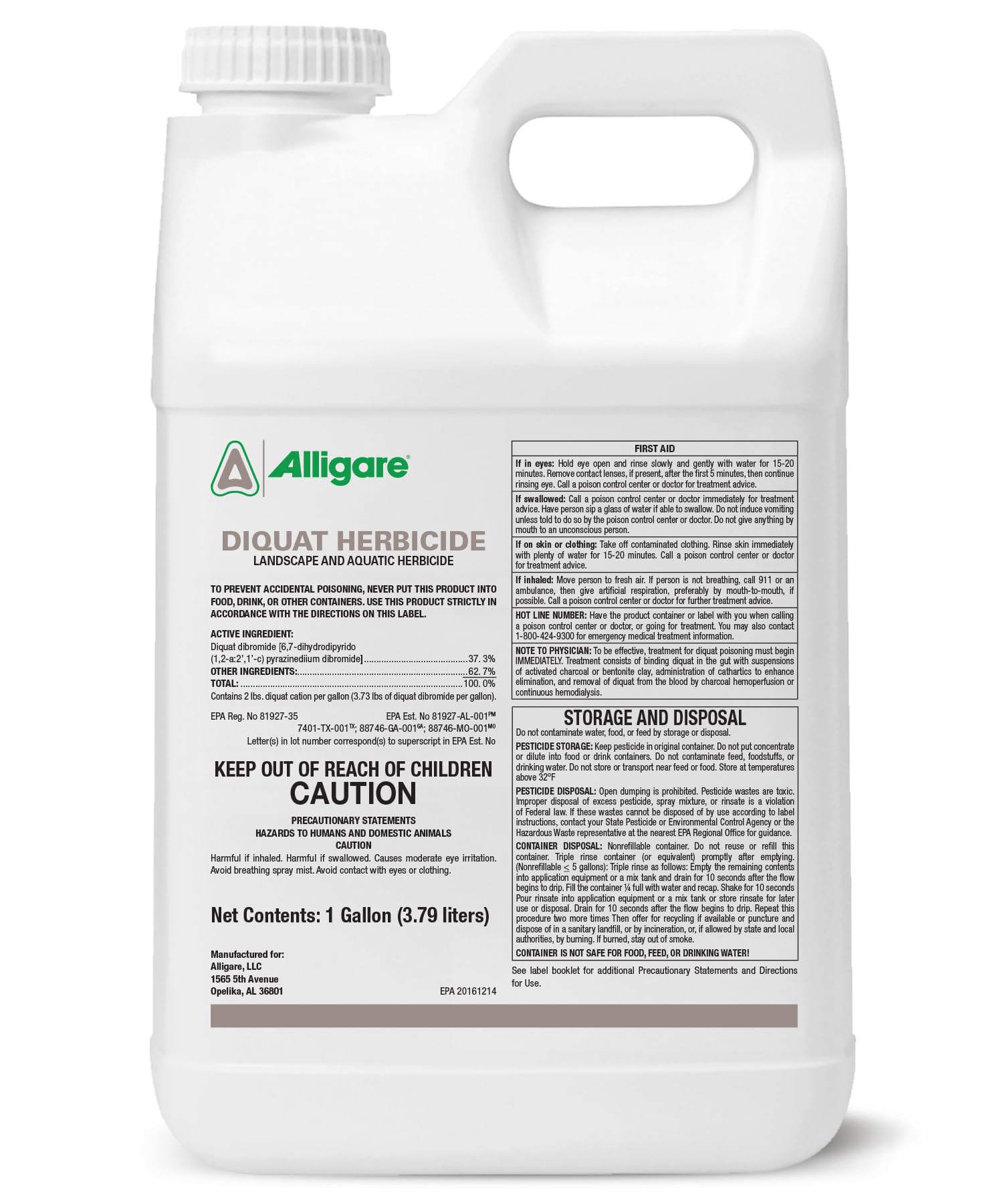
⚡ Clear waters, clean landscapes — conquer weeds like a pro!
Alligare’s Diquat Aquatic Herbicide is a fast-acting, non-residual liquid solution designed for broad-spectrum control of aquatic and terrestrial weeds. Perfect for ponds, lakes, nurseries, and lawns, it delivers rapid weed and algae elimination while being safe for fish and wildlife. Trusted by professionals and homeowners alike, this 1-gallon powerhouse ensures lasting clarity and weed-free environments.
| ASIN | B00C4Y228S |
| Active Ingredients | Herbicide |
| Best Sellers Rank | #17,677 in Patio, Lawn & Garden ( See Top 100 in Patio, Lawn & Garden ) #145 in Weed Killers |
| Brand | ALLIGARE |
| Brand Name | ALLIGARE |
| Coverage | Various aquatic environments |
| Customer Reviews | 4.5 out of 5 stars 1,249 Reviews |
| Included Components | 1 gallon bottle of Alligare Diquat |
| Item Form | Liquid |
| Item Weight | 2 Pounds |
| Liquid Volume | 128 Fluid Ounces |
| Manufacturer | Alligare |
| Unit Count | 128.0 Ounce |
S**T
Kills weeds fast.
Great product, seller needs to make sure the caps are tight though. Glad they put it in a plastic bag.
E**9
This stuff really works!!
This stuff is amazing. I have a lake in my backyard and every spring It starts to grow aquatic weeds. Also with the rains in April and May, it makes the water just kind of cloudy and yuck so I mix up a batch of this and it kills the aquatic leaves, but it’s safe for the fish. I also discovered that this stuff is lethal for any sort of regular weed. I was using regular weed killer and it would take a week or so to actually kill the weeds but never really just knock them out. So when I have extra of this stuff from the Lake. I put it on any weed that I want to annihilate. It kills them within an hour or so. I like that because they stay dead. They do not come back from this stuff. It is a little expensive to use as a total weed killer and you do need to have a soap or something so that it adheres to the weeds and you add it in your mixture when you’re using this... You use water, this stuff and I forget the name of what the soap thing is supposed to be called and you mix those three things together and you have your mixture. I get two batches out of each of these bottles. That requires two bottles of the soap stuff. I mix those in a sprayer and I’m good to go! This is good stuff!
D**Y
Small Pond Additive.
We have a small pond and this product helped with the midsummer bloom.
E**O
Powerful stuff
A proper mixture of Glyphosate and this Diquat results in a potentially powerful combination for many types of undesirable plants. I learned about this deadly mixture after studying Roundup QuikPro. The Diquat provides quick knockdown to prevent further growth and the generic Glyphosate slowly works its way down to kill the root. I find this particularly effective when dealing with thistles that have already grown and are starting to produce seed heads. Buying in the gallon size brought the per-ounce price to a reasonable level. The reason for knocking off one star is what happened in transport. This is a potent bit of hazardous material that should be shipped properly. The container was sent via USPS, which is famous for its abuse of packages. The foil seal on the mouth of the container had failed and the product was leaking into the cardboard box. Feedback was given to Amazon to relay the notice to the seller. There should be a sturdy plastic leak-proof over-wrap around the gallon container (this was lacking) and much better packing material inside the cardboard box (that part was not at all satisfactory. But other than the leak problem, the product is effective and it may be a good idea to stock up before the EPA finds out just how effective it is.
T**G
works well on duckweed and coonweed
I started using diquat in 2023 my 1 acre pond was 100% covered with duckweed and coon weed coming from the bottom I started treating it in June the results were visible within 2 days my pond has trees on all 4 sides so after reading everything I could find on duckweed I knew this was going to be a long process I would treat my pond every two weeks and since there are no fish I more or less sterilized it by fall it was 95% clear of duckweed and coon weed but since duckweed sinks to the bottom in the winter I knew that some would come back and in 2024 it did but only a small amount I sprayed it in May 2024 in killed most of it but I will tell you no matter what the experts say if your pond has trees around it is the leaves that fall in your pond is where duckweed gets what it get what it needs to grow I'm not sure if you can completely kill it 100% but I have a clear pond now but after going through what I did it was worth the time and money to get a beautiful pond back I had used several different types of products but with duck weed don't waste your money on anything but diquat they do make a product that will clear up the muck on the bottom but it is extremely expensive and has to be used yearly and new leaves fall in every year I decided diquat was my best option.
W**E
Effective for both lake weed control and ground plants
I've been using this chemical to control lake weeks for about 10 years. Here is what I've learned. This company (Lawn & Pest Control Supply) packs the product properly - with a tape seal and plastic bag - so that it can be easily unpacked. Do not purchase from NuFarm, they glue the lids closed with sealant so that the lids are impossible to remove without making a mess. Safety - this is super concentrated - wear gloves and SAFETY GLASSES - do not get it on your skin. I always pressure/leak test my spray rig before adding this chemical. Lake application - We use this to control underwater weeds in about 25 acres of a 40 acre lake. For preventative maintenance we apply a gallon every 3 (water temperature 85+) to 5 weeks (water temperature 55 to 65) using a 25 gallon sprayer to inject 3' below the water (in the sunlight zone). Never use more than 2 gallons (don't treat your entire lake at once!) because all the weeds will die and float making a big mess and killing your fish when the weeds decompose (taking all the oxygen from the water). I dilute 20 gallons of water to 1 gallon of water, injected at 4 gpm (2 down tubes) driving the boat at idle and holding a beer in the hand does the trick. Weeds need to be green/actively growing and in the sunlight zone (about 3' below the water) for this to work. Adding a gallon of copper improves the efficacy and makes the water more clear, although this year I am experimenting with coarse copper granules sprinkled in the root zones which seems to retard growth pretty well but does not kill unless applied at about a pound per 5 square feet. Do not apply below 50 degree water temp, the weeds must be growing and get sunlight for this product to work. Maximum efficacy by applying with at least 4 hours of sunlight after application and do not stir up the mud or all the chemical will bind with the mud instead of the leaves. Our lake is spring fed so it would be too expensive to dye. Using the diquat/copper combination we are able to keep the weeds under control and also maintain a healthy habitat. I also add a little bit of blue pond dye to help me see where I have applied. TIP - make sure to rinse your spray equipment with lots of clear water after use, this chemical is highly corrosive. Also it does stain fiberglass and carpet. I have also tried this chemical for killing weeds and grass at my house, at ~2oz per quart and it killed everything. Again be sure to spray when sun is forecast, this chemical works by interrupting the photosynthesis.
K**Y
10 STARS. It’s a miracle product!
Oh. My. Mercy. This stuff is like manna sent from above when it comes to controlling lily pads. Let me start by saying we have done everything we know to control the rampant water shield in our 5ish acre pond. We’ve spent thousands on Navigate, used RoundUp mixed with Ajax, and even gotten in the pond and pulled them up by the roots. Nothing, and I mean NOTHING has worked as fast or effectively as Diquat. I knew that it worked by disrupting the plant’s photosynthesis ability, but I didn’t realize how quickly that it would take effect. We sprayed it early in the morning and by that afternoon the lily pads were already dead—no lie. I walked my little self out to the pond thinking I would take some “Before” pics before the chemicals really took effect, and I about fell out because the lily pads were already brown. By the end of the first week, they were turning loose from the bottom and clumping into floating masses of dead lily pads. We did get in the boat and scoop those out, and I could see more dead lily pads stems still holding on. Here’s how I mixed and applied, and I’m quite certain it isn’t right, but it worked: I applied in early May, just as the lily pads were blooming and before they developed their natural resistance to herbicides (Look up research on the gelatinous covering that they develop as it gets warmer). I mixed an entire gallon of Diquat with a full bottle of Ajax (for surfactant) and plain water in my 15 gallon sprayer. I had that hooked to the truck’s lighting system and just spot-sprayed, only focusing on one area of the pond. And that’s key, because the Diquat wound up spreading to ALL OF THE OTHER LILY PADS—even the ones we didn’t spray. The lily pads we didn’t spray died just as fast as the ones we did. That’s my one caution...be sure that you only spray this on and around the stuff you want to kill. There were even a few areas of overspray on the pond’s dam that i accidentally turned brown. I believe the proper mix rate is 32 oz per 100 gallons, but please don’t quote me. I did have trouble determining the mix rate for broadcast spraying in water. I found a cheat sheet on North Dakota State University’s website that helped me understand mix rates a little more. Next time I’ll mix it appropriately, but this stuff worked so well I’m hoping there isn’t a next time.
P**R
Weeds removed
Worked well
Trustpilot
2 weeks ago
2 months ago