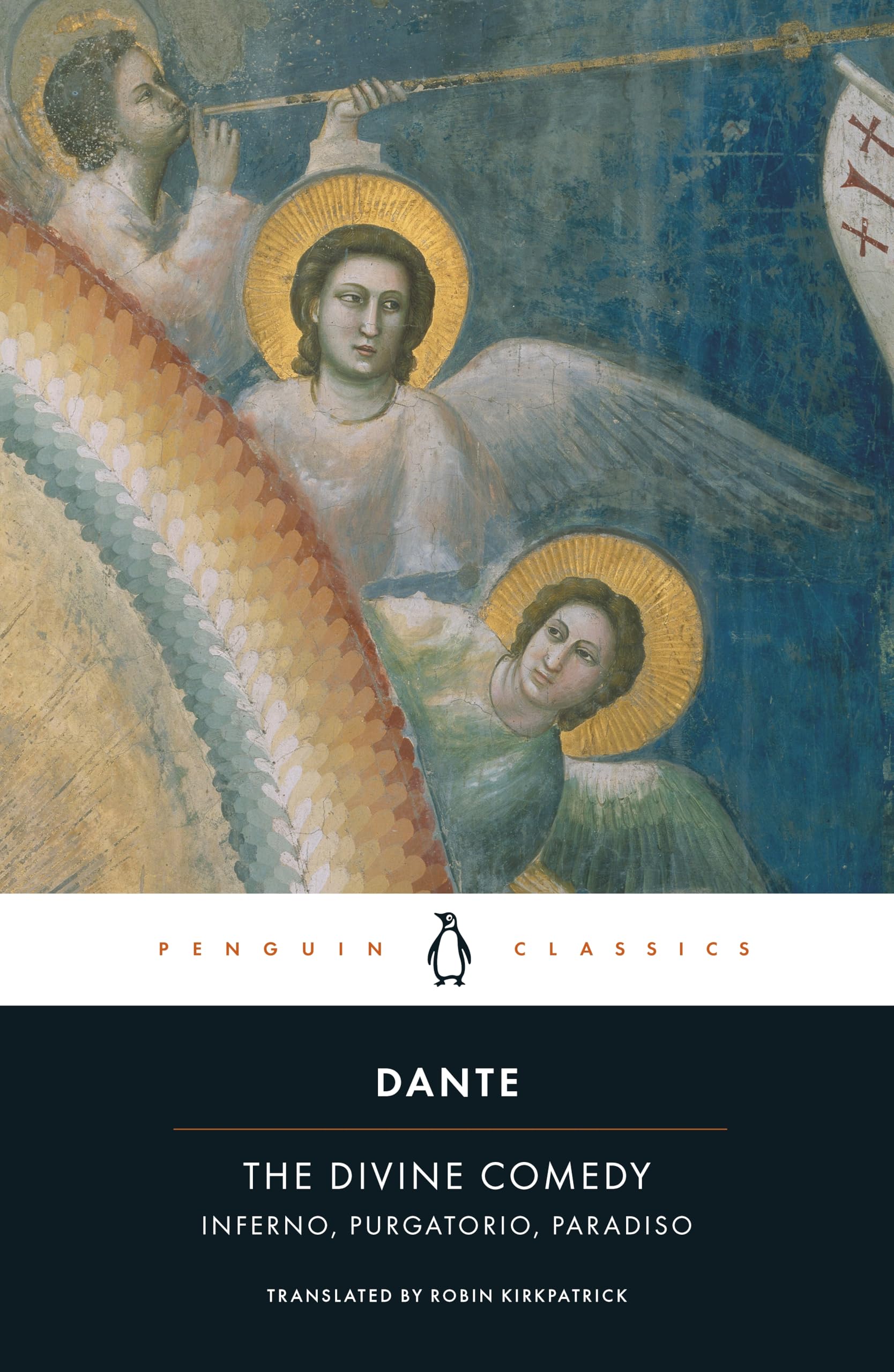
Buy The Divine Comedy: Inferno, Purgatorio, Paradiso Illustrated by Alighieri, Dante, Kirkpatrick, Robin (ISBN: 9780141197494) from desertcart's Book Store. Everyday low prices and free delivery on eligible orders. Review: Timeless classic - This is not (cannot) be a review of Dante's classic - who would dare, as Dante's text is up there, at the very top, next to Lear and Quixote, the essays of Montaigne and Emerson, and a few more - not much more books. It is a piece of history, it's a book that makes you feel you need no more books, or as Carlyle said: Dante is the voice who put an end to ten centuries of silence. This is more a review of the superb Penguin edition, of the priceless introduction, of a very good translation and over one hundred pages of notes that lead the reader through the layers of the timeless poem, and through a who's who in Medieval Florence - and as a bonus, to the actual antecedent for Shakespeare's Romeo and Juliet. Dante has seldom, if at all, been presented as superbly as it is here. As Harold Bloom said, "immortal books are those which you want to finish soon, so you can read them again, sometimes even when you're still reading them for the first time". This one fully qualifies for that notion. Words that leave one without words. Lastly, a tip for those who enjoyed this jewel of a book: do read before, during or after it, Oxford's Very Brief Introduction of Dante, by Pater Haimsworth and David Robey, a magnificent companion to the poem and a very illuminating view to Dante. Review: A fine translation - I have made one previous attempt to read the Divine Comedy in English, using Longfellow's translation of 1867. This foundered somewhere in the middle of Purgatorio (i.e. the second of the three sections), largely as a result of trying to read it in too-large chunks with too-long gaps in between (and consequently losing the plot). My current read-through, using this Penguin Classics edition translated by Robin Kirkpatrick (c. 2007), has been more successful and I am now nearing the end of Paradiso (the final section). This is partly due to my newer strategy of reading (aloud) one canto every day, but this wouldn't work if the translation didn't flow well. Fortunately it does. Kirkpatrick's translation is in iambic pentameter blank verse, which works much more naturally in English than trying to force the original Italian poem's terza rima to work in translation. He uses a variety of registers, from exalted to earthy (which probably mirrors the original text, although my grasp of Italian isn't good enough to know for sure - if it was I probably wouldn't bother with a translation anyway). There are fairly frequent quotations in Latin, which are left untranslated in the text with a translation given in the end-notes. The notes are extensive and give a lot of useful background information about the many classical allusions and references to Dante's contemporaries and the politics and culture in which he was writing, as well as a few nice maps and diagrams. There is also a very comprehensive looking introduction which I haven't read yet (I decided to plunge straight into the text and then go back to the introduction when I've finished).
| Best Sellers Rank | 5,585 in Books ( See Top 100 in Books ) 1 in Italian Poetry (Books) 4 in Mystical Poetry 7 in Religious Poetry (Books) |
| Customer Reviews | 4.7 out of 5 stars 831 Reviews |
R**A
Timeless classic
This is not (cannot) be a review of Dante's classic - who would dare, as Dante's text is up there, at the very top, next to Lear and Quixote, the essays of Montaigne and Emerson, and a few more - not much more books. It is a piece of history, it's a book that makes you feel you need no more books, or as Carlyle said: Dante is the voice who put an end to ten centuries of silence. This is more a review of the superb Penguin edition, of the priceless introduction, of a very good translation and over one hundred pages of notes that lead the reader through the layers of the timeless poem, and through a who's who in Medieval Florence - and as a bonus, to the actual antecedent for Shakespeare's Romeo and Juliet. Dante has seldom, if at all, been presented as superbly as it is here. As Harold Bloom said, "immortal books are those which you want to finish soon, so you can read them again, sometimes even when you're still reading them for the first time". This one fully qualifies for that notion. Words that leave one without words. Lastly, a tip for those who enjoyed this jewel of a book: do read before, during or after it, Oxford's Very Brief Introduction of Dante, by Pater Haimsworth and David Robey, a magnificent companion to the poem and a very illuminating view to Dante.
M**R
A fine translation
I have made one previous attempt to read the Divine Comedy in English, using Longfellow's translation of 1867. This foundered somewhere in the middle of Purgatorio (i.e. the second of the three sections), largely as a result of trying to read it in too-large chunks with too-long gaps in between (and consequently losing the plot). My current read-through, using this Penguin Classics edition translated by Robin Kirkpatrick (c. 2007), has been more successful and I am now nearing the end of Paradiso (the final section). This is partly due to my newer strategy of reading (aloud) one canto every day, but this wouldn't work if the translation didn't flow well. Fortunately it does. Kirkpatrick's translation is in iambic pentameter blank verse, which works much more naturally in English than trying to force the original Italian poem's terza rima to work in translation. He uses a variety of registers, from exalted to earthy (which probably mirrors the original text, although my grasp of Italian isn't good enough to know for sure - if it was I probably wouldn't bother with a translation anyway). There are fairly frequent quotations in Latin, which are left untranslated in the text with a translation given in the end-notes. The notes are extensive and give a lot of useful background information about the many classical allusions and references to Dante's contemporaries and the politics and culture in which he was writing, as well as a few nice maps and diagrams. There is also a very comprehensive looking introduction which I haven't read yet (I decided to plunge straight into the text and then go back to the introduction when I've finished).
A**!
Amazing read
Ever since Dan Brown's inferno, I had an intense I Dante. Finally I can read all three parts of his epic writing and is going to ve very useful for me.
M**K
Hard to read but interesting book
Good book, v hard to read but I suggest before each canto read the explanation at the back then read each one. I did that and made easier to understand it. Besides Dante brings political turmoil and political people of his time or right before his time and events from FIRENZE (Florence) and Italia of 13th century. Hard to recognise those people or events. But at the back explanation helps. He also uses a lot of Greek characters and Roman people that were in power from church and political parties. It's an interesting book but it's pretty hard to understand. Keep an open mind.
A**R
a classic for a reason
Well worth a read. Dantes journey down through hell and up through purgatory into heaven is a classic for a reason.
M**M
Oooooo a real classic
Good book in perfect nick I have always wanted this book but I couldn’t afford it or find it in English now thanks to Amazon it’s mine! Guided tour of the after life and beyond it will be nice to no what is waiting for me when I come to it
M**Y
Delivery
A1 Excellent
S**U
Good read
Bought to replace an old battered copy. I'm guessing anyone purchasing this, are a bit academically minded. It is a wonderful example of Canto.
Trustpilot
1 day ago
2 months ago