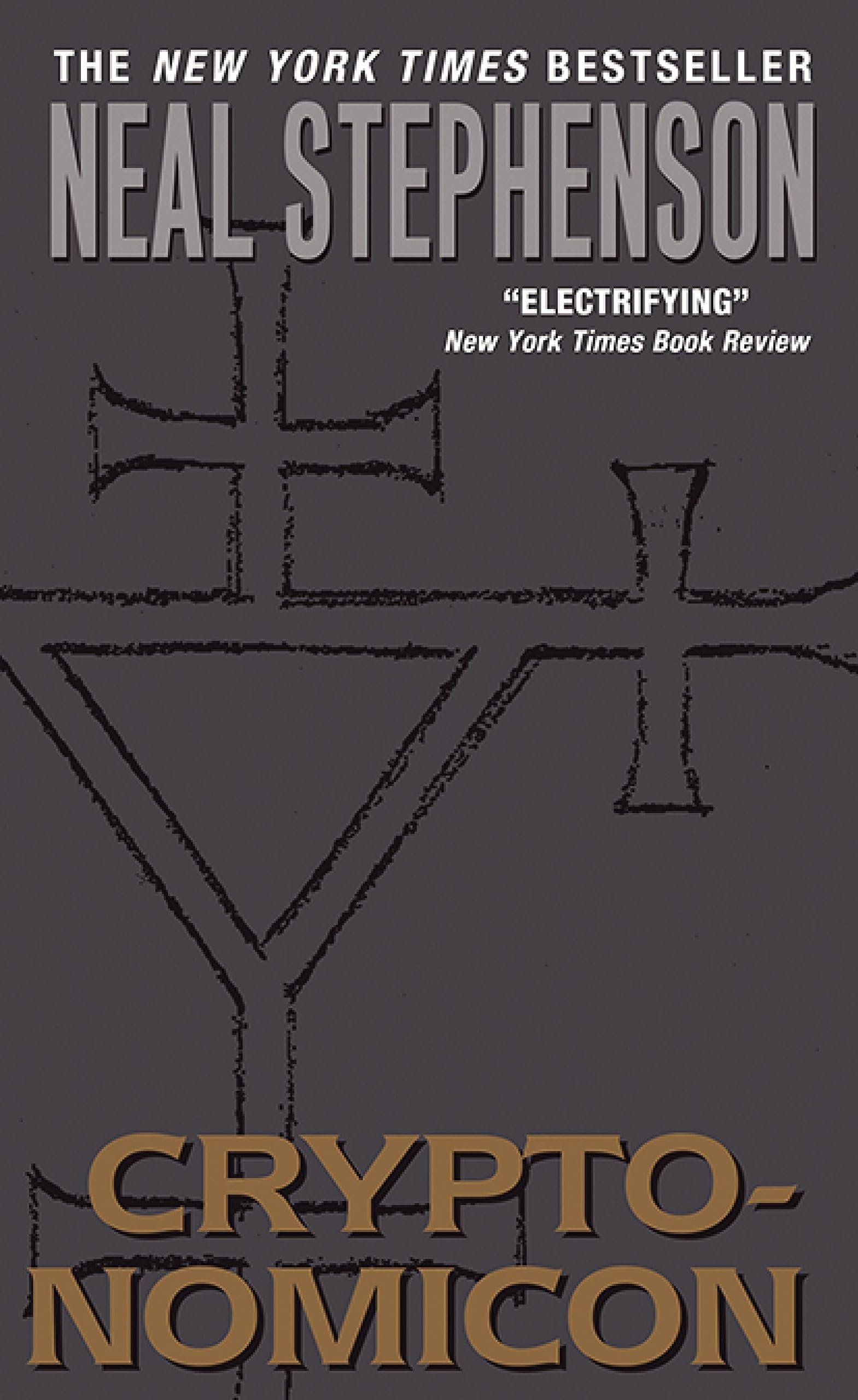

Cryptonomicon
Product ID: 4778999
Buy anything from 5,000+ international stores. One checkout price. No surprise fees. Join 2M+ shoppers on Desertcart.
Desertcart purchases this item on your behalf and handles shipping, customs, and support to USA.
desertcart.com: Cryptonomicon: 9780060512804: Stephenson, Neal: Books Review: WOW! - I LOVED this book. But, for potential readers, I have a VERY large caveat: Unless you have a love of mathematics and/or cryptanalysis you're going to miss out on much that made the book, for me, so great. In fact, judging from the one and two star reviews so prevalent here, you more than likely are going to hate it and end up torching it in your back yard in frustration and dancing around the ashes. By way of anecdote, I was talking to one of my neighbours who happens to have a degree in mechanical engineering while we were out walking our dogs about a certain aspect of the book that had me puzzled for a bit, and another neighbour stopped to join us. After listening for a time, she looked at me and asked, in a semi-sarcastic, baffled tone, "Are you reading an Engineering textbook for fun?" When I told her it was a novel, she became even more nonplussed. So, the point here is, you've been warned. I happen to be an English Literature major, but I was one of those kids in school who in, say, trigonometry class just looked at a math problem, knew the answer and handed in my tests in five minutes. The words, "SHOW WORK" are scorched into my memory of adolescence. On the other hand, if you've liked Stephenson's other works, or like picaresque literary jaunts in general, you will no doubt like this one as well. You'll just have to skip the parts I found most fascinating. I can now say, though, that I understand why Stephenson fans took him to task for lack of verisimilitude in Snow Crash and the books which constitute The Baroque Cycle, both of which are a great deal of fun to read, but not terribly conducive to deep thinking. This book is so conducive, for a number of reasons, but the primary one, I should say, is that very few people realise just how WEIRD the branch of mathematics known as Statistics is. The simplest example I can think of is coin tossing: If you enter a (rather primitive) casino, toss a coin once and come up heads, your chance on the second toss of coming up heads again is 25%. It's not 50%. Furthermore, if you toss the coin and it comes up heads, then put the coin in your pocket and wait three days, three months, three years, however long, and take that same coin out of your pocket on the other side of the globe and flip it, your chances of coming up heads, after all this time, are still 25%, not 50%. I've gone out about the Math enough for this review, but the Math herein is very much concerned with probabilities like this one. It makes you start thinking, as the character Waterhouse does at one point, of the entire world as a giant probability wave. I can't tell you how many hours of sleep I lost tossing and turning with different numbers running through my head. The characters in this book, as Stephenson puts it are "people too busy leading their lives to worry about extending their life expectancy." This makes for very intriguing, if involved, reading. But the writing can also approach the poetic at times. The sinking of the Arizona at Pearl Harbor is described thusly: "A military lyre of burnished steel that sings a thousand men to their resting places at the bottom of the harbor." And the book is so terribly funny. The Englishman, Chatan's, description to Detachment 2702 of the importance of knowing the right way to, er, blow your head off if in danger of being caught by the enemy is priceless, "You would be astonished at how many otherwise competent chaps botch this apparently simple procedure." Also, as noted by other reviewers, there are numerous in-jokes, my personal favourite being the Latin motto for the Societas Eruditorum: "Ignoti et quasi occulti." Which Enoch Root translates for Bob Shaftoe as, "Hidden and unknown-more or less," which is EXACTLY what it means! Notice the quotation marks surrounding more or less. The word "quasi," in Latin means "more or less" or "as it were" or "so to speak". Alright, I've gone on long enough, perhaps too long, for an desertcart review. For those few who might be interested, I'll try to include a simple program I came up with for solving the Turing bicycle problem, which Stephen uses to illustrate how the Enigma machine works in the Comment section once this review is posted. A wonderful book! Review: Detailed, really really detailed. :) - FYI - Kindle version ends at 87% with the rest of the book being appendix and ebook extras. The LAST thing I wanted after reading this book was 13% more reading about code. :-) Wow, what an intense, laborious, interesting, pedantic, read. Told from multiple points of view, alternating between WWII and present day (late '90's) this is a really complex novel about ... stuff. Lots and lots of stuff and detail about said stuff. Obviously, it was about breaking code in the war, also, breaking code as a hacker. It was about war and the effects of war, and the creation of the first digital computer, and the proper way to eat Captain Crunch. And some Greek mythology. Money. Cyber-everything. All over the place. It even included some hints at the creation of the NSA, which was interesting. Particularly since it's very clear to see the need for code-breaking in the war, and what it has "morphed" into. It really was a great story, well-told. I'm glad I slogged through but I would really only recommend this book to people who like to know how things work, to the last detail. The characters were great, and fully developed. I found myself rooting for almost everybody, good guy or bad, and I suppose there's something to that as well. Just because someone is ostensibly on a side you are not on, doesn't mean they aren't on your side. I had a lot of difficulty with the rotating POV's which is part of what made this slow for me. You'd get into a storyline, and then BAM pulled out of it, and who knew when you'd get back to it. Those types of structures don't generally bother me, but in this case it sort of always left an easy stopping point. Also, this book needed editing like NOBODY'S business. You don't have to go step by step decoding an ENTIRE message for me to get the point. And there was one scene (a prison exchange) where it got so didactic they actually spelled out the real definition of a word conversationally. It was so inauthentic. It's a magnum opus for sure. Worthy of its recognition and probably worthy of 5-stars. But I just couldn't get past the bog of excessive detail enough to give it the full 5.
| Best Sellers Rank | #319,417 in Books ( See Top 100 in Books ) #113 in Hard Science Fiction (Books) #422 in Cyberpunk Science Fiction (Books) #2,339 in Science Fiction Crime & Mystery |
| Customer Reviews | 4.5 4.5 out of 5 stars (8,397) |
| Dimensions | 4.19 x 1.75 x 6.75 inches |
| ISBN-10 | 0060512806 |
| ISBN-13 | 978-0060512804 |
| Item Weight | 10.4 ounces |
| Language | English |
| Print length | 1168 pages |
| Publication date | November 5, 2002 |
| Publisher | William Morrow Paperbacks |
D**S
WOW!
I LOVED this book. But, for potential readers, I have a VERY large caveat: Unless you have a love of mathematics and/or cryptanalysis you're going to miss out on much that made the book, for me, so great. In fact, judging from the one and two star reviews so prevalent here, you more than likely are going to hate it and end up torching it in your back yard in frustration and dancing around the ashes. By way of anecdote, I was talking to one of my neighbours who happens to have a degree in mechanical engineering while we were out walking our dogs about a certain aspect of the book that had me puzzled for a bit, and another neighbour stopped to join us. After listening for a time, she looked at me and asked, in a semi-sarcastic, baffled tone, "Are you reading an Engineering textbook for fun?" When I told her it was a novel, she became even more nonplussed. So, the point here is, you've been warned. I happen to be an English Literature major, but I was one of those kids in school who in, say, trigonometry class just looked at a math problem, knew the answer and handed in my tests in five minutes. The words, "SHOW WORK" are scorched into my memory of adolescence. On the other hand, if you've liked Stephenson's other works, or like picaresque literary jaunts in general, you will no doubt like this one as well. You'll just have to skip the parts I found most fascinating. I can now say, though, that I understand why Stephenson fans took him to task for lack of verisimilitude in Snow Crash and the books which constitute The Baroque Cycle, both of which are a great deal of fun to read, but not terribly conducive to deep thinking. This book is so conducive, for a number of reasons, but the primary one, I should say, is that very few people realise just how WEIRD the branch of mathematics known as Statistics is. The simplest example I can think of is coin tossing: If you enter a (rather primitive) casino, toss a coin once and come up heads, your chance on the second toss of coming up heads again is 25%. It's not 50%. Furthermore, if you toss the coin and it comes up heads, then put the coin in your pocket and wait three days, three months, three years, however long, and take that same coin out of your pocket on the other side of the globe and flip it, your chances of coming up heads, after all this time, are still 25%, not 50%. I've gone out about the Math enough for this review, but the Math herein is very much concerned with probabilities like this one. It makes you start thinking, as the character Waterhouse does at one point, of the entire world as a giant probability wave. I can't tell you how many hours of sleep I lost tossing and turning with different numbers running through my head. The characters in this book, as Stephenson puts it are "people too busy leading their lives to worry about extending their life expectancy." This makes for very intriguing, if involved, reading. But the writing can also approach the poetic at times. The sinking of the Arizona at Pearl Harbor is described thusly: "A military lyre of burnished steel that sings a thousand men to their resting places at the bottom of the harbor." And the book is so terribly funny. The Englishman, Chatan's, description to Detachment 2702 of the importance of knowing the right way to, er, blow your head off if in danger of being caught by the enemy is priceless, "You would be astonished at how many otherwise competent chaps botch this apparently simple procedure." Also, as noted by other reviewers, there are numerous in-jokes, my personal favourite being the Latin motto for the Societas Eruditorum: "Ignoti et quasi occulti." Which Enoch Root translates for Bob Shaftoe as, "Hidden and unknown-more or less," which is EXACTLY what it means! Notice the quotation marks surrounding more or less. The word "quasi," in Latin means "more or less" or "as it were" or "so to speak". Alright, I've gone on long enough, perhaps too long, for an Amazon review. For those few who might be interested, I'll try to include a simple program I came up with for solving the Turing bicycle problem, which Stephen uses to illustrate how the Enigma machine works in the Comment section once this review is posted. A wonderful book!
N**O
Detailed, really really detailed. :)
FYI - Kindle version ends at 87% with the rest of the book being appendix and ebook extras. The LAST thing I wanted after reading this book was 13% more reading about code. :-) Wow, what an intense, laborious, interesting, pedantic, read. Told from multiple points of view, alternating between WWII and present day (late '90's) this is a really complex novel about ... stuff. Lots and lots of stuff and detail about said stuff. Obviously, it was about breaking code in the war, also, breaking code as a hacker. It was about war and the effects of war, and the creation of the first digital computer, and the proper way to eat Captain Crunch. And some Greek mythology. Money. Cyber-everything. All over the place. It even included some hints at the creation of the NSA, which was interesting. Particularly since it's very clear to see the need for code-breaking in the war, and what it has "morphed" into. It really was a great story, well-told. I'm glad I slogged through but I would really only recommend this book to people who like to know how things work, to the last detail. The characters were great, and fully developed. I found myself rooting for almost everybody, good guy or bad, and I suppose there's something to that as well. Just because someone is ostensibly on a side you are not on, doesn't mean they aren't on your side. I had a lot of difficulty with the rotating POV's which is part of what made this slow for me. You'd get into a storyline, and then BAM pulled out of it, and who knew when you'd get back to it. Those types of structures don't generally bother me, but in this case it sort of always left an easy stopping point. Also, this book needed editing like NOBODY'S business. You don't have to go step by step decoding an ENTIRE message for me to get the point. And there was one scene (a prison exchange) where it got so didactic they actually spelled out the real definition of a word conversationally. It was so inauthentic. It's a magnum opus for sure. Worthy of its recognition and probably worthy of 5-stars. But I just couldn't get past the bog of excessive detail enough to give it the full 5.
R**E
I haven't trawled through every review here, but I know I'm going to be at least the third person to say that this is - by some distance - the best book I have ever read. A complex plot covering several strands and three generations, it blends high science with pivotal moments of 20th century history. Don't be put off by the science - even a numbskull like me could busk it through these sections: it is enough to be aware of the sheer complexity facing the protaganists, rather than having to understand the science itself (though it's all there if you can handle it). Add to this some deeply moving plot lines, some wonderfully drawn characters, and relentless shifts in time and location to keep the reader on their toes, and it all makes for a compelling, utterly rewarding read - one that I have come back to time and again since I first read it, and I still find something new each time. Stephenson's performance in writing this is quite staggering. It's rare to find someone who is clearly quite at home in the world of computer geekery (check out the explanation of Van Eck Phreaking, for example) who can also write such compelling characters or have such a feel for their place in historical events. When (on the first page) I first met Bobby Shaftoe, the sheer naming of the character made me groan inwardly. But after a while in the company of Sgt Robert Shaftoe, we realise that he is one of the greatest fictional characters ever written: part mad, part addict, part copper-bottomed hero, he is a work of genius. And just when things are getting too technical/complicated/overwhelming, the guy is genuinely laugh-out-loud funny. I would never previously have thought of the bombing of Pearl Harbour in terms of its comic value, but when viewed through the eyes of a misplaced idiot-savant armed only with a navy-issue glockenspiel, it rapidly turns into a tour de force of comic writing. Mills and Boone it ain't. This is an intelligent book for intelligent people (myself excepted). Buy it, read it, treasure it.
C**M
This is probably my favourite book. I bought it again for Kindle so I can re-read it at leisure. It's long and complicated, well worth ploughing through. Plenty of derring-do in the second world war and in the present day, lots of technical stuff and plenty of human interest. Superb stuff, finely described characters, lots of action and some black comedy, heart-rending tragedy and a fantastically satisfying end.
V**F
Olvidad al Señor de los Anillos, a los Mangas, a la trilogía Illuminatus... Esta novela os hará (al menos justo después de leerla) la persona mas inteligente del planeta. Evidentemente se toma sus libertades artísticas, pero pocos libros describen la ciencia de la criptografía y sus fundamentos matemáticos de una manera tan apasionada y a la vez entretenida. La trama tiene lugar en varios lugaes y en dos épocas, entrelazadas entre si por el nexo común de los códigos. Pero no todo es ciencia. Este libro es para todos los públicos.
J**L
Great read
J**A
It's a very interesting novel that takes us through World War II, allowing us to share the work great minds were doing to defeat the enemy. It masterfully weaves together many themes, keeping you engaged the entire time.
Trustpilot
2 weeks ago
1 week ago