Desert Online General Trading LLC
Dubai, United Arab Emirates
Desert Online General Trading LLC
Dubai, United Arab Emirates
Full description not available
A**R
Engaging and accessible writing by scientists. Full of insight and utility.
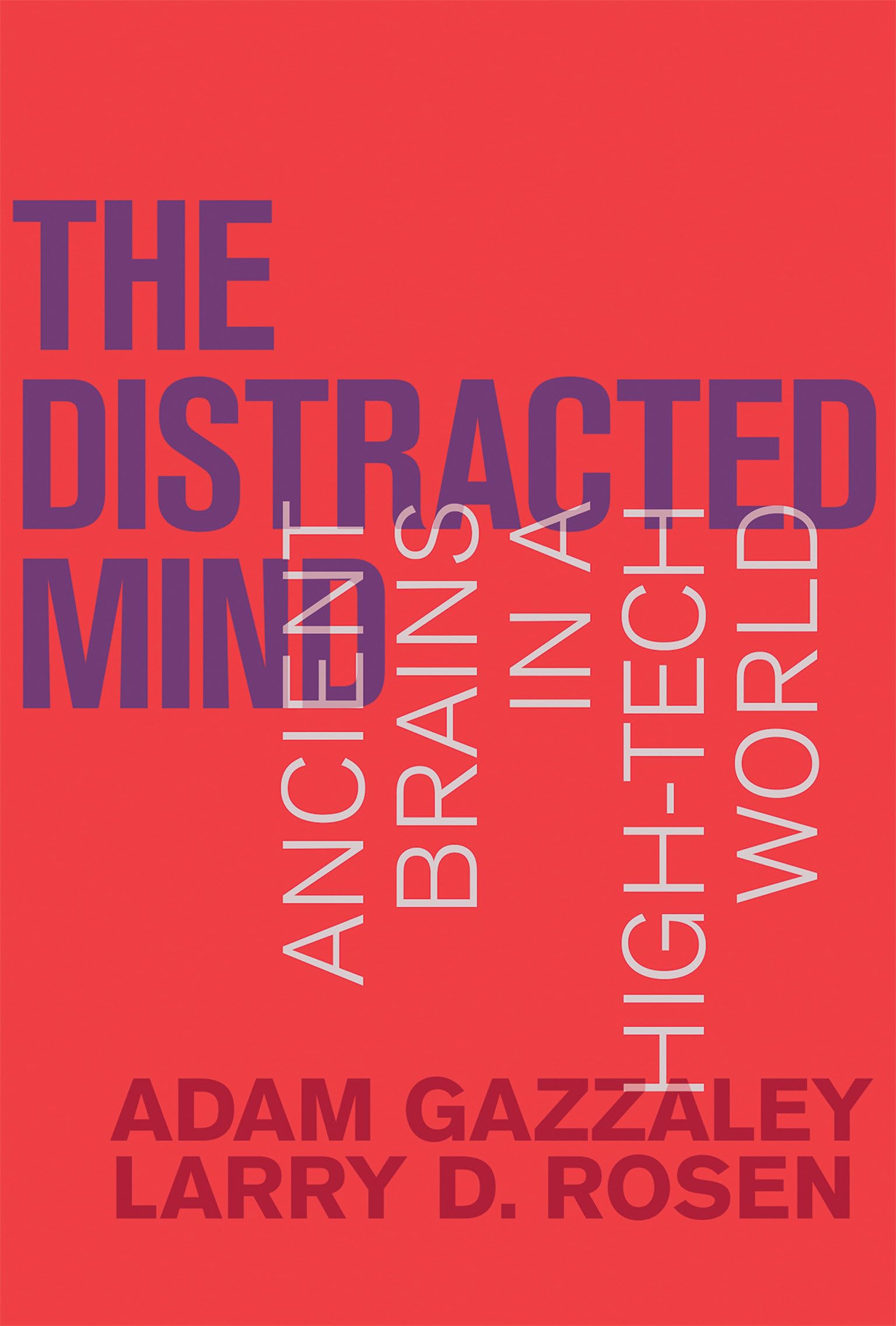
This book is a fresh deviation from the many “self-help” pseudoscience books written by non-scientists that are populating Amazon. It is written by bona-fide neuroscientists and leaders in the field, Adam Gazzaley and Larry Rosen. The style, however, is that of a professional popular press science writer. I found myself completely drawn in and engaged as the writers hit the balance between science (without being too dry) and popular literature (without being too “fluffy”). In fact, at times, towards the middle to end, it was truly a page-turner. I didn’t want to stop reading.The book hits upon perhaps the singular problem of our day – how to stay focused with so many – primarily electronic – distractions. I personally struggle with this problem every day – wasting untold hours on FaceTime and Twitter every week. Our electronic distractions are extremely effective in grabbing our attention. This book describes the latest theories and insights on why this happens to us, precisely what is going on, and how we might be able to reclaim more control over our attention. There’s also a bit of fMRI research included.It is divided into three parts: 1. “Cognition and the Essence of Control,” 2. “Behavior in a high-tech world,” and 3. “Taking control.”The first is an evolutionary perspective of how our minds work to optimize our survival. Efficient information collection has been fundamental to our survival, however, our instinct for and intrinsic pleasure with absorbing new information through technology is starting to interfere with normal life. Here the authors develop a useful model for attention switching – called “optimal foraging theory” which I thought was a good setup to understand at an intuitive level the factors at play when we are distracted. The basic idea is brought forth with the observation of a squirrel looking for nuts. Once a patch of nuts is found, what determines when the squirrel decides to look for another patch of food? A major factor is how close the other patches likely are. We forage for information, however the “distance” we have to go to find more information is nearly zero (therefore infinitely easy), thus we are always switching, creating a highly non-optimal state. At this stage in the book, I was completely drawn in as the writing was outstanding.The second part goes into the many scientific studies (mostly from the Gazzaley lab) that demonstrate how our performance suffers and how we are absolutely fooling ourselves if we think we can multi-task without a – sometimes significant – deficit in performance for each task. It also further applies the “optimal foraging theory” to our daily lives. The authors explain the role that increased accessibility of information, anxiety, boredom, and reduced metacognition play. This part is packed with insight and puts the construct of attention into an easily understandable and quite accessible framework.3. I would have preferred this section to be a bit more substantial as I could use all the advice I can get! However, the information provided here was all useful and some was truly insightful and innovative. Here they provide a good discussion, based on their own research and that of others, on the pros and cons of what we can do to reign in our attention: traditional education, meditation, cognitive training, video games, exposure to nature, drugs, physical exercise, neurofeedback, and brain stimulation. I was particularly intrigued by several areas. First, Dr. Gazzaley’s most popular research has been on brain training games. Here he discussed what works and what doesn’t as this field is extremely popular yet has shown highly mixed results and has become a bit controversial. I appreciated how he addresses these issues head on – what works and what doesn’t and why . One central issue in brain training games has been with “transfer” of skills obtained in a game to other aspects of real life. Other research on how pretty mundane sounding things like a walk in the woods naturally engages our attention and refreshes our brains was extremely interesting. I personally know that physical exercise is a great short and long term aid for increasing the ability to focus, and was heartened to see the growing body of solid science backing this up. This is the best, most exhaustive list of attention aids that I’ve seen – a great reference even for the researcher planning to delve into this area. Lastly, he ends with some interesting suggestions of phone apps that give feedback on phone use, etc.. The idea here is that the more we are aware, quantitatively, of our distractions the better we can deal with them.Overall, this book struck a great balance between great popular press writing, solid science, true insight, new information, and actionable and practical advice. A satisfying read overall! Now to stop picking up my phone so much…
L**X
SOLID AND INFORMATIVE
The book delivered on conclusions that are mostly intuitive, but the hard science and rationality is refreshingly reassuring. Read this to get a thorough explanatory breakdown of what our brains are going through in the 21st century. The suggestions for dealing with distraction felt sound, but were more like familiar reminders than revolutionary methods for change.
A**R
The Best Book I Have Ever Read
Humans went from foraging for food to foraging for information. We inherently seek novel experiences which deliver physiological arousal and enjoyment. These short-term dopamine rewards we receive from immediately answering the incoming text, email, or social media message, are addicting and derailing of our attention, working memory, and goal management cognitive control.It took me only a week to read Adam & Larry's book, The Distracted Mind, because it's the best book I have ever read. Understanding how our ancient brains work in this high-tech world is crucial for maximizing our cognitive control.At the top of Maslow's Hierarchy of Needs is Self-Actualization which arguably is the pinnacle of human brain evolution. Executing the ideas which lead to achieving one's full potential requires higher level goal setting and attentional regulation. This collides head on with our limitations in cognitive control coupled with our insatiable drive for information. In addition, our desire to prevent social anxiety and solve boredom makes us susceptible to the constant bombardment of distractions and interruptions exacerbated by the explosion of the internet, smartphones, and social media.We check our phones right when we wake up. We check our phones to the last minute before we go to sleep. We check our phones during meals with family and friends, sacrificing our ability to maintain healthy relationships. We even check our phones when we are driving, risking injury or death for ourselves and selfishly putting others at risk. We have a serious problem.To become more productive, creative, and to have more energy, we should partition our day into project periods. William James, the father of American psychology said, "everyone knows what attention is." We must focalize and concentrate our consciousness to take possession of our mind. Social networking should be done during a designated time, not as constant interruptions to our day. Email too should be done at designated times. An email that we know is sitting there unread messes up our attentional resources as our brain keeps thinking about it which distracts us from what we're doing. What might be in it? Who is it from? Is it good news or bad news? It's better to leave our email program off than to hear that constant ding and know that we're ignoring messages. Turn off all alerts of any kind including vibrations and if we still feel a pull, then move the device to a different room. Close down all apps and tabs that we are not using to complete the task at hand and limit ourselves to a single screen.It's also crucial to relax our attention and activate our default mode network. Take breaks to walk among trees and birds. Take breaks to do physical exercise which enhances cognition by increasing blood flow to the brain. Take breaks to daydream. Take breaks to doodle. Take breaks to think creatively. Allow your mind to just wander. Take a nap. Talk to another human. Read a joke. Tell a joke. Laugh! JOMO (Joy Of Missing Out) is a beautiful feeling to embody. Subscribe to Digital Detox. Warn your family and friends then keep your computer and phone off for a full day. Go to a mediation retreat.Maximize the efficiency of executing what brings you self-actualization.Dr. Adam Gazzaley has helped build a company called Akili which is going through clinical trials to be able to prescribe high-quality video games as cognitive therapeutics for ADHD, autism, depression, Alzheimer’s disease, and traumatic brain injury.I myself am working with a team that is building awareness and cognition enhancing experiences in Augmented Reality on Microsoft HoloLens.
Trustpilot
1 month ago
1 month ago