
DOWNLOAD THE APP


Customer Services
Copyright © 2025 Desertcart Holdings Limited
DOWNLOAD THE APP
Full description not available
S**A
Love the book
A very nice read
M**L
The sands of Tomb were unbalanced
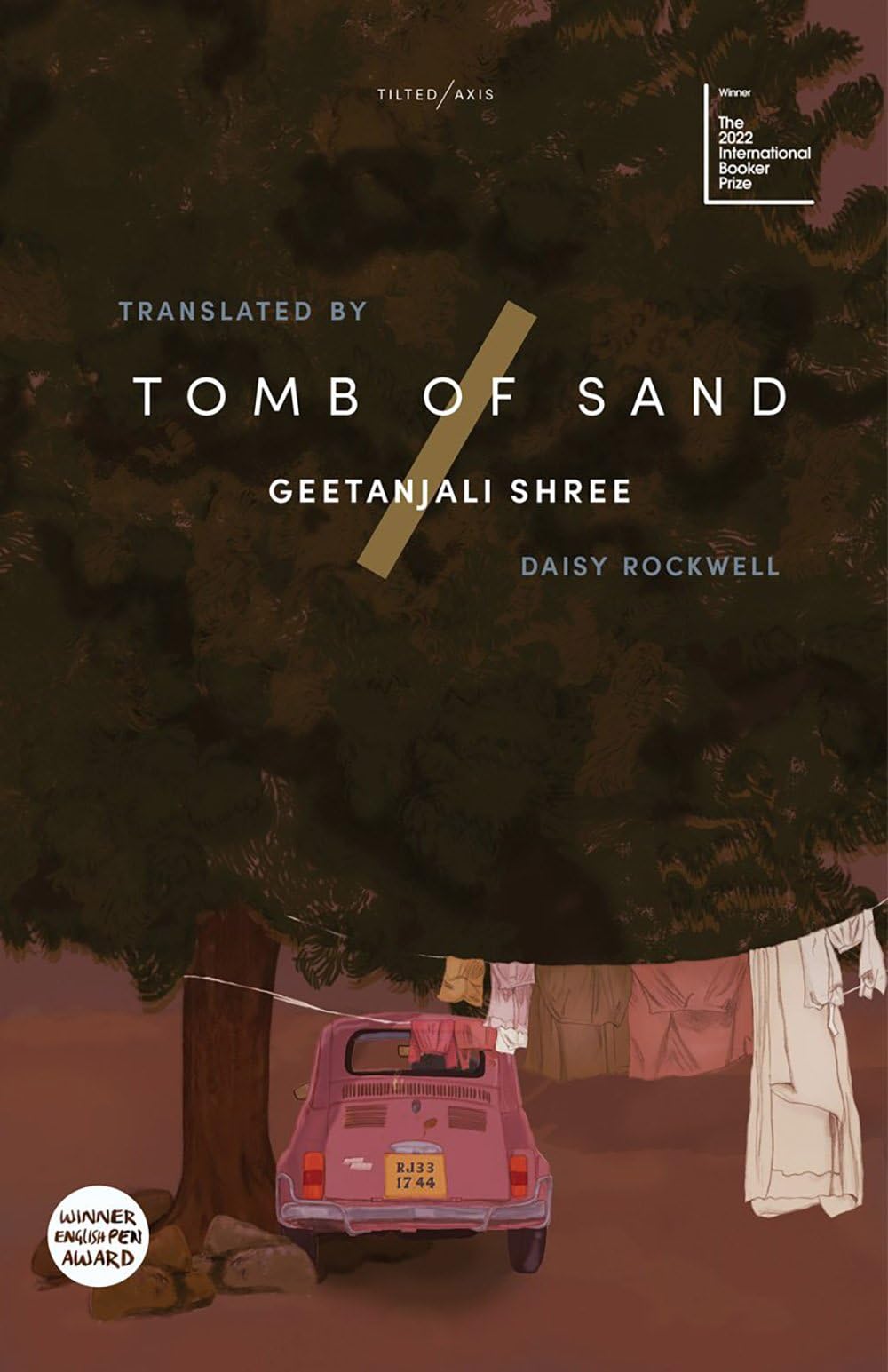
This is a book like no other I have ever read before. An original take on an Indian family where objects become human-like, and nature that thrives all around us is given a platform to tell its own stories. The prose is simply breath-taking, with an almost poetic rhythm, but also witty and very funny and pointed in places.The story concerns an eighty-year-old woman – Ma - who becomes depressed after losing her husband, takes to her bed and spends her days looking through a crack in the wall. But what does she (and we) really see? This is the nub of the story.Eventually Ma rises and leaves her comfortable upper-class home (funded by state ‘corruption’) and indirectly arrives at the home of her daughter, Beti, who has already rebelled against the norms and expectations of Indian society. Not only that, but Ma also befriends a hijra (transgender) woman – Rosie - and the ‘bohemian’ set is complete.With the strength and resolve that this brings to her otherwise ‘traditional’ meaning largely invisible life, Ma travels back to Pakistan, seeing the border as, instead of separation, a bridge between two worlds and two periods of her life, blocked by Partition. At the end of the story, we see what Ma has been looking at all along through that chink in the wall, as she is finally resolved.As a story of liberation and ultimately healing, I do think Tomb of Sand works, but I wish we could have travelled back to Pakistan with Ma far earlier than we did. We were at least two thirds through a 700+ page book before being invited to join them on their journey. What followed felt rushed to me and not explored nearly as deeply as I had hoped. To market the book as one about the trauma of Partition is accurate in terms of the key driver of the book, yet not at all in terms of its balance.A huge number of families on both sides of the border (or bridge) with similar preferences and desires will be forever estranged. Not for them the guard and maid of Ma’s comfortable neighbourhood, nor two thirds of a book in which to contemplate the almost spiritual nature of all life.
G**R
A long immersive read with a moving finale
Geetanjali Shree writes in immersive impressionist unpunctuated poetic prose whose complex depth too easily invites skim reading. The impressions are rich, but the book meanders at length until part 3 when the ravages and consequences of Partition are forcefully described, and a storyline develops. Shree offers frequent wry comments on human nature and social interaction. At 740 pages, careful reading is a substantial, but ultimately worthwhile, investment.
A**A
TWO WOMEN, ONE STORY - A REVIEW FROM INDIA
RAGA SHREEAs an engineer, I used to believe that effective narrations are necessarily compact, linear and logical. ‘Tomb of Sand’ has none of these qualities; on the contrary, the long story builds up layer by layer, with complex metaphors blending into each other (if you have a technical mind, think of 3D printing instead of CNC machining!) – I must say that I am pleasantly surprised by Gitanjali Shree’s unconventional but effective mode of narration.I do not agree with the reviewers who say that the pace is slow. In fact, the book is divided into three parts and the pace of the story mirrors a Hindustani classical performance: a slow ‘alaap’, followed by a ‘khayal’ in madhya laya, and finally a high-speed ‘tarana’ which leaves one gasping for breath!Long, poetic descriptions lend a magical quality to everyday objects and situations, such as this incidental description of an airport: “She felt like a tiny bug among many, trapped in a laboratory. Fake lights, fake passions, fake pushing and shoving. Bugs like her, crammed into every crevice, all terribly busy and awfully foolish, running in every direction, looking for their gates. Everyone’s been dressed in clean and crisp attire, and everyone’s had identical wheeled suitcases attached to them that pull them along. In this glittering fluorescence, their every movement is observed, their every particularity captured by the cameras…”Shree expresses a wide range of emotions, including powerful one-liners like “women are stories in themselves”, “Man worships the idols he himself creates” and “It’s easy to frighten those who are already frightened”. There are trenchant observations like, “Sisters-in-law do not desire the sort of life another leads. But they are pleased to see another deprived of the life they themselves wish to lead.”I particularly liked the author’s description of a party followed by, “they say it was such a memorable party, each year new folks add themselves to the list of invitees. Those who missed it suffer from an inferiority complex, and in order to save face, are forced to lie about their attendance.” Also, there are some comical interludes like, “When the doorbell rings suddenly, Beti picks up the phone and starts saying ‘Hello hello.’”WELL, DAISY ROCKSDaisy Rockwell skillfully presents not just the narrative, but also the sociocultural milieu of this story for an international readership. In her own words, “I have striven throughout my translation to recreate the text as an English dhwani of the Hindi, seeking out wordplays, echoes, etymologies and coinages that feel Hindi-esque.” Thus, there are literal translations like “their minds turned to curd”. I also enjoyed the translator’s own little gems like noisome/noise-some and “traffic jams or marmalade”!The real skill of the translator lies in judging what portions should not be translated, retaining a flavour of authenticity to satisfy the Indian reader, eg “D V Paluskar is singing Raga Shree, ‘Hari ke Charan Kamaal’. His voice circles softly above the mother-daughter conversation…” Though twenty or thirty years might have passed since I played Paluskar on my cassette player, I could visualize this scene perfectly. The effect would have been completely lost if Rockwell had attempted to translate the refrain of the bhajan.
H**A
Extraordinary!
It's an absolutely marvellous feat, what Geetanjali Shree has managed in Tomb of Sand: to take a loose thread of a story and building a whole world around it, building the different worlds of its characters and objects, making them all speak, making language dance. And Daisy Rockwell, the translator, should receive all the translator awards there are for breaking English open to the rhythms and variances that Shree has created. Novels like Tomb of Sand come very, very rarely!
R**E
Takes boredom to a new level
Regretfully, the single most frustratingly tedious read I have ever encountered - gave up after 600 pages or so. Simply not fun, thought provoking or even modestly good. The quirky style of the author gets old fast, and after the first 500 pages you wish for proper use of commas. As a comparison, A Tomb of Sand makes "A house for Mr. Biswas" feel like Die Hard.
J**N
Quite a hard read
Beautifully poetic but a lot to plod through
G**V
Astounding
A challenging but brilliant book that leaves you wiser. A rare gem of a novel.
Trustpilot
4 days ago
2 days ago