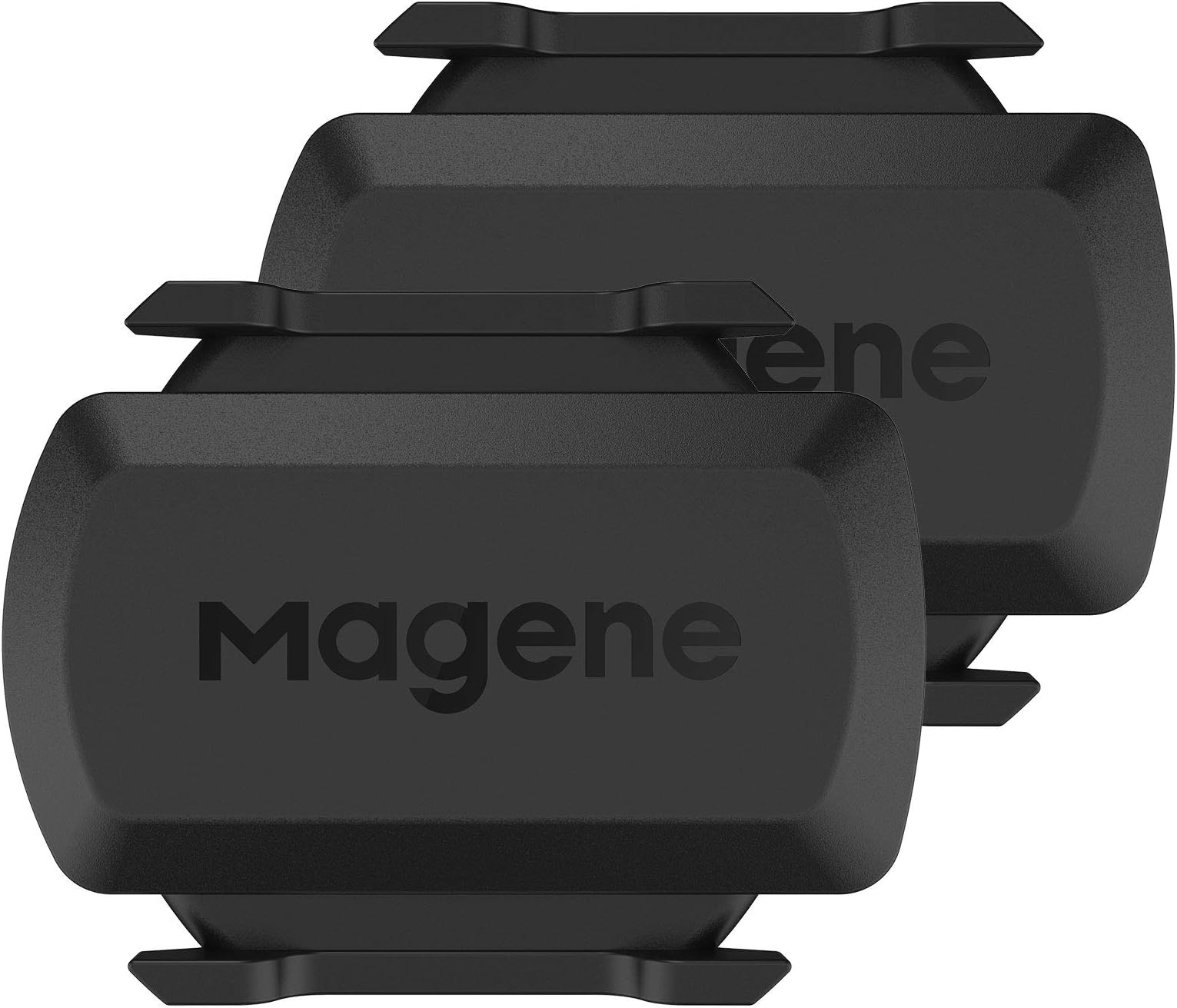
🚴♀️ Ride Smarter, Train Harder, Connect Faster!
The Magene S3+ Speed/Cadence Sensor is a lightweight, weather-resistant cycling accessory offering up to 500 hours of battery life. Compatible with Bluetooth and ANT+ protocols, it supports simultaneous multi-device connections and is optimized for popular fitness apps like Zwift and Wahoo Fitness. Designed for both indoor and outdoor cycling, it provides precise speed or cadence data with easy mode switching, making it an essential tool for serious cyclists seeking reliable, versatile performance tracking.


| ASIN | B087QD82Y6 |
| Battery Average Life | 500 Hours |
| Battery Cell Composition | Lithium Manganese Dioxide |
| Battery Life | 500 Hours |
| Battery Type | Lithium Manganese Dioxide |
| Best Sellers Rank | #4,735 in Sports & Outdoors ( See Top 100 in Sports & Outdoors ) #1 in Cycling Computers |
| Brand | Magene |
| Brand Name | Magene |
| Color | Black |
| Connectivity Technology | Bluetooth |
| Customer Reviews | 4.1 out of 5 stars 7,112 Reviews |
| Human Interface Input | Buttons |
| International Protection Rating | IP54 |
| Item Weight | 8.8 Grams |
| Manufacturer | Magene |
| Model Number | S3+ |
| Mounting Type | Handlebar Mount |
| Sensor Type | Cadence Sensor,Speed Sensor,GPS |
S**E
Seem like good value for the price
I bought these as an alternative to the big “G” and big “W” brands. Follow the included instructions to set them up, one as a cadence and one as a speed sensor. They paired easily with my Garmin 1050 head unit and seem to be a better design than the Wahoo pair that they replaced. So far they’ve worked flawlessly. I was impressed enough to buy a 2nd pair for my backup bike.
A**R
No complaints
Does the job, easy install 🤔 overall and I'm a first time sensor user. Durable, rain, sleet snow, No complaints 🤷🏻♂️
D**O
Works just as it should, at a fraction of the "name brand" cost.
I purchased the two-pack so that I could use one as a speed sensor, and one as a cadence sensor. I intended to use them with my Garmin Edge 1030 Plus cycling computer and GPS. I was skeptical when I ordered. The Garmin Speed Sensor 2 and Cadence Sensor 2 bundle costs more than twice the price of this aftermarket two-pack. So I assumed something would be lacking. Maybe I wouldn't be able to pair both at the same time (speed and cadence) as I had seen in some reviews. Maybe the speed sensor would require manual calibration. Or maybe they would be substantially inferior quality. None of these fears turned out to be warranted. Unpacking: The two sensors were in one anti-static wrap, and included in the package were two rubberized backing pads, and four elastic band mounting straps (two of each of two sizes). Initializing: After opening the battery compartments, you must remove a piece of packaging that prevents the battery from discharging prior to use. Upon closing the compartments again, one sensor initialized with a green LED, and the other red. The LED color tells which mode (speed or cadence) the sensor is in. It's important to pay attention to which is which so that you install the correct one on the wheel hub, and the correct one on the left crank arm. Initializing the units was easy. If one had initialized in the wrong mode, simply removing and reinstalling the battery will switch it back to the desired mode. Installation: Insert the rubberized backing strip, then strap the speed sensor around the bike's wheel hub, and the other around the left crank arm for cadence. The straps fit correctly. Compared to the Garmin unit, the cadence sensor fits exactly the same. The Garmin speed sensor incorporates a hub form-fitting rubberized housing integrated into the strap. The aftermarket speed sensor does not have the form-fitting housing. Yet it stays secure around the hub none the less. So the Garmin Speed Sensor 2's rubberized housing is a nice touch (at 2x the price), but not necessary. Pairing: On the Garmin Edge computer tap settings, sensors, add a sensor. Select speed for the hub-mounted sensor. Give the bike wheel a spin. The sensor will be displayed with some ID number. Tap that one, and tap add. If you want, go back in and edit the sensor name to change the numeric ID to a name that is recognizable. This is particularly useful if you have sensors on multiple bikes. For the cadence sensor repeat the process: Settings, Sensors, Add a Sensor, Cadence, spin the cranks, then tap the ID of the sensor that pops up. Optionally edit its name so it's recognizable. One thing that I feel is worth mentioning: I expected that I would have to manually calibrate the wheel size. The Garmin Speed Sensor 2, when paired with a new enough Garmin Edge (520, 520+, 820, 530, 830, 1030, 1030+, and possibly others) will auto-calibrate the wheel size. But I assumed that feature wouldn't work with this aftermarket sensor. Nevertheless, I set it to auto calibration mode and went for a ride. After about a mile the Garmin Edge 1030 Plus indicated that auto-calibration of the speed sensor was complete. So to my pleasant surprise, this aftermarket sensor will work with Garmin's auto-calibration for wheel size. Great! Test ride: I took this set for a brief five mile ride, and then looked at the results. There were no drop-outs in cadence other than when I wasn't actually pedaling anyway. Speed is harder to verify since the GPS can calculate speed without the speed sensor. The sensor just makes it more accurate. But there were no notifications of losing a connection to a sensor, so I assume speed was working fine. Certainly the GPS home screen did indicate that both were connected and sending data. The speed and cadence data seemed indistinguishable from when I use Garmin name-brand sensors on my other bike. Comparison to Garmin Speed Sensor 2 and Cadence Sensor 2: I have both the Garmin sensors and these aftermarket sensors. They both seem to work the same; they turn on when the wheel or cranks spin, and shut off a minute or so after I discontinue use. Their estimated battery life is similar too. The Garmin's hub mount is a little nicer, but both are adequately secure. Both are waterproof. Size is similar. And pairing works exactly the same. In my case, I even have both the Garmin sensors and these aftermarket sensors paired to the same Edge cycling computer. When I use one bike, the GPS detects one set. When I use the other bike, the GPS detects the other set. They work the same. The biggest difference is I paid $80 for the Garmin sensors as a set, and less than $40 for these aftermarket sensors as a set. I really think the ability to switch between speed and cadence mode by reinstalling the battery is a nifty piece of engineering. I'll never switch them after initial setup. But it does mean you can buy one, or two, and then decide how you want to use them. One thing I see people ask sometimes: If a GPS detects speed, why would someone buy a speed sensor? There are three reasons. First, if you're using an indoor trainer, you can mount the speed sensor on the rear hub and still get speed data despite the fact you're pedaling away on a trainer in the basement. Second, if you're mountain biking in terrain with steep mountains and tree cover, or if you're riding downtown in urban settings with tall buildings blocking GPS signal, you'll experience fewer drop-outs in speed data. Third, is accuracy. Even if you're a suburban road cyclist like I am, the speed sensor improves the accuracy of speed reporting of the GPS, and also decreases the latency between speed changes and reporting on the device of the speed change. And that's why I have the speed sensor; just to improve the accuracy and latency of speed reporting. Conclusion: At half the price of a set of Garmin sensors, and providing the same sensor information to the GPS, with the same mounting for cadence, and nearly the same mounting for speed, and with similar battery life, similar waterproofness, and identical device pairing with Garmin Edge GPSs, to me it's easy to conclude that buying these at half the price is the best choice. I have both a set of Garmin sensors, and a set of these -- one set on each of my two bikes -- and if I had it to do over, I'd save the $40 and go with two sets of these instead. It could be that these will wear out sooner, though I rather doubt it; there's not a lot that can go wrong with them. There are two reasons I gave four stars instead of five: First, I like the hub-hugging design of the rubberized shroud that comes with the Garmin Speed Sensor 2 better than I like this aftermarket sensor's flat rubberized backing strip. In use, it makes no practical difference, though. But the Garmin design is slightly nicer in that one regard. I don't really feel that piece of rubber justifies a $40 price difference for the set of sensors, though. The other reason for four stars is this: The product listing claims IP67 weatherproofness: dust proof and submersible to 1 meter for 30 minutes. But the packaging and instructions list the weatherproofness as IP66: dust proof, and heavy seas splash resistant. Meanwhile, the Garmin devices are listed as IPx7: no specific dustproof rating, but submersible to 1 meter for 30 minutes. If this device is IP67, it's rated better than the Garmin at IPx7. But if it's IP66 as the packaging and instructions state, it is less weatherproof than the Garmin, but potentially more dustproof. This ambiguity (the uncertainty because the product listing's specifications differ from the specifications on the packaging and instructions) warrant a 1-star deduction. I've seen reviews that suggest the rubber bands that strap these devices into place aren't durable. I haven't had them long enough to have encountered a failure. If I do encounter a failure in the first year, I'll deduct another star. But for now, 4-stars stands.
N**I
my sensor shows inaccurate cadence
sensor is dissapointing. after i received it i connected it initiallly and a couple of days later when i actually went cycling, the sensor wouldn't connect so reseted it on the road and then it worked, that so far only happened once. the problem now though is that everytime i go cycling, i have not once received overall accurate reading with the sensor. to be precise, everyone once in a while the count would jump to 130+ and so on or drop completely and then it would do the same, but otherwise it would stay at or around the correct rate for some time but then it would mess up again temporarily, also in slight elevation it would just disappear for a short period, same as with some bumps but not all which i noticed last night. Because of the inaccurate numbers, my max cadence is way higher than it should be,i cant reach what it shows for even a second. i messaged the seller regarding this but no response at all, lucky for me i still have time to return it so i will just contact amazon in the next couple of days after i have found a replacement and return it. advice for anyone who wants to buy it, if you receive a good sensor, bless you, you got one for cheap, but if its bad or has issues, dont hold your breath for their reply. i understand now why their are some reviews regarding communication. my rating is for the accuracy -2* and drop in connection (elevation and bump -2*) of the sensor and not with the customer service at all, that would be lower
V**H
Works as expected
Pairs correctly right away.
M**E
Beware of thickness
Great value. Picked this up for my other bike, so I don’t have to swap sensors so much…. Was originally bought for my wife’s bike, but due to the thickness, it doesn’t fit between crank and chainstay. It does work if my fattier bike.
C**F
Works well for basic data
I got this for a very basic indoor exercise bike I got without any electronics. I use with a tablet or phone for basic record keeping of cadence and time.
P**N
Old stock needs new batteries
Received these on Wednesday. Installed on Wednesday and did short test and both seemed to work properly. Went for a ride on Thursday and one unit didn't want to work. I checked my installation figuring maybe I made a mistake. Went for a ride on Friday and the first unit still did not work and the second unit failed during the ride. Brought both units inside and checked the batteries. Both read well below 3 volts. I replaced both. Reinstalled both units. One unit would not work in cadence mode but works well for speed sensing. Obviously I was aware of this because I wanted it for cadence so I removed both sensors and swapped them and reinstalled. After a short bench test both seemed to have found a home and my ride on Saturday was a real pleasure with both operational. The batteries had shipped with a plastic disk between the battery and the contacts in the units. The instruction suggest they should be good for 500H of use. Apparently these had been on the shelf somewhere too long. In addition, there may have been some form of leakage that caused the one unit not to be able to do the cadence function. In both units the red light is quite bright while the green is invisible in sunlight. The failing unit was a little less bright green suggesting that it has a problem somewhere.
Trustpilot
1 day ago
3 weeks ago