Desert Online General Trading LLC
Dubai, United Arab Emirates
Desert Online General Trading LLC
Dubai, United Arab Emirates

Full description not available
L**T
A classic work
This is a famous book by a famous mathematician on a famous problem well known to experts It has Pedigree starting with Georg Cantor to David Hilbert and up Paul Cohen
A**N
Confused 100-year-old paper on real numbers versus physical magnitudes.
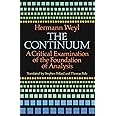
This 1919 work by Hermann Klaus Hugo Weyl (1885-1955) shows the continuation of the confusion between physical space and mathematical number systems which has persisted since classical Greek times. Although Weyl was one of the true geniuses of the first half of the 20th century, he over-estimated the "reality" of mathematical concepts. He tried too hard to identify mathematical concepts (which exist in the human mind) with the physical world (which exists "out there").This paper apparently shows the early signs of Weyl's conversion to the intuitionist creed, following Brouwer into irrelevant obscurity as regards the foundations of mathematics. (See for example the "concluding remarks" at the end of Chapter 1, pages 45-50. See also Weyl's comment in the 1932 reprint preface that his "current beliefs" had already made this essay obsolete.) This semi-mysticism does not diminish at all the importance of Weyl's key contributions to physics and other areas of mathematics. There are more than 20 concepts in mathematics which are named after Weyl, but nothing in the foundations of mathematics as far as I know.A good solution to the issue of the suitability of the real number system for modelling physical magnitudes (such as length and time) is to distinguish between reality and measurements. We only know the real world through observations which are an interaction between the "world out there" and us human beings. So the so-called real numbers are a very good model for our measurements of the real world, but maybe not such a good model for the real world itself (which is "behind the phenomena"). Quantum field theory in particular has taught us to distinguish between phenomena which we can measure and the real things-in-themselves (the ontology) which we can only guess at. The first is objective. The second is speculative. Two different kettles of fish!All in all, this book is useful as a historical document of the kind of confusion which reigned in the foundations of mathematics in the early 20th century. Thankfully mathematics emerged from this painful confusing twilight of intuitionism versus formalism into the bright daylight of dry, lifeless pure formalism. Something important is missing from the austere modern dogma of first-order languages and model theory. Old documents like this help us to understand what has been lost, but I think few mathematicians would want to return to that era of muddled metaphysical mysticism.Chapter 1 commences with the philosopher's version of logic going back to Kant and even Aristotle. It's unfortunate that Weyl tried so hard to fit mathematics within the framework of the irrelevant academic philosophy of that time. He should have given up when it became clear that this was a "bad fit". Mathematical logic is just totally different to "natural logic" and philosophical logic. Chapter 1 tries to obtain inspiration and justification for mathematical logic from everyday informal-language logic. Mathematics is just totally different to informal logic.I'm finding it difficult to find anything positive to talk about in this book. The best thing I can say is that it makes me so glad that formalism won the battle against intuitionism. (Hilbert famously was deeply disappointed that his PhD student Weyl was converted to Brouwer's intuitionist cult.)In Chapter 2, sections 6, 7 and 8, Weyl discusses concerns about the validity of the real numbers as a model for physical magnitudes. (I had these qualms myself in undergraduate years because I was studying mathematics and physics at the same time.) The point which Weyl seems to miss is that mathematical systems are only models! Models aren't always perfect!
C**F
a fascinating detour
I first learned of this book from Eves and Newsom back in the early 1960's. It sounded fascinating but I couldn't read German. Now we're lucky to have it in Englsh translation with an introduction that relates Weyl's notation and terminology to the current one. (Or, if you're really out of date like me, you can use it in reverse to catch up on the modern field of foundations studies).Precise statement is the essence of the study of the foundations of mathematics and what follows won't rise to that level but I hope it won't be seriously misleading either. In real life definitions are often circular; dictionaries define words in terms of other words, etc. Ordinarily this is not a problem but vicious circles can happen. In 1872 Dedekind published a definition of real numbers in terms of sets of rational numbers.This fulfilled a long term dream of defining the reals without reference to geometric concepts. Encouraged by this Frege began his project of deriving all of mathematics from basic logical notions. He was largely successful but Russell found a contradiction within his system. It wasn't clear what caused this problem and Poincare suggested that it arose because Frege had allowed a certain kind of circular definition called 'impredicative'. While it was true that the contradiction could be eliminated by avoiding impredicative definitions, this solution was very drastic: it also barred Dedekind's defintion of the real. Most mathenaticians, including Whitehead and Russell, shrank from this step and proposed more moderate ways of fixing the foundations of mathematics. Working in the aftermath of World War I, Weyl was attracted to the more radical idea of trying to develop mathematics without using any impredicative definitions. He managed to derive some, but far from all, of analysis and the result was this book. Subsequently, Weyl was attracted to an even more radical critique of mathematical foundations proposed by Brouwer (you can read about this in Mancosu's great anthology "From Brouwer to Hilbert". At the same time Weyl remained passionately attached to mainstream mathematics. As far as I know, he never resolved his own conflicts about this. Naturally, anything by Weyl is brilliant and worth reading and this book is no exception.
Q**G
this book did not solve the CH
Totally do not agree with this book, It did not solve any problem and it did not solve CH at all.It did not see through the essence of the CH.Please see the book <Principles of Large Number Domain> by link:https://www.amazon.com/Principles-Large-Number-Domain-Mathematical/dp/B0C477KPMQ/ref=sr_1_1?crid=10W5T3CQ8E5DW&keywords=Principles+of+Large+Number+domain&qid=1684000013&sprefix=principles+of+large+number+domain%2Caps%2C140&sr=8-1&ufe=app_do%3Aamzn1.fos.f5122f16-c3e8-4386-bf32-63e904010ad0It cracks the CH thoroughly.CH is only simplest problem in <Principles of Large Number Domain>. All problems and Puzzles solved in <Principles of Large Number Domain> are much more difficult than the CH. The CH is nothing.This book is useless for the CH.Misleads us in the wrong direction,Humans should step forward instead of staying in old dreams.
Trustpilot
4 days ago
1 month ago
4 days ago
1 month ago