Some deliveries may take a little longer than usual due to regional shipping conditions.

DOWNLOAD THE APP


Customer Services
Copyright © 2025 Desertcart Holdings Limited
DOWNLOAD THE APP
Full description not available
M**R
Marvelous and original
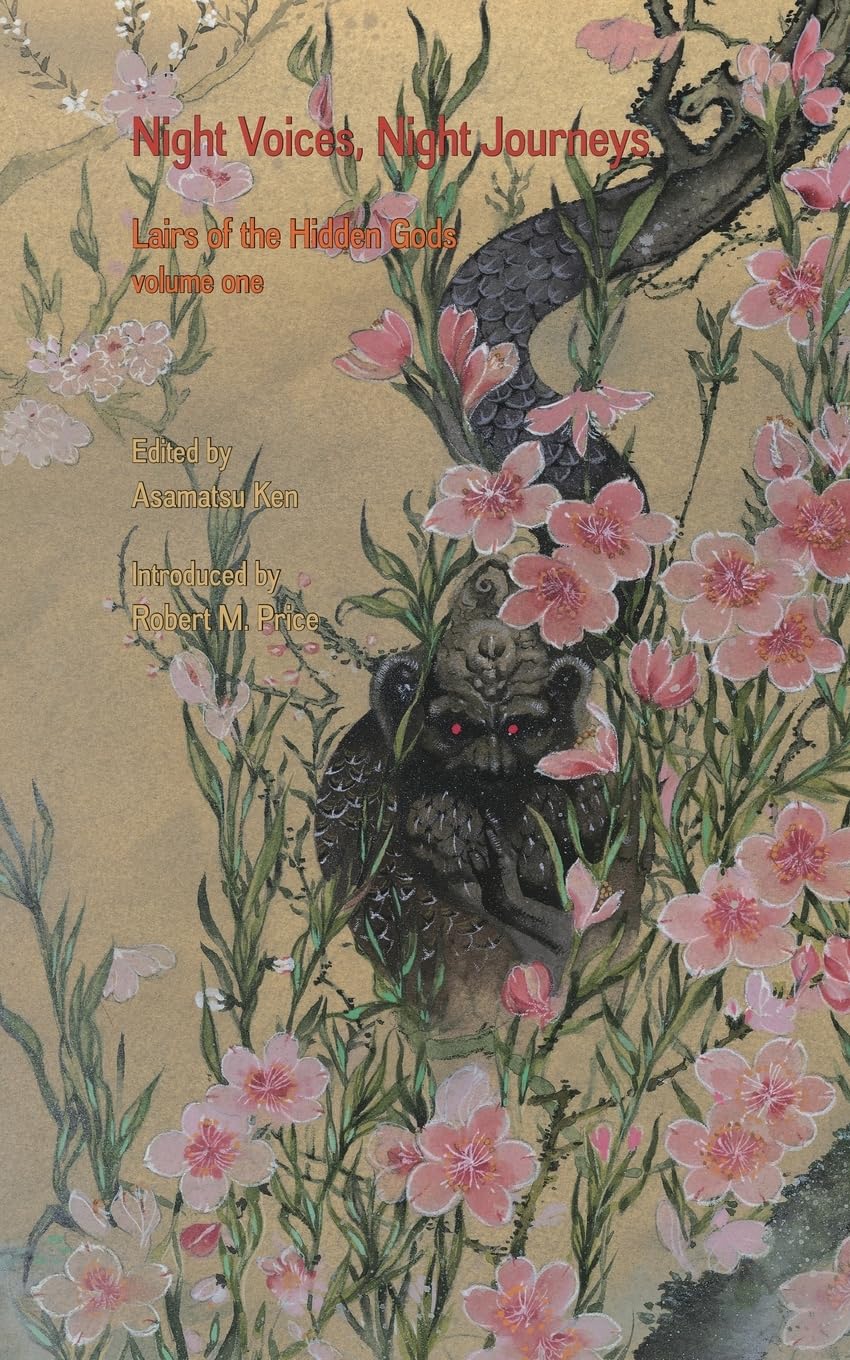
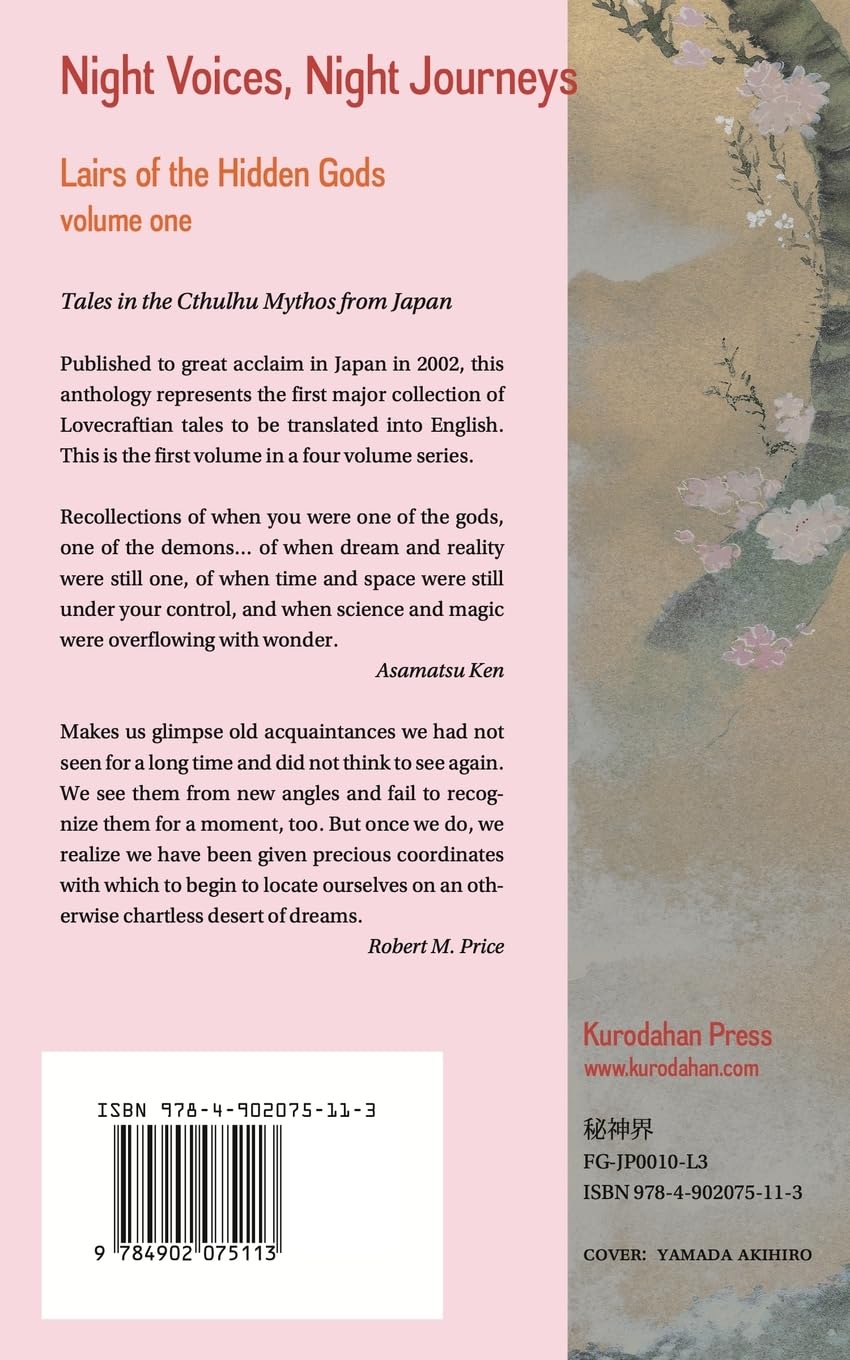
In summary, Night Journeys, Nights Voices, subtitled Lairs of the Hidden Gods volume one, is urgently recommended to all serious mythos aficionados.Parenthetically, this book is part of a veritable avalanche of great new mythos and related books that have been popping up on my doorstep. Just in the last few months we have had Horrors Beyond and Lost Worlds of Space and Time, with Tales Out of Dunwich and The Tsathoggua Cycle soon to follow, not to mention the upcoming Arkham anthology, The Dagon Cycle, The Yig Cycle, The Cthulhuian Singularity, Unholy Dimensions and The Black Sutra. Most of the stories in these will be new to me, even the reprints! It's a golden age, I tell you.Night Voices, Night Journeys is a publication of Kurodahan Press, and is, I believe, POD. The best way to order it is from Amazon, where it is $20 plus shipping. The page count is a VERY generous 363. However, 14 pages are taken up by introductions by Asamatsu Ken and Robert Price, and each story has its own title page and brief introduction, also by Robert Price. And from page 289 onward the material is factual discussion of mythos manga and Lovecraftian fiction in Japan, with brief notes about the authors and translators at the end of the book. Production qualities are good. My copy had one printing error on page 301 where a crease led to a flaw in the typesetting, but the print was still readable. The cover has a lovely painting by Yamada Akihiro of a Japanese sea demon hidden amidst flowering plants. This is really quite different than the art style I am used to seeing on mythos books from the western world. I found it quite striking; most mythos novelsillustrations do not depict horror concealed in exquisite beauty. This book was written a number of years previously for the Japanese horror market and I guess the success (or perhaps the quality) was sufficient to prompt an English language version. Hence the anthology was edited by Asamatsu Ken, a Japanese author and HPL fan rather than one of the usual mythos crew here in the west. For such a book to succeed in the west it is extraordinarily important to have an excellent translation, one that can not just change the words into English but can also portray the atmosphere the author was trying to convey, that can appropriately bring off the rhythm of the dialogue and use of slang, puns or other word play. In many ways the translation is an expression of the interpretation of these intangibles by the interpreter, and the work in some ways becomes their own. I know from reading The Iliad that two translators can derive entirely different language out of the same source work. I confess I have only ever read a few works of fiction written by Japanese authors before (one book Miyamoto Musashi was from my days taking karate), so I don't have a great deal of experience in this forum. The success of this book in the US will stand or fall with the quality of the translation as much as with the stories themselves. Happily these seem to be superb translations. The stories read seamlessly, naturally, allowing us to readily enter the author's worlds. For once I have no complaints about the introductions by Price, which were thoughtful, well written and informative. I would follow his advice, however, and not read the individual story introductions until after you have read the work in question, to avoid spoilers.In some ways this book is both frustrating and tantalizing. These are new stories, written specifically for this anthology, much like with Horrors Beyond or Dead But Dreaming. This means there are other works already extant in Japan that we know nothing about. Here is an untapped mythos resource that I will only ever see as it is translated. In a way that means I'll probably only see the cream of the crop, but I can't help wondering about jewels known only to Japanese fans. And it makes me wonder about mythos fiction from other countries. We have many stories from the US and the UK, and now we are seeing some Australian fiction. What about India or China, or any African nations? Heck what about Russia or non English speaking Europe?? One thing HPL fans do is write their own mythos contributions. This has kept the mythos alive and squirming over the years. The tradition dates back to the days HPL first ever wrote a story and his friends leaped over themselves creating new entities and tomes. As we only see fiction written by English speakers we are missing out!! And this cuts both ways. I would imagine very little mythos fiction beyond the hoary classics is translated into Japanese so the revisionist view of Derleth is not extant in Japan. In fact it is HPL, the Lovecraft circle and Derleth, with of course whatever mythos heritage is native to Japan, that forms the basis of the Japanese mythos fiction here. I wonder what Asamatsu Ken would think of the stories in Eldritch Blue or Dead But Dreaming.Fortunately for us English speaking fans this is the first volume of a projected 4 volume series. I fervently hope that they sell well so we do, in fact, get to see all 4 volumes.Here are the contents:ASAMATSU Ken - Foreword: "Recollections of Tentacles"ASAMATSU Ken "The Plague of St. James Infirmary" translated by R. KeithROELLERHISADOME Kenji "The Cthulhu Mythos in Japan" translated by EdwardLIPSETT HOSHINO Satoshi "Cthulhu Mythos Manga List" translated by RyanMORRISINOUE Masahiko "Night Voices, Night Journeys" translated by EdwardLIPSETTKAMINO Okina "27 May 1945" translated by Steven P. VENTIMAKINO Osamu "Necrophallus" translated by CHUN JinMURATA Motoi "Sacrifice" translated by Nora Stevens HEATHSHIBATA Yoshiki "Love for Who Speaks" translated by Stephen CARTERYAMADA Masaki"The Import of Tremors" translated by Kathleen TAJIYONEZAWA Yoshihiro "Four Decades of H.P. Lovecraft and Manga"translated by Ryan MORRISI will briefly discuss the stories below, but not the nonfiction. As usual spoilers, small or large, may follow. When I relate my impressions of a story I like to place it in context with other related stories I have read. For reasons alluded to above I cannot do that here; all my very old Derleth paperbacks and books by other Lovecraft Circle authors are hidden away in boxes somewhere. I relied on Price's introductions to place each story in context, but only after I read it. I must also say that the tenor of the anthology was intangibly different than other anthologies I have read recently, perhaps relating to the Japanese approach? There was a sort of surreal, almost dreamy feel to many of the stories, even when they were graphic. In some ways the horror was more detached. And many of them were about love and had distinct, sometimes graphic, sexual overtone.ASAMATSU Ken "The Plague of St. James Infirmary" - This is actually a lengthy novella, setting fire servants of Cthuga against water servant of Cthaat in gangland Chicago (an interesting setting for a Japanese author in a Japanese anthology!). Mr. Asamatsu uses a Japanese word "yoki" to good effect here; I doubt it translates well but it is rendered as gruesome feeling. Yoki suffuses the pages, no doubt as the author intended. Dreamlike, ghastly and compelling come to mind when reflecting on this story. This is the one work where I did detect a bit of lecturing to Americans. I mean the few paragraphs on the bottom of page 62-63, where American hypocrisy and lack of insight is paraded into the narrative. This is, of course, old hat. It was the only time I ever discerned anything like that, and I only bring it up for the sake of even handedness.*********spoiler follows!!!***********One very cool thing about this story was weaving into it some true historical figures and a venerable mythos fiction character of Henry Kuttner. I never would have known about the latter except for Mr. Price's introduction as it has been ages since I read the Book of Iod. Now we know the truth about Elliott Ness and Al Capone. I wonder if the Japanese character Hasegawa Kaitaro is similarly a real person adapted for this novella.YAMADA Masaki"The Import of Tremors" - Oh what a good yarn this was, about some unspeakable entity trying to acquire a new host in the twilight of WWII. I knew some of the history without prompting, like the Kobe earthquake, but I did not realize that Kobe was fire bombed like Tokyo was.KAMINO Okina "27 May 1945" translated by Steven P. VENTI - I would gather that the time of the military collapse in Japan in mid 1945 is used to good effect by horror writers in Japan. This time is related to the American assault on Okinawa, and uses it as a smokescreen to a confrontation between Hastur and Cthulhu, very Derlethian!! Also very well written!INOUE Masahiko "Night Voices, Night Journeys" - Surreal, beautifully written, this story gives the anthology its name. Some night journeys are eternal.MURATA Motoi "Sacrifice" - In this story a yuppie-type's wife gets caught up in a cult that may use her as a sacrifice to a soil god. Robert Price was right on the money when he compared it to the movie(and novel) The Wicker Man. I was a bit bemused because that is what I came up with myself before I read his remarks. Any way, this was perhaps the weakest story here, not bad just not as powerful as the others were for me.MAKINO Osamu "Necrophallus" - Oh my, wonderful! For me this is the best story contained in the anthology. And Horror Between the Sheets purports to be about mythos sex. Hah! Makino's work was visionary! "Necrophallus" probably outdoes anything inEldritch Blue for combining sex and true mythosian horror.SHIBATA Yoshiki "Love for Who Speaks" - This is a marvelous tale of what are essentially The Deep Ones. They call to their own. A superb close to the superb fiction in Night Voices, Night Journeys.The rest of the book is nonfiction.Need I say that I thought this was a masterful collection?Congratulations to Mr. Asamatsu and his authors. And thank you to Mr. Lipsett for bringing it to us. Really, everyone should read it.
E**O
Kurodahan before they vanish!
Nice quality, clean. With shipping, I seldom care.
J**S
Splat
I was intrigued to see what Japanese writers might do with a Lovecraftian inspiration, having enjoyed both HPL's own stories and a smattering of enjoyably pulpy products of Japan's modern pop culture, along with one or two works of actual Japanese literature. However, this book reflects none of the careful atmospheric construction that marks the work of Lovecraft, and of the authors he admired. Instead, it almost immediately descends into graphic, grossout violent and slobbery stuff, with no pause to secure your suspension of disbelief. It's like reading a video game aimed at 12 year old boys. If you're curious about Japanese horror, skip this and try Japanese Tales of Mystery and Imagination by Edogawa Rampo instead.
J**L
Beasts from the East!
When I think of Japanese monsters, I tend to envision rubber-suited Kaiju fare, or Anime, with its big-eyed schoolgirls with even bigger guns blazing away at tentacled things with lots of eyes and mouths. And fun as they elements may be, they hardly suggest the lurking, brooding terrors of H. P. Lovecraft! But as Robert M. Price's Introduction to this book posits, who but the Japanese could truly understand unsuspected horror pouncing down from the skies in the more-than-half-a-century wake of Hiroshima and Nagasaki? And it shows in these 7 stories -- 6 stories, really, and a short novel -- as the horror is a palpable force lurking behind it all, in these truly incomparable well-written tales. These stories are very original, very well-realized, and damn scary! Editor Asamatsu Ken's "The Plague of St. James Infirmary leads off in fine short pulp novel fashion, utilizing elements from the Mythos works of Henry Kuttner and Brian Lumley, especially, and throwing in Eliot Ness and Al Capone to boot! Yamada Masaki's "The Import of Tremors" is another favorite, as is Murato Motai's "Sacrifice" -- both tales embodying the message: "Watch what you eat!" And the other stories were all good too, ranging from a depiction of Derlethian Great Old Ones' rivalries to a surrealistic sex-tinged odyssey to a graphic (read: cringe-inducing) waking nightmare, and even a touching love story! But make no mistake: Lovecraft's influence is clearly felt throughout it all. And it doesn't end there with the fiction either. We also get Bibliographies of the Cthulhu Mythos scene in Japan and a Manga primer to start us on our way to exploring this most fascinating mileu -- more of which future volumes of LAIRS OF THE HIDDEN GODS will continue to bring us. This is one beautiful book, and all involved can truly be proud (and I'd really be lax in my reviewer duties if I didn't mention the stunning pastels-and-tentacles cover by Yamada Akihiro)! Highly recommended!
Trustpilot
3 weeks ago
2 weeks ago