

Desert Online General Trading LLC
Dubai, United Arab Emirates
Desert Online General Trading LLC
Dubai, United Arab Emirates
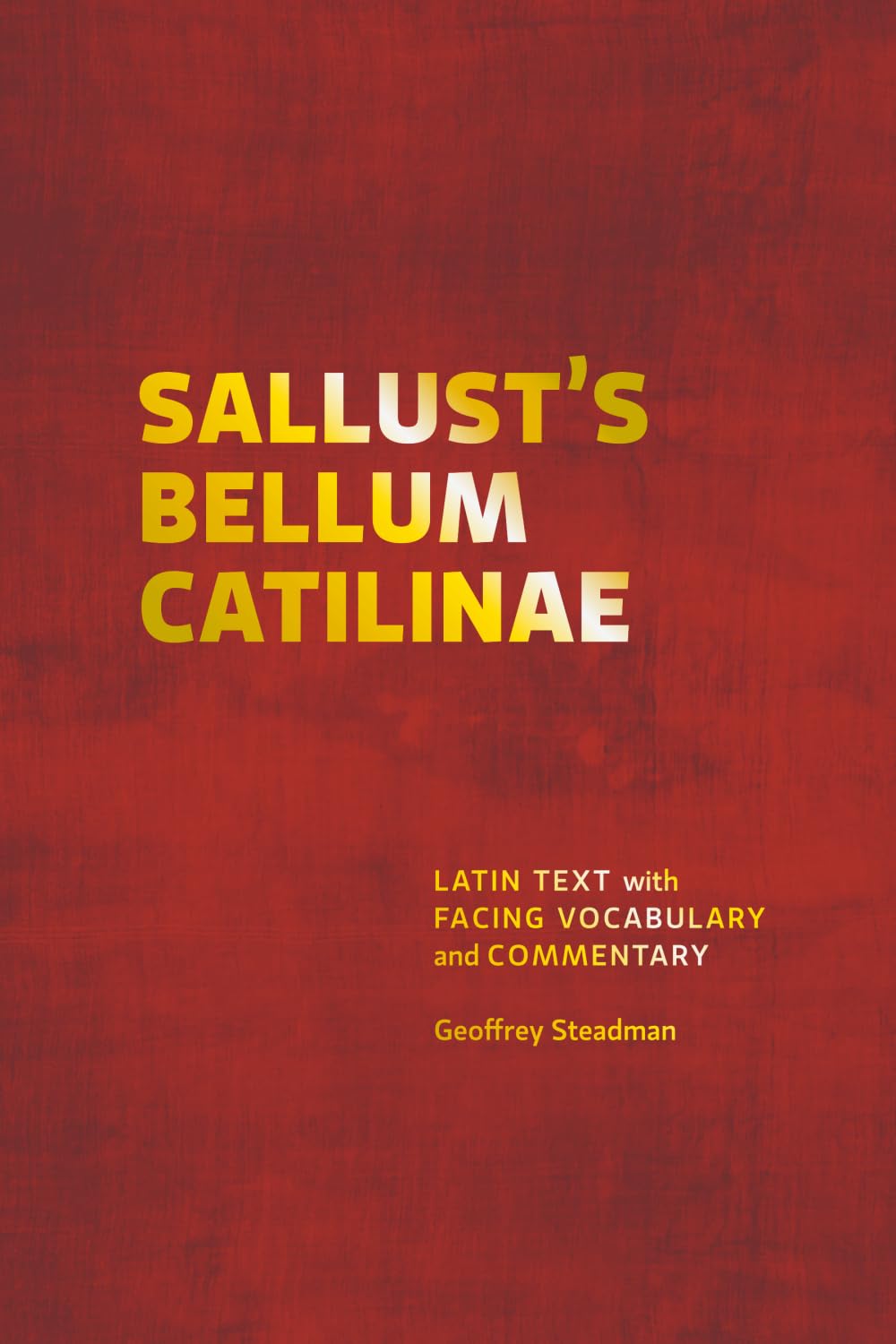
Sallust's Bellum Catilinae: Latin Text with Facing Vocabulary and Commentary
G**3
This is easily the most challenging of Steadman's Latin readers to date
Bellum Catalinae is perhaps the most challenging of the works published by Dr Steadman for Latin students: 12 lines or so of text per page are supplemented by a short vocabulary and grammar commentary, with a more extensive "core vocabulary" and further memoranda on the topic of grrammar at the back. Where this book differs from Steadman's Caesar and Cicero volumes is that the Latin text is a little denser, and the grammar commentary (deliberately) less helpful: it hints at the answer, rather than providing it. Steadman assumes, I take it, that if you are reading Sallust, you are far enough on in your studies not to need that much help.This review is not a critique of Sallust: his short, compact, syntax with a deliberately archaic vocabulary have been the subject of far more learned comments than mine over the years. Still, it is helpful to students to have one of Latin's more unusual stylists presented in such an accessible, helpful, and affordable fashion. Moreover, this makes an interesting and logical successor to Steadman's "Cicero's First Catilinarian" - Sallust (mischievously?) underplays the glory his rival hoped for in this short history, while engaging in far more detailed studies of Cato and Caesar and their contrasting plans for the fate of the captured plotters, in a style quite at odds with Cicero's own.This book has four stars from me, rather than five, because, for the first time in Steadman's commentary, I saw that some of the grammar notes were a little off piste: very few, and certainly not enough to put anyone off buying this text, but they are there. Doubtless he will correct them in future editions;This is easily the most challenging of Steadman's Latin readers to date, but, despite my initial frustrations with Sallust's style, I found it tremendously rewarding to make it through an unadapted Latin monograph while reducing my dependence on the commentary. I would characterise this as an intermediate-advanced reader, suitable for those at the equivalent of English-Welsh A-level (17 - 18, assuming the reader began studying Latin at age 11). It is well worth the purchase.Background to the Review:By way of background: I am now in my late 30s, hurtling towards 40. As my new year’s resolution in 2018, I resolved to improve my Latin to the level at which it had been when I was 18, before I went to University. I studied Latin between the ages of 11 and 18, up to and including A-Level (the academic pre-University exams in England and Wales). After a couple of months of relentlessly drilling noun, pronoun, adjective and verb endings, recommitting “hic, haec, hoc” and the imperfect subjunctive to memory, I started casting around for things to read. I knew I wasn’t ready for an Oxford Classical Text, but happily, there are far more accessible Latin textbooks, far more readily available than there were in 1998. These reviews deal with what I discovered, and what I thought of it.
Trustpilot
1 week ago
3 weeks ago