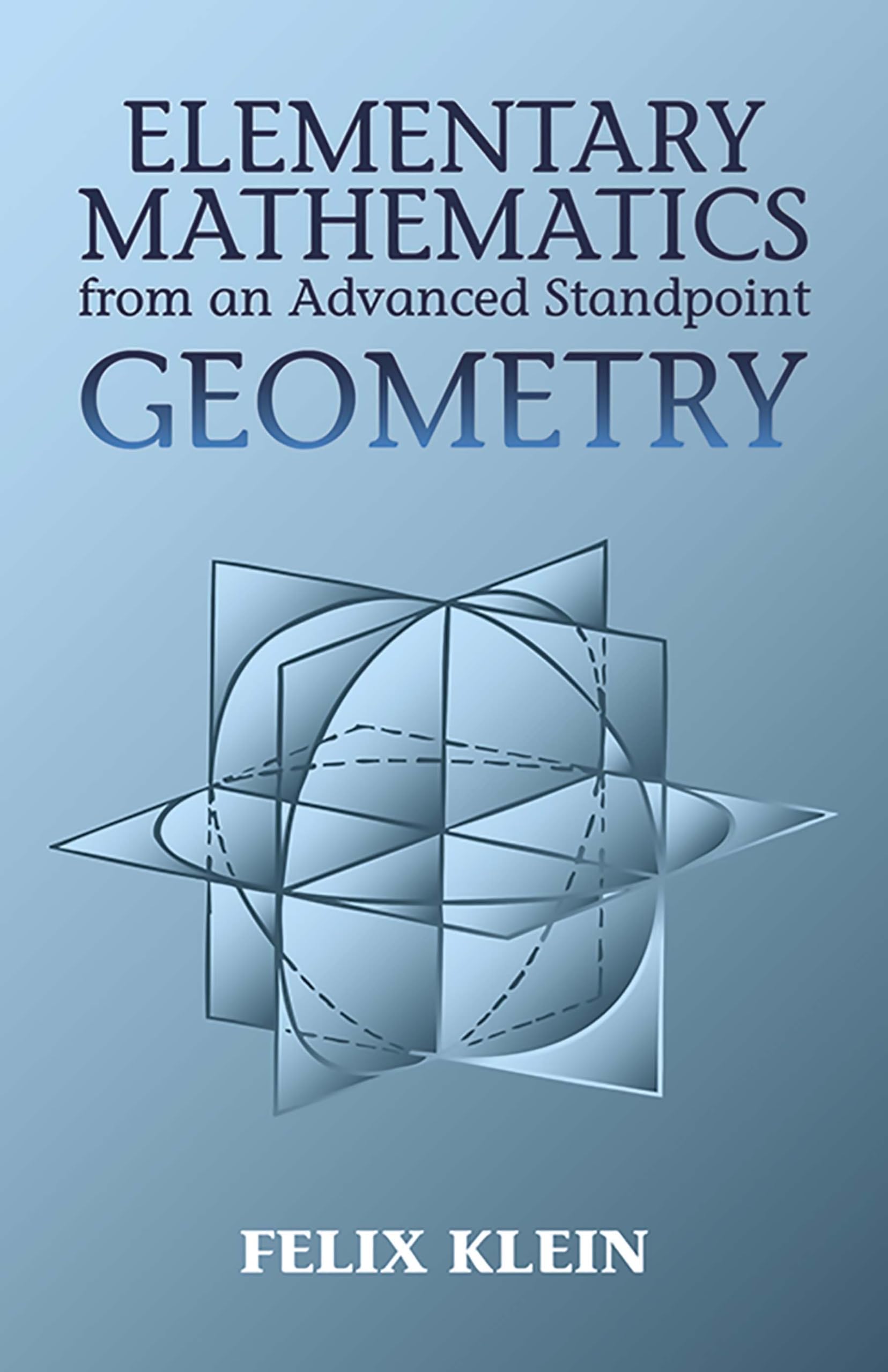
Elementary Mathematics from an Advanced Standpoint: Geometry
Buy anything from 5,000+ international stores. One checkout price. No surprise fees. Join 2M+ shoppers on Desertcart.
Desertcart purchases this item on your behalf and handles shipping, customs, and support to USA.
Description
desertcart.com: Elementary Mathematics from an Advanced Standpoint: Geometry: 9780486434810: Felix Klein: Books Review: A Classic Geometry textbook for geometry students and geometry teachers. - This is a Classic geometry textbook for geometry students and teachers. This book helps mathematicians to underestand The Erlangen Program and Felix Klein's viewing of Mathematics. Review: purchased as gift - classic math text.
Specifications
| Best Sellers Rank | #408,421 in Books ( See Top 100 in Books ) #58 in Geometry #193 in Geometry & Topology (Books) |
| Customer Reviews | 4.5 out of 5 stars 51 Reviews |
Reviews
D**S
A Classic Geometry textbook for geometry students and geometry teachers.
This is a Classic geometry textbook for geometry students and teachers. This book helps mathematicians to underestand The Erlangen Program and Felix Klein's viewing of Mathematics.
P**N
purchased as gift
classic math text.
A**S
Sadly the print quality is not good. Surprisingly the other volume (Arithmetic
It is no doubt a classic. Sadly the print quality is not good. Surprisingly the other volume (Arithmetic, Algebra, Analysis) is much better.
J**I
It's fine.
I was hoping this would be similar to "Elementary Geometry from an Advanced Standpoint" by Moise.
P**A
This book by F. Klein is well known. ...
This book by F.Klein is well known .Klein is famous for his clarity and novelty of approach.
M**N
It's a classic. What more need be said?
It's a classic. What more need be said?
A**R
Five Stars
Just thank you.
J**S
Great resource for high school math teachers with a strong mathematical background
This book (and its second volume on geometry) saved my sanity when I taught high school mathematics. Felix Klein is one of the greatest mathematicians of the 19th century, the first person to put geometry on a group-theoretical footing, which led to the geometry of modern physics. This book comes out of a course that Klein taught to high school math teachers in Germany in 1906-7. At that time, his audience would have had Ph.D.s in mathematics, and so he taught them high school mathematics from the perspective of a mathematician at the Doctoral level. The result is absolutely fascinating, and gave me so many resources for teaching math courses that would be interesting to my students and also interesting to myself. I'll give you an example. When I was 15, I asked my teacher how an expression like 2^(sqrt 2) could be well-defined. Exponentiation is well-defined for rational numbers, but how do we know that such a definition extends to all real numbers? My teacher was stumped, and I was very disappointed. It wasn't until I took a real analysis course in college and proved that the exponential function exp(x) is continuous at every real value of x (and indeed at every complex number of finite modulus as well) that I understood why 2^(sqrt 2) is well-defined. How does Klein approach the problem? He asks the student to draw the hyperbola xy = 1 on the blackboard. Then he asks the student to draw the line x = 1 on the same axes. Then he suggests using a yardstick as a slider to slide forward along the x-axis, or backwards towards x = 0, all the while noticing where the yardstick meets the graph. Then he asks the student to notice that the yardstick sweeps out area under the curve xy = 1, positive area to the right of x = 1, and negative area to the left of x = 1, Klein invites the student to consider that sweep of area to be a continuous function, zero at x = 1, negative between x = 0 and x = 1, and positive when x > 1. Klein notices that the value of that function at ab is equal to its value at a plus its value at b, and that its value at a squared is double its value at a. Klein then says that this function is invertible since it is monotonic, and that its inverse has an interesting property, that its value at ab is equal to its value at a multiplied by its value at b. He then asks the student to name the original function the natural logarithm of x, and its inverse exp(x). This demonstrates that both functions are continuous. From here, you can show that 2^x is equal to exp ((ln 2) x), and that 2^(sqrt 2) = exp ((ln 2) (sqrt 2)), and you have shown that 2^x is continuous at sqrt 2. This can obviously be made more rigorous, but it gives an easy introduction to natural logarithms and the exponential function, and I've used his demonstration in my classroom whenever I've introduced the subject since I read the book. His understanding of mathematics is so beautiful and fluid and expressive. It is a great privilege to see how he views mathematics, and share it with my students.
Common Questions
Trustpilot