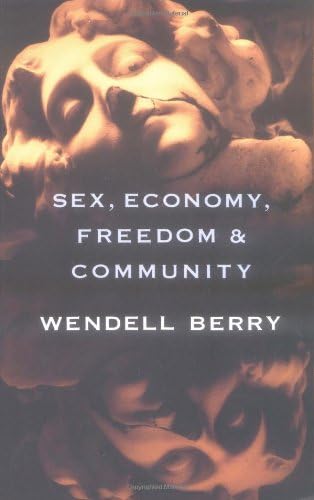
Sex, Economy, Freedom & Community: Eight Essays Paperback – January 1, 1993
Product ID: 14310806
Desertcart purchases this item on your behalf and handles shipping, customs, and support to USA.
Full description not available
J**R
A truly unique thinker
Wendell Berry is a name that has come up over and over in my reading and in discussions with other readers. Most intriguing to me was the fact that his writing -- covering topics from politics to religion to current affairs, and everything in between -- has been recommended to me by friends and acquaintances from all political and theological stripes, spanning the entire spectrum from left to right. One of the book's endorsements pointed out Berry's "unique position in American social debate: not liberal, not conservative, not libertarian, but always sharp-tongued and aglow with common sense." Sounds like my kind of writer!Berry is one of the last century's most prolific writers of poems, short stories, essays, and novels. He also taught at the University of Kentucky during the time that both of my parents attended there. Even today at the age of 75, he is an active speaker, teacher, and advocate for the ideas he has set forth in his writing.I chose for my first foray into the writing of Wendell Berry this book, which is a collection of eight essays (the last of which provides the title for the book) centered loosely around the theme of economics, though there is a diversity of themes represented in the various essays. I feel that I ought to present my review of this book on two levels: Quality and Content.The quality of Berry's writing is first-rate. I've read many books that I would classify as well-written, but there are occasional books that are a joy to read, simply because of the way an author has been gifted in the art of sculpting stories through the medium of words. This is one of those books, and Berry is one of those gifted writers. It is no wonder that people of so many different backgrounds have enjoyed his writing. I think I would enjoy reading his essays even if I disagreed with him on every point!Which brings us to content. I don't believe there could be anyone who disagrees with Berry on every point, simply because of the sheer common sense and pragmatism with which he writes. I imagine that I'd quite enjoy reading his essays even if I was in complete opposition to his conclusions, which I am not. Of course, I doubt as well that there is anyone who will completely agree with Berry, but this would please the author, who states in the foreword, "An essayist has no right to expect complete agreement but has a certain responsibility to ward it off. If you tell me, dear reader, that you agree with me completely, then I must suspect one or both of us of dishonesty."Berry is in no danger of being completely agreed with, as he is the rare individual who can be classified as truly "other" in nearly every way. As he lays out his philosophy on economics, the environment, war, religion, and any number of other things, he goes to great lengths to avoid being boxed into what he calls "political packages". He believes strongly in conserving and preserving the environment, but is not an "environmentalist". He hates war, and is highly critical of militarism, but is not what we would typically think of as a "pacifist". He is a self-described "contrarian" and "dissenter", but also a great American patriot. At every point he fairly but critically evaluates American culture as he observes it (the essays in this book were written between 1991 and 1994), while outlining his vision of what ought to be, with a practical (though not at all easy) plan for how it could be accomplished.You (and I) will have to read more of his writing to truly comprehend Berry's positions, but I'll attempt to briefly outline some of them as set forth in these essays:Strong focus on developing the community and local economyBerry writes in the tradition of the "Southern Agrarians", believing that the key to success in and joy of life is rooted in land ownership and conservation. Each person should own land, growing crops and raising livestock to support their own family. Neighbors should spend time together, supporting each other both financially (by buying/selling within their local community as much as possible) and socially (by bearing one another's burdens and encouraging one another's successes). The key to common safety and defense is good relations within the community, and between neighboring communities. He upholds the Amish as an example of a community that lives in such a way, but does not advocate separation from society-at-large as they do.There is not much hope (or use) for cities in Berry's worldview. Cities separate people from the land, and create foreign dependence and a society built on competition rather than on mutual success. He exhibits both optimism and pessimism toward the possibility of a future worldwide agrarian society (his idea of a utopia). Optimism, in that he believes that all it would take is for small, local pockets of people to begin to live in such a way, influencing first their neighborhood, then their towns, counties, states, nation, and eventually the world, as people learn to live peaceably together and to desire mutual success rather than attempting to "climb to the top" at others' expense. Pessimism, in that he does not see this as a realistic possibility, because humans are generally too selfish and greedy.Conservation of God's CreationBerry believes in the inherent goodness of God's creation, and feels that humans, as the height of creation, have an obligation to be good stewards of the land and creatures. He agrees with anti-Christian conservationists that the Church has a terrible track record of stewardship, but sees Christians as the best potential solution, not the greatest problem. We need only see that everything belongs to God and that we are to care for what He allows us to "own", extending our influence as we are able.In the only essay where Berry specifically speaks of his Christian beliefs, though, he goes too far in his high-view of Creation, bordering on worshiping creation more than the Creator. His views on Biblical interpretation seem to be somewhere between the Julius Wellhausen tradition of "higher criticism" and the deism of Thomas Jefferson. Alarmingly, he also speaks of God's Spirit residing in animals, plants, and the dust itself, which is a heterodox idea found in panentheism and the gnostic Gospel of Thomas, not Scripture.While Berry describes himself as a Protestant, his actual doctrinal beliefs (as near as I can discern from these essays) would be rejected by all but the most liberal of Christian theologians.Peaceableness toward enemiesWritten in the aftermath of the Gulf War, Berry devotes one essay in this collection to defining his philosophy of "peaceableness". He advocates applying the Biblical command to live peaceably with neighbors on a national scale. This does not imply a passive non-violence, nor aggressive anti-war protesting. Instead, it requires an "active peace", that would require as much courage and sacrifice (frequently including lives) as war. His concept of peaceableness is an outworking of his agrarian society on an international level, when nations would genuinely desire the mutual success of all others, rather than engaging in power struggles that ultimately accomplish nothing but endless cycles of destruction. Though many discount this idea as being naive or unrealistic, he rightly points out that it has rarely been attempted, and that some nations, such as Switzerland, have successfully implemented policies of peace for extended periods of time.Decreased reliance on technologyBerry is adamantly opposed to most uses of technology. He sees most technology as destructive both to the land and to our communities, because our interpersonal relationships are increasingly impersonal. He is in favor of"natural" technological advances that improve our ability to responsibly farm the land or to communicate with one another, so long as we don't become overly reliant on technology.************************************************************Overall I agree with Berry on many points. I like the idea of buying local and building a strong local economy based on mutual success and good relationships. I believe this type of economic situation (rather than Marxism/socialism as some suggest) is what is described in the New Testament (see Acts 2:42-47, 4:32-35) when believers in the early church "had all things in common". I would wonder, though, whether there might be a scenario in which this type of philosophy might be applied to the culture we see today. Is there a "middle ground" in which people rely less on technology and more on personal interaction, developing our local economy and limiting our dependence on outside (whether foreign or other domestic communities) goods, and being responsible stewards of Creation, without completely reverting to a totally agrarian society? I don't know. If it is possible, it will only happen because of the leadership of great thinkers and communicators such as Wendell Berry, though hopefully with a better grasp of God's purposes for Man as set forth in His Word. We must remember that, as much as we love God's Creation (including our fellow Man), this world is not our home. Our desire for perfect community will be found only in the Body of Christ, and will only be realized in the Heavenly Kingdom that is yet to come.
T**K
A Convicting Read
This, I think, is a difficult book to review. There are so many diverse themes throughout the book that it is hard to describe what the book is "about", and my reaction to the book was a mixture of excitement, personal conviction, and intellectual challenge. Yet, hopefully I can get something coherent down for you.The book is a collection of eight essays written by Berry, all of which deal (sometimes loosely) with the degradation of community. "Community" is a term of art for Berry; it is more than merely a group of people living in close proximity to one another who happen, from time to time, to bump into each other at the store. Rather, community is a defined group of people who live together in a particular place, over time, in a way that fosters a strong sense of togetherness. People who have this type of community have experiences together in everyday life, such as work, play, tragedy, and joy. In community of this nature there is a sense of belonging that most Americans today would not be able to relate to.Berry is not the only intellectual (a label I would guess he'd hate hear applied to himself) to suggest not only that our communities are deteriorating, but that this deterioration adversely effects the quality and essence of our lives. For a more empirical approach to the subject, see especially Bowling Alone : The Collapse and Revival of American Community by Robert Putnam. I think when Berry's book is read in light of Putnam's we see not only a picture of the problem but also a recipe for the remedy.Berry is a challenging author. He is at times very radical, and he sometimes employs demagoguery to press his point. However, when taken as a whole he approaches his topic from a position of humility and honesty. There is even a sense, after coming to grips with this humility and honesty, that Berry comes to his subject with righteous indignation. He is clearly passionate about small, rural communities like his own, and his passion easily rubs off onto the reader. After reading this book, I feel like I have a heightened sense of compassion for people who are trying to keep their communities alive.This book is probably not for everyone. I would recommend it to people who already have sympathies for the rural, self-sufficient lifestyle and those especially who have concerns for the quality of our environment (a topic that Berry hits upon numerous times). This is not to say that this book cannot change minds. However, many people who read this book from the point of view of an average modern American will dismiss Berry's ideas as utterly and hopelessly out of date. This is because Berry criticizes the way in which most of us (including himself, he admits) tend to live our lives. It takes a special intellectual state of mind to read such a book, in which you are being criticized, and keep an open mind. I hope that, if this book is for yourself, that you do keep an open mind, and allow Berry to convince you that he is right, and to show you a better way. Happy reading!
J**L
Clear and lucid thinking...how rare these days.
Every day it seems the world looks a little more broken to me. It helps so much to read a few pages of Wendell Berry. He is a fantastic example of someone who thinks for himself; and really strives to get to the core truth about the important issues we face as a civilization. It should be required reading for everyone in the United States - IF we want to get on a path to restoration and healing of our society. But that's where the scary part comes in. I'm beginning to think people would put this book down and give up on it a few pages in. Even if they did get all the way to the end, not many would be willing to put the ideas into practice in their daily lives.I picked this selection for my book club, and it was very interesting to watch the responses of the participants. You could sense the tension - watch them wiggling in their chairs. They were so relieved when we were finally done with the book; and not because it was poorly written; just because it requires an examination of how far we've all fallen from what is true. I will continue to encourage people to read this excellent and important book, but it will never be an easy sell...and that's a shame.
H**N
His love of life and community can be felt as one ...
I appreciated Berry's emphatics' on community, especially in the essay on sex. He has the ability to express difficult concepts in a "down home" fashion. His love of life and community can be felt as one reads the various essays.
K**R
Protest against globalisation.
'Sex, Economy, Freedom and Community' is the last and longest of eight essays in the book of the same title. Berry sets out a call to community which might be called `localism'. "If the word community is to mean or amount to anything, it must relate to a place (in its natural integrity) and its people. It must refer to a placed people."(168) Community for Berry involves intimacy and belonging by a people in a place. "A community identifies itself by an understood mutuality of interests. But it lives by the common virtues of trust, goodwill, forbearance, self-restraint, compassion and forgiveness."(120) True community therefore is limited to the local because of the scale demanded by mutuality and intimacy.He draws a very clear distinction between the public, and the community. Public is anonymous and subject to regulation because of the absence of mutual recognition and responsibility. Inevitably, therefore, globalisation, the industrialised economy and public sexual exploitation constantly work against community. "The triumph of the industrial economy is the fall of community." (133)Freedom cannot exist without discipline in the form of responsibility to others in relationship. Fidelity is therefore essential not only to the life and health of individual couples but also for the community. It is a form of self-discipline which frees the community. On the other hand, "Seeking to "free" sexual love from its old communal restraints, we have "freed" it also from its meaning, its responsibility and its exaltation. And we have made it more dangerous." (142)In the preface Berry indicates that the purpose of the book is to help us to refuse to buy the future as it has been packaged by politicians, scientists and educators and is being sold to us. In the first and second essays he helps us to understand the way in which local economy protects and nurtures the land, whilst globalisation and the industrial economy rapes and abuses it. The health and sustainability of social and economic practices in a locality is the basis for healthy, sustainable community. "If we could think locally, we would take far better care of things than we do now."(20) This leads into a chapter on the value of meaningful conservation which is more than the preservation of scenic places, the conservation of natural resources, or the limitation of the most flagrant abuses of industrial development.(27) "No settled family or community has ever called its home place an "environment."(35) Our connection to our locality is work, and `good work' protects the locality from the need for conservation.Chapter four is a short piece on the dangers of changing the General Agreement on Tariffs and Trade (GATT) in favour of supranational corporations. This and the following two chapters set out the violence that can be done by political and military interventions. Chapter seven sets out plainly Christianity's culpability in sharing the values of globalisation and the industrial economy and its failure to stem economic and political violence.Together the earlier chapters lay the foundation for the vision I have called 'localism', healthy, sustainable placed peoples and peopled places relating to each other in communal ways.
J**C
Five Stars
thank you ontime and ready for school.
F**R
Three Stars
fills time
Trustpilot
2 weeks ago
2 weeks ago