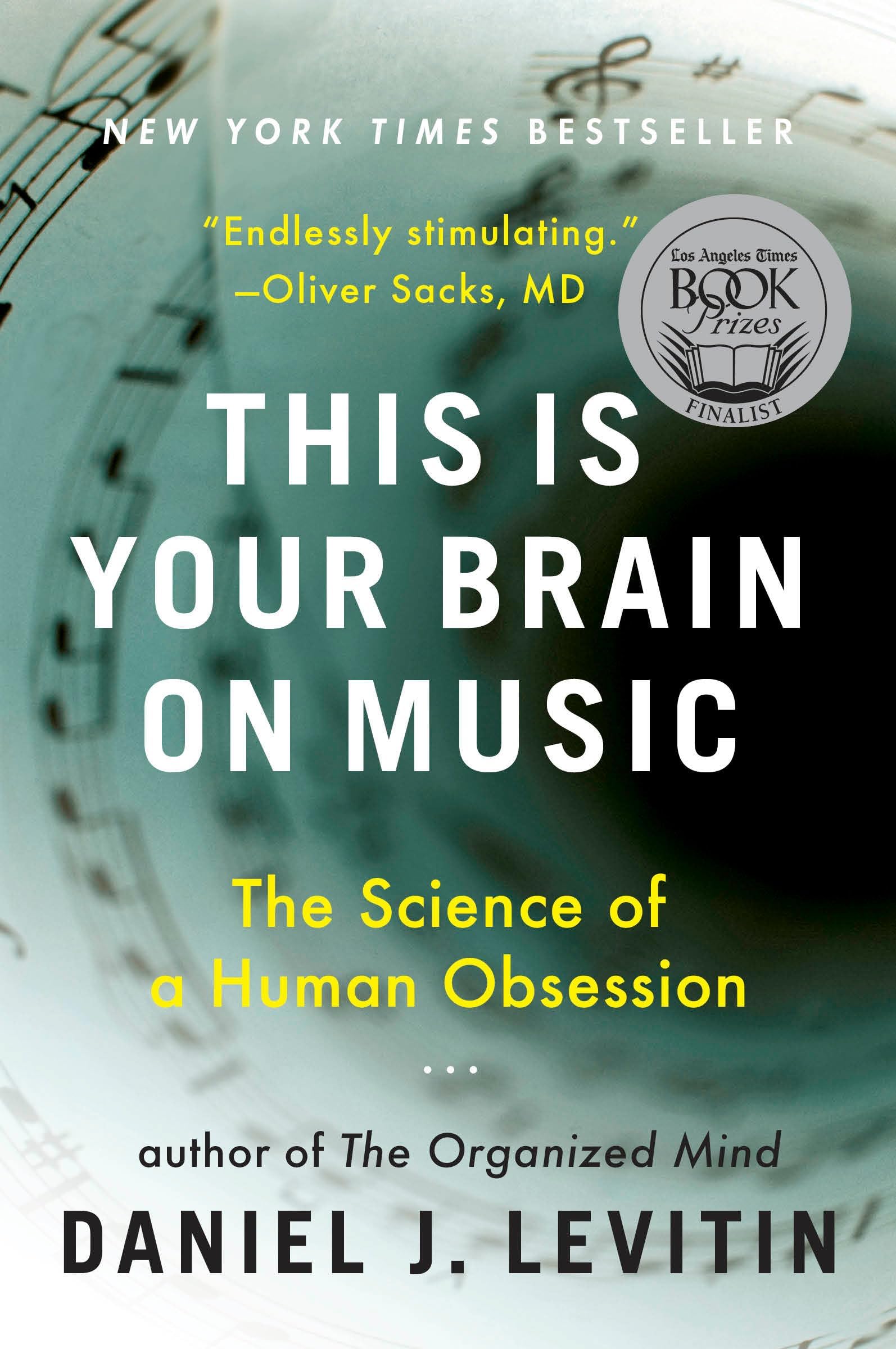
This Is Your Brain on Music: The Science of a Human Obsession
Product ID: 1223346
Desertcart purchases this item on your behalf and handles shipping, customs, and support to USA.
In this groundbreaking union of art and science, rocker-turned-neuroscientist Daniel J. Levitin explores the connection between music—its performance, its composition, how we listen to it, why we enjoy it—and the human brain. Taking on prominent thinkers who argue that music is nothing more than an evolutionary accident, Levitin poses that music is fundamental to our species, perhaps even more so than language. Drawing on the latest research and on musical examples ranging from Mozart to Duke Ellington to Van Halen, he reveals: • How composers produce some of the most pleasurable effects of listening to music by exploiting the way our brains make sense of the world • Why we are so emotionally attached to the music we listened to as teenagers, whether it was Fleetwood Mac, U2, or Dr. Dre • That practice, rather than talent, is the driving force behind musical expertise • How those insidious little jingles (called earworms) get stuck in our head A Los Angeles Times Book Award finalist, This Is Your Brain on Music will attract readers of Oliver Sacks and David Byrne, as it is an unprecedented, eye-opening investigation into an obsession at the heart of human nature. Review: An Enlightening and Entertaining Glimpse into Music Processing and Preferences - Daniel Levitin's "This Is Your Brain On Music" is a stimulating look into the way the brain processes music, from the anatomical structures that play a role in hearing and identifying music to the emotional responses that music stirs. When I ran across this book, I was really excited to read it because it combines two of my favorite subjects: music and neuroscience. What could be better? This book definitely did not disappoint. The first two chapters address the basic aspects of music, such as pitch, rhythm, tempo, contour, timbre, loudness, meter, key, melody, and harmony. As a musician, this chapter didn't tell me anything I didn't already know, and I feel that readers who are musicians can skim this chapter. The second chapter is a more in-depth look at rhythm, tempo, and meter, detailing how some beats are louder or more important than others and how notes are grouped rhythmically. The third chapter talks about the complexity of neural connections and circuits in the brain and how certain areas of the brain contribute to music processing. The fourth chapter discusses how our brains have musical expectations. When listening to certain chords in a musical work, we have an idea of what should come next. Composers who violate these expectations in just the right ways can create suspense and interest. The next couple of chapters talk about how we categorize music and how music creates an emotional experience for its listeners. Chapter seven addresses musical expertise and why some people go on to become expert musicians and others do not. Chapter eight discusses the reasoning behind our musical preferences and why we like the music we do. The book wraps up with an examination of the evolutionary basis and significance of music. Music, Emotion, and...the Cerebellum? One part of the book that I found to be really interesting was the discussion of music's remarkable ability to evoke an emotional response. Levitin explains that the cerebellum plays a crucial role in one of music's central aspects: timing. Our cerebellum helps us track the beat when listening to a piece of music. However, the cerebellum's work is not limited to musical timekeeping alone. Levitin's studies showed the cerebellum's involvement when people were asked to listen to music they like versus music they didn't like, or music that was familiar to them versus unfamiliar music. Initially, Levitin thought these results were generated by errors. However, after learning of the work of Harvard professor Jeremy Schmahmann, which showed that the cerebellum is involved in emotion and contains numerous connections to the brain's emotional centers, Levitin became extremely interested in pursuing the issue further. Using a technique called functional and effective connectivity analysis, Levitin's laboratory was able to provide evidence showing that the rewarding aspects of music listening are partly mediated by the cerebellum's contribution to regulating emotion through its connections to the frontal lobe and the limbic system. "The story of your brain on music is the story of an exquisite orchestration of brain regions, involving...regions as far apart as the cerebellum in the back of the head and the frontal lobes just behind your eyes...When we love a piece of music, it reminds us of other music we have heard, and it activates memory traces of emotional times in our lives." It is truly amazing to see that a part of the brain that was thought to perform only one major function in music processing actually performs another extremely important function, perhaps the most intriguing function in the brain's processing of music: the generation of an emotional response to music. The fact that music has the ability to evoke an array of emotions in its listeners is what makes music so special to me. I thoroughly enjoyed learning about the neurological basis for the emotions that music is so apt to conjure forth. Music Preferences: Why We Enjoy the Music We Do Why is it that I love The Eagles, but don't particularly enjoy listening to Johnny Cash? Why is it that my best friend can't get enough of country music, but hates alternative rock? These are the types of questions that I have often wondered about, and Levitin attempts to answer them in his book. One of the main questions I've been curious about is how and when music preferences are formed. For instance, if an expectant mother listens to classical music a majority of the time that she is pregnant, will her baby develop a strong preference for Mozart and Beethoven? It turns out that musical preferences are influenced, but not determined, by what we hear in the womb. Therefore, the baby referred to in the previous example may develop a liking for Mozart and Beethoven, but it may not. Levitin goes on to talk about how researchers point to the teen years as the turning point of musical preferences. "Part of the reason we remember songs from our teenage years is because those years were times of self-discovery, and...were emotionally charged; in general, we tend to remember things that have an emotional component because our amygdala and neurotransmitters act in concert to 'tag' the memories as something important." Levitin also addresses other factors that influence our music preferences, such as our personality characteristics, the degree of complexity of the music, and our past experiences (whether positive or negative) with certain types of music. Although I probably could have thought of these factors that influence music preferences on my own, the book provides an explanation as to why and how these factors influence our musical tastes, which I found to be extremely enlightening. Why You Should Read This Book As a music lover who happens to also be interested in neuroscience, "This Is Your Brain On Music" was a fabulous read. However, with Levitin's easily accessible writing style and references to well-known artists and songs, I feel that this book offers valuable and interesting insights that even someone who isn't obsessed with music and neuroscience can enjoy and comprehend. Review: Daniel Levitin and His Musical Approach to Neuroscience - Daniel J. Levitin, Professor of Psychology at McGill University and bestselling author of “The World in Six Songs” brings to the table another best seller with “This is your Brain on Music: The Science of a Human Obsession.” He brings many different viewpoints due to his experience as not only a musician in a rock band, but his time as a sound engineer and doctor as well. This book opens your mind to the science of music and how it causes the brain to react, from emotions to musical expertise. In my opinion it is a five star book because it not only allows us to see Levitin’s opinions but his research and factual data behind those opinions. Levitin begins this book with a thorough explanation of the basic components of music, for example timbre (the rhythm and frequencies that distinguishes one instrument from another) and pitch (the frequency that determines the note in the musical scale). He then introduces you to the idea of rhythm and how one can recognize a song just by the first couple of notes if they have heard it before. The brain is the next important part of the book, and provides the details you need to know in order to connect music to the brain. Levitin then touches on the importance of the ear to music as well. Here he also touches on how composers, who know how people react to certain sounds, can create music that causes a specific response in their audience. “Composers use hundreds of subtle shadings of timbre and note length to convey the many different emotional shadings of human experience.” (Levitin, 92) He later brings up two theories on why we recognize and remember songs. The first, the theory of constructivism, believes one stores everything in the mind and recalls it when needed. The “tape-recording” theory, in contrast, believes the mind remembers snippets of a musical piece and fills in the gaps along the way. In the end, Levitin connects the two to form his own theory with parts from both. He introduces two important parts of the brain, the amygdala and cerebellum, when talking about how music connects to emotions and evolutionary survival. “Music may be the activity that prepared our pre-human ancestors for speech communication and for the very cognitive, representational flexibility necessary to become humans.” (Levitin, 260) Levitin believes that talent is not enough to be good at something and that training plays an important role as well (as in the case with nature vs. nurture). Towards the end of the book, he explains that we are emotionally attached to music we hear when we are young because it is our earliest and most profound exposure during a strong period of neuroplasticity in our growing brain. Society is also important because it determines the type of music we are exposed to and the attitude we feel towards this music. The final segment of the book brings an evolutionary perspective to music and explains how it has held importance in mate selection throughout history. In human mate selection, he showed how “the combination of the two [feelings and emotions] – as best exemplified in a love song – is the best courtship display of all.” (Levitin, 267) Levitin’s book touches on many aspects of Neuroscience that I can relate to from my studies. Neuroplasticity, or growth, of dendritic spines, can happen when learning new material, for example a new song. Also, neurotransmitters are extremely important in causing responses in one’s brain. When listening to loud music your neurons would be firing in abundance causing an increase of neurotransmitters across the synaptic gap. This will lead to an increased post synaptic response. When it comes to music, two neurotransmitters are important in determining how you feel, dopamine and adrenaline. Dopamine is an excitatory effect in the pleasure center of the brain. Therefore it would make sense that it would be found in more abundance in the brain when you are listening to music you enjoy. On the other hand, when you hear music you do not like, you can blame this on the amygdala releasing adrenaline to stimulate the sympathetic system of your body (the fight response in the “fight or flight” system). The amygdala plays a part of emotion and memory. These are both important in musical enjoyment and recalling. The cerebellum on the other hand deals with the fear and pleasure responses and helps determine how you feel when listening to music. Lastly, two important parts of the brain are fundamental in music, Wernicke’s area and Broca’s area. The first has to do with processing language, or in this example understanding lyrics, while the second area has to deal with speech production, or being able to pronounce the lyrics. I feel his book started off a little boring, since it focused on a detailed explanation of musical theory, which I myself knew a lot about. Therefore, I found the introduction slow; however, it did not stay that way. The book was especially good in drawing people in who may not want to read a textbook on this material but would enjoy learning about it from a rock artist-turned-doctor. This book touches on many major aspects of neuroscience, including neurobiology, neurochemistry, psychology (Gestalt and cognitive), and empirical philosophy. It also touches on many theories, including memory theory, categorization theory, and exemplar theory. It takes these fundamental ideas and relates them back to music in a way that will interest even the most non-science people that read it. I feel this book is a fantastic addition to the literature world because it introduces us to the science of something that makes us human.


| Best Sellers Rank | #13,097 in Books ( See Top 100 in Books ) #2 in Physics of Acoustics & Sound (Books) #2 in Musical Philosophy & Social Aspects #4 in Music Encyclopedias |
| Customer Reviews | 4.5 out of 5 stars 3,059 Reviews |
E**T
An Enlightening and Entertaining Glimpse into Music Processing and Preferences
Daniel Levitin's "This Is Your Brain On Music" is a stimulating look into the way the brain processes music, from the anatomical structures that play a role in hearing and identifying music to the emotional responses that music stirs. When I ran across this book, I was really excited to read it because it combines two of my favorite subjects: music and neuroscience. What could be better? This book definitely did not disappoint. The first two chapters address the basic aspects of music, such as pitch, rhythm, tempo, contour, timbre, loudness, meter, key, melody, and harmony. As a musician, this chapter didn't tell me anything I didn't already know, and I feel that readers who are musicians can skim this chapter. The second chapter is a more in-depth look at rhythm, tempo, and meter, detailing how some beats are louder or more important than others and how notes are grouped rhythmically. The third chapter talks about the complexity of neural connections and circuits in the brain and how certain areas of the brain contribute to music processing. The fourth chapter discusses how our brains have musical expectations. When listening to certain chords in a musical work, we have an idea of what should come next. Composers who violate these expectations in just the right ways can create suspense and interest. The next couple of chapters talk about how we categorize music and how music creates an emotional experience for its listeners. Chapter seven addresses musical expertise and why some people go on to become expert musicians and others do not. Chapter eight discusses the reasoning behind our musical preferences and why we like the music we do. The book wraps up with an examination of the evolutionary basis and significance of music. Music, Emotion, and...the Cerebellum? One part of the book that I found to be really interesting was the discussion of music's remarkable ability to evoke an emotional response. Levitin explains that the cerebellum plays a crucial role in one of music's central aspects: timing. Our cerebellum helps us track the beat when listening to a piece of music. However, the cerebellum's work is not limited to musical timekeeping alone. Levitin's studies showed the cerebellum's involvement when people were asked to listen to music they like versus music they didn't like, or music that was familiar to them versus unfamiliar music. Initially, Levitin thought these results were generated by errors. However, after learning of the work of Harvard professor Jeremy Schmahmann, which showed that the cerebellum is involved in emotion and contains numerous connections to the brain's emotional centers, Levitin became extremely interested in pursuing the issue further. Using a technique called functional and effective connectivity analysis, Levitin's laboratory was able to provide evidence showing that the rewarding aspects of music listening are partly mediated by the cerebellum's contribution to regulating emotion through its connections to the frontal lobe and the limbic system. "The story of your brain on music is the story of an exquisite orchestration of brain regions, involving...regions as far apart as the cerebellum in the back of the head and the frontal lobes just behind your eyes...When we love a piece of music, it reminds us of other music we have heard, and it activates memory traces of emotional times in our lives." It is truly amazing to see that a part of the brain that was thought to perform only one major function in music processing actually performs another extremely important function, perhaps the most intriguing function in the brain's processing of music: the generation of an emotional response to music. The fact that music has the ability to evoke an array of emotions in its listeners is what makes music so special to me. I thoroughly enjoyed learning about the neurological basis for the emotions that music is so apt to conjure forth. Music Preferences: Why We Enjoy the Music We Do Why is it that I love The Eagles, but don't particularly enjoy listening to Johnny Cash? Why is it that my best friend can't get enough of country music, but hates alternative rock? These are the types of questions that I have often wondered about, and Levitin attempts to answer them in his book. One of the main questions I've been curious about is how and when music preferences are formed. For instance, if an expectant mother listens to classical music a majority of the time that she is pregnant, will her baby develop a strong preference for Mozart and Beethoven? It turns out that musical preferences are influenced, but not determined, by what we hear in the womb. Therefore, the baby referred to in the previous example may develop a liking for Mozart and Beethoven, but it may not. Levitin goes on to talk about how researchers point to the teen years as the turning point of musical preferences. "Part of the reason we remember songs from our teenage years is because those years were times of self-discovery, and...were emotionally charged; in general, we tend to remember things that have an emotional component because our amygdala and neurotransmitters act in concert to 'tag' the memories as something important." Levitin also addresses other factors that influence our music preferences, such as our personality characteristics, the degree of complexity of the music, and our past experiences (whether positive or negative) with certain types of music. Although I probably could have thought of these factors that influence music preferences on my own, the book provides an explanation as to why and how these factors influence our musical tastes, which I found to be extremely enlightening. Why You Should Read This Book As a music lover who happens to also be interested in neuroscience, "This Is Your Brain On Music" was a fabulous read. However, with Levitin's easily accessible writing style and references to well-known artists and songs, I feel that this book offers valuable and interesting insights that even someone who isn't obsessed with music and neuroscience can enjoy and comprehend.
J**E
Daniel Levitin and His Musical Approach to Neuroscience
Daniel J. Levitin, Professor of Psychology at McGill University and bestselling author of “The World in Six Songs” brings to the table another best seller with “This is your Brain on Music: The Science of a Human Obsession.” He brings many different viewpoints due to his experience as not only a musician in a rock band, but his time as a sound engineer and doctor as well. This book opens your mind to the science of music and how it causes the brain to react, from emotions to musical expertise. In my opinion it is a five star book because it not only allows us to see Levitin’s opinions but his research and factual data behind those opinions. Levitin begins this book with a thorough explanation of the basic components of music, for example timbre (the rhythm and frequencies that distinguishes one instrument from another) and pitch (the frequency that determines the note in the musical scale). He then introduces you to the idea of rhythm and how one can recognize a song just by the first couple of notes if they have heard it before. The brain is the next important part of the book, and provides the details you need to know in order to connect music to the brain. Levitin then touches on the importance of the ear to music as well. Here he also touches on how composers, who know how people react to certain sounds, can create music that causes a specific response in their audience. “Composers use hundreds of subtle shadings of timbre and note length to convey the many different emotional shadings of human experience.” (Levitin, 92) He later brings up two theories on why we recognize and remember songs. The first, the theory of constructivism, believes one stores everything in the mind and recalls it when needed. The “tape-recording” theory, in contrast, believes the mind remembers snippets of a musical piece and fills in the gaps along the way. In the end, Levitin connects the two to form his own theory with parts from both. He introduces two important parts of the brain, the amygdala and cerebellum, when talking about how music connects to emotions and evolutionary survival. “Music may be the activity that prepared our pre-human ancestors for speech communication and for the very cognitive, representational flexibility necessary to become humans.” (Levitin, 260) Levitin believes that talent is not enough to be good at something and that training plays an important role as well (as in the case with nature vs. nurture). Towards the end of the book, he explains that we are emotionally attached to music we hear when we are young because it is our earliest and most profound exposure during a strong period of neuroplasticity in our growing brain. Society is also important because it determines the type of music we are exposed to and the attitude we feel towards this music. The final segment of the book brings an evolutionary perspective to music and explains how it has held importance in mate selection throughout history. In human mate selection, he showed how “the combination of the two [feelings and emotions] – as best exemplified in a love song – is the best courtship display of all.” (Levitin, 267) Levitin’s book touches on many aspects of Neuroscience that I can relate to from my studies. Neuroplasticity, or growth, of dendritic spines, can happen when learning new material, for example a new song. Also, neurotransmitters are extremely important in causing responses in one’s brain. When listening to loud music your neurons would be firing in abundance causing an increase of neurotransmitters across the synaptic gap. This will lead to an increased post synaptic response. When it comes to music, two neurotransmitters are important in determining how you feel, dopamine and adrenaline. Dopamine is an excitatory effect in the pleasure center of the brain. Therefore it would make sense that it would be found in more abundance in the brain when you are listening to music you enjoy. On the other hand, when you hear music you do not like, you can blame this on the amygdala releasing adrenaline to stimulate the sympathetic system of your body (the fight response in the “fight or flight” system). The amygdala plays a part of emotion and memory. These are both important in musical enjoyment and recalling. The cerebellum on the other hand deals with the fear and pleasure responses and helps determine how you feel when listening to music. Lastly, two important parts of the brain are fundamental in music, Wernicke’s area and Broca’s area. The first has to do with processing language, or in this example understanding lyrics, while the second area has to deal with speech production, or being able to pronounce the lyrics. I feel his book started off a little boring, since it focused on a detailed explanation of musical theory, which I myself knew a lot about. Therefore, I found the introduction slow; however, it did not stay that way. The book was especially good in drawing people in who may not want to read a textbook on this material but would enjoy learning about it from a rock artist-turned-doctor. This book touches on many major aspects of neuroscience, including neurobiology, neurochemistry, psychology (Gestalt and cognitive), and empirical philosophy. It also touches on many theories, including memory theory, categorization theory, and exemplar theory. It takes these fundamental ideas and relates them back to music in a way that will interest even the most non-science people that read it. I feel this book is a fantastic addition to the literature world because it introduces us to the science of something that makes us human.
J**R
A Musician's View on a Neuro-Musical Book
Summary Daniel J. Levitin's "This is Your Brain on Music: The Science of a Human Obsession" is an interesting read that exposes how the brain processes music. Levitin employs a variety of musical selections throughout his book and utilizes them to illustrate how different parts of the brain interact to produce what we interpret as music. As Levitin says, "music is organized sound," and he tries to expose the inner workings of this theory in his book. Book Organization The book is organized into nine chapters with an introduction, two appendices, and an index. The first chapter, titled "What Is Music?," provides a basis for understanding music on a theory level. Definitions are heavily utilized in this section. The subsequent chapters deal with rhythm, processing music, anticipation, categorization, musical emotion, and musical instincts. The first appendix contains an image of the brain with labeled structures involved in hearing and music processing. The second appendix has extra detail on harmony and chords. The index is very detailed and helpful. Synopsis "Brain on Music" focuses heavily on relating music theory to how our brain works. Why do we like different kinds of music? Why is music even a part of our lives? How do we distinguish between different voices and instruments? Levitin uses a variety of musical references to answer these questions: Bach, The Beatles, Mozart, Led Zeppelin, Ludacris. Levitin begins the book by providing a general set of musical terms for reference: pitch, tempo, rhythm, timbre. These terms set the stage for the rest of Levitin's book. The subsequent chapters (chapters two through nine) address rhythm, the brain, anticipation, categorization, emotion and music, musical expertise, taste in music, and musical instinct respectively. Levitin infuses these chapters with personal anecdotes and different scientific and psychological studies. Introduction: Levitin begins his book with an explanation of his history and interaction with music and what continues to drive him in his research today. He also explains the structure of the remainder of the book. Chapter 1: What is Music? Here, Levitin defines pitch, rhythm, tempo, contour, timbre, loudness, and reverberation as well as higher order concepts such as melody, harmony, meter, and key. This chapter sets an informational basis for the rest of the book. Chapter 2: Foot Tapping Levitin more specifically defines and discusses rhythm, tempo, and meter. This is the point in the book at which Levitin presents the idea that music and sound are not real; rather it is all part of our perception. Chapter 3: Behind the Curtain This chapter focuses on the differences between the mind and the brain and the physiological basis behind the processing of sound. Chapter 4: Anticipation Levitin frames the idea that anticipation and expectations are what drive us to be intrigued by music. Those songs which surprise us intrigue us the most, but too much intrigue can turn us off to a song. Chapter 5: You Know My Name, Look Up the Number Levitin proposes two theories of memory: (1) that we retain all of the details of an event and (2) that we have relational memory. He explains how both are technically wrong and that we rely on a series of cues to trigger a musical memory. Chapter 6: After Dessert, Crick Was Still Four Seats Away from Me This chapter discusses the connection between music and emotion and its relation to the reptilian brain. Chapter 7: What Makes a Musician? Levitin suggests that genetic predisposition, such as having larger hands, plays an important role in giving musicians an edge over non-musicians. He further explains that other factors may play a part: patience, emotion, and creativity. Chapter 8: My Favorite Things This chapter delves into answering why we like the music that we do. Levitin proposes that a large part of our taste in music comes from environmental influences including the culture that we are raised in. Chapter 9: The Music Instinct This chapter, potentially one of the most interesting in the book, examines how music, once used in mating calls as a tool for survival, has evolved into a source of entertainment. For Neuroscience Enthusiasts This book is not nearly as neuroscience-heavy as I expected it to be. There is little in the way of pure neuroscience. A lot of the studies utilized throughout the book are neuropsychology studies whose neurological mechanisms are not understood very well. Though the methods of how we interpret and find meaning in music are not clearly addressed, there is an excellent explanation of the anatomy and physiology of the ear and how it works. The concept of timbre, also known as tone color or tone quality, is extremely well explained and is one of the most interesting topics of the book. Opinion As a musician, I did not find much value with this book, but looking at Levitin's work through the eyes of a non-musician, I can see the value that it would have to understanding music in a broad sense. The most valuable and interesting part of the book that I found was understanding how timbre and overtones work. The material I was most interested in learning at the outset did not have great scientific support in the book: why we like the music we like and why music even came to be in the first place. Levitin's literary solution to these questions was based heavily on psychology and predictions, and it fell very flat. Many of Levitin's references were very old-school, so young neuroscientists and those interested in pursuing a career in auditory neuroscience may not be able to quickly grasp and understand his musical references which ultimately set the framework for his book. Recommendation For non-musicians who wish to learn more about music theory and the scientific basis behind it, this is an excellent read. However, for those who consider themselves skilled musicians (singers, instrument players, conductors, etc.), this book could have a two-toned effect. If you're looking for a general overview, I highly recommend it. However, if you're looking for a heavy neuroscience background, I would not simply because it seems that Levitin's ultimate goal was to provide a broad overview with a spattering of neuroscience.
J**E
Why music rocks your brain.
For those of you trying to understand brain injuries there is a fascinating book which I think is a must read, especially if you happen to have a situation with any hearing issues or auditory centers processing problems. Even if you just love music it is a great read. I think the concepts would help explain any brain injury case to a jury. The book explains the complexity of the neural connections and the systems involved in our perception and understanding of musical sounds which really are nothing but air molecules vibrating on our ear drum which is trasmitted as a signal by the auditory nerves. The incredible brain takes it from there and makes sense of the rhythms, the notes, the tones, etc. There is no sound in the forest when a tree falls unless someone is there to hear it. Almost every part of the brain is involved in auditory processing and the book explains this very well and in a way that could be used to explain this marvelous system to jury. The author asks a lot of interesting questions; why do we like some songs and not others?, why do we sometimes get a song in our head that we can't stop humming?, why do songs affect our emotions so easily? He makes a clear distinction between the mind (thoughts, feelings, emotions, sense of me) from the organic brain itself (axons, neurons, lobes, fluid, blood vessels, arteries) and explains how neuroscientists use imaging studies to map these different areas. So while we make great efforts in court to prove that the brain is damaged by trauma, it is really the mind of the victim that is affected in its functioning. Pain fibers, music fibers, thought fibers are all interconnected. So a pain sensing neuron may be directly connected to a neuron that processes emotions. So, damage to either is damage to the entire link. This can help explain why pain can change the emotions of a person and cause anxiety and depression organically. The author is Daniel J. Levitin who is both a rock and roller and a cognitive neuroscientist. He even uses the phrase "reptilian" brain in explaining how music affects our primitive selves. He explains why in some cultures musical sounds mean different things to a person than they may mean to a person from another culture. He gives a very good description of how the brain processes information from the bottom (brain stem - reptilian) to the top (frontal lobe) and from the top down in a continuing processes that making sense of and adds the meaning to our sensory inputs, and sometimes makes mistakes while doing so. I am only half way through this read, hope I get to bed by midnight. Jim Law Offices of James Parziale, APC Established 1972 James Parziale, JD. Trial Lawyers College 2001 2140-4th Ave. San Diego, Calif. 619-231-2700 [...]
M**E
A great read if you enjoy music and/or neuroscience too
I had chosen this book for an evolution class based on my own interest and how my own interest ties with evolution so as a musician and as someone who currently plans to pursue a path in neuroscience I couldn’t have found a better book to read. I have read roughly a little more than ¾ of the book so far and the way the author presents the information, whether on the features & structure of music or discussing in depth the neuroscience and/or cognitive neuroscience of the brain and its connection to music, I found myself not wanting to put the book down whenever I started a chapter. Even when he discussed the features of music like tempo, rhythm, melody, timbre and etc , features that I was already familiar with from the musical training I received, I still was able to learn new things & perspectives on those topics. Once I began to reach the chapters in where he ties music with cognitive neuroscience and discusses his own journey from being a musician & producer to a neuroscientist that started to investigate music from the scientific view, it had truly made me feel that my own interest in how music affects the brain was significant and inspired me to dive deeper into it. It has also helped me with my senior research project, giving me insight on how to approach researching this field. In short, I'm glad that I am able to read a book that shares both of my interests, present it extremely well, and learn from it but also that the author took the time to share his unique perspective on it. So I would recommend anyone who enjoys music and neuroscience or even if it's just one or the other, to take the time to read this book and you won’t regret it.
O**N
Producer of pop music and a professor? Does not happen very often, I guess.
I like to start my reviews while I am still reading the books. Not exactly, actually. I read first the 'bad review' since it has been written by someone not influenced by the author and urged to declare his/her book a work of a genius. In this case the one star review is bit technical for me - written by a professional musician. So far, so good. At the beginning the author, however presents music as something bit static. It is not, obviously. I remember how a younger NYU colleague claimed Beatles were as good as Mozart and, at that time, Beatles were for me just guys with a lot of hair singing sometimes about getting high on LSD or something. Almost fifty years later, McCartney is a kind of UK nobleman and I do not have to mention the fate of the other Beatles as they split. The bottom line: music is a highly individual stuff and even small difference in age, combined with some cultural differences, can decide between its perception as a noise or enjoyable sounds. I am just reading about the geographical differences - they are, in my opinion, not surmountable. Making progress through the book. One longish chapter is devoted to the basics of music - staff quite well known for centuries, starting, perhaps with J.S. Bach who apparently created the 'well tempered clavier' and thus West European tonality. Interesting but a very, very old stuff. Useful somewhat to musicians but not to the listeners of music. Although amateur orchestras are usually not properly tuned as the professional once and I used to hear the difference before I became almost deaf... The next chapter deals with the complex matter of our brain in correlation to our mind. Fairly good exposure of current hypotheses about that, nobody really knows anything. For instance: do any mammals like music? Apparently, some birds do. That is, of course, not a story to be covered in this book. The REAL stuff the author contribution as a scientist starts about 30% in the book. In my opinion, before we can start study of uniquely human (among mammals) aptitude for music, we should understand more fundamental issues by studying other mammals, mostly the primates. The author mentions that he could not become a researcher along this line because, in a very recent past, the animals had to be killed and their brain tissues studied. He mentions however, non-lethal real time methods like EEG and fMRA, the second one quite recent application of imaging the brain without damaging it. Is this kind of research performed on primates? I do not know and, so far, the book does not say. I stay with 3 stars since some original research is presented here. One has to start somewhere although a non-lethal study of primates seems to me more appropriate than a jump to study of humans. I was unable to finish the book. The author presents lots of interesting details but, finally, I decided that I am not that interested in his field of research. Recommended to more patient and inquiring minds than I posses.
L**A
A fine, readable intro to music and the brain.
This is sn excellent, well-written book on a topic that deserves more attention—the interaction between human brains and music, as informed by science. This is the most current book on this topic as I write. The second-most-recent book is 20 years older, and at the present rate of advance in brain science, that is a long time. Other reviewers have complained that the author drops too many names. I disagree. His first career, before he went back to school and got his Ph.D, was as a recording engineer. It is not name-dropping when you know famed singer-songwriter Joni Mitchell on a first-name basis, have discussed musical details of recording her while doing it, and then have later interviewed her about relevant topics in this book. This is by no means the only such useful example this unusual writer provides. The book does have an uneven feel to it in some spots, because it slows down to take you, like a fly on the wall, to unexpected places, but these are worth going to. I happen to know the science of some of what Levitin discusses, as I worked in computer speech recognition for five years, built two labs, and have a couple of published papers from that work. On what I know, Levitin is spot-on accurate. He also provides thorough notes and references if you want to dig deeper. But he also is a very good explainer, which I really appreciated when he discussed music. All in all this is a fine introduction. If it has any weakness, it is that he does not try to organize and categorize as much as he could have, but he WILL keep you reading!
E**I
organized words
"Endlessly Stimulating," sez Oliver Sacks on the cover blurb. He's right. Anyone who's gone from "I like that song" to "Why do I like that song?" will want to read this book. Daniel J. Levitin describes what EEGs, fMRIs and the like can tell us about what areas of the brain light up when music is played. It turns out to be a lot like the areas where language lights up, which somewhat supports his speculation that our tastes in music are wired at about the same age we acquire mastery of language (preteen). Right now precision neuron-firing can't be determined, so it follows that there's no meaningful tracing of musical tastes over the course of a lifetime. But greater precision will come, and Levitin offers a testable hypothesis that explains why we always know so knowingly that music we grew up with. There's also a lot of info about musical aptitude, including why some people opt for this or that instrument. He also reveals that most people have "perfect pitch" and that it is memory based, not a divine gift. By "reveals," I mean that he makes points and then cites behavioral and neurological studies which back up his points. There are no end or footnotes, but the chapter notes at the back of the book provide thorough documentation. Some of this book is dry--I skipped pages 18-41, a mini-music theory explanation of scales, intervals, chords. I understand Levitin's belief that readers need to know this stuff to follow his argument, but they don't. Levitin weakens his conclusion by splitting some of his arguments and veering off to attack perceived opponents (yeah, Pinker, how do you account for all Mick Jagger's love babies?), but TIYBOM does a great job of balancing musical value judgements with what is known about the brain. I wish every music reviewer would read this book. Some other amazon reviewers have slammed Levitin for ignorance about this or that musical style. All the points he makes about pieces I know--classical, jazz, 60s rock--seem right on the money. Looking back over this review, I haven't done the guy justice. Levitin's experience in the business makes this book shine over all others.
C**A
Kaft beschadigd
Besteld als kerstcadeau voor mijn zoon, snel geleverd en gelukkig voorradig. Helaas blijkt er een scheurtje in de kaft te zitten. Ik laat het aan mijn zoon of hij wil dat ik hem retour stuur. Wel jammer dat het boek niet extra verpakt is voordat het in de envelop gedaan is. Dat had misschien het scheuren kunnen voorkomen, het lijkt erop dat deze bij het verpakken is blijven hangen.
R**A
Extraordinaria lectura
Un libro muy claro y didáctico, al mismo tiempo que profundo y científico sobre lo que la música le hace a nuestro cerebro y por qué ésta es tan importante en la vida y evolución del hombre.
S**A
Interesting book
Bought for a gift for a music student , was well received
J**F
A Must Read. For Sure!
Incredible book,very similar to Oliver Sacks’s Musicophilia but surprisingly this one's better. Puts forward a fascinating and at times staggering piece of the puzzle,that in the end is part of the fabric of reality. But it's an easy and very enjoyable read. Really is A must read.
D**E
Libro illuminante, d'ispirazione.
L'esplorazione del nostro cervello musicale espressa in termini comprensibili anche ai non addetti ai lavori. Daniel Levitin scrive in maniera brillante e accattivante.
Trustpilot
2 weeks ago
2 months ago