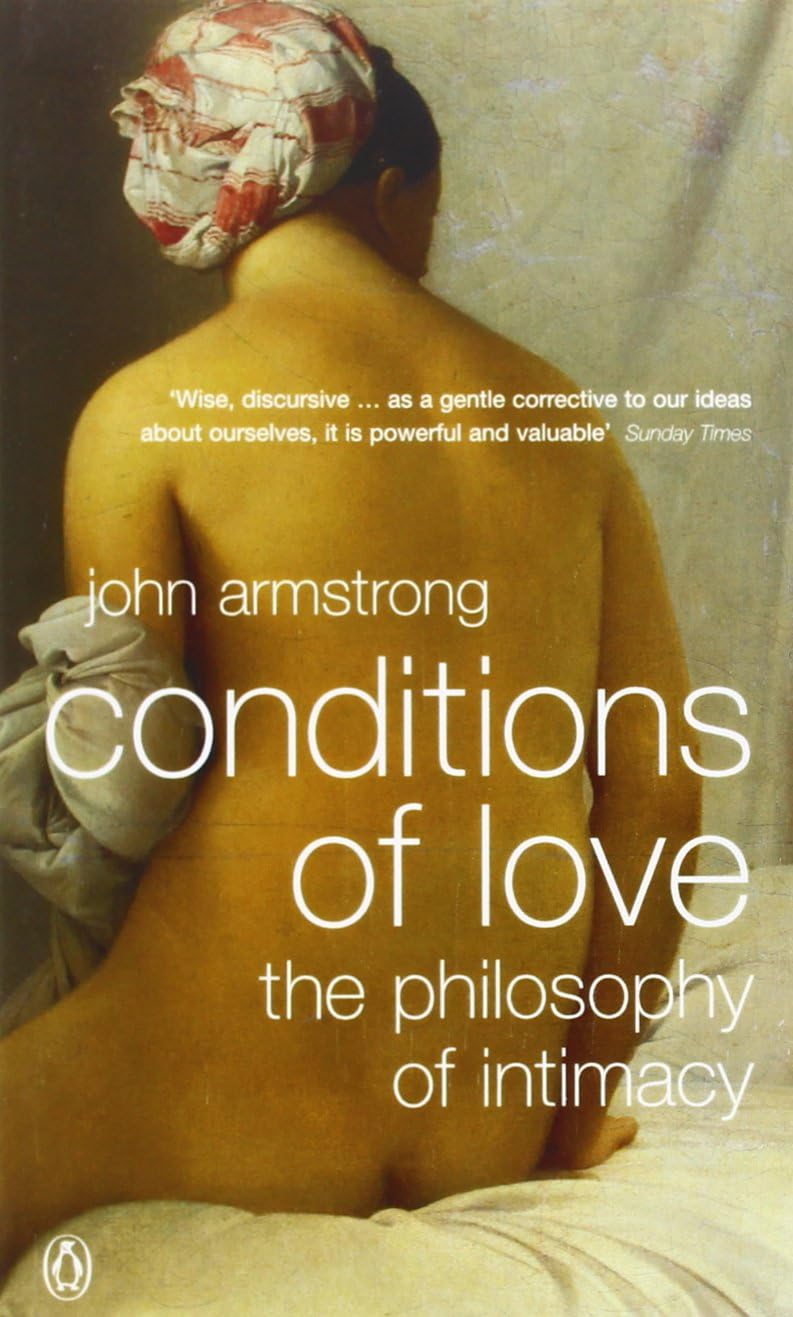
Conditions of Love: The Philosophy of Intimacy
Product ID: 94003256
Desertcart purchases this item on your behalf and handles shipping, customs, and support to USA.
Raises one of the deepest and most puzzling questions we can put to ourselves ' What is Love?' Drawing on writers and thinkers as diverse as Plato, Tolstoy, Freud and Stendhal, John Armstrong explores how our perception of love is formed by culture and history. For anyone who believes or disbelieves in love. Review: A well analytical book on love - I first read this book in a library. then I ordered a copy for myself. It is one of those books which take you to the depths of intricacies of love and intimacy. It takes a great understanding 'to love'. Love is not straight, it has hidden curves, ups and downs, challenges, temptations....and so much more. Everyone should put some sincere efforts in understanding this phenomena which is capable of making our life hell or heaven. author also gave various examples to illustrate nuanced facets of love. A must buy! Review: Very wise! - This book is profoundly wise and very well written and I highly recommend it above any of the other "psycho-babble" books filling the self-help shelves of book stores. This book is well worth reading more than once.
| Best Sellers Rank | #130,851 in Books ( See Top 100 in Books ) #9,429 in Personal Transformation |
| Customer Reviews | 4.7 out of 5 stars 65 Reviews |
A**D
A well analytical book on love
I first read this book in a library. then I ordered a copy for myself. It is one of those books which take you to the depths of intricacies of love and intimacy. It takes a great understanding 'to love'. Love is not straight, it has hidden curves, ups and downs, challenges, temptations....and so much more. Everyone should put some sincere efforts in understanding this phenomena which is capable of making our life hell or heaven. author also gave various examples to illustrate nuanced facets of love. A must buy!
C**N
Very wise!
This book is profoundly wise and very well written and I highly recommend it above any of the other "psycho-babble" books filling the self-help shelves of book stores. This book is well worth reading more than once.
N**N
Easy to read and educative
I am puzzled by one of the negative reviews of this book: Armstrong does deal with jealousy, approaching it from an evolutionary psychological perspective; he does cross reference; his bibliography includes some of the most notable books written on love; and if he refers to 'females', at least he is consistent by referring to 'males' too. True, he doesn't cite texts on love written by women, and that is a shortcoming, but this lack certainly does not lead to a one-sidedness in his discussion of love. You may not be satisfied with what he says about all or some of these things, but at least do him the small honour of giving an accurate account of what the book contains. I liked this book. I thought Armstrong did a good job of showing how our idea of love has evolved over the millennia, how revolutionary ideas such as evolution, Marxism and psychoanalysis have left indelible marks on our idea of what love is, enriching the concept while also making it increasingly more complex. All of this is done in a comprehensible language, with a logical structure, and easily manageable and sensibly divided chapters. Armstrong's argument seems to be that there is no essence of love, and that to go in search of a hard and fast definition is doomed from the start and based on an error of thinking. Love is not any one thing, but a host of related things which are neither identical with each other nor legitimately reducible to something held in common. He shows the many aspects of love: friendly, parental, childish, long-term, passionate, unrequited, and so on. You are left ultimately with an impression of the complexity of the notion and the futility of the attempt to reduce it to one simple thing, an endeavour which the question 'What is love?' all too irresistibly invites.
B**R
Remarkably wise
The critic from "Publishers Weekly" quoted above must have been having a bad day when he or she read this book. Generally, that review manages to miss the point. Armstrong doesn't "critique" Socrates or Stendahl, etc.; he uses them to interrogate our experience of love and finds the kernel of truth they each captured, while also synthesizing these (and many other) perspectives into a coherent picture. There is nothing murky here, and certainly no failure to think through the positions. I'm a pretty fierce critic myself, and the clarity and coherence of this book seem to me to pass muster. I picked this up while canvassing possible resources for my students in an advanced applied ethics course, hoping it would help with a section on sexuality. For that, it isn't to the point-that's not really the topic of the book. But I'm glad I found it, and I'll be recommending it to students and friends alike as a source of wisdom about love. The question Armstrong sets himself is, What makes it possible for people to love each other, over the long haul, in satisfying ways? "Falling in love" rarely lasts, as we all know-the heat of early romance fades when faced with broader realities. Armstrong points out that modeling love on this transient incandescence means we simply cannot understand how to love-when we try to see enduring love as some sort of dilute form of romantic intoxication, we are trying to make it something it is not. I don't know of another book that casts such a broad net in considering love. Armstrong understands, as almost no contemporary psychologists or therapists do, the history of human efforts to understand love. Thus, he includes in his thinking experiences, problems, and insights that escape the blinkered views of contemporary ideologies. A fair number of Greeks, for instance, had some interesting thoughts about love and its place in individual lives and in human relationships. As I've already mentioned, Armstrong sets these many experiences and insights side-by-side, uses them to interrogate our experience, and takes from each some guidance on his question. He thus unites his broad understanding of our history with contemporary psychology and sociobiology to produce a remarkably complex, nuanced account. Yet the writing is clear, simple, and engaging. To synthesize so much diverse, often-subtle material into a complex and sophisticated account, then to write in a style that seems effortless-quite an accomplishment. This could have been called "Love's Little Instruction Book for the Highly Intelligent." Devoid of smarm, rich in compassion, and informed by the best that has been thought or said on the subject across human history-well, it won't be jumping off the racks of the check-out line a Wally World, but it ought to have a honored place on the shelves of every well-educated person.
J**H
A beautiful book
Stress help this book defining understanding of love. and many more on the subject. you will be off for having done so
L**N
Very good!
It is a very interesting book. The condition of the book is very good.
Trustpilot
3 weeks ago
2 days ago