
Buy anything from 5,000+ international stores. One checkout price. No surprise fees. Join 2M+ shoppers on Desertcart.
Desertcart purchases this item on your behalf and handles shipping, customs, and support to USA.
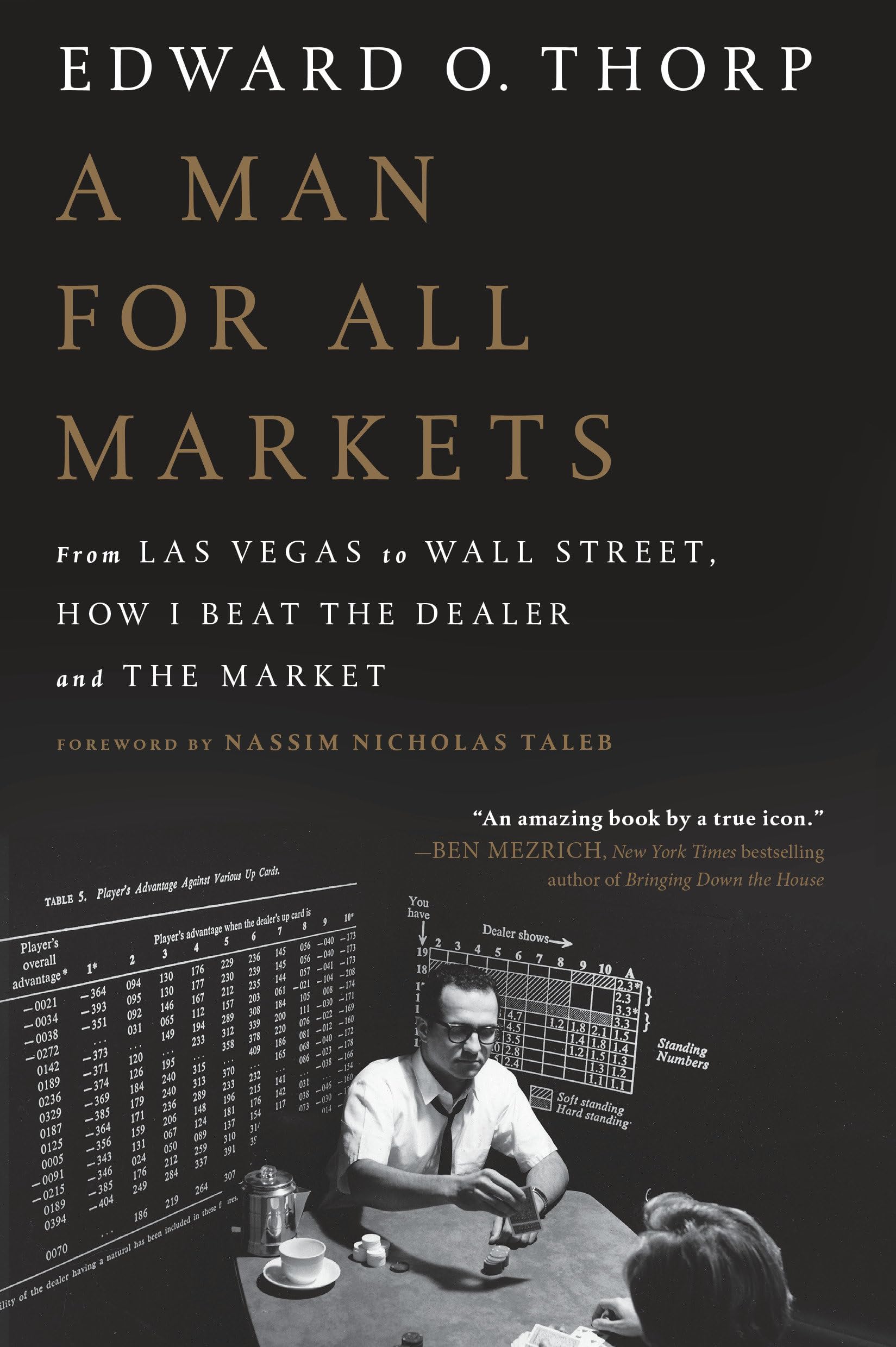
The incredible true story of the card-counting mathematics professor who taught the world how to beat the dealer and, as the first of the great quantitative investors, ushered in a revolution on Wall Street. A child of the Great Depression, legendary mathematician Edward O. Thorp invented card counting, proving the seemingly impossible: that you could beat the dealer at the blackjack table. As a result he launched a gambling renaissance. His remarkable success—and mathematically unassailable method—caused such an uproar that casinos altered the rules of the game to thwart him and the legions he inspired. They barred him from their premises, even put his life in jeopardy. Nonetheless, gambling was forever changed. Thereafter, Thorp shifted his sights to “the biggest casino in the world”: Wall Street. Devising and then deploying mathematical formulas to beat the market, Thorp ushered in the era of quantitative finance we live in today. Along the way, the so-called godfather of the quants played bridge with Warren Buffett, crossed swords with a young Rudy Giuliani, detected the Bernie Madoff scheme, and, to beat the game of roulette, invented, with Claude Shannon, the world’s first wearable computer. Here, for the first time, Thorp tells the story of what he did, how he did it, his passions and motivations, and the curiosity that has always driven him to disregard conventional wisdom and devise game-changing solutions to seemingly insoluble problems. An intellectual thrill ride, replete with practical wisdom that can guide us all in uncertain financial waters, A Man for All Markets is an instant classic—a book that challenges its readers to think logically about a seemingly irrational world. Praise for A Man for All Markets “In A Man for All Markets , [Thorp] delightfully recounts his progress (if that is the word) from college teacher to gambler to hedge-fund manager. Along the way we learn important lessons about the functioning of markets and the logic of investment.” — The Wall Street Journal “[Thorp] gives a biological summation (think Richard Feynman’s Surely You’re Joking, Mr. Feynman! ) of his quest to prove the aphorism ‘the house always wins’ is flawed. . . . Illuminating for the mathematically inclined, and cautionary for would-be gamblers and day traders” — Library Journal Review: Extraordinary - “A Man for All Markets” is at its core a captivating memoir on how Professor Thorp managed to acquire a fortune estimated at around $800-million. It’s dense, it’s detailed, it’s engagingly written, it’s a lot of fun to read and it’s full of valuable information. I would love to have read the chapters on markets some years ago when I was an active trader. I’d have made a lot more money! How did he do it? “Education,” he explains in a later chapter. He either taught himself or he learned from others. Indeed Chapter 1 is entitled “Loving to Learn.” He began as a poor boy in Lomita, California delivering newspapers in the morning and in the afternoon. He got into UCLA and graduated with a degree in physics and then went on to grad school to study mathematics. He became fascinated with challenges, most famously with the gambling card game, blackjack or twenty-one. He devised a point count system that, coupled with his ability to remember cards, allowed him to beat the casinos at their own game. And then he wrote a bestselling book, “Beat the Dealer” showing others how it could be done. I read that book when it came out in the early Sixties and was fascinated. Because my memory is only average I ended up playing poker instead of blackjack--but that’s another story. Following up on his success at twenty-one, Thorp, along with Claude Shannon, designed and built a mechanical and electrical device that allowed them to gain an advantage in roulette by predicting with some proficiency approximately where the bouncing ball would end up. That was quite a coup especially considering that it happened fifty-some years ago. This takes us through the first ten chapters. Then in Chapter 11: “Wall Street: The Greatest Casino on Earth” Thorp turns his attention to the financial markets. The titles of the next 14 chapters not only outline the story but could serve as something like a syllabus for a graduate course in investing. Viz., “Front-Running, The Quantitative Revolution, Swindles and Hazards, Buying Low, Selling High, Hedging Your Bets, Compound Growth, Beat Most Investors by Indexing, Asset Allocation and Wealth Management, etc.” There’s an illuminating chapter on financial crises and lessons not learned. Thorp concludes with Chapter 30 “Thoughts,” which I found fascinating. There are also five appendices, three on inflation and the dollar, historical returns, and the performance of his fantastically successful hedge fund, Princeton Newport Partners. I think it is important in accounting for Thorp’s extraordinary success to realize that he was very good with people and formed valuable friendships with knowledgeable and gifted persons including the afore-mentioned Claude Shannon, Warren Buffet and others. Additionally, his curiosity and love of challenges took him places others couldn’t go. Finally, there was the loving support of his very talented wife, Vivian. If I were giving out advice on how to be successful in this world I would say first pick your spouse wisely. Also, Thorp was thrifty. On page 86 we learn that when he was playing blackjack in Las Vegas he would call his wife collect and to save money would ask for “’Edward __ Thorp,’ the middle initial being a code we had devised to tell how many thousands of dollars we were ahead or, if the initial came before ‘Edward,’ how many behind…” “After hearing the name of the person being called, Vivian would politely tell the operator that Mr. Thorp ‘wasn’t here at the moment.’” I think it is a good lesson to understand that not only is a penny saved a penny earned but it’s worth more than that because what’s saved is untaxed and the money can be invested. Thorp elaborates on the value of thrift in building wealth elsewhere in the book especially on page 269. I want to say that I have a personal affinity for both this book and its author because of some similarities in the lives we have led. For those interested see my recently published memoir “If I Had Been a Better Man.” Okay now for some tidbits from the amazing professor of gambling and markets. “Joseph Heller and Kurt Vonnegut were at a party given by a billionaire…Vonnegut asked Heller how it felt to know that their host might have made more money in one day than Heller’s “Catch-22” since it was written.” Heller replied that “he had something the rich man could never have.” Vonnegut wondered what that might be, and Heller answered, “The knowledge that I’ve got enough.” (p. 213) Thorp actually discovered in 1991 that Bernie Madoff’s trades were fakes and that he was running a Ponzi scheme. See pages 213-219. A joke: “…pronounced MADE-off, as in “with your money.” (p. 217) If you haven’t heard of the so-called “secretary/marriage problem” in math turn to page 224. The problem is when to say yes to get the best candidate. Once you say no you usually don’t get another chance and you may find the remaining candidates not as good. On the other hand, if you say yes too soon you might miss the best choice. Thorp’s answer to high frequency trading: “a small federal tax…a few cents a share…” (p. 231) On the crisis in funding for the California university system: “To starve education is to eat our seed corn. No tax today, no technology tomorrow.” (p. 341) --Dennis Littrell, author of “The World Is Not as We Think It Is” Review: Good reading material - Read full summary of this book on my blog: imeducatingmyself.com/a-man-for-all-markets-from-las-vegas-to-wall-street-how-i-beat-the-dealer-and-the-market-by-edward-o-thorp-book-review The life of the Edward was quite interesting, and full of ups and downs – but in the end it turn out be everything good. I really enjoyed reading this book, it does contain a lot of useful material which we can apply to our lives. I bought this book because was interested to learn about Edward’s investing strategy. And there are useful material when it comes to investing, but it’s not for absolute beginners. If you don’t know anything about investing, than you might find this book a bit confusing. I like how he played the both sides of investing; buying and shorting stocks. Even though I have to say that I’m not a fan of shorting stocks, it does require a lot of analysis and experience to get it right; I’ve done it couple of times, and it didn’t turn right for me. But in the end, since he had been in contact with Warren Buffett, he does apply the long-term value investing. And when you go through a lot of methods of trading, majority of investors would agree that this is the best way. But, nevertheless, it does require a lot of research and investigating about particular stock(s) in which you are going for the long-term. I wasn’t very interested in that part of the book that talks about Blackjack, because I’m not interested in playing cards, or anything similar. If you are someone who is interested in cards, you can find useful information on how Edward developed his card counting method. One thing about the gambling I like that, he didn’t end up addicted to gambling, and it didn’t destroyed his family. That is very important that he knew when to stop playing and move to something else. It was successful experiment, and that was all. One thing that got me, positively of course, is his life with Vivian. The greatest thing that can happen to anyone is to have great life companion. Of course, I believe that they’ve had some problems, that is normal – but overall, everything went well for a long time. And from that I conclude that two great minds can make a lot of things possible. This book is also good for those who are looking to motivate them self in life. Maybe your’re not interested in card ( I know I’m not), nor investing, but just getting through the book and getting familiar with Edward’s life, and how he was determined to succeed in life – I know my motivation was raising up reading the book.


| Best Sellers Rank | #19,418 in Books ( See Top 100 in Books ) #5 in Gambling (Books) #32 in Biographies of Business & Industrial Professionals #45 in Introduction to Investing |
| Customer Reviews | 4.5 out of 5 stars 2,742 Reviews |
D**L
Extraordinary
“A Man for All Markets” is at its core a captivating memoir on how Professor Thorp managed to acquire a fortune estimated at around $800-million. It’s dense, it’s detailed, it’s engagingly written, it’s a lot of fun to read and it’s full of valuable information. I would love to have read the chapters on markets some years ago when I was an active trader. I’d have made a lot more money! How did he do it? “Education,” he explains in a later chapter. He either taught himself or he learned from others. Indeed Chapter 1 is entitled “Loving to Learn.” He began as a poor boy in Lomita, California delivering newspapers in the morning and in the afternoon. He got into UCLA and graduated with a degree in physics and then went on to grad school to study mathematics. He became fascinated with challenges, most famously with the gambling card game, blackjack or twenty-one. He devised a point count system that, coupled with his ability to remember cards, allowed him to beat the casinos at their own game. And then he wrote a bestselling book, “Beat the Dealer” showing others how it could be done. I read that book when it came out in the early Sixties and was fascinated. Because my memory is only average I ended up playing poker instead of blackjack--but that’s another story. Following up on his success at twenty-one, Thorp, along with Claude Shannon, designed and built a mechanical and electrical device that allowed them to gain an advantage in roulette by predicting with some proficiency approximately where the bouncing ball would end up. That was quite a coup especially considering that it happened fifty-some years ago. This takes us through the first ten chapters. Then in Chapter 11: “Wall Street: The Greatest Casino on Earth” Thorp turns his attention to the financial markets. The titles of the next 14 chapters not only outline the story but could serve as something like a syllabus for a graduate course in investing. Viz., “Front-Running, The Quantitative Revolution, Swindles and Hazards, Buying Low, Selling High, Hedging Your Bets, Compound Growth, Beat Most Investors by Indexing, Asset Allocation and Wealth Management, etc.” There’s an illuminating chapter on financial crises and lessons not learned. Thorp concludes with Chapter 30 “Thoughts,” which I found fascinating. There are also five appendices, three on inflation and the dollar, historical returns, and the performance of his fantastically successful hedge fund, Princeton Newport Partners. I think it is important in accounting for Thorp’s extraordinary success to realize that he was very good with people and formed valuable friendships with knowledgeable and gifted persons including the afore-mentioned Claude Shannon, Warren Buffet and others. Additionally, his curiosity and love of challenges took him places others couldn’t go. Finally, there was the loving support of his very talented wife, Vivian. If I were giving out advice on how to be successful in this world I would say first pick your spouse wisely. Also, Thorp was thrifty. On page 86 we learn that when he was playing blackjack in Las Vegas he would call his wife collect and to save money would ask for “’Edward __ Thorp,’ the middle initial being a code we had devised to tell how many thousands of dollars we were ahead or, if the initial came before ‘Edward,’ how many behind…” “After hearing the name of the person being called, Vivian would politely tell the operator that Mr. Thorp ‘wasn’t here at the moment.’” I think it is a good lesson to understand that not only is a penny saved a penny earned but it’s worth more than that because what’s saved is untaxed and the money can be invested. Thorp elaborates on the value of thrift in building wealth elsewhere in the book especially on page 269. I want to say that I have a personal affinity for both this book and its author because of some similarities in the lives we have led. For those interested see my recently published memoir “If I Had Been a Better Man.” Okay now for some tidbits from the amazing professor of gambling and markets. “Joseph Heller and Kurt Vonnegut were at a party given by a billionaire…Vonnegut asked Heller how it felt to know that their host might have made more money in one day than Heller’s “Catch-22” since it was written.” Heller replied that “he had something the rich man could never have.” Vonnegut wondered what that might be, and Heller answered, “The knowledge that I’ve got enough.” (p. 213) Thorp actually discovered in 1991 that Bernie Madoff’s trades were fakes and that he was running a Ponzi scheme. See pages 213-219. A joke: “…pronounced MADE-off, as in “with your money.” (p. 217) If you haven’t heard of the so-called “secretary/marriage problem” in math turn to page 224. The problem is when to say yes to get the best candidate. Once you say no you usually don’t get another chance and you may find the remaining candidates not as good. On the other hand, if you say yes too soon you might miss the best choice. Thorp’s answer to high frequency trading: “a small federal tax…a few cents a share…” (p. 231) On the crisis in funding for the California university system: “To starve education is to eat our seed corn. No tax today, no technology tomorrow.” (p. 341) --Dennis Littrell, author of “The World Is Not as We Think It Is”
A**R
Good reading material
Read full summary of this book on my blog: imeducatingmyself.com/a-man-for-all-markets-from-las-vegas-to-wall-street-how-i-beat-the-dealer-and-the-market-by-edward-o-thorp-book-review The life of the Edward was quite interesting, and full of ups and downs – but in the end it turn out be everything good. I really enjoyed reading this book, it does contain a lot of useful material which we can apply to our lives. I bought this book because was interested to learn about Edward’s investing strategy. And there are useful material when it comes to investing, but it’s not for absolute beginners. If you don’t know anything about investing, than you might find this book a bit confusing. I like how he played the both sides of investing; buying and shorting stocks. Even though I have to say that I’m not a fan of shorting stocks, it does require a lot of analysis and experience to get it right; I’ve done it couple of times, and it didn’t turn right for me. But in the end, since he had been in contact with Warren Buffett, he does apply the long-term value investing. And when you go through a lot of methods of trading, majority of investors would agree that this is the best way. But, nevertheless, it does require a lot of research and investigating about particular stock(s) in which you are going for the long-term. I wasn’t very interested in that part of the book that talks about Blackjack, because I’m not interested in playing cards, or anything similar. If you are someone who is interested in cards, you can find useful information on how Edward developed his card counting method. One thing about the gambling I like that, he didn’t end up addicted to gambling, and it didn’t destroyed his family. That is very important that he knew when to stop playing and move to something else. It was successful experiment, and that was all. One thing that got me, positively of course, is his life with Vivian. The greatest thing that can happen to anyone is to have great life companion. Of course, I believe that they’ve had some problems, that is normal – but overall, everything went well for a long time. And from that I conclude that two great minds can make a lot of things possible. This book is also good for those who are looking to motivate them self in life. Maybe your’re not interested in card ( I know I’m not), nor investing, but just getting through the book and getting familiar with Edward’s life, and how he was determined to succeed in life – I know my motivation was raising up reading the book.
M**E
A Great Look Into Risk
You would think that this book was boring, but it certainly was not. Edward Thorp is a fascinating genius. I am not even sure why this book came on my radar, maybe because of Nassim Taleb, but whatever the reason, I am thankful that I read it. The author did some amazing things like develop the first wearable computer and even created a system to beat the dealer at Blackjack. He ended up running a Hedge Fund. He was a successful trader for numerous years and now spends his time in giving back to worthy projects. The book is good because of the lessons he gives throughout the text. There are a lot of little pieces of wisdom throughout. Here is one. "This damaged his self-esteem, which, as I came to understand later, is an absolute no-no in human relationships unless you do not mind creating an inveterate enemy." This is a fact of life. Here are two great questions. "None of this would have happened if, as I wish I had done, I had asked myself beforehand, If you do this, what do you want to happen? Moreover, If you do this, what do you think will happen? I would not have liked either answer. These two questions became valuable guides for me in the future." Before we act, it is wise to ask these questions. Often he takes a story and gives a principle like this. "In the abstract, life is a mixture of chance and choice. Chance can be thought of like the cards you are dealt in life. The choice is how you play them." There are many other quotes of wisdom in the book. This book might not be for everyone, but in life, it is best to read widely and apply your thinking to ministry. Taking an interconnected approach to church leadership can have vast results.
S**E
Excellent
Great book if you are really into investing with a historic view.
A**A
Almost new book!
The book is almost new and received it in just 4 days. That was 5 days ahead of estimated arrival date. Thanks
A**R
Disappointing But Still Worthwhile
Edward Thorp is a remarkable man - a polymath of science, computing, mathematics, and finance - and I have looked up to him for a large portion of my life, from when I read "Beat the Dealer" as an impressionable young teenager, to my career in finance as I learned more about his incredible investing exploits, told skillfully in Poundstone's "Fortune's Formula". So, I came to this book with very high hopes. The book is basically four parts: First, a relatively uninteresting account of Thorp's early years, which were mainly spent reading and experimenting. Second, the stories of his successful card counting, roulette, and baccarat adventures, which were more interestingly told in "Beat the Dealer" and several other accounts. Third, his investment management career, which was so consistently successful until it came to a screeching halt on federal charges against members of the east coast branch of his firm (Thorp does appear to have been completely uninvolved and unaware). Most of his success appears to have turned on what would today be considered fairly simple options arbitrage, albeit only simple because Thorp himself devised much of the foundational work on which options pricing rests today. Fourth, and longest, a 120+ page meditation on the recent past, including a handful of successful investment ideas that have been discussed ad nauseam elsewhere (thrift conversions, the Palm/3Com arbitrage trade, statistical arb) and long ruminations on compound interest, personal finance, the hedge fund industry, personal fitness, time, and his interesting but fairly tangential interactions with Warren Buffett, among other things. This section also contains a jarring discussion of Thorp having extensively vetted Bernie Madoff’s fund in 1991 and then conclusively proving that it was a fraud. Then, shockingly, other than telling an investor client to withdraw his funds, he sat on this information for 17 years despite having located investors who had entrusted at least $500m to Madoff, and likely being aware of far more. The SEC ignored Harry Markopolous, but it seems much more likely that they would have taken Thorp, a distinguished academic and well-connected public figure, seriously. It is hard to take Thorp’s moralizing on much smaller issues seriously when he seemingly sat on information that could have saved hundreds of investors their life savings. Thorp then describes a similar situation with a smaller $200m Ponzi scheme in 1982. Many of us may have failed to speak up as well, but Thorp devotes no time to the ramifications of his failure to act. I came away very disappointed in this book - Thorp is a brilliant, brilliant individual who has contributed significantly to numerous fields - but most of these stories have already been told in classic works by Thorp himself, Klarman, Greenblatt, Poundstone, etc. The book feels padded with wise but fairly generic advice, and notably lacking in discussion of his family life and how he coped with the abrupt end of Princeton Newport, with a nearly two-decade skip between Chapter 16 and Chapter 17. I would still recommend this to almost anyone interested in gambling or finance (especially both!), and remain a fan of his, but I came away from this very disappointed.
C**G
Great biography read for those math, gambling and/or investment oriented
The book gives a good detail of his life, but focuses mostly on his mathematical, gambling, and investment adventures and work. The math behind it isn't complicated enough to scare most readers away, but detailed enough to interest more math oriented readers. The story adds a refreshing subjective and nuanced angle to various topics that can get rather technical. He does get into some political stuff, but not really party related near the end. I wish he had touched on the government's role in the mortgage crisis more. He does place blame on the government and SEC in other places, but I feel it's missed there and also in the Great Depression post analysis. Some of his advice sounds rather academic, without considering second order effects such as tax and regulation changes. Granted he's not the usual virtue signaller that some rich people become later in life. But I can sense a hint of trying to "atone" for being successful.
E**Y
Good economics super smart guy biography
Interesting biography of a really nerdy economics data guy. Kept me interested.
M**G
All seasons indeed!
Love the book, in awe of what Ed has done. Easy read too.
W**M
Very good book
Mr Thorp writes very engaging. He reminds me of Richard Feynman; he looks at the world with an open and scientific view. Added with a bit of mischief.
C**N
Excelente livro”
Um livro instigante. Leitura não muito fácil.
T**.
Gain new insights into investing and gambling
I have read quite a few books on investing, finance, its history and especially the financial crisis of 2007-08. Nevertheless did this book make it into the top five of my favorites. Edward Thorp has a very quantative and rational mind yet tells his story in a very interesting way, that leads to the book being read in a great flow. For someone with some experience in the field, not everything was new information, but it was still nice to be inspired to think about these constructs again. I really enjoyed the dive into the world of gambling, that the author exploited. Making a link between gambling and investing were new thoughts for me, which can help investors making better decisions whilst looking for edges. I will recommend this book to friends.
A**R
A Man for All Markets
Excellent illustration on how real understanding of mathematics and probability apply to gambling and finance and real life issues, all written in a clear direct style. If like me you are an engineer who after a later MBA went into business, you will not be able to put the book down. I’m glad Thorp validates my passive low cost stock market investment strategy. He personally made a lot of low risk money by playing the inefficiencies in the market - so he actually significantly contributed to making the market more efficient by arbitraging the prices to a more correct level...
Trustpilot
2 weeks ago
1 month ago