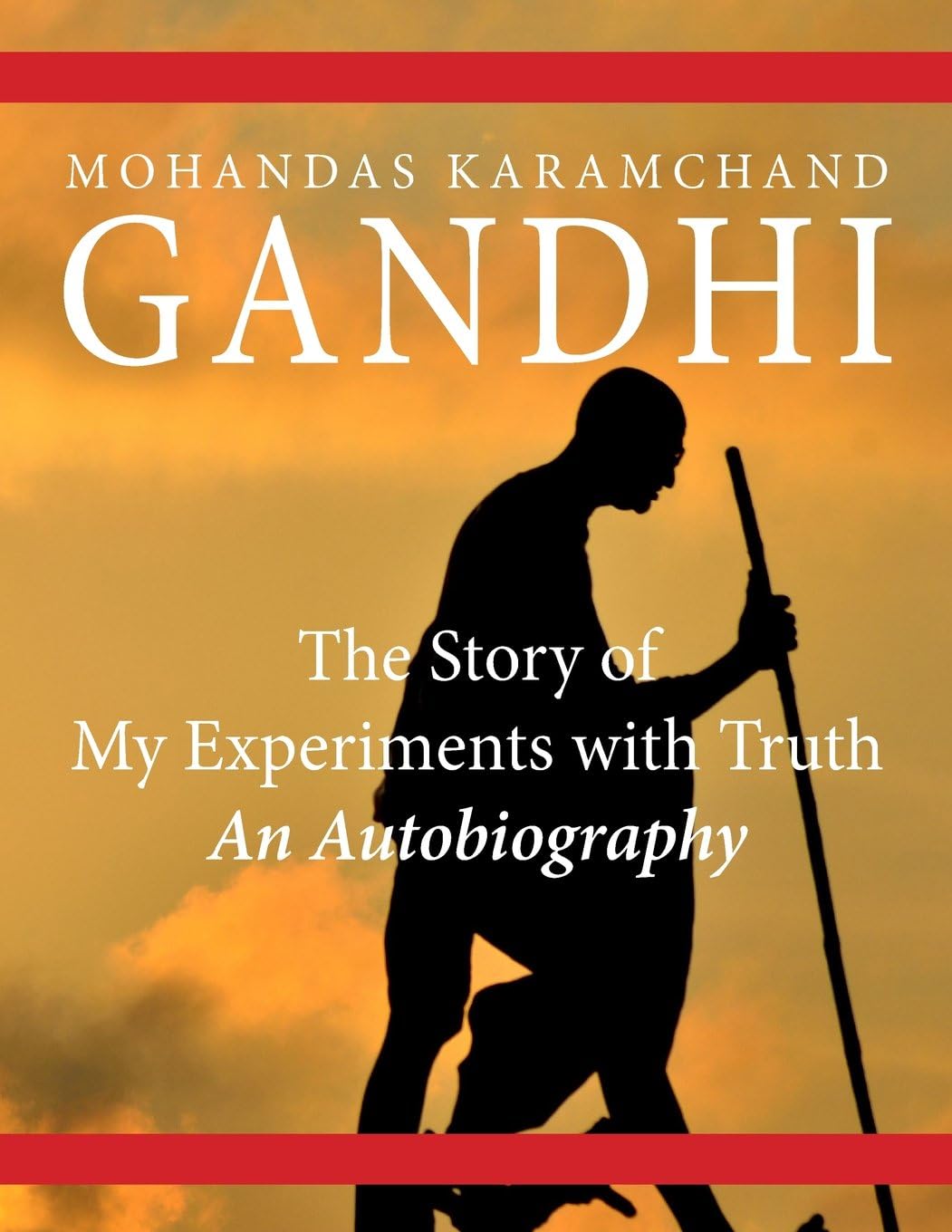

The Story of My Experiments with Truth: An Autobiography Paperback – March 27, 2016
Product ID: 834318
Desertcart purchases this item on your behalf and handles shipping, customs, and support to USA.
Full description not available
O**H
Truth!
As the title indicates, this book is one about Mahatma Gandhi's life covering the years between his birth (1869) and 1921 - at which point his life and movement had become publicized.While it would be very difficult to summarize his life, there are a few key themes that characterized it:a) His deep-rooted belief in truth. A belief that he lived through his actions.b) His passion for public service, particularly fighting for the rights of the oppressedc) Servant Leadershipd) Self Discipline - a leader must lead himself before leading othersThrough this autobiography, numerous leadership lessons can be learned in each of these areas.Below are key excerpts from the book that I found particularly insightful:1- "But one thing took deep root in me the conviction that morality is the basis of things, and that truth is the substance of all morality. Truth became my sole objective. It began to grow in magnitude every day, and my definition of it also has been ever widening."2- "He (Mr. Leonard) exclaimed, 'Gandhi, I have learnt one thing,and it is this, that if we take care of the facts of a case, the law will take care of itself. Let us dive deeper into the facts of this case."3- "But all my life though, the very insistence on truth has taught me to appreciate the beauty of compromise. I saw in later life that this spirit was an essential part of Satyagraha. It has often meant endangering my life and incurring the displeasure of friends. But truth is hard as adamant and tender as blossom."4- "The heart's earnest and pure desire is always fulfilled. In my own experience I have often seen this rule verified. Service of the poor has been my heart's desire, and it has always thrown me amongst the poor and enabled me to identify myself with them."5- "And now after considerable experience with the many public institutions which I have managed, it has become my firm conviction that it is not good to run public institutions on permanent funds. A permanent fund carries in itself the seed of the moral fall of the institution. A public institution means an institution conducted with the approval, and from the funds, of the public. When such an institution ceases to have public support, it forfeits its right to exist."6- "During my professional work it was also my habit never to conceal my ignorance from my clients or my colleagues. Whenever I felt myself at sea, I would advise my client to consult some other counsel, or if he preferred to stick to me, I would ask him to let me seeks the assistance of senior counsel. This frankness earned me the unbounded affection and trust of my clients. They were always willing to pay the fee whenever consultation with senior counsel was necessary. This affection and trust served me in good stead in my public work."7- "But the path of self-purification is hard and steep. To attain to perfect purity one has to become absolutely passion-free in thought, speech and action; to rise above the opposing currents of love and hatred, attachments and repulsion. I know that I have not in me as yet that triple purity, in spite of constant ceaseless striving for it. That is why the world's praise fails to move me, indeed it very often stings me. To conquer subtle passions to me to be harder far than the physical conquest of the word by force of arms...So long as a man does not of his own free will put himself last among his fellow creatures, there is no salvation for him. Ahimsa is the farthest limit of humility."
K**I
If you read one autobiography in your life, let it be this
This is the autobiography of, in my view, the greatest man in recorded history. It describes his thoughts in great detail, and the most interesting part is the evolution of his ways into the greatest proponent of non-violence in achieving righteous political goals. He essentially ended the British Empire (without India, Britain became nothing) without lifting a finger. Also touching is the man's humility. He lived with the bare essentials in life. All his material possessions could fit into a shoe box: his copy of the Bhagwad Gita, eye glasses, wooden flip-flops, loin cloth, and a stubby pencil. He typically used other people's rejected pencils and used them until he couldn't hold them any longer. To him, throwing away a perfectly good pencil (or anything else which was still usable) was an insult to someone else's labour. While one could go on and on, I will stop here. Enjoy the read!
C**N
Gandhi's Life Struggles
Between political struggles and his being a vegetarian, I was looking for a bit more on the spiritual side. After all, he was called Mahatma. Which means great soul. (This review has to be short.)Gandhi was confronted by Christians who wanted to sell him their twisted idea of Christianity. Actually he was greatly moved by Tolstoy's work; Tolstoy hated how Christians distort the teachings of Jesus, and are so anxious to wage war. Jesus taught 'love thy neighbor' and "turn the other cheek".He struggled with diet, he refused to eat meat, eggs, and refused even milk. In the end he tried to subsist on fruit juices. Gandhi believed that abstinence was important in realizing God, yet he was disgusted by his own lust and how he treated his wife.
E**M
We all can learn from this man...
I enjoyed this book. There were parts that were a bit boring, and others that were very instructive- especially when he talked about his 'experiments' with non-violent protests and confrontation for change. It inspired me to find other examples of successful non-violent leaders. There aren't many. But if you enjoy this type of thinking and writing you might also look at 'The Kingdom of Heaven is Within You' by Tolstoy which inspired Ghandi. (They corresponded and were contemporaries.) 'Strength to Love' by Martin Luther King is also a good one. He was inspired by Ghandi and came to embrace civil disobedience without violence. We could use more leaders that focus on positive change without attack and violence. A few people have shown that it is possible!
A**H
An inspiring read
Even though a lot of what Gandhiji talks about is more than a century old, it is humbling to see that he did so much with what we did at the time. The book was an eye opener for me as most of what we know about Gandhiji is based on the lead up to India's independence whereas as this book focuses on his life before that movement started.Gandhiji's biggest critic was also himself. He constantly puts himself down for failing his conscience. He wasn't perfect and erred on the wrong side of life a few times but so haven't we all and this reminds us that it is only human.All in all a good read, though a bit slow at times but well worth it.
M**R
A must read
A must read for everyone on the journey seeking and understanding Truth.Life-changing, wonderful words of wisdom and kindness that brings incredible peace and inspirations
A**E
Um homem, apenas
Gostei de ler, pois sendo uma autobiografia, não dá espaço a especulações. Gandhi como ele é, um homem, e não um deus.
A**A
great insight into a great person that lived a simple yet profound life
This is a book that would guide the minds of those who are seekers for inner unfoldment. Gandhi the great leader wrote candidly about his fears, weaknesses and limitations allowing the regular person to identify with his life; yet he attained such personal heights by the quest for "truth" as he embraced virtue and service to others as his life mission. Thus a book of what is possible despite our so called limitations.
J**U
Excellent livre
Je recommande fortement ce livre, un témoignage superbe de Gandhi sur sa vie, ses idées, ses combats.Le format kindle est en très bonne qualité, bien meilleure que des versions gratuites que l'on peut trouver sur internet.
H**R
War ok
Hat meinen Mann nicht so gut gefallen aber es ist immer schon schwer immer das richtig zu bestellen keine leichte Aufgabe..
T**R
Interesting
I loved leaning and readying about this great man. It was a inexpensive price.
Trustpilot
4 days ago
1 week ago