
Desertcart purchases this item on your behalf and handles shipping, customs, and support to USA.
๐ Unlock the epic saga of cancer โ where science meets humanity in a battle for survival.
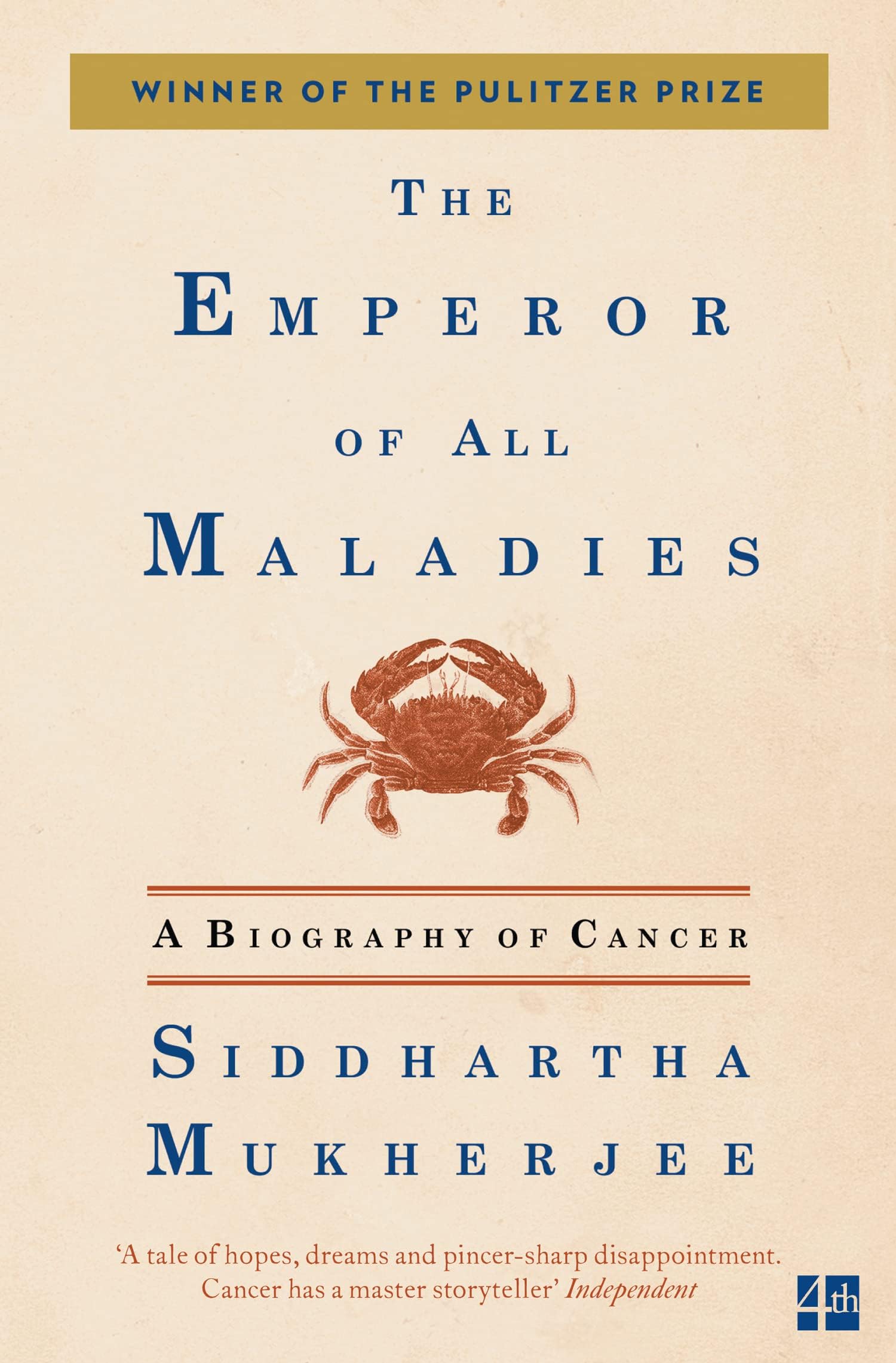
The Emperor of All Maladies by Siddhartha Mukherjee is a Pulitzer Prize-winning, critically acclaimed nonfiction work that chronicles the 5,000-year history of cancer. Combining rigorous scientific detail with compelling human stories, it offers a lucid, deeply humane exploration of cancerโs biology, history, and the ongoing fight against it. This book is essential reading for professionals seeking a profound understanding of medicineโs greatest challenge and the resilience of those who confront it.


| Best Sellers Rank | #21,016 in Books ( See Top 100 in Books ) #107 in Biology Books #309 in Health, Fitness & Nutrition #315 in Healthy Living & Wellness |
| Customer Reviews | 4.6 out of 5 stars 9,497 Reviews |
H**K
An Epic in Elegance: The Literary Power of Mukherjeeโs The Emperor of All Maladies
From the very first pages, The Emperor of All Maladies captivates you with a rare blend of scientific clarity, historical sweep, and deeply human narrative. This is not just a medical history โ it is a story of hope, suffering, reinvention, and the relentless struggle between life and disease. Beyond its scientific depth and historical scope, the book also shines as a work of literature. The prose is never dull โ it is vivid, elegant, and often poetic. Siddhartha Mukherjee transforms what could have been a dense medical chronicle into an engrossing narrative, enriched with imagery and metaphor. His phrasing lingers long after the page is turned. When reflecting on a missed scientific opportunity, he observes: โThe two halves of cancer, cause and cure, having feasted and been feted together, sped off in separate taxis into the night.โ He defines cancer with striking clarity as โโฆwhere cells acquire an autonomous will to increaseโ and issues the ominous reminder that โCancer is intrinsically loaded into our genes, waiting for activation.โ Lines such as these reveal Mukherjeeโs rare gift for making science not only understandable, but luminous and memorable. What Makes It Stand Out 1. Brilliant balance of science and story The author weaves detailed biomedical content (cell growth, oncogenes, molecular pathways) with gripping human stories of patients, doctors, and researchers. The technical details never overwhelm โ they enrich the narrative, letting you see cancer not as abstraction, but as a tragic force that touches lives. 2. Immense sweep of history The book traces cancerโs battle from early observations through decades of experimentation, innovation, failures, and breakthroughs. You sense how medicine evolved โ the shifting paradigms, the false leads, the incremental advances. This gives one a profound appreciation for how fragile and tentative progress often is. 3. Philosophical resonance The book frames cancer as not merely medical but existential. โCancer is stitched into our genomeโฆ a flaw in our growth, but this flaw is deeply entrenched in ourselves.โ Mukherjee makes us ask: can we ever fully eradicate cancer without also eradicating the very processes โ aging, repair, regeneration โ that sustain life? This questioning elevates the book from a chronicle to a meditation. A key insight: that cancer is, in some way, entangled with our very nature โ embedded in processes of growth, aging, repair, mutation. 4. Moments of human resilience Between the science, there are stories of patients, physicians, and scientists โ people who persevere, fail, adjust course, sometimes triumph. These human threads provide an emotional anchor. You care. You cheer. The personal dimension is not an afterthought โ it is integral. 5. Impressive clarity and structure Even when describing complex processes (oncogenes, chemotherapy, genetic mutation), the author keeps explanations lucid and accessible. โScience embodies the human desire to understand nature; medicine, then, is fundamentally a technological art.โ With sentences like this, the book feels like a guided journey, not a lecture. Standout Quotes: โCancer is stitched into our genomeโฆ a flaw in our growth, but this flaw is deeply entrenched in ourselves.โ โWe can rid ourselves of cancer only as much as we can rid ourselves of the processes in our physiology that depend on growth โ aging, regeneration, healing, reproduction.โ โScience embodies the human desire to understand nature; medicine, then, is fundamentally a technological art.โ โPerhaps cancer defines the inherent outer limit of our survival.โ In Short: This book deserves five stars. It is rare to find a work that is at once scientifically ambitious and deeply humane, historically comprehensive and emotionally gripping. If you care about medicine, human suffering, scientific ambition, or just the fragility and resilience of life, this will stay with you long after the last page.
K**R
Disturbing yet very informative read...
This book is an eye opener, chilling read and brings cancer into a fresh perspective which all of us want to avoid. The phrase out of sight out of mind is dismissed once you read this book. As someone without knowledge of medical science, I found this book easy to understand and follow yet it was one of the most difficult books to sit down and read, primarily due to the intensity of the subject. Many words or adjectives come to mind after reading this book, including detailed, long, very intense, upsetting, disturbing, depressing yet informative. I think the most accurate description would be highly informative. Author has filled the pages with years of experience and his complete knowledge of the subject. Reading this book ensures a better understanding of cancer and how it has affected the journey of medicine in treatment of cancer. From the beginning of the story Author dives into history of cancer and the way it is portrayed as the story goes, it seems more like an actual person and not an illness. More like a super powerful villain who is here for human extinction or advancement of human race. Itโs literally do or die situation for human race against cancer. โIn writing this book, I started off by imagining my project as a โhistoryโ of cancer. But it felt, inescapably, as if I were writing not about something but about someone. My subject daily morphed into something that resembled an individualโan enigmatic, if somewhat deranged, image in a mirror. This was not so much a medical history of an illness, but something more personal, more visceral: its biography.โ โSiddhartha Mukherjee Author reveals how cancer has been around much longer than we thought by showing examples of exhumed corpses from ancient Egypt and other archeological sites. Once mankind realized how aggressive and fast growing cancer is, the historical treatments were equally zealous and intense with the goal to find a cure and get rid of the cancerous tissue as soon as they can. Cancer is an expansionist disease; it invades through tissues, sets up colonies in hostile landscapes, seeking โsanctuaryโ in one organ and then immigrating to another. It lives desperately, inventively, fiercely, territorially, cannily, and defensivelyโat times, as if teaching us how to survive. To confront cancer is to encounter a parallel species, one perhaps more adapted to survival than even we are.โSiddhartha Mukherjee The emperor of Maladies โ the title captures ones interest and this no doubt has proven to a book which sticks with you even after you finish reading it. To conclude, the book sheds new light on the future of war on cancer, Medicine and science has come a long way in the past decades and new treatments continue to be discovered and tested. The war on cancer is far from over, however based on the knowledge from this history; we surely are equipped to face it head on. "We are so close to a cure for cancer. We lack only the will and the kind of money and comprehensive planning that went into putting a man on the moon" -Dr. Sidney Farber
A**A
An Almost Definitive Read on Cancer
My first introduction to the dreaded disease of cancer was through movies, where the hero bleeds through his nose, wraps a shawl and goes around with unshaven face, singing sad songs about his plight. My motherโs narrations about her elder sisterโs traumatic experience with breast cancer and resultant mastectomy at a young age didnโt make much of an impact on me. As I grew up, there were so many characters with cancer in so many movies that the word cancer itself started to feel like those foreign locations that the lead characters go to for their duets โ exotic, intriguing, yet faraway, having nothing to do with me. But as I matured into adulthood, I started seeing relatives, families of friends and colleagues bear the brunt of this ominous disease. My brief volunteering with an NGO that works for cancer patients brought me face to face with the seriousness of this scourge of humans. Young children suffering from leukemia, men in their early twenties fighting lung cancer caused by smoking, elderly people disfigured by throat cancer due to tobacco use - cancer was no longer exotic and faraway. It was close and gross. When recently someone near and dear was diagnosed with cancer, I felt my curiosity piqued. I was looking for resources to learn more about this disease and do what I can to spread awareness. Thatโs how I found this book. And, what a worthy primer this turned out to be! Cancer is not a modern illness. Its ancientness parallels that of our own. For millennia, people have suffered from and succumbed to cancer. But what makes this dreaded disease unique is its ability to evolve at the same rate as we do. Every time we find a cure and hope to kill this disease forever, cancer evolves and moves the bullโs eye. To borrow an idea from the author, imagine an Achilles whose vulnerability shifts someplace else, just as you target an arrow at his heel. All those centuries of painstaking research has taught us one thing โ this disease emerges from within. While external agents โ like viruses and carcinogens - play a crucial role in waking this demon from its slumber, cancer is something internalized. It is our own body cells gone rogue, disobeying the lifecycle of birth-growth-decline. In a cruel twist of fate, our own body cells, nano-representations of our own selves, find a mutated vigor for โlifeโ, start proliferating so profusely that they end up killing us, their collective image. Killing a harmful virus or bacteria has been relatively easier, because they have definite shape, purpose and, especially, are apart from us. But cancer is a part of us, our own cells, our genes, DNAs gone rogue. Not just that. Each of these mutations takes its own unique form as there are individuals. Cancer isnโt one single disease to find a cure against. It is a bunch of mutations, the perverted race of cells to proliferate and spread all over. This book taught me those things in an intense way. Starting from the earliest mentions of this disease in history, nearly 2500 years ago, to the latest development in the field of oncology, this book tries to light up a very vast area. And, it succeeds too. The tug of war between cancer and science, the misunderstandings, poorly designed treatments, lessons learnt, sacrifices by patients as well as physicians, their tenacity in the face of adversity, emotional / physical reliefs brought by discovery of cures, relapses and remissions, egos and ebullience of the people involved, this book tells it all. If you are looking to learn what cancer is and what a devastating trail it has left all through the annals of mankind, then this is a book you must start with. The sheer effort and research that fills these pages is astounding. Dr. Mukherjee has put his heart and soul into this book. The book is comprehensive but not complete though. For example, the book doesnโt dwell into ovarian cancer, something that I was so keen to learn about. The book doesnโt provide any advice on how to prevent cancer, if at all it is possible, or what kinds of lifestyles are prone to the risk of it. But, of course, the good doctor promptly justifies his reasons in the annexures. This book doesnโt tell you everything that you would like to know about cancer. But it will tell you all the basics that you need to know about it. If you are pursuing the subject with curiosity, this is a good book to begin with. Not an easy read, but definitely worth the time. As I finished reading and sat staring at the covers, I had this strange emotion โ in their traits of reproducing profusely, migrating to wherever possible, reshaping the landscape of their destination (organ), and increasing ability to defy death that results in the ultimate demise of the host organism, isnโt cancer quite akin to us humans? Are cancer cells the microcosmic parallels to what we humans are to the macrocosm, i.e., the Universe?! Who knows?! May be, we are!
S**A
Literary delight
Itโs a masterclass in science communication done right. Literary masterpiece by one of the best contemporary authors.
N**L
Excellent read.
This is a book about cancer. Its biography. It is almost impossible to know about the existence of this book since we donโt look for such books in the bookstore. My dad came about the name of this book when he was watching a TV news article in hospital about a man who does some social service for poor cancer patients. He gave reference of this book, which my dad told me to buy. He wanted to read it, but at that time his chemotherapy was at top force and he couldnโt. I just casually started reading it once day with not much expectations. I was hooked. It starts from the start, takes a smooth and continious journey and give a holistic picture of cancer landscape. Itโs a straight 5/5. I feel that in near and far future, this book will become more and more known, which if you think is kind of unfortunate.
H**T
A Book Beyond Appreciation
I guess I am out of words to express my opinion about the book. I highly doubt any other book can be written on Cancer with such captivating explanation. From the moment I started reading this book I couldn't put it down. Such brilliant is the storytelling that it binds you to the theme of the book. I read this book after reading Siddharth Mukherjee second book "The Gene - An Intimate History". These two books have had profound impact on my understanding of human biology. The author has taken us on a journey to let us know the experiments, struggles, disappointments, fights and eventual victories on many front of human biology. This book deals with cancer. As the title of the book is aptly given, this indeed is "Biography of Cancer". The books tells the story of cancer from the very first written record of the disease to the latest advancements made in the field of cancer to better understand it and to find a permanent cure for it. Why cancer still remains an elusive disease ? Why despite knowing so much about human genome we cannot find a cure for cancer ? Will we actually be able to find a permanent cure? Or cancer will always remain one step ahead of us ? The book delves with these issues and tells the story of cancer which at times is complex, confusing and terrifying and at other times is intriguing, fascinating and beautiful.
A**A
The book is A description of cancer ๐ฆ...
First of all the book is purely engaged with the biography of cancer. The book depict many real stories of cancer patients. Now the question is what we can know from this book? History of cancer. The struggle / contribution of many scientists and many discoveries to it. If you are from scientific field or not, it is a must read book for all.
T**S
The war on cancer and Hope
The author has succinctly and engagingly educates the reader about the history, struggles, battles fought in this war against an enemy which inspires a terrifying awe . The resilience of the cancer cell and the indefatigable zeal and will of the warriors who are waging war on this enemy which is our very own body is like two grandmasters in a chess championship. The book definitely gives hope to the reader that in this age our cause is not lost, instead we are marching on successfully albeit slowly, sometimes we are even beaten but then again we get back up, as if the normal cells are fighting the cancer cells. The book helps understand the process and prepares you to what to expect of this ordeal, if not fully then to a great extent, so that when we are staring down the barrel we know what's coming.
A**S
Baskฤฑ kalitesi ve kitap orjinal.
รrรผn รงok gรผzel ve beklediฤim gibi geldi. Kitap kalitesi ve baskฤฑsฤฑ gรผzel. Teลekkรผr ederim.
A**S
A must read for anyone digging deeper in understanding cancer
I just finished reading it, and I must say it is definitely worthy of its Pulitzer. THe book features very detailed information (the amount of research needed must have been tremendous), but it is conveyed in a very fluid writing. Dr Mukherjee masterfully guides us through seminal moments in the history of cancer discovery and treatment, highlighting the human characters involved in each of those moments. It's very interesting to see characters and concepts come back again in different moments, often in ways to fill in gaps that seemed obvious in retrospect. The only significant aspect lacking in the book is the role of modern pharmaceutical companies and the government (and professional) entities that regulate them. We see a little bit of it with Genentech and Novartis, and the NCI is a major character in the book. However, the whole of the pharmaceutical industry and agencies like the FDA are not there. This is, nonetheless, a must read for anyone interested in digging deeper into the hows and whys of cancer as it is today. Since it was published in 2010, I would love to see an update (a sort of "sequel") covering the stories of the advancements of the last few years; since it's such a dynamic field.
A**O
A beautiful story narrated by a skilful writer
I was looking for some scientific information about cancer, and I stumbled upon this book. I was expecting a somewhat boring chronology of cancer research; I couldn't have been more wrong. The author makes a wonderful job in selecting stories and "storylines", and telling them in an enjoyable style (a well-deserved Pulitzer). You will travel through history and follow the fall of the humoral theory, the rise (and fall) of radical surgery, the rise (and fall) of radical chemotherapy, and the rise of the genetic theory of cancer. It turns out that following the evolution of the scientific understanding of cancer is the best way to learn about it. In addition to cancer itself, the book teaches much about science going wrong: scientific communities following dogmas and being blind to evidence against them; a premature all in battle against cancer (lacking mechanistic understandings); fabrication of data; politics and corporations hampering scientific research; the loss of connection between doctors and patients. A highly suggested read, although the book is slightly outdated now.
E**Y
Insightful read for both science students and general public
Fantastic book. I read this during my undergraduate university years as a biology student studying health and disease. It was incredibly insightful, both for its historical storytelling and the slightly greater focus on the science of cancer compared to other similar books tailored for a general audience.
B**K
A Literary Achievement of Science
The Emperor of All Maladies: A Biography of Cancer by Siddhartha Mukherjee "The Emperor of All Maladies" is a literary achievement of science. It's an enlightening journey through the history of cancer through the eyes of a coming-of-age oncologist. A beautifully written book that treats this complex topic of cancer with the utmost care and respect while providing the reader valuable insights into the scientific quest to eradicate or control this insidious disease. This outstanding 608-page book is broken out into six major parts: 1. "Of blacke cholor, without boyling", 2. An Impatient War, 3. "Will you turn me out if I can't get better?", 4. Prevention is the Cure, 5. "A Distorted Version of our Normal Selves", and 6. The Fruits of Long Endeavors. Positives: 1. Outstanding accomplishment of literary science. Extensive research of cancer and conveyed to the masses in an enlightening readable fashion. Kudos! 2. Engaging and humane prose. 3. What sets this book apart is the author's ability to interweave human stories into the biography of cancer thus achieving a perfect balance of humanity and science. 4. Great facts and fascinating scientific tidbits about cancer throughout this book. 5. Cancer...what it is, and the never ending scientific quest to eradicate or control it. 6. Cancer has many manifestations. This book covers many of them through the eyes of the patients, scientists and doctors. Leukemia and breast cancer, do get special attention. 7. Innate ability of Dr. Mukherjee to provide details with panache. 8. The history of the drugs developed to combat the many manifestations of cancer. The history of the agencies, and support groups. The scientists behind the design, development and deployment of the drugs. 9. Great quotes, "Cancer thus exploits the fundamental logic of evolution unlike any other illness. If we, as a species, are the ultimate product of Darwinian selection, then so, too, is this incredible disease that lurks inside us". 10. A look into the history of ancient diseases. The progression (not always in a straight line either) of science as it relates to treating diseases. The key discoveries that were instrumental to progress, anesthesia as an example. The discovery of radium in 1902. 11. The history of organizations launched to fund research. Special mention to the tireless efforts of Mary Woodard Lasker and Sidney Farber. 12. Conducting clinical research. The trials and tribulations. The various treatments and effects. A lot of focus on chemotherapy. The multidrug concoctions. The reality of the results. The tamoxifen trial. 13. The causes of cancer. The various theories. As an example a look into the somatic mutation hypothesis of cancer. 14. The quest to understand the biological behavior of cancer before going on an all out attack. Fascinating stuff. 15. The quest to prevent diseases. Many examples of historical cases: the "chimney-sweepers' cancer, tobacco, malaria, to name a few. Find out the extreme experiment that put one scientist's own life at risk. 16. The history behind screening trials. Pap smears, mammography, the findings, and the lessons learned. 17. The insidious disease...AIDS. Retroviruses. 18. The link between chromosomal changes and cancer. The causes. 19. Proto-oncogenes. "Cancer was intrinsically loaded in our genome, awaiting activation". The first cogent and comprehensive theory of carcinogenesis. 20. Understanding the progression of cancer. "Down to their innate molecular core, cancer cells are hyperactive, survival-endowed, scrappy, fecund, inventive copies of ourselves." 21. The six rules that explain core behavior of more than a hundred types of tumors. 22. The three new Achilles' heels of cancer. The three essential ingredients for a targeted therapy for cancer. 23. The current biological and societal challenges of cancer. The pathway disease. 24. Excellent links to notes. 25. The inclusion of a glossary and bibliography. Negatives: 1. At over 600 pages, it does require an investment in time. Thankfully, it's time well invested. 2. Lack of charts and illustrations would have added value. Could have been added to appendices to avoid disrupting elegant prose. 3. It can be an emotional read sometimes as the reader will find themselves invested in the lives of so many people...let's face it, we are talking about dealing with cancer. 4. Some readers will get lost among the many and recurring storylines. 5. The photographs would have added more value if they would have been inserted in the context of the narrative instead of a separate appendix. In summary, this is an outstanding and important book. What sets this book apart is Dr. Mukherjee's ability to weave multiple storylines into a fascinating narrative about the history of cancer with just the right touch of humanity. This was an ambitious book and I can only imagine how daunting a quest this was but the author succeeds and as a result we the readers benefit from the knowledge and wisdom. I can't recommend it enough! Further suggestions: " The Immortal Life of Henrietta Lacks " by Rebecca Skloot, " The Secret History of the War on Cancer " by Devra Davis, " One Renegade Cell: How Cancer Begins (Science Masters Series) " by Robert A. Weinberg, " Cancer as a Metabolic Disease: On the Origin, Management, and Prevention of Cancer ", " The Violinist's Thumb: And Other Lost Tales of Love, War, and Genius, as Written by Our Genetic Code " by Sam Kean, and " Cancer Ward " by Alexander Isayevich Solzhenitsyn.
Trustpilot
2 weeks ago
2 months ago