
Desertcart purchases this item on your behalf and handles shipping, customs, and support to USA.
🎓 Unlock the hidden art of math before everyone else does!
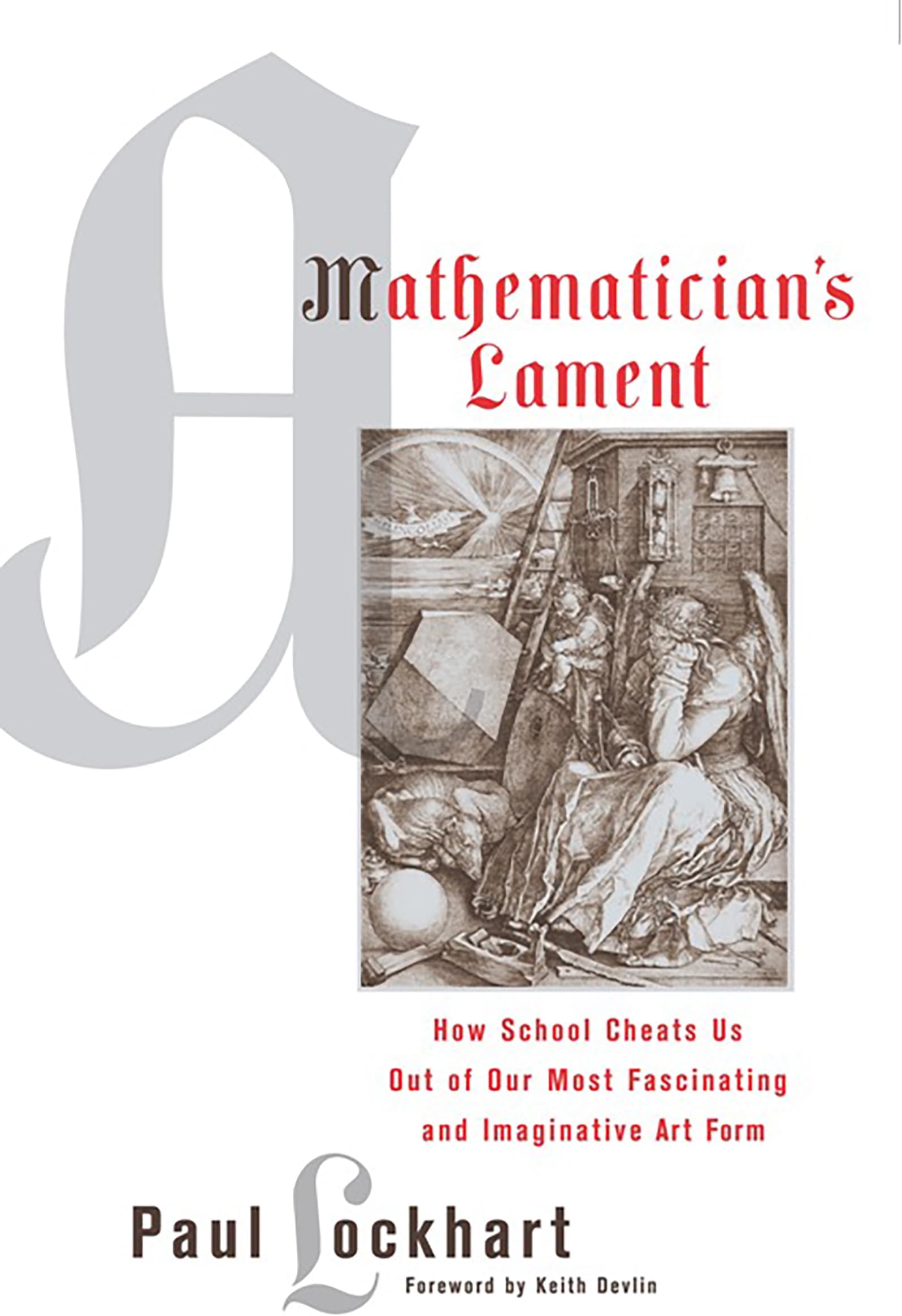
A Mathematician's Lament is a critically acclaimed, concise book by Paul Lockhart that exposes the creativity and beauty of mathematics, challenging the conventional, mechanistic K-12 teaching methods. Praised by experts and educators alike, it inspires a fresh, artistic approach to math education, making it a must-read for teachers, parents, and reform advocates.
| Best Sellers Rank | #42,894 in Books ( See Top 100 in Books ) #29 in Education Reform & Policy #38 in Mathematics History #41 in Mathematics Study & Teaching (Books) |
| Customer Reviews | 4.6 out of 5 stars 572 Reviews |
M**E
an important effort to emphasize the art of mathematics in teaching and learning
The author is lamenting the common (universal?) focus on failing to open students' eyes to the art of mathematics. The focus in schools is often authoritarian, based on transmitting algorithms and rote, mechanistic learning. On the other hand, there is a clever and fun side to the art of mathematics, a display of the elegance and beauty of mathematics, and a creative side to mathematics that is often missing in the teaching of mathematics. Prof. Lockhart laments this absence. Even very talented mathematicians, once in the school system, find it very difficult to introduce students to the fascinating, beautiful "why" questions and explorations of mathematics. This is common throughout the school system in the U.S. at every level, not just in grades K-12. Algorithms are rarely beautiful and elegant, rarely encourage our creativity, and rarely encourage the search for patterns and connections. The beauty and elegance of mathematics is the fascinating human side to mathematics. Of course, rote learning rarely engages students. The result is that, even the mathematically able and talented, can fail to connect with the raw human power of elegance and beauty in mathematics. Prof. Lockhart's book is very short, but it can be highly recommended as emphasizing a side to mathematics that is terribly important for us, and is lacking in the current education system. We live in an age when algorithms and the treatment of humans as machines dominates, while rote learning and drill is often viewed as necessary and expedient in education. Therefore, the author's lament seems to draw us to some ideal world that is very remote from today's world but worth thinking about and recognizing as important. In the real world, much of mathematics, at any level, and in any field, can seem overly hard, unmotivated, dry, and/or unappealing, even to mathematicians. There is some artistry about mathematics, as it is, and as we encounter it, but we do not have the privilege, none of us, of living in Prof. Lockhart's pristine and idealized version of the mathematical world.
R**R
An Important Read
Once in a while we read books that we just know are especially important, and that we know we will be thinking and talking about long after reading them. This book is one of them for me. I am a returning adult student, and I am about to finish my training to become a math teacher. Having gone through my education program, my enthusiasm was just about completely drained, and I've been having trouble remembering why I ever wanted to become a math teacher in the first place. Why would anyone? Paul Lockhart knows, and his book has reawakened my desire to help students discover the joy of mathematics. His argument is concise, and he makes it forcefully. His book is a joy to read, mainly because his understanding of the subject and his passion for it are clear in every page. He reinforces ideas I already had about how school sucks the life out of math (and all subjects), but he also challenges some of my opinions. I think this will happen with most people who read it. Once he finishes making his argument about math education in about the first two-thirds of this short book, he devotes the remaining section to describing what he finds wonderful about mathematics itself. This section should make just about anyone want to become either a mathematician or a math teacher. I want people to read the book for the specifics of his arguments, but I want to discuss one important point that he makes. Many people in math education claim that in order to make math more understandable and interesting to students, we need to show how practical it is and how it is used in everyday life. I've always felt like this idea was wrong, or at least limited in its usefulness in that regard. Well, Lockhart demolishes the idea, essentially claiming that practical uses are simply by-products of math, and that the real excitement and beauty of mathematics is in the abstract, imaginary, and creative world of mathematical ideas that have no specific connection to the everyday. By-products and applications can make math seem boring and secondary to the uses it serves. I agree with him--and much more now after having read his argument. I honestly think just about everyone should read this book. Of course math teachers should, as should anybody involved in math education in any way. But I think people outside of math education should read it too. The specific mathematical ideas discussed in the book do not require a strong mathematical background, and I can't think of a better book that so concisely conveys the nature of the subject and the way it is viewed and misunderstood in society. I'm still not sure I agree with Lockhart's every point, but I love this book. (And I might agree with his every point after more thought and experience in the classroom.)
N**N
An honest, insightful perspective of the state of math education
The author’s love of the subject leaps through the pages to the reader, you really get the sense that he is really trying hard to crush a widely-held view that math is a miserable, dry subject. Math really is fun and exciting! It’s worth the purchase price just for his concise summation of the current math curriculum and his trenchant take down of high school geometry as it is taught. There are points where I have some disagreement, as good as this book is. The use of fun games to create interest in math such as playing Go and other games, i question whether we need such gateway devices to create interest in math. If Go is fun, play Go, but it shouldn’t be played with the sole intention of leading to math. Math, really IS fun on it’s own, and without school, more kids will come to it naturally. Secondly, the author mentions that many of the questions and problems which lead mathematical inquiry have no practical use and it is the sheer pure joy of math itself that is the source of pleasure in doing it. I do not disagree but i would be hesitant to immediately make a statement like that considering math is such a vast subject and perhaps real world applications could very well drive interest in children. He does double back later to mention it’s not really important to worry about such things and I would agree. Don’t let these nitpicks stop you from buying the book. It’s an excellent book, and I believe the main point that the book successfully delivers is the radical change of view to the standard view of math: it’s an art form, not a misery and a distinctly human activity. Children if given a chance outside of school, will love it and not get turned off by it.. and it will be a pleasurable life long pursuit.
J**N
Good ideas - Arrogant Approach
The man is very arrogant, and makes some hefty claims against the current educational system. I think the book is very worth reading if you can sift past his "if everybody were as awesome as I am the world would be a better place" attitude. I enjoyed the book a lot, because I love math, and so does Lockhart. The book comes in two parts. Part 1 is Lockhart's accusation of the current system. Excerpt: "The truly painful thing about the way mathematics is taught in school is not just what is missing - the fact that there is no actual math being done in our math classes - but what is there in its place: the confused heap of destructive disinformation known as 'the mathematics curriculum'" This part was right on some level, meaning that the way math is taught is flawed. BUT it certainly goes too far, and is not helpful. As many people, when they get on their soapbox, they lose sight of reason, and start "lamenting". HOWEVER, part II of this book is great, and I would buy it just for that if you are interested in math, if you hate math, if you think you are good at math, or if you are the worst mathematician in the entire world, or if you fall somewhere in the middle. I think that covers everybody. He does a great job introducing a more interesting and intuitive way to introduce math in school. I appreciate this, because often authors stop at part 1 - and just complain. Lockhart, however, introduces a kernel of a solution. I wish he had spent the entire book on part 2 - and better fleshed out the way this could be implemented. But the title of the book is "A Mathematician's Lament" not "A Mathematician's Solution", so I guess he achieved his end.
M**C
Best book out there for math teachers.
I absolutely love this book. As a high school math teacher I've often felt so wrong in doing things like handing over formulas, like one may hand over hard-earned money to a thief. It just doesn't seem fair to me or my students to present a conclusion that many in the past spent so much time trying to figure out, without giving my students the time and guidance to figure it out and earn it on their own. Take for instance the area of a triangle. Many of us as math teachers simply GIVE the formula A=1/2*b*h without explaining WHY let alone having the students explore on their own and find out the area of a triangle themselves. The author describes how math is "the art of reason" and that like music, like painting, it's okay to play around with it because in playing around one can discover so many beautiful things that last within the mind forever. The author also talks about how math education in public schools is destroying creativity with numbers, shapes, and the imagination, and gives several funny, sardonic examples of how we're doing that. He does however give several examples of beautiful problems and how to go about allowing students to explore this "imaginary land of mathematics" as he describes. The author makes an awesome comparison of his love for mathematics and the way numbers behave to the love a biologist has for animals and the way hamsters behave. I love his metaphors and allusions; they really bring the world of mathematics into a whole new light for people like me- a math teacher who rediscovered her love for math. This is a fun, interesting read for anyone who likes math and EVEN for those who hate it! You'll probably discover why you hate it and then realize that you actually hate the public school system for making you feel stupid and maybe even say math isn't so bad after all.
C**D
An Old Flame, Rekindled.
In the fall of 1997, I entered my first day of 7th grade. Prior to the eclipse of me graduating primary school, I was elected to enter the honor courses that our school district provided. Looking back now, honesty tells me I can't really consider this a feat, as growing up in a poorer region of my country - I'm sure anyone with a slight level of intelligence was considered gifted. Nonetheless, that fall I walked into my first period class, first year, junior high - Pre-Algebra. Weeks went by, and I learned how to solve problems that include fractions and exponents. Simple enough. Same grudgingly long school days where I regurgitated information out of a textbook, and like an adolescent dog the teacher's would crack a smile and light up when I did something correctly, their puppy treat of sorts, as if they actually did anything to aid me other than giving me painstakingly good memorization drills. During the introductory lesson of how to solve equations, the Solve for x that we've all come to know and hate, I decided to raise my hand and ask the teacher "What is x?" - This was the first time I had ever spoken up in class and questioned the teachings, in the form of "What is x?" "What am I ACTUALLY solving?" "When will I ever use this?" "Why am I wasting precious daylight in a dark, damp classroom when I could be exploring my own problems that I had at age 10?". The teacher misunderstood my question, and reverberated back to me that "What is x?" is the whole point of the lesson. So I reiterated - "No, what actually is x? Why am I solving for x? What purpose does x have in my life?" I can remember the moment, pretty plain-as-day. He looked at me in a confused stare and stated that it was just a math problem and that I needed to learn this for the test we'd be having. At that point, my interest in math died. Not a slow death like most grade A students that I went to school with due to years of agonizing regurgitated teaching, reaching father than just math. It was a swift, nail-in-the-coffin death that continued to echo throughout my entire education. From that point forward, if a subject did not interest me and I found no meaning of it's contents in which I could deduce a reason as to needing to know the information - either by events that were taking place in my life at the time - or events that I could plausibly suggest may take place in future dates - well, I just didn't apply myself to those subjects. I only learned what I wanted to learn, what interested me. Luckily, I was a pretty curious individual and self-study became my after-school activity. Computers became my love fairly quickly, despite my lack of knowledge for higher mathematics. Currently, I'm rather successful in my career based on salary, position, as well as overall applied knowledge in my field of study. I never went on to college for fear of placing myself through the same torture I experienced in grade schools. I had picked up The Mathematician's Lament, among some other mathematics books in a hope to try and rekindle a love for mathematics and problem solving, the latter of which is so ingrained in my everyday life. Thankfully, Paul Lockhart has brought that flame with this book - and my quest for the art of explanation has since been reestablished.
J**S
Pedagogical Philosophy
Forget Mathematics; or, rather, generalize mathematics to any discipline and Mr. Lockhart has basically argued--quite successfully--that a teacher without a love for or at least a deep understanding of said discipline does a disservice to their students. Realizing, as does the author, that such a state represents an ideal to be sought after rather than a goal that can be reasonably reached, the argument is stated as such. So strong, in fact, is the argument that it was the argument that found its publisher rather than the author. At its heart, Dr. Lockhart rails against the educational system itself. Is education designed to produce understanding or knowledge? Must knowledge be shaped and produced in such a fashion so as to not undermine some hidden orthodoxy? It is as hard to picture a public school system bereft of curricula and admittedly arbitrary standards as it is to eliminate such distractions. Is understanding merely the happy and rare accident that is achieved by few or is it a destination to which a good teacher can deliver any willing student. Such questions will not be easily answered; however, the truth of Dr. Lockhart's assertions will be recognized by virtually any recipient of a public education. Assuming that the invisible hand matches appropriately-processed students with the needs of the economy thereby benefiting society in general, would our system know what to do with students processed to the Lockhartian ideal? I suspect we would do very nicely, but there are only so many folks who may be privileged to earn their keep by doing pure math--pure anything. Accordingly, the rest of us must endure the drudgery of economic necessity and simply hope that a teacher like Dr. Lockhart comes our way. Time for some cynical lawyerspeak: We have plenty of teachers like Dr. Lockhart, they are available now to the privileged few who can afford them and/or the time to seek them out--they are all around us if we would only look. Unfortunately, our system is locked into the flawed ideal that we can buy such teachers. In truth, raising salaries of teachers enough to attract the brightest minds will only result in subsidizing more of the very evils Dr. Lockhart is trying to avoid because you have to quantify and categorize those for whom the higher rewards are intended. Until we can afford a system that loves learning and exploration for its own benefits, genius will have to find its way around the obstacles placed before it.
R**T
Brilliant and a little devastating
When I began to read Lockhart's Lament, I was skeptical -- particularly with his view of mathematics as more of an art than a science. I am an applied mathematician, and I most enjoy teaching applied mathematics, but after serious and humble reflection, I came to fundamentally agree with Lockhart. Mathematics was developed as an expression of human creativity, and teaching it as such is really the only viable option for most students to be able to appreciate it and therefore fully apply it (if they ever need or want to). As a relatively new mathematics teacher, I appreciate Lockhart's observations of the mathematics curriculum. I taught (college) trigonometry just before reading his Lament for the first time, and I was blown-away (and a little devastated) by the accuracy of his scathing description of that course: "Two weeks of content are stretched to semester length by masturbatory definitional runarounds... students must learn to use the secant function, 'sec x,' as an abbreviation for the reciprocal of the cosine function, '1 / cos x' (a definition with as much intellectual weight as the decision to use '&' in place of 'and.') That this particular shorthand, a holdover from fifteenth century nautical tables, is still with us... is mere historical accident... Thus we clutter our math classes with pointless nomenclature for its own sake." This book is an absolute necessity for anyone who wants to make sure their students actually enjoy mathematics. But be warned, if you view teaching mathematics as just a job, this book probably isn't for you.
W**T
Ein sehr besonderes, kleines Buch ...
... schön fände ich es, wenn möglichst viele es lesen - die, die Mathe unterrichten, an der Schule, auch an der Hochschule, in der Lehrerbildung und -fortbildung, in all den Kommissionen, die sich Gedanken darüber machen, was wann, wie und wozu unterrichtet und gelehrt werden sollte. Und wenn die, die es gelesen haben, sich darüber austauschen würden - im Lehrerzimmer, im Kollegenkreis, in all den Gremien und Kommissionen. Fände ich wirklich schön. Schön - wie die Mathematik.
G**I
Interesting perspective
Loved mathematics and hated art all my life. Had never thought about them being one and the same. Maybe not too late to question other perspectives. Great read
J**L
Maths is art - not science
Every so often, I read a book which I cannot put down. Paul Lockhart's book is one of them. I received it this morning and finished it this afternoon, including some time to work through one or two of his 'maths games.' As reported in other reviews, Lockhart brings a wealth of experience as a university level maths teacher, who decided to take his talents to benefit K12 level students in school. Lockhart is exactly the kind of teacher everyone should have in their maths class. His approach is simple and intuitively sound; namely, that maths as it is currently taught in most school classrooms is not really maths per se; rather it is a training process that rewards those who are good at learning a multitude of facts in the shape of formulae and algorithms, but who are not necessarily inclined towards or even competent at thinking 'outside the box.' As the Forward to the book by Keith Devlin (a maths professor at Stanford University) points out, many successful high-school mathematics students come unstuck when arriving at university to study mathematics, since the approach and character of the subject is so very different. The analogy is that pre-university maths is similar to learning to paint by numbers and that only when one 'arrives' at university is true maths introduced into the curriculum and the student is allowed to pick up a blank canvas to construct a painting. Many cannot make the transition, largely because they lack the mind-set necessary for this unstructured approach. Lockhart appeals to us to appreciate that this transition is not something which should simply occur for a minority of students arriving at university. Rather, real maths should be the starting point of a child's introduction to the subject, so that the beauty and creativity that is at the heart of mathematics can be truly appreciated and crafted by the student. Unfortunately, the existing educational system tends to wrongly assume that maths is really a branch of science and as such should be taught to prepare students to be competent in the use and manipulation of calculus to support their studies in the sciences. In order to reach this level at school, the student is therefore 'trained' from day one in basic maths, to be followed in sequence by more maths, algebra 1, geometry, algebra 2, pre-calculus and finally calculus. Of course, many students leave school or drop the subject at aged 16 and don't really even get exposure to calculus. Unfortunately, well before aged 16, many more students have simply been 'turned off' by maths, since its method of 'training' tends to reward the students who invest in the recipe of learning a mathematical operation, then practising the skill to a level where it is ingrained into the psyche. A good example being the algebraic formula for determining the factors of a quadratic equation where x=(-b+/-SQRT(b^2-4*a*c))/2*a. Whilst useful for solving the specific kind of problem, its relevance to the vast majority of students is such that once they have sat and passed or possibly failed their 16 year old maths exam, then like all the other formulae learnt for 'the exam' it will be willingly forgotten and never used again for the rest of their lives. However, it would be wrong to paint Lockhart as being some free thinking spirit who denies the importance of learning certain facts, even formulae. His point is however, that frequently the student at school is introduced to such topics and concepts like the above formula as simply the next thing to learn and be mastered on the curriculum. Most of the time, the most important question of why does this formula work, or what is the history and reason behind its development is never mentioned. Lockhart's argument is that without expecting a student to be familiar with everything that has been developed in mathematical thinking during the past 3,000 years, it would at least make sense to introduce students to the various areas of the subject by way of exploration; by way of playing games and looking at maths as something to enjoy and experience without artificial exercises. One example of an artificial exercise that Lockhart uses which I enjoyed was his illustration of how in algebra one might be asked to solve the 'real life' problem of the age of your friend Maria, who is ". . . 2 years older than twice her age seven years ago." Lockhart's heartfelt retort to such attempts to make the subject interesting is that these kinds of unrealistic and ridiculous examples are not what algebra is all about. Instead, simply ask the question, "Suppose I am given the sum and difference of two numbers. How can I figure out what the numbers are themselves?" Lockhart states that "Algebra is not about daily life, it's about numbers and symmetry - and this is a valid pursuit in and of itself." Furthermore, Lockhart is not out to attack school maths teachers. He fully recognises that most are 'trapped in the system,' but he appeals to maths teachers to rethink what they are trying to achieve in their classes. Perhaps most importantly, Lockhart's observations go right to the heart of one of the problems of modern education in general, namely, that its objective is primarily to train people for the workforce. Setting aside any Orwellian undertones to such criticism, I wish that government ministers and policy makers would take note of Lockhart's messages. Maths is an art that should inspire and encourage thinking outside the box from the youngest ages. It should not be taught as a series of facts simply to be learnt for performing computations in a series of exams. Such an approach suffocates the intellectual development that real maths can so easily nurture. One may not agree with everything said in this book, since it is first and foremost a lament, but also a call to arms as such it is naturally subjective in nature. However, like all good ideas, anyone reading it could not possibly fail to be stimulated into thinking about these important ideas. Well worth the read.
B**,
Motivation totale pour entrer en match
J'ai toujours eu ce sentiment que le cursus traditionnel était nul. C'est en contact avec le monde des sciences informatiques que j'ai enfin compris la beauté des math appliquées.
M**.
Matemáticas en inglés
Un regalo para mi hijo, que está estudiando matemáticas.
Trustpilot
1 month ago
2 days ago