Desertcart purchases this item on your behalf and handles shipping, customs, and support to USA.
๐ถ Own the airwaves with power, precision, and pro-level features!
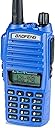
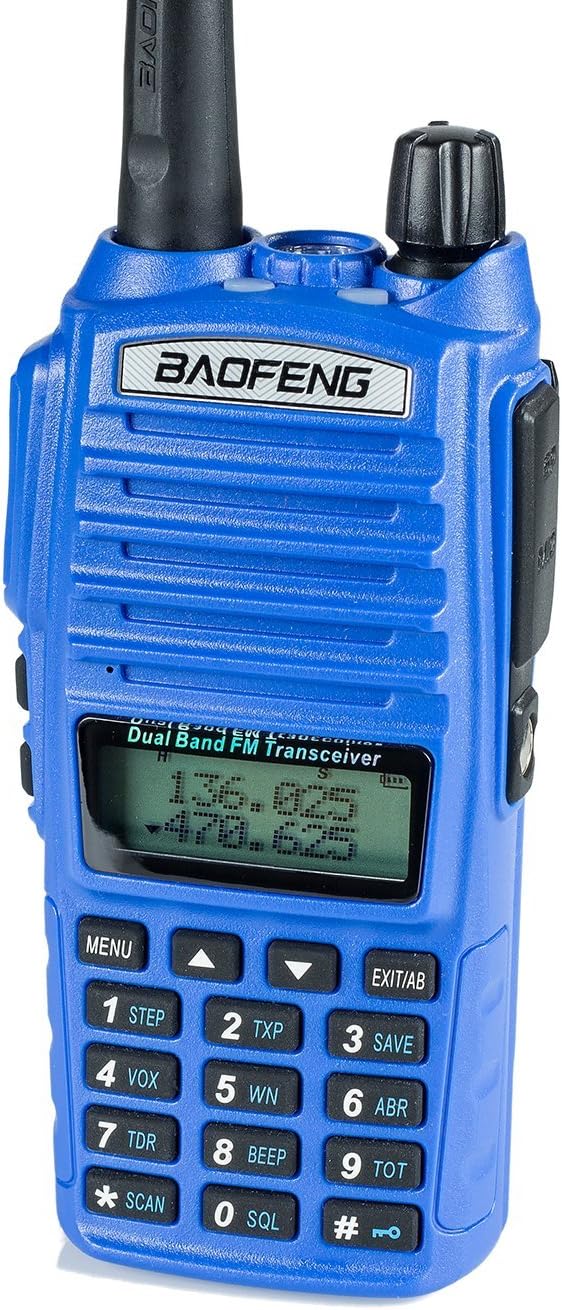
The BaoFeng UV-82HP (Blue) is a high-power, dual-band portable two-way radio operating on VHF (136-174 MHz) and UHF (400-520 MHz) frequencies. Featuring adjustable power settings up to 7 watts, a long-lasting 1800mAh battery, and 128 programmable channels, it offers professional-grade versatility and range. Its rugged, waterproof design and dual PTT buttons enable simultaneous monitoring and transmission on two channels, making it ideal for amateur radio enthusiasts and professionals seeking reliable, customizable communication gear with strong USA-based support.


| ASIN | B015D9OQDE |
| Additional Features | VOX Talk Around Mode, Waterproof |
| Best Sellers Rank | #109 in Portable FRS Two-Way Radios |
| Brand | BAOFENG |
| Built-In Media | UV-82HP Radio, 1800mAh Battery, V85 Dual Band Antenna, CH-8 Charger, CH-8 110V Adapter, Earpiece Kit, Wrist Strap, Belt Clip, User Manual |
| Color | Blue |
| Compatible Devices | CHIRP-compatible devices, audio accessories, potentially other BaoFeng/BTECH devices via software updates |
| Customer Reviews | 4.4 out of 5 stars 4,840 Reviews |
| Frequency Range | 136 - 174 MHz, 400 - 520 MHz |
| Global Trade Identification Number | 00685256254881 |
| Item Dimensions D x W x H | 4"D x 10"W x 7"H |
| Item Weight | 8 ounces |
| Manufacturer | BAOFENG |
| Mfr Part Number | UV-82HP BLUE |
| Model Number | UV-82HP BLUE |
| Number of Batteries | 1 Lithium Polymer batteries required. |
| Number of Channels | 128 |
| Special Feature | VOX Talk Around Mode, Waterproof |
| Talking Range Maximum | 60 mile |
| Tuner Type | UHF, VHF |
| UPC | 685256254881 |
| Voltage | 7.4 volts |
| Water Resistance Level | Waterproof |
O**T
Impressed with this feature packed radio!
The plethora of HT radios available can make choosing a first radio a daunting task. Having just entered the amateur radio world I didn't want to make a huge investment on my first purchase. I was originally looking at the UV-82 while I studied for my exam when suddenly this newly updated UV-82HP version showed up. The price was more but I figured I might as well go for the newest in the line. Some of the elites and purists will mock Baofeng radios as low-grade, cheap Chinese junk. Which is fine, everyone is entitled to their opinion. However, after looking at the reviews it seemed that many people were happy with their purchases. I don't know if it was that I wasn't expecting much but this little radio has really impressed me. The more I learn about amateur radio and the competition, I am finding that this radio is hard to beat, and for the price - can't be beat. Unboxing the radio I first noticed that the radio looks substantial and has quality feel in the hand. It certainly looks nicer in reality than it looks in the picture. I have a base model Baofeng 888s and this UV-82HP is finished much nicer and looks sharp. There is no shoddy workmanship visible. The menu can be a bit daunting until you learn what the menu titles represent, after that, things become somewhat self explanatory. I have read many complaints about the difficulty of programming the Baofengs. However, following the instructions on miklor-dot-com I was able to program a repeater into the radio manually. It won't be hard to commit these steps to memory. I also have used CHIRP software, which is fairly easy. The easiest however is RT Systems, which I would highly recommend. The three power settings are great. They can easily be toggled with one button operation on the keypad. I was hitting repeaters (high elevation) miles away while inside a building. My contacts were impressed that I was on handheld and reaching them. I did immediately replace the stock antenna with a thin whip Comet. This is the antenna that got me out so far to the repeater. I have two of the units and doing simplex in a densely populated area we were able to stay connected at least 1.5 miles. That may not seem impressive but in densely populated area with neighborhoods and buildings (Los Angeles area) I was impressed. After buying a roof-mount I was hitting far away repeaters with ease and my feedback was that I was coming in loud and clear. The dual channel display is easy to read and can be customized to light up in different colors from within the menu or through software. A real nice feature for this โcheaperโ HT is that it listens to two different channels and/or bands at the same time. The PTT button is dual also. Pressing the top button will have you transmitting on the A display channel and pressing the bottom of the button will have you transmitting on the B display channel. That is not something youโll find in some of the more expensive HT radios. Battery life has been great lasting me for days. Mostly listening with a few transmissions. It does a great job scanning which can be activating by pressing and holding a button on the keypad. The belt clip that comes with the radio is strong and substantial. The spring tension is impressive. I purchased a speaker mic for it. This was not dual-PTT that Baofeng sells but a single button. When using a single button speaker mic - if you have channel A selected you will be able to listen but not Tx. The trick to using a single button speaker mic when the dual PTT option is active is that you must have channel B (the bottom display) selected, doing so will allow you to both transmit and receive. This challenge is altogether avoided by purchasing Baofeng's dual PTT speak mic. I chose another single button brand though on a recommendation and it works fine for me. VFO mode is very easy to access. Just hold down the menu key and turn the radio on. I recently acquired a Yaesu FT-60. Yes, the superior Yaesu quality is immediately evident from the moment you pick it up and it is loads easier to manually program. However, the FT-60 costs over twice as much and still lacks some of the very nice features that the UV-82HP has. I have not used the Yaesu very much yet so I cannot give a full comparison. I may update this review at some point down the road to give some extra highlights and comparisons. One thing to consider is that the Baofeng UV-82 allows you to transmit on FRS/MURS/GMRS frequencies. You should know that it is not legal to transmit on these frequencies due to the fact that this radio has a removable antenna and that it transmits at a higher wattage than what is allowed. However in case of a serious emergency you are allowed to use whatever means available to you to get assistance. The UV-82 gives you that just-in-case option. The Yaesu FT-60 will allow you to listen on the FRS/MURS/GMRS bands but not transmit. I am very happy with this Baofeng. I will not hesitate to buy their products again in the future. For this price I donโt see how you can go wrong. Recommended.
A**Y
Great handheld radio
This might be the best BF handheld. Pros: - not locked, so you can program it to transmit on any VHF/UHF (including GMRS and MURS) - Easy to program / Chirp programmable - shell feels more durable; way more so than the UV-5R and its siblings - Power output is pretty close to advertised: 7/5/3 watts on VHF and 6/4/2 watts on UHF - screen is legible in sunlight - fits nicely in the hand (way better than UV-5R) Cons: - included battery doesn't support USB-C charging; need to buy a separate USB-C battery
A**L
Good radio, great value
I'm a long-licensed Ham with a General class license. I recententI got back into the hobby after many, many years away. My primary handheld is a Yaesu VX-6R, which I bought primarily because it's submersible and I can take it with me when I'm kayaking! So much of what I'll say here is as a result of comparing the two! But with that said, I'll cut right to the chase and say I really like the UV-82HP...I liked it enough to buy another one a week later!! Now, realize, the Yaesu costs 4X as much, which might at first glance make you wonder if the BaoFeng was going to suck in comparison! Well, it doesn't!! In fact, in terms of audio quality, and reported signal strength from contacts I've made on 2m and 70cm, they are indistinguishable from each other! With the same antenna, from my office, I can hit the same machines, get the same signal reports, and listen with more or less equal sound quality. Now don't get me wrong...I'm not saying it's a better radio than the Yaesu! For one thing, the Yaesu is a tri-band radio, and the BaoFeng is dual band! But still, for 1/4 of the price of the Yaesu, you get a lot! Dual band, dual view handheld. Dual PTT switch. More power. And, it includes accessories (desk charger, earbud with PTT switch) that cost extra for the Yaesu! These work well, though I cannot get the included foam sock over the earbud no matter how hard I try! Battery life seems good...definitely better than my Yaesu! So, if the performance on 2m and 70cm are equivalent, and given that the BaoFeng comes with stuff you don't get with your Yaesu, at 1/4 the price, you may be asking why anyone wouldn't choose the BaoFeng? Aside from the waterproofing and the third band capability, the big difference between the two is in how they're programmed. The Yaesu allows more options for storing and scanning memories, and it allows a lot more of them to be stored! For example, my Yaesu allows me to assign memories to one or more 'banks', and I can choose to scan all the memories, or a bank of memories, or more than one bank of memories. You can't do that with the BaoFeng UV-82HP...when you scan, you scan ALL the memories...and there's no way to omit a subset of repeaters (say ones that are in the Fort Worth area), when I'm home (near Dallas), or to omit the home repeaters when I'm in Ft Worth! And while I'm talking about scanning, I should mention that the BaoFeng scans memories very slowly. VERY slowly. Slow enough that I can read the names of the channels as it scans them. You're not gonna do that with the Yaesu...it scans several times faster than the Bao Feng. If you want to assign names to the memory channels on the BaoFeng, you can...but you have to do it using software and a computer, and upload it all to the radio using an interface cable! The Yaesu allows entering channel names without having to resort to the computer. To be completely honest though, you're going to want to program either one of these using a computer and an interface cable. Programming without one is possible, but it's a pain in the rump! Another thing I didn't care for was this; if you program the BaoFeng with your PC (using CHIRP, for example), and you assign names to the frequencies you enter into the memory channels, you lose the ability to see what frequency that channel is on! I programmed all the local repeaters with the name of the city they're in. For example, I named the repeater's IN Dallas as 'dall1', 'dall2'. But once I did that, I couldn't see what the frequency was, and I don't have them memorized. I want to be able to see what the frequency for a given channel IS, even if I have to press a button or two to display it,but you can't with the BaoFeng. To get around this, I programmed a duplicate of each channel...so channel one is named Dall1, and channel two, which is the same frequency, isn't named...So, as I'm scrolling through, every other channel is a named channel, and if I want to know the frequency, I scroll to the very next channel and I can see it!! This works pretty well...But, it cut the number of repeaters I can program by half! Since I started with 128 memory positions, if I do it this way, I cut that down to 64! I'm sure that I'll remove some of the lesser used machines eventually, and recover some slots! But it's something to think about, especially if you want to program other channels from other bands...like weather band channels, or police and fire frequencies, etc. About programming....Having to turn the radio off and then back on while holding the menu button to swap from frequency mode to channel mode is getting a bit annoying, but I suspect that will abate some as I finish programming the radio. The Yaesu flips between memory mode and frequency mode at the press of a button! On the other hand, I didn't find that programming the radio manually was all that difficult. It's at least as easy as programming my Yaesu. And the '0' is in the right place on this BaoFeng! As I was initially programming it (manually), it seemed like I was only able to save to a memory channel if I was in frequency mode. I don't know if this was true in all cases, or just saving to an empty channel, or what...but if you have issues saving to memory, or saving changes to an existing channel, it may be because you're in channel mode. I'm just throwing that out there as an observation...I haven't really dug into it to see what the specifics are. This particular BaoFeng model comes with a pretty decent manual. I was prepared for one that was basically worthless, and was pleasantly surprised! Ergonomically, I like this radio. It feels comfortable in my hand, and feels solidly built. I have never owned any previous BaoFeng radios, but I've heard that they were much cheaper feeling than this one. Be aware that when you get your BaoFeng, it's going to come with a couple of pre-programmed memories. I thought at first mine was used...but I saw a funny youtube video that indicated they're all this way. I did a complete reset for mine, and it wiped those channels clean. I'm taking off a star because of the limited memory channels, the limited scanning options, and the issue with not being able to see the frequency of a named memory channel. Nevertheless, I feel the UV-82HP is a good radio and a great value. If both of mine were lost or stolen, I'd buy two more to replace them!
J**H
Great Radio, Great value, fully programmable
I bought two BaoFeng UV-82HP radios for some outdoor adventures over the holidays. The radios came with two chargers, two headsets, and two sets of very detailed instructions written in actual English by a native speaker! Everything worked as advertised. I also ordered an adapter cable so I could hook my radios up to my laptop and program then with CHIRP software. The first time I hooked them up, I had to do some online searching for troubleshooting as the radio woudn't connect to chirp. I installed a couple drivers online, but I don't think this step was necessary, because it didn't resolve the issue. I turned off the radio, unpluged the radio from the cable, plugged it back in, powered it back on, restarted the CHIRP software, and IT SUDDENLY CONNECTED! My friend bought a TYT radio and he couldn't use chirp. His radio is great functionally, but he was pretty envious at how I could instantly reprogram both my radios via CHIRP in seconds, and to do the same would take him literally like an hour. After initial setup, we took the radios out for a field test. My friend was on his TYT handset, and had my second UV-82HP as well to compare as I drove away from the house with my UV-82HP. He read me loud and clear in the city out to about 2.5 miles on my UV-82HP, but lost me after that. I was in a vehicle in the city and he was inside my house. With his TYT and a 15" whip antenna, he was able to communicate with my BF UV82-HP out to 3.5 miles in the city. We were reading loud and clear both ways until 3 miles, and could still communicate at 3.5, though the signal was broken. On the highway, my friend and I used the UV82-HP for about 2 days of intermittent transmitting before I exhausted the battery. I don't know the exact runtime in hours, but suffice it to say these batteries will last through a full day of constant use easily. All our transmissions were loud and clear from vehicle to vehicle, and I never want to do another roadtrip without my BaoFeng!. In the outdoors, we never reached a distance at which our signal became broken. On your average hiking trip, where you become separated at most by about a mile, you can easily communicate with these radios on medium, and usually low power! We rarely even used high power. I estimate the distance of the radio on high power outside of a vehicle in the forest if not separated by mountains is at least 3 miles, which is a LONG ways in the woods. For the price, the radios are an outstanding value. They are super easy to program and use, and function very well in the hands of a beginner like myself. These were my first ever radio, and it took no time at all to get them up and running, and even communicating with other radios using unique privacy tones at specific frequencies. I recommend these for you first radio. The price is equal to the super cheap box-store radios with 2W max power, but these easily outperform them. You can't go wrong with these radios.
T**R
Outstanding Value
I have been a ham for 50 years but this is the first handy-talkie I purchased for amateur bands. I am generally not a fan of HTs. I have operated and serviced many VHF and UHF HTs back in the day. So, this review is probably biased a little bit towards what I've seen in commercial and industrial applications. Without considering the extra features for ham use, the Baofeng UV-82HT checks most of the boxes. Overall, it seems like a good radio. But, as some say, the devil is in the details. There are some great features and in my opinion some warts. That said, let's get to it. I think the great features (not necessarily unique) are: User Manual is well written and illustrated in English, and is actually helpful! Dual Push to Talk (PTT) / Dual Watch This is fantastic. One can monitor two frequencies at once: UHF/VHF; VHF/VHF; or UHF/UHF. To transmit to one or the other just press either the A or B PTT as applicable. A question is what happens if both have a signal at the same time? If you don't want this feature it can be turned off. Three programmable transmit power levels: High-Medium-Low For VHF: H=8 Watts, M=4 Watts, L=1 Watt For UHF: H=7 Watts, M=4 Watts, L=1 Watt Battery Voltage Display Press the โ0โ key for about 2 seconds and battery voltage is displayed; for example, DC8.2V It also displays the legacy battery ICON with bars to represent battery reserve. Ability to listen to broadcast FM, NOAA Weather, etc Press the F key below the PTT and listen to some tunes on FM Radio while your favorite repeater is idle. Reception of a signal on your active channel will interrupt broadcast FM radio and put you on the active channel. You won't miss a call. FM reception will resume after a little delay when the VHF/UHF signal ends. There is a scan feature for FM that will stop when it gets a signal, regardless of which scan mode is programmed. NOAA weather can be programmed from the keyboard in VFO mode or with software. With software you can skip the scanning of this channel. There is a built-in LED flashlight on top of the radio that can shine steadily or strobe. Comes in various colors How cool is that? I bought a blue one. Some of the warts Squelch threshold adjustment, or the lack thereof? The adjustment is made by programming a digit (0-9) into menu 0. The default setting is 5. Programming a 0 will open squelch continuously. I have tried different digits and there is little change in squelch threshold. Recently a weak, fading signal on 2 meters kept opening the squelch when nothing but noise could be heard. It could not be squelched โ no matter what I programmed. Annoying! Like audio volume, squelch adjustment works better when analog. A dual concentric audio/squelch pot would be great. Scanning / Memory โ Channel Mode There are 128 channels that can be programmed with either a VHF or UHF frequency, CTCSS, etc. However, the scanning rate is 3 channels per second. Obviously, scanning a large number of channels is impractical. You will probably want to scan only a dozen or so. A given frequency must be stored in a memory to scan it and each channel in memory will be scanned unless programmed to skip. With CHIRP this is easily done by placing an S into the skip column of the channel table. It doesn't appear to be possible to skip scanning a channel by a keyboard entry. VFO Mode Awkward and cumbersome. It enables manual programming via the radio keypad. The user manual suggests VFO mode is useful for experimenting in the field and programming is somewhat difficult at first. I would say its painful. You must first specify a vacant memory channel. This is problematic. You can scroll through the memory channels: 1,2,3... or enter a channel number from the keypad, but I have found no way to determine which, if any, channels are empty. Once programmed, a channel cannot be edited using the key pad. The channel must first be deleted. This insures that an existing cannot be overwritten. Scanning is possible in VFO mode. It can scan by incrementing the frequency in fixed steps as programmed in menu 1, STEP โ Frequency Step. This scanning mode is very slow and probably not practical for many. Radio Case and Battery Case The radio case is pretty solid and feels good in the hand, but the bottom is not flat. There are two plastic nubs on the bottom of the case and two more on the bottom of the battery. There is also two rectangular depressions, one in the battery, another in the radio. If you set the radio upright on a hard surface it is unstable and can easily fall over. Not cool! Charger When placed on a hard surface, the charger can slide easily. There are four circular ridges on the bottom presumably for feet pads, but no pads were provided for my charger. Not a huge deal, but I fume when the charger, along with my radio, slides around with the slightest touch. Finally, the LED on the charger is red while charging, green when finished charging, and flashes multi-colors when you remove the radio. OK, maybe this is not a wart, but it annoys the heck out of me and it attracts small children. Why not just turn the LED off? Summation Any design involves compromises between performance, features, aesthetics, price, etc, leaving room for improvement. I think the UV-82HT is designed with a good mix of compromises. The radio has more features than I will likely use. It is very flexible. I have not tested any performance specifications. Perhaps I will in the future. Meanwhile, I can enjoy operating it. I like it a lot. It is an outstanding value. I give it 5 stars and my recommendation without hesitation. 73
B**Y
Good radio for visually impaired
This review is from the perspective of a totally blind person who is also a longtime ham. I sold all of my ham gear about 15 years ago, when I lost my eyesight. We recently moved to a new State and I thought that getting on the local repeaters might be a good way to meet some local hams and build some new friendships. I wanted a 2m portable radio that was at least partially accessible for me. Naturally, I sought out the offerings from the big three plus Alinco. I had previously owned portables from Yaesu, Kenwood and Alinco and they were all wonderful radios. The only currently available radio that I found with any accessibility built-in is the Kenwood THD-74 at over $600. That was well out of my $300 budget. I then began reading about the radios from China and learned that some have partial accessibility built-in. I did a lot of research and Baofeng was a very popular brand. After many hours of research, (too many hours for a $63 purchase) I settled on the UV-82HP. I have only had the unit for a week, so I cannot comment on how well the radio will hold up in the long run, but so far I am very impressed. This radio feels solid in the hand, not like a cheap toy from China. The volume control is solid and the buttons on the front and side, feel and work very well. While I have not yet transmitted with the unit (other than to key up the local repeater) the reception and audio quality are excellent. I have been listening in on the regional fire dispatch and it is loud and clear. I charged the unit on the day that I received it and have not charged it since, which is 6 days so far. Of course, if I was doing more transmitting, it would certainly require more charging. Speaking of charging, I did experience one problem and that was with the charging base that shipped with the radio. It was nearly impossible to insert the battery into the charger. It required excessive force to both insert and remove the battery. I contacted the seller, Baofeng Tech, and they sent me a new charging base and wall wart. The new base is much better and the radio easily slides in and out of the base. I was impressed with the level of service from BT and that is why I did not hesitate to give this product a five star review. There are resources on the Internet that provide info on using the UV5R as a blind person. I was able to apply much of that information, along with some excellent YouTube reviews, to get up to speed with the UV82HP very quickly. I did send a note to BT, asking them to consider two additional accessibility enhancements. The first would be to have the voice announce either A or B when switching between the two VFO displays. The second would be to program one of the buttons to speak the frequency or the individual letters of an assigned channel name. I do not believe that this would be very difficult to accomplish and would make a huge difference for a visually impaired user. As a screen reader user, I decided to purchase the RT Systems programming software and cable. I was able to quickly learn the software and program in my desired frequencies. It is necessary to use the software with the NVDA screen reader, as it does not work with JawsโI tried it. Be aware that there are sections of the software that are not accessible using NVDA, but the sections most important to getting the radio programmed are accessible. I always treat my electronic items with care. I feel that this radio will last me a long time, if I treat it well. After my brief experience with this Baofeng product, I would not hesitate to purchase another of their higher-end radios.
R**S
New BaoFeng 8 watt HT is very nice and affordable buy!
As a Baofeng radio fan, I was very interested in trying out the 8 watt new UV-82HP. I currently have 2 UV-5R HT's and a BTECH UV-5001 (50 watts of VHF fun) and love them all. The new 82HP was very nice looking as I took it out of the box. It was just as small as the UV-5R radios but has the bigger Volume button on top. The volume knob is a bit difficult (tight) to rotate to increase the volume and I'm not sure if it's just a slight part defect or like that on all of them now. I manually worked a lot of the tightness out by repeated motion. Using my old data cable from my UV-5R radios, I interfaced with my laptop running Debian Linux, and started up CHIRP. I downloaded the baseline image from the new radio to keep and then imported my old image (from my working UV-5R) with dozens of preset channels into the 82HP image. I was shocked but this actually worked and then I uploaded the image to the new radio. After restarting the radio, it showed all my old channels...excellent. The only thing I don't like is the new 'rocking PTT' button, which by default, is set to use VFO A if you press the top part of the mic button or VFO B if you press the lower part of the PTT button. If you want to set it to just do one PTT function as a whole, you HAVE to have the programming cable to set the flag. You cannot use the MENU button to do it which would have ticked me off if I hadn't already had one. You can then use the EXIT/AB button to switch the dual channel to the one you are TX on. Overall, for the price, you can't beat their products. I will say that I like the UV-5R much better when it comes to functionality and knobs so Baofeng needs to simply upgrade that model to 8-10 watts to have a huge winner. Almost forgot, as you learn in all of your FCC classes, the antenna is the most important item in your inventory...and that applies here as well. Ditch the rubber duck default antenna and get a good replacement immediately. I always use the Nagoya NA-771 15" female SMA replacement on my Baofeng radios and it's the bomb for RX and TX. SPPQ Original Nagoya NA-771 SMA Female Dual Band Whip Antenna VHF/UHF (144/430Mhz) For BaoFeng UV-5R UV-82 GT-3 And Kenwood Wouxun Radio [15.6In ]
D**Y
Great Radio at the price point!
There's been much praise given to the UV82HP and count me as one that gives this radio thumbs up. At this price point, I cannot find anything seriously wrong with it. Its perfect for analog VHF/UHF with my ham ticket. My unit puts out ~6.8W on high and 3.8W on Medium, but spot on 1W for low. Signal reports are good. Compared to other BaoFeng radios, I think this one is one of the best. That extra 2 watts can really be handy at times. Sometimes you can find the radio on discount (I bought one at $40 during Black Friday!) I'll give pros and cons from my perspective: Pros 1. Inexpensive but solid HT. 2. 1 watt audio. This speaker is loud and is surprisingly distortion free at high volumes. Don't underestimate how important this is when using it mobile or in a noisy outdoors environment (like the beach). Those lesser power speakers don't match 3. Crisp responsible alphanumeric buttons 4. Free and easy to use programming software (CHIRP) 5. Tx/Rx on full frequency range. MARS/CAP! Careful... it may not be legal for you to Tx on those ranges, but its certainly there for emergency scenarios. 6. Battery life. Used this all day, Tx and Rx cycles about 20/80. Battery was still at 50%. 7. Kenwood-style speaker mic connector. - Good solid fit. 8. Inexpensive accessories. 9. Inexpensive radio. Break it? Get it wet?.. get another! CONS: 1. Two stage PTT button is a bit flimsy. Might break down the line 2. Manual programming is not intuitive. Software to program is a must (but hey, its free! 3. Programming/cloning cable has too many crappy Prolific clones out there. Tempting to buy due to low price, but not worth the headache. Get a real FTDI serial cable (>$20) and its worth it. Why a con? Cable costs 1/3rd of what the radio does! 4. Display. Hard to read with backlighting. Not that great for night or mobile use. Not bad enough that it's a deal killer 5. The "Flashlight" is a joke. Might be fine to find where your keys fell under your car seat, but first you need to find the on button for the radio... 6. FM broadcast reception is mediocre at best, probably due to the limited antenna bandwidth. I wouldn't consider this a feature 7. No way to enact the backlight without hitting the PTT or other buttons. Needs dedicated backlight "on" button 8. Not terribly resistant to intermod. Watch out in RF heavy areas 9 Weather resistance? Not in the slightest. 10. Only 128 memory channels. Very limited, especially if you travel like I do. Wishes: 1. Make a USB charger for the unit. Only a wall adapter, battery free with 12V car plug and a strange AAA battery case exists. This would be a great Go Bag radio if it had the ability to charge from a USB cable. 2. More accessories please! Comments: 1. There's a lot of confusion I encounter about what this radio is "legal" to use for in the US. Regardless of what others say, it is LEGAL to Tx on the VHF/UHF Ham bands within your Ham radio license permissions (assuming you have an amateur radio license). It is NOT legal to transit outside those ranges unless you are LICENSED to do such. These radios can Tx on FRS, MURS and GMRS frequencies. The first two services it is NOT legal to Tx on it. With GMRS, the radios need to be FCC Type approved. These radios are not. The "narrow band FM" on these radios do comply with the MURS narrowband requirements, but they are not type accepted to do such in the US. Lastly, you do NOT need a license to Rx (monitor only) ANY frequency these radios can receive. 2. Legalities aside, having a radio that *can* Tx on those outside frequencies is definitely a benefit for use during an emergency or disaster scenario. It is LEGAL to transmit on frequencies you are not usually licensed or type-accepted to do such in a life-threatening or disaster scenario. All that said, I'm very glad I've got these HTs in my arsenal. Very good for the price!
Trustpilot
1 month ago
2 weeks ago