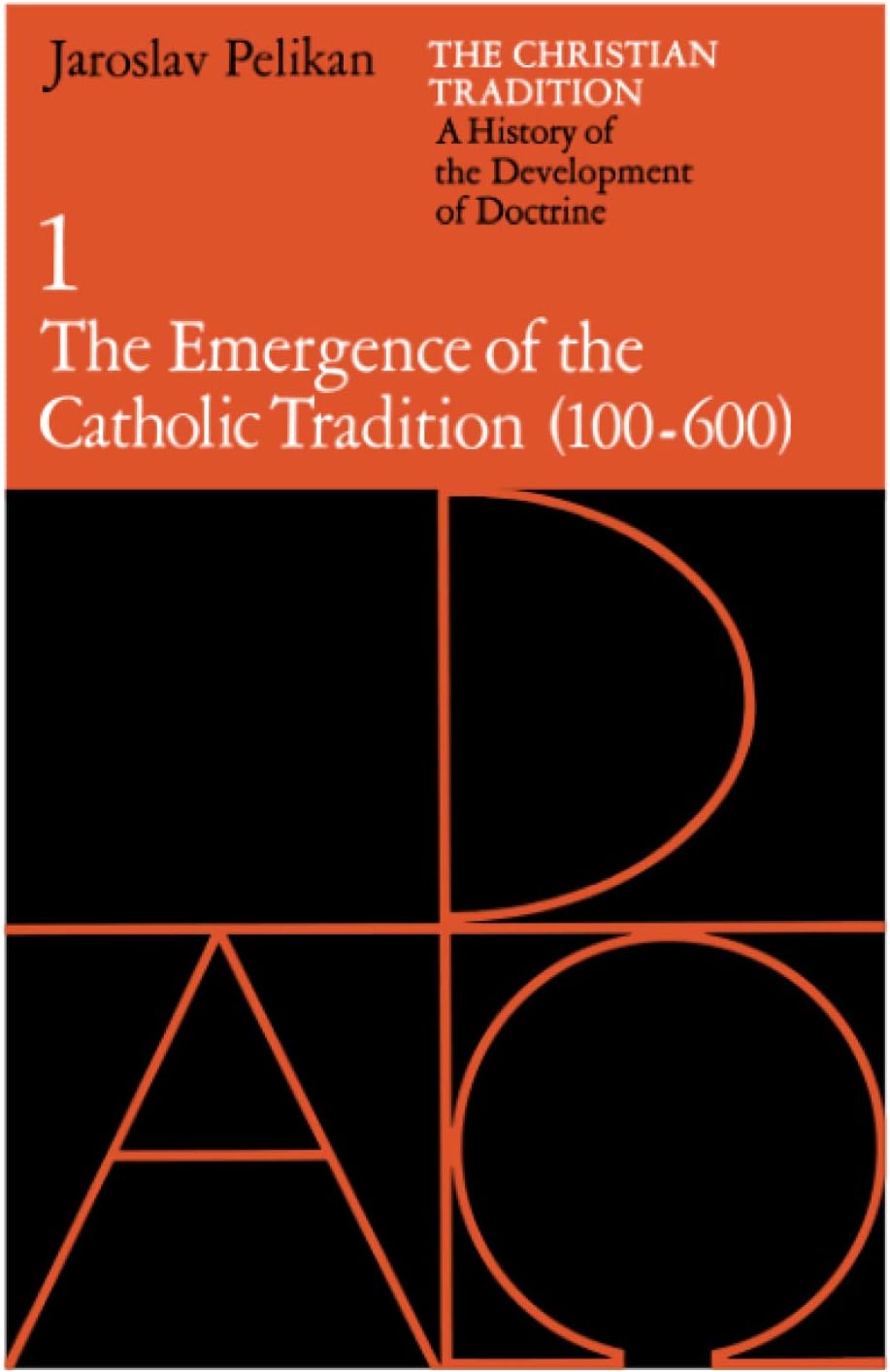
The Christian Tradition: A History of the Development of Doctrine, Volume 1: The Emergence of the Catholic Tradition (100-600) (Volume 1)
Product ID: 7624392
Desertcart purchases this item on your behalf and handles shipping, customs, and support to USA.
The first volume of a magisterial survey of the entire history of the Christian tradition, this volume focusing on the emergence of Catholicism In this five-volume opus Jaroslav Pelikan traces the development of Christian doctrine from the first century to the twentieth. Review: Magisterial Work on History of Christian Doctrine, Vol. One - Dr. Pelikan takes the jumble of early Christian writings, both orthodox and heterodox, and weaves from them a sensible history of the development of Christian Tradition. This is not a "history" as such in which game pieces move here and there along a strict chronology; Pelikan is less concerned with the Church councils than what people professed before and after the councils. This is also not recommended as an introductory text to the history of theology. I'd recommend first Henry Chadwick's "The Early Church" (a more accessible and linear history), then J.N.D. Kelly's "Early Christian Doctrines." Pelikan's is a much more detailed work. In this first volume, Pelikan sets the stage by describing the religious and philosophical milieu into which Christianity was born, and from which Christianity inherited so much. Anyone who believes that the history of Christian doctrine is a thick, black, straight line may be suprised at the nuances and odd directions that doctrine took among some persons in some places at some times. Also, to what degree did eventually heterodox persons play in the development of orthodox doctrine? Example: Pelikan has some interesting observations of Tertullian's proto-Montanism vis-a-vis the personality of the Holy Spirit and the development of trinitarian thought. And while not a major criticism, Pelikan is a little weak when it comes to the Aramaic influences in very early Christian thinking; check out Fr. Joseph Fitzmyer's various Dead Sea Scrolls studies for that important aspect. Pelikan's strengths, and they are significant, are in the tracking the development from Paul and other early Christians of the separation of Christians from "law" into "grace," and the effects of that movement with regard to salvation. He also tracks the development of Christology, stopping along the way to examine variant thinking (such as "angel Christology") that reflected other competing traditions. How was Christ divine? How was Christ human? Pelikan examines how early Christians answered these questions and reconciled the apparent paradox. Of tremendous interest to me was the section on "Nature and Grace." What is "sin"? And how does the Christian reconcile his responsibility to live *as* a Christian and also acknowledge God's sovereignty? Pelikan steps through the written deposit of early Christian thinking of the first 600 years - some calm, some polemical and filled with the hyperbole that comes in the struggle to be heard - and organizes it for both the scholar and the enthusiastic and somewhat informed ordinary reader. Pelikan also retains a delightful balance, always knowing what the value of his work is. Before launching into this five volume work that will occupy so much of his professional life, he observes in the first lines of this volume that "doctrine is not the only, not even the primary, activity of the church. The church worships God and serves mankind, it works for the transformation of the world and awaits the consummation of its hope in the next. 'Faith, hope, love abide, these three; but the greatest of these is love' - love, and not faith, and certainly not doctrine." Amen, Dr. Pelikan. Still, this *is* a work on the development and history of doctrine. I accept it for what it is, and, that, it does very, very well. Review: Very Good! - I purchased this book based on the high amount of good reviews it has received in the past, and I was in no way disappointed! Pelikan did a great job making top notch scholarship easy to follow along with and I learned a ton. This book is split into seven chapters, all of which are well put together and masterfully thought out. The main point of this study was to overview the doctrines of the church throughout history, not study the actual history that was going on during the times that doctrines were developed. This makes it even more interesting because dates and places are not often mentioned, mean that the book is very much focused on a long line of evolving thought as opposed to random events and places. There is a lot of cool information that made this book worth it. For example, I had never known that Tertullian was a Montanist, I never knew that Augustine so readily defended infant baptism, plus I got a front seat primer on Cyril of Alexandria's major beliefs (which I sort of knew, but I got details), plus more!!! I cannot recommend this book enough! I can't wait to crack open the second one!
| Best Sellers Rank | #231,856 in Books ( See Top 100 in Books ) #841 in History of Christianity (Books) #1,116 in Christian Church History (Books) #4,075 in Christian Theology (Books) |
| Customer Reviews | 4.6 out of 5 stars 147 Reviews |
S**N
Magisterial Work on History of Christian Doctrine, Vol. One
Dr. Pelikan takes the jumble of early Christian writings, both orthodox and heterodox, and weaves from them a sensible history of the development of Christian Tradition. This is not a "history" as such in which game pieces move here and there along a strict chronology; Pelikan is less concerned with the Church councils than what people professed before and after the councils. This is also not recommended as an introductory text to the history of theology. I'd recommend first Henry Chadwick's "The Early Church" (a more accessible and linear history), then J.N.D. Kelly's "Early Christian Doctrines." Pelikan's is a much more detailed work. In this first volume, Pelikan sets the stage by describing the religious and philosophical milieu into which Christianity was born, and from which Christianity inherited so much. Anyone who believes that the history of Christian doctrine is a thick, black, straight line may be suprised at the nuances and odd directions that doctrine took among some persons in some places at some times. Also, to what degree did eventually heterodox persons play in the development of orthodox doctrine? Example: Pelikan has some interesting observations of Tertullian's proto-Montanism vis-a-vis the personality of the Holy Spirit and the development of trinitarian thought. And while not a major criticism, Pelikan is a little weak when it comes to the Aramaic influences in very early Christian thinking; check out Fr. Joseph Fitzmyer's various Dead Sea Scrolls studies for that important aspect. Pelikan's strengths, and they are significant, are in the tracking the development from Paul and other early Christians of the separation of Christians from "law" into "grace," and the effects of that movement with regard to salvation. He also tracks the development of Christology, stopping along the way to examine variant thinking (such as "angel Christology") that reflected other competing traditions. How was Christ divine? How was Christ human? Pelikan examines how early Christians answered these questions and reconciled the apparent paradox. Of tremendous interest to me was the section on "Nature and Grace." What is "sin"? And how does the Christian reconcile his responsibility to live *as* a Christian and also acknowledge God's sovereignty? Pelikan steps through the written deposit of early Christian thinking of the first 600 years - some calm, some polemical and filled with the hyperbole that comes in the struggle to be heard - and organizes it for both the scholar and the enthusiastic and somewhat informed ordinary reader. Pelikan also retains a delightful balance, always knowing what the value of his work is. Before launching into this five volume work that will occupy so much of his professional life, he observes in the first lines of this volume that "doctrine is not the only, not even the primary, activity of the church. The church worships God and serves mankind, it works for the transformation of the world and awaits the consummation of its hope in the next. 'Faith, hope, love abide, these three; but the greatest of these is love' - love, and not faith, and certainly not doctrine." Amen, Dr. Pelikan. Still, this *is* a work on the development and history of doctrine. I accept it for what it is, and, that, it does very, very well.
F**N
Very Good!
I purchased this book based on the high amount of good reviews it has received in the past, and I was in no way disappointed! Pelikan did a great job making top notch scholarship easy to follow along with and I learned a ton. This book is split into seven chapters, all of which are well put together and masterfully thought out. The main point of this study was to overview the doctrines of the church throughout history, not study the actual history that was going on during the times that doctrines were developed. This makes it even more interesting because dates and places are not often mentioned, mean that the book is very much focused on a long line of evolving thought as opposed to random events and places. There is a lot of cool information that made this book worth it. For example, I had never known that Tertullian was a Montanist, I never knew that Augustine so readily defended infant baptism, plus I got a front seat primer on Cyril of Alexandria's major beliefs (which I sort of knew, but I got details), plus more!!! I cannot recommend this book enough! I can't wait to crack open the second one!
T**L
History/theology of the early unified church
First volume of a great history of christianity/theology, nicely written, and scholary with enough depth for serious students of church history, but accessible to general reader of history. This volume covers beginning of Christianity of the unified church. I also have the volume on rise of the orthodox church.
M**E
a treasure that will last a lifetime
Jaroslav Pelikan (1923-2006) was an international treasure, and one of the greatest of American scholars. The author of very many books on Christian thought and culture, his 5-volume series 'The Christian Tradition' is his very finest — and this first volume is the best in that series. If you intend to be a pastor or preacher — or just a thoughtful, reflective Christian — this will last you a lifetime, and will never go out of date. And whatever your theology or tradition, you will not be able to complain that he has dealt with you unfairly. His summaries of theological tangles and conundra are never less than careful, judicious, and charitable. A friend bought me this series when I was a graduate student, and I have consulted it countless times since — when preparing brief summaries for my own students over the decades; as a reliable guide to which to direct them; and sometimes, when unsure that I have understood some theologian or some issue correctly, to set me gently back on course. I can think of almost no more pressing addition to the library of anyone embarking, whether formally or informally, on theological studies — and no better rescue from the parochialism of books that merely reflect one's own denomination or particular sub-tradition.
S**9
Quality Work, Not the Easiest to Read
I believe as someone else had pointed out, the quality in terms of accuracy and insight is top notch. The readability isn't as friendly. His thesis is that Christian Doctrine is what the Church has believed, taught, and confessed based upon the word of God. He certainly leans on the historical elements and dwells deeply from early Christian writers, thinkers, and the Scriptures as they would have been understood in the context of history. This text should not be seen as a chronology of historical data that covers every thinker or writer since the time of Jesus, but the development of how we arrived at certain positions on certain matters as a result of historical situations relating to Christian theology and doctrine and attempts to help you arrive at an understanding to be more faithful in articulating a defense for the faith you have as a Christian.
V**.
A must-read, the best introduction to the thought of early Christianity
I don't think that the English language has a word that is sufficient to describing just how excellent this book is. Every Christian and, really, every non-Christian should have to read this book. Pelikan describes in a good amount of detail, but in a nonetheless very approachable and readable manner, the development of doctrine from the close of the Apostolic era through to the time of St. Augustine, St. Gregory the Great, and the Fifth Ecumenical Council, hinting at the developments of both East and West slightly beyond. His approach is wide and his views are always fair and balanced. A very helpful feature of the book is the sidenote approach where, rather than in-text citations, footnotes, and endnotes, Pelikan instead lists the sources of his quotations and summaries to the side of where they are given. I'm looking forward to reading the rest of the books in this series. I cannot recommend enough reading this book, no matter your own personal doctrinal or non-doctrinal views.
J**R
Good but difficult read
Very good read. But you'll need more than the average reading level of 8th grade. In the book Pelikan repeatedly points out two things (unintentionally): 1. That the Modalists were the original Christians and 2. That early Modalists called themselves Trinitarian. He also points out that a large number of bishops at Nicea were Semi Arians and actually preferred Homoiousia over Homoousia which confirms what Bishop Jerry Lynn Hayes says in Godhead Theology. Solid 9 out of 10.
A**R
Buy it, you will not be disappointed.
I have only read the first book of this five-volume set, but Dr. Pelikan’s research is exhaustive. I found his writing to be a delight because of its readability. If this were a novel, you might call it a real “page turner.” As a post graduate student who has read more books than I can count, I can easily say that this is one of my favorites. No matter what your reason is for buying this book you will not be disappointed. Bon appetite!
T**N
Big thumbs up!
Phenomenal in depth and breathtaking in scope. Yes, it’s from the 1970’s and research may/has added more to the conversation since. But still, Pelikan’s work is a must for those exploring the topic. This is the first of five volumes, the others dealing with the subsequent eras after this. This has certainly whet my appetite for the others.
Trustpilot
3 weeks ago
2 months ago