Buy anything from 5,000+ international stores. One checkout price. No surprise fees. Join 2M+ shoppers on Desertcart.
Desertcart purchases this item on your behalf and handles shipping, customs, and support to USA.
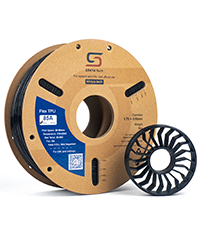
🖤 Flex your creativity with Siraya Tech’s toughest, most reliable TPU filament yet!
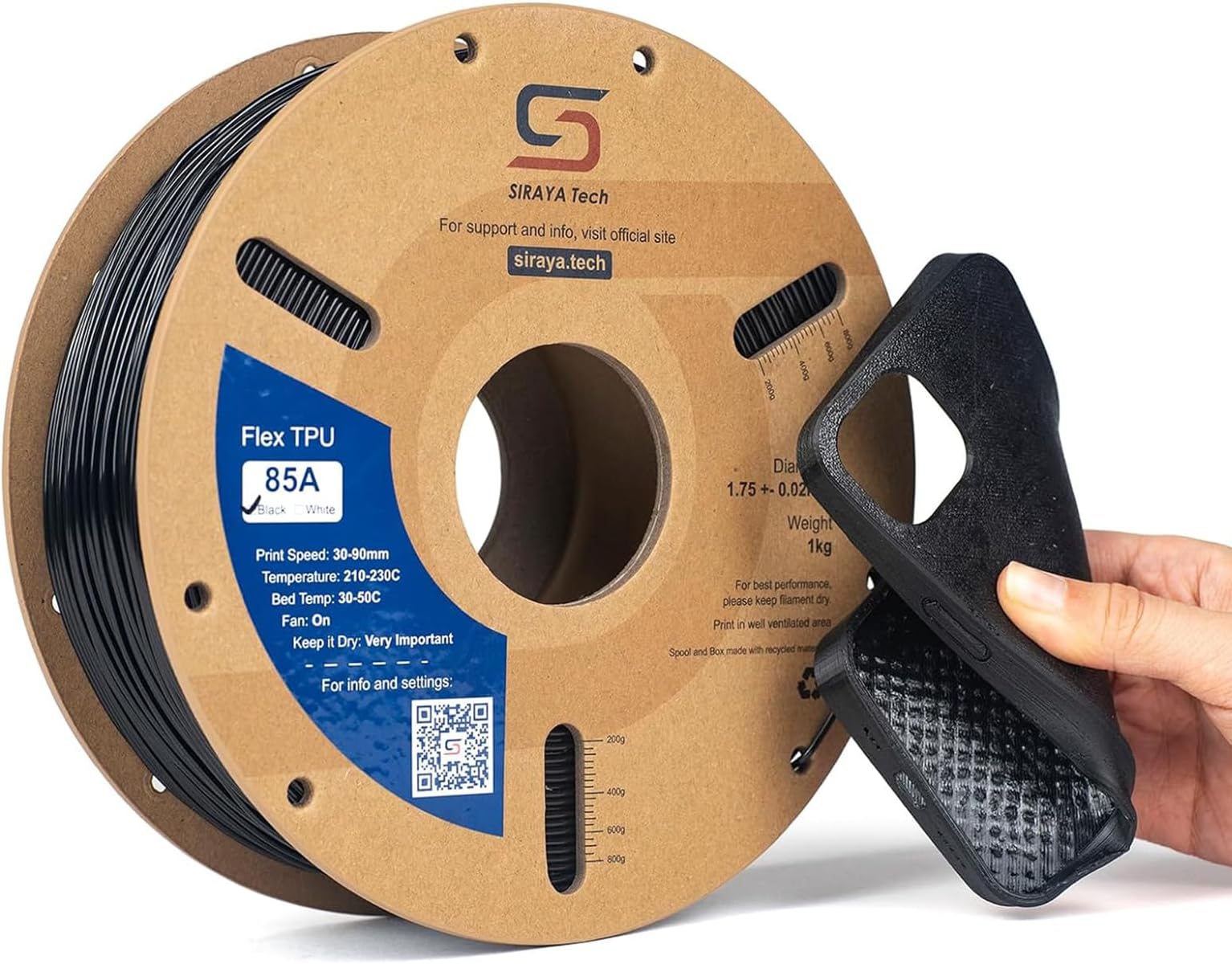
Siraya Tech Flex TPU Filament (85A Shore) offers a premium blend of flexibility and toughness, ideal for producing durable, bendable 3D prints. Packaged in moisture-resistant aluminum resealable bags, it ensures consistent print quality and a shelf life exceeding 3 years. Compatible with most FDM 3D printers, this filament is perfect for applications ranging from custom footwear to protective gear, delivering smooth extrusion and superior adhesion for both beginners and experts.


| Brand | Siraya Tech |
| Colour | Black |
| Item Diameter | 22 Centimetres |
| Item Weight | 1 Kilograms |
| Material | Flex TPU |
| Special Feature | High Flexibility & Toughness, High Flow & Speed, Moisture-Resistant Packaging, Biocompatibility Testing Special Feature High Flexibility & Toughness, High Flow & Speed, Moisture-Resistant Packaging, Biocompatibility Testing See more |
1**3
Good first impressions
So far I'm quite impressed. There are some limitations as expected, but still a great filament at a good price. FYI Layer lines in the photo are much less noticeable in real life. (0.2mm layers) Pros: - Soft and scales with temp as advertised - Texture: normal TPU is quite glossy and ugly, and tends to show off lartefacts. This is matte a slightly bumpy surface similar to CF/GF filaments, which looks great and hides layer lines well. Feels nice too. Makes it pick up dirt as well though, maybe white is not the way to go here. - Profiles: Provided filament and process profiles for the 240C/250C/270C on the Siraya website worked really well for me (using X2D with H2D profile) - Accuracy: Surprisingly accurate, even fine details are retained well (if not spoiled by stringing) Cons: - Stringiness. Much worse than typical 95A TPU. As soon as you have multiple elements it travels between per layer it oozes all over. It looks worse than it is, you can pull of most of it, but some stick to the rest of the print. Seams can look bad as well. - Flakes: produces fine filament flakes that are bit of hassle to clean - Bridges/overhangs: Not TPUs strong suit, but here it basically can't do it at all. Worse the softer you go. It can do fairly steep angles well (~60° for 250C, ~70° for 270C), but even small overhangs like the edges on the side of the benchy or the minor bridges on the ball, which are fine on TPU 95A have strong artefacts. Tested with X2D and 0.4mm nozzle.
E**L
Great for hard case tool inserts
I bought this to try making custom hard case inserts, similar to another reviewer. I was largely unsuccessful getting this to print at 270C on my 0.4mm nozzle (it immediately clogged), but after switching to 0.6mm I have had no issues at all. At the 270C settings, this material really can't do overhangs, but after doing some testing I found that it works fine at 15% infill with 4+ top layers. At lower infills or fewer top layers, the infill texture shows through and there can be gaps in the top layer. Because of the foaming aspect, prints seem to use less filament than if printed in regular TPU. The texture of the finished product is similar to EVA foam and looks very clean after cleaning up some errant strings. It is perfect for my use case, and it's so nice being able to print an exact fitting insert! In the past I used sheets of packing foam, and it always was a pain trying to cut an exact fit while maintaining a clean look. Since the surface comes out relatively smooth it's also easy to wipe clean. TLDR; this stuff is great!
R**T
Minimal Flex but Maximum Resilience.
What I printed with it: Robot grippers: We have some Delrin robot grippers that occasionally get shattered from robot crashes (shown in blue). I am trialing this stuff as a replacement (shown in black). The other engineers are always skeptical of printed parts for high-use industrial replacements, as they assume printed stuff is fragile. I let them take a hammer to these without any effect; very few materials can survive a hard-edge impact like a hammer blow. The material was dense enough to hold a part steady but has just enough give to survive some impacts, I think it is a good candidate for this application. Timing belt: I work 3rd shift, and we had a timing belt go out on a conveyor, no replacements in-house, and no place to go buy a replacement, given it was the middle of the night. As always, our production can't stop; so the operators slid parts down the line, and in the meantime, I was able to model and replace the belt within a few hours. The belt I made was left on for approximately 8 hours without issue before replacing it with a genuine belt. The printed belt looked unphased in the end and clearly could have lasted much longer. I do understand this would not be as strong or long-lasting as a real belt because those have nylon strands running the length of the belt, but for an emergency short-term fix I was very impressed that this worked as well as it did. The feel: Naturally rough feeling surface texture (think of it like default fuzzy skin), it is not especially grippy like you may imagine from a rubber or silicone, as it feels more like a timing belt. This stuff is dense, very hard, with a tiny bit of flex if you make your geometry thin enough (Like 2mm or less ), and it doesn't really compress or bend much at all. Easy to print: It is a TPU and a fiber fill, so you should dry/ keep it dry (mine arrived ready to use in a foil and vacuum sealed bag, but still a good idea to dry to be sure), It is AMS compatible, thank you! At least with my Bambu H2D, as it is stiff enough to use in an AMS. I just used the Bambu PETG translucent as a profile starting point and added the manufacturer's recommendations onto that. As with all fiber-filled filaments, you need to use a hardened nozzle and know it will eventually wear on some of the consumable components. What to use this for? It is not going to work in most applications you think of for TPU or flexible filaments, as it is simply way too stiff, and doesn’t stretch, but if you need something that can take a beating, this is your material.
P**.
Prestazioni e qualità sorprendenti, ma il filamento deve essere asciugato perfettamente.
Ho già il Filaflex 82A di Recreus, che la mia Qidi Q1 Pro gestisce senza difficoltà; dato che quello è un filamento di grande qualità ma anche costoso, ho voluto provare il Siraya Tech 85A per realizzare componenti più "economici", come ad esempio guarnizioni di grandi dimensioni. Con sorpresa devo dire che il materiale mi ha veramente sorpreso: ha una consistenza assolutamente inaspettata, molto simile a quella della gomma siliconica e quindi molto flessibile. Anzi, la morbidezza del materiale mi è parsa maggiore di quella del Filaflex, nonostante secondo le specifiche tecniche non dovrebbe essere così. Aggiungo altre due proprietà molto interessanti del materiale: se stampato su piano liscio, ha notevoli proprietà antiscivolo anche su superfici bagnate (è ottimo per suole o inserti anti-slittamento); se stampato su piano liscio e in lastra sottile aderisce a vetri ed altre superfici lisce (come il metallo lucido) rimanendo appeso anche in verticale. La stampa è agevolata dal fatto che il produttore consente di scarica dal proprio sito web i profili di stampa già pronti per diverse stampanti 3D: quello della Q1 Pro non era presente, ma ho scaricato quelli per Bambulab e Flashforge, adattandoli senza problemi. Il risultato sono state stampe perfette sin dal primo utilizzo e con una resa di inaspettata alta qualità, anche con ugello da 0.4 mm. Il filamento è estremamente igroscopico e se resta esposto anche per poche ore le stampe falliscono. Va asciugato molto bene e possibilmente anche protetto durante le stampe prolungate. Per ridurre il rischio di stampe problematiche è consigliabile utilizzare ugelli più ampi di quello standard, come ad esempio da 0.6 o 0.8 mm. Allego un brevissimo video che mostra una serie di guarnizioni che ho disegnato e stampato, con ugello da 0.8 mm, per l'utilizzo in esterno. Pur con le avvertenze relative all'igroscopicità, il filamento rimane molto convincente per le eccellenti proprietà fisiche.
F**K
やわらかい
RCプレーンのエアレスタイヤ製作用に購入 95AのTPUは硬くて弾むので 85Aを試してみました 駐機中に変形しない強度と 適度な柔らかさが両立出来ました 95A用の設定で問題なしでした
Trustpilot
3 weeks ago
1 week ago