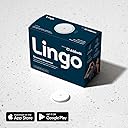
Desertcart purchases this item on your behalf and handles shipping, customs, and support to USA.
๐ฌ Track smarter, live healthier โ your glucose, your power move.
The Lingo Continuous Glucose Monitor offers 24/7 real-time glucose tracking with a comfortable, water-resistant biosensor worn on the arm for up to 14 days. No prescription needed, it syncs seamlessly with iOS and Android apps to provide personalized insights on how lifestyle factors affect glucose levels. Designed to support prediabetes management and heart health, Lingo empowers users to optimize nutrition and build healthier habits with data-driven feedback and free sensor replacements for added peace of mind.


| ASIN | B0DRVD8TH8 |
| Battery Cell Composition | Silver Oxide |
| Battery Life | 14 days |
| Best Sellers Rank | #562 in Health & Household ( See Top 100 in Health & Household ) #1 in Blood Glucose Monitors |
| Brand | Lingo |
| Brand Name | Lingo |
| Customer Reviews | 3.0 out of 5 stars 5,102 Reviews |
| Global Trade Identification Number | 00357599848002 |
| Included Components | Package contains the biosensor and the biosensor applicator |
| Item Dimensions L x W x H | 4.7"L x 2.25"W x 3.5"H |
| Item Weight | 3.36 ounces |
| Manufacturer | Abbott Lingo US |
| Manufacturer Contact Information | Abbott Diabetes Care Inc., 1360 South Loop Road Alameda CA 94502 |
| Model Name | Lingo |
| Operating Time | 14 days |
| Part Number | 77263-02 |
| Product Dimensions | 4.7"L x 2.25"W x 3.5"H |
| UPC | 357599848002 |
| Unit Count | 1 Count |
L**E
Ignore All the Bad Reviews - This is a Great Product
Iโm an RN and bought this because I am super interested in all of the metabolic disease that is overrunning our country and feel that the current standard lab testing does a poor job in identifying problems early when there is still time to modify behaviors and outcomes. As I was looking at CGMs, I was surprised to see so many bad reviews. Iโve never written an Amazon review in my life but felt my experience was so different from the bad reviews that I needed to help people feel informed. The reviews noted issues with the CGM 1) Falling off easily 2) Not being accurate 3) Not working. I purchased the Abbott Lingo and was very, very impressed with the applicator, the biosensor, and the app. Everything worked flawlessly for the full two weeks when it appropriately ended its time. Regarding the issues others noted above: 1) I proactively purchased the Ceeport CGM sensor stickers and cut a small hole in the center since the dot on the biosensor canโt be covered. Abbott should probably consider including a sensor sticker with their package, but until then, itโs a no brainer to buy a $1 sticker to protect a $45 biosensor. The sticker lasted the full 2 weeks and I had zero issues with the sensor or sticker coming loose with daily exercise and showers. 2) Reviewers had complained that they did a finger prick glucose test and it was completely different than the reading on their CGM. I didnโt test my blood sugar at all during the two weeks, however I do know that the CGM is not testing *blood* sugar, itโs testing *interstitial fluid* (in the tissues) fluid, so itโs going to vary and it is a delayed result. My satisfaction with the rest of the product and seeing appropriate fluctuations based on meals/exercise/stress level give me confidence that this is likely pretty accurate. 3) When you initially open the app any time you want to see your reading, it says โsensor not in rangeโ (or something) and the first time I saw this, I thought it wasnโt working. It does this every time you open the app, lasts 30 seconds or so, and then it pairs and all the info since the last time you logged in is uploaded on the app. It functioned perfectly for me for the two full weeks. Lastly Iโd like to comment on the application of the biosensor. I was SO nervous about sticking myself with the needle. It literally did not hurt. The spring action made so much clicking sound when it fired as I was *very slowly, nervously* putting pressure on it, that it caught me off guard and all of a sudden it was applied and I didnโt even feel the poke! I was amazed. Nice work Abbott. The other positive component of wearing this CGM was the awareness of my bodyโs response to different foods. It gave me incredible insight (and therefore power) into how my diet was affecting me at the cellular level, and gave me great motivation to improve my dietary choices. I felt like the phone app was easy to navigate and very well done. Excellent product!
D**L
Installing the app
If this sensor is useful or not, I will never know... because I could not get it to work. To apply the sensor to the arm is easy and you will not feel a thing. To install the app is a total different issue. I have a Samsung Phone and I use this phone exactly for the reason intended by Alexander Graham Bell and nothing else... like most seniors my age. I do not care one bit for all this nonsense and pretend functionality on a modern phone. Actually most phones are virtually unusable because the keyboard is too small for old fingers. But I did managed to "register" for a Google account. They of course ask me all sorts of questions which are none of their damn business... but I suffer with dignity so I go to the Google Play Store and search for "Lingo" and installed the app. The app started with asking me all sorts of questions... again, none of their business. I paid for the sensor so I should be able to use it, but no... they are more interested in my info. Then 10 or 20 pages later (i did not count) finally the page which read: Ready To Scan... I did hold the back of my phone directly onto the sensor which I had already put onto my arm. and .... nothing... then the message... Pairing Error... I tried numerous times Then I called the support line and as expected a gentleman with a heavy indian accent ( you recognize the accent when they call you and try to con you out of your money, never pick up the phone when you do not recognize the number). Obviously the guy talks too fast, uses unnecessary words and you cannot understand a thing. This went on for good 1 hour and nothing. among other things, he asked me to delete the app, reinstall this and then search for a red dot... ??? what red dot??? I still do not know what he meant. Anyway I told him, that I cut my losses and tell everybody about my ordeal. Then he suddenly offered me to replace the sensor. Very well I am down $50 already, might as well... arrives in 2-3 days, meaning 4-5 days because of the weekend. Why is there no "app" for this sensor on a PC. After all A PC has a screen I can actually see and a keyboard which does not require baby fingers. And for Pete's sake, do not ask me all these dumb questions, which are none of your business. If the replacements ensor works, I will try it... but then never again. Simply measure your morning fasting BG like before and that is that. Minute to minute updates are superfluous and expensive technology and a pain in the rear. 12/21/25 1:14pm Important update. I did not want to wait for the replacement and ordered another one yesterday from Amazon same day delivery. This one worked, but did not give me any reading for 1 hour and afterwards it was 20 points too low compare to the finger stick (73, 92). however this morning it was a lot better, In fact just now it reads 92 and the contour next fingerstick reads 95. I am more than happy with that. To be sure I get some benefit from this device... after all I learned that overnight my BG dropped to 55 for a brief moment... I seriously doubt that. All you can see trends, and I am lucky with this one, it is even accurate.... but I am an EE and I did work with large continuous datasets which were contaminated with large random errors and judging by the graph, it looks very much like a data set processed using a Markov Process. This is a mathematical process to get the best up to date measurement even when the whole data set is contaminated with random errors. But there is no free lunch in mathematics, nothing beats accurate measurements, no amount of math and statistics will make it better, even when it appears like that. In the moment I am happy... lets see, if the other reviews have a point. besides, why do you want to measure something you already know? Sugar and refined carbohydrates spike your blood glucose... its common knowledge... don't eat junk food and you do not need a CGM, Everybody who wears a CGM or reads this post, has already done the most important thing, which is educating oneself about nutrition... everything else is superfluous. Important update 05/Jan/2026 I am on my 2nd sensor. They last only 14 days for whatever reason, most importantly I guess, the glue will not stick much longer than that, probably the skin will secrete oils which dissolve the glue??? The good news was, that removing the old sensor was easy and it left no mark on my skin other than a tiny hole where the sensor was inserted. Unfortunately, the second sensor is also about 20 points too low, relative to the test strip. Of course one could argue that the test strips read 20 points too high, which I seriously doubt. Consecutive testing with test strips (Contour Next EZ) show readings within 5 counts of each other using brand new test strips. Overnight I get readings of 55 with the CGM, which is utter nonsense, because I am a recovering type 2 diabetes patient... even a reading of 75 overnight is hard to believe. The only useful thing I have discovered is that overnight my BG drops significantly. Morning glucose measurements are virtually useless, because of the classic BG spike after waking up. As soon as you out of bed, the BG is already on the rise and it can go up 30 maybe even 40 points within minutes and you have no way of knowing on which part of the curve you are measuring. So again, I have a warm feeling that maybe I have conquered my insulin resistance, just add 20 points to whatever the CGM tells you and when this is under 80 during the night, you maybe ok... still avoid carbs for the rest of your life
H**S
Does what I needed it to do.
I needed something to monitor my glucose that didn't require turning my fingers into a pincushion. It needed to be reasonably accurate. Continuous monitoring from the Lingo patch seemed to be worth a shot. Up front. I am not a physician. I am not being treated for diabetes. In general I am in pretty good health. I found it a little awkward to plant under my left arm. But is it doable. I shaved the area to give the device the best shot of getting a good grip. It stayed in place for the two weeks (14 days) the app will communicate to the device. I have an iPhone. Follow the direction to get the iPhone and app talking Bluetooth. After the app is installed, you will need to hold the iPhone approx 3 inches from the Lingo patch. It takes several long seconds (think 30+) for app to find the patch and start pulling in readings. Based on supplied documentation from Lingo/Abbott, the device is powered by Bluetooth. I guess you could call it another device from the IoT world. Powered by the power of the Bluetooth intranet. If your iPhone is more than 12 feet away (or has obstructions) the Lingo patch "will get angry" and stop pulling in readings. The remedy to restart data transfers was to move the iPhone 3 inches from the Lingo patch (and get it charged up again)..... One time I needed to disable/enable Bluetooth on the iPhone. On day 10 of the patch I had an annual doctor visit. This was my chance to get an accuracy measure of Lingo to a standard blood panel glucose measure. The patch reading before the blood draw was 84 mg/dL. The lab came back with 82 mg/dL. I was able to learn "bits and pieces" how my eating habits (type of carbs and time of day) were effecting my blood glucose levels. The last couple of years my A1C measures have "creep above" 6.0. "Fasting" measured glucose blood levels were still below 100, but just barely. In my case I discovered eating a load of complex carbs didn't spike my glucose (above 190), and it dropped below 140 within 2 hours. But the the glucose never seems to drop back to the 80's/90's. Healthy carbs, maybe not happy carbs. This issue was worst if eaten late in the evening or in the early AM hours. This eating habit was changed. I also found that "sneaking" a small snack was "radioactive" when measured in 5 minutes interval by the Lingo patch. Another area to modify eating habits. Except for a triple black coffee and cocoa powder (unsweetened) in the morning, I don't usually eat anything until noon. Lingo report me in the 90's-100's (yea waking up in the morning will bump your glucose). Not were I thought (or wanted) to be. As an experiment I ate 1/2 cup of fresh fruit and two heaping teaspoons of honey with the coffee brew. Within 60 minutes the patch would report a spike of over 200 mg/dL, (Lingo accurate measures stop at 200). Within two hours I would be under 100. For the next 3-4 hours the patch reported me between 68 - 89). This is how I got my 9:30 doctor visit/labs (10:35 draw) down to a measure of 82 mg/dL. Unhappiness. The distance limitation and "restart" of the patch is best understood as, "The patch and your phone have become inseparable friends". Get use to it. The Lingo app is a somewhat expansive. All I really need was the .csv download. I am handy with Excel. Again, I got all the analysis I needed from Excel and the Lingo .csv file. I couldn't find a way to enter notes in the app and have them download with the Lingo .csv file. But this may have been me not wanting to be a "Lingo App Master". It would be nice if the Lingo app would alarm/announce it has lost contact with the patch. Kind of a basic "IT 101 App" thing. Again, maybe I didn't dig deep enough into the app. For my purposes the device is a 5 star.
V**A
Nopeโฆcannot recommend, lots if issues
Heads upโฆLong review, Iโm not a fan and canโt recommend it. I purchased 4 of these thinking I would get a good idea of what my diet and exercise was doing to my blood sugar for 2 solid months. First one worked okay. I did test it against a finger-stick monitor (Registered Dietitian here,) and found that it reads low. The monitor I used is made by Freestyle, same company (Abbott) that makes Lingo. My finger-sticks were about 5-15mg/dl higher than the readings coming from the biosensor. I tested it several times during the two weeks, most were 15mg/dl higher. I knew at that point that it wasnโt super accurate, but I could still see that even a tiny bit of sugary creamer in my coffee sent my blood sugar up and then crashing after a few hours if I didnโt eat anything else with it. That info helped me to give up the coffee creamer since I always tend to crash after sugar. I tested different sweet stuff, mixed with and without fats and protein. I was excited to continue with the next sensor and was planning to just stick consistently with my healthy low carb diet and not test sweets since I know I crash every time. I wore the first one without issue, knowing that it wasnโt super accurate I just looked for trends. It was fairly easy to take off after two weeks of wear, but I was surprised how sticky it still was. Hardly felt it on me or when I applied it or removed it. I could not sleep on my left arm or I would get odd swings in readings at night. After removal I waited two days and installed the 2nd. The second gave me a kinda high reading for me after an hour even though I hadnโt eaten anything yet, I think it was around 89mg/dl. Then I got the dreaded error: โPlease wait 8 hours to see your reading or contact support.โ No readings or history were showing. EIGHT hours? That seemed crazy. I did wait about 3, but nothing changed, so I emailed Abbott. I did get a response fairly quickly, maybe 12-18 hours. Iโm sure a call would be quicker. I had to answer a billion questions and finally got an email back that a replacement was on its way. So I was told I could remove the sensor that I had on and trash it. Sensor 2 removal was tough. Since it was freshly placed, it was super sticky. After I finally got it off I was bleeding quite a bit, took a while to stop and yeah, that was fun. That one left a scary purple bruise. Since I still had 2 more sensors on hand I decided to place another on my right arm today (3 days later,) since my left arm is still bruised. I was a bit scared after the drama removal of the last one. Again, no pain applying. Whew. I was sure this would work. After one hour, (it takes an hour to calibrate,) this time it said my blood sugar was below 55. (Which BTW, I got that a lot when I wore the first sensor. When itโs below 55mg/dl, you donโt get a number, just <55.) then about another hour later I got the same error message again asking me to leave it on for 8 hours or contact customer service. Ugh. I did email Abbott a few hours ago and requested a refund for 3 sensors this time, no answer yet. I wore this one about 4 hours. Nothing. I just removed this second โerrorโ biosensor and it was tough to remove like the last. New and very sticky, which is excellent if itโs going to stay on for 2 weeks, not 2 hours. Thankfully, I didnโt bleed much and no bruise so far. The app is pretty limited. Really needs improving. I did read that the Lingo goal is very confusing for a lot of people and I can see why it would be. Itโs not intuitive. I got the hang of the app and was happy that it connects to Apple health and automatically adds my exercise. Easy enough to add food, but doesnโt connect to the Cronometer food tracking app that I use and love. I wish that the readings below 55 would be displayed since I tend to be hypoglycemic (low blood sugar) and it would be helpful to see what the lows were. I will say that I can typically feel my lows and my <55 readings did not feel like I was having a low. Wish I had confirmed a few of those with a finger stick. Great idea for self-help people like me. Needs lots of improvement. If youโre prediabetic or know an endocrinologist, or even talk to your family doctor about why you want to try one, especially if youโre worried about your health or have a family history of diabetes. I would ask for a prescription version of a CGM. Your doctor might give you one to try, but those need to be placed and removed by a health care professional. Your doctor will be more willing to give you a finger stick monitor if youโre willing to stick your finger first thing in the morning for a fasting reading, after meals and exercise. Monitor is cheap, test strips are pricy OTC. You can also get a prescription for test strips if your doctor sees a need. Seems scary, but itโs not too bad and itโs definitely more accurate if you're really worried about your health.
C**F
doesn't read above 200. No CGM accurate below 70.
I am not giving medical advice, I am giving information; and you should discuss it with your own doctor. There are a lot of sites out there with people who have had to live with and manage it for years that are not medical people, but their observations are GOOD, but still discuss it with your doctor. I have just been around people with diabetes, so these are just my opinions. The ULTIMATE diabetes doctor is the endocrinologist. Got it for DM2 (diabetic who still has some insulin and not on insulin yet), person who wouldn't do finger pricks daily. This worked very well. I would get it again. Good for the money. Doesn't need prescription. The initial application had little to no pain and he could tolerate that. Before, I could not get him interested in what his food or exercise did to his blood sugar and how he felt. But now that he could SEE the changes in blood sugar when he ate...and see the bigger changes in the blood sugar when he ate foods that had a high โglycemic index โ(means they are simple starches that are easily digestible and turned into sugar quickly like rice, bread, potatoes...vs low glycemic foods that have a lot of fiber in them and are complex and difficult to quickly breakdown and thus do not cause your blood sugar to jump up high quickly, but instead rise slower and rise less high) he was getting REWARDED by seeing what his actions did...LIKE A COMPUTER GAME. This person is a somewhat unusual diabetic, in that his blood sugars can run around 150, and people with diabetes don't worry too much about that. But what HIS body does is pour sugar out through his kidneys greater than 1000 and he also spills ketones out in his urine. This makes him what is called a "ketone prone euglycemic diabetes mellitus type 2 (DM2). And the BIG problem with this is that even most doctors are not aware that it exists. They take a look at the pretty good blood sugar and don't look farther. In fact, I am surprised how little most doctors understand diabetes; or what to do about it. There are many people out there that have diabetes or prediabetes; that their doctors are telling them "everything looked good", in reference to any labs that were drawn. If you were fasting (no food or anything but water for at least 8-12 hours), and your blood sugar, also called blood glucose was above 100, you may have diabetes. If you have a big belly, are overweight, blurry vision, hypertension, high triglycerides (when they check your cholesterol, they should also check your triglycerides) darkened skin patches in places like neck, arm pits, face; or have been told you have syndrome X, metabolic syndromeโฆyou may have prediabetes or diabetes. The reason it is important to deal with it as soon as you find you are heading that way is that elevated sugar in your body damages almost every single part of your body. So, if your doctor jumps on this he can help you understand what to do to lower your blood sugar and extend your life, and extend it with a lot less diseases showing up! One reason that doctors may ignore your elevated sugar levels in your labs is if the also take a test called an A1c. This test measures the average blood sugar over 30days. And the doctor looks at that and says well this is pretty good, it was only 135...an A1c of about 6.3.(When your A1c reaches 6.5 this means your average blood glucose was 140 over 30 days and this says you are diabetic) BUT what the doctors can't seem to get through their heads is; THIS IS AN AVERAGE OVER 30 DAYS...which means your blood sugar could have been 200, 300 or higher and then dropped down when you slept or to 70 when you were not eating. BUT you are definitely having organ damage when it hits 200. They don't see if you are spilling ketones.... they just see one thing, the average over 30 days. IT's like, your dad beats your mom really bad for 2 out of 30days...and so the average of beating to normal is "not so bad" โฆexcept to your mom!) So a CGM (continuous glucose monitor) can show you a lot. It can help you see how long your blood glucose stays up after you eat, but it can also help you learn how to eat to keep your blood glucose lower. PLUS, if you want to try to stay in a normal blood glucose range (70-140), so that you don't age as fast or have your body destroyed as fast...It can show you "Time In Zone", with is whatever range you want your blood sugar to stay in. PLUS even more important it can help you start to learn what it feels like when your blood sugar: > goes up-hyperglycemia- (thirsty, pee a lot, hunger, blurred vision, dry mouth, feet tingling, itchy skin, fatigue, slowed thinking, brain fog, irritability, anxiety, depression, headaches, tremors,) > goes down - hypoglycemia (irregular heart beat, paleness, sweating, hunger, dizziness, confusion, shaking, tingling around the mouth, fatigue, anxiety, ) IT IS EXPECIALLY IMPORTANT TO RECOGNIZE WHEN YOUR BLOOD SUGAR GOES DOWN BECAUSE your brain can be immediately and irreversibly damaged! I suggest drawing yourself a stick figure and putting the symptoms you might feel drawn to the area of the body it might happen in and putting that on your refrigeratorโฆ.becauseโฆ.not only you but your family NEED to learn this. Low blood sugar is one of the problems with CGMs, below the lower normal range of blood sugar, 70; NONE of the CGMs do a good job. They can tell you it is low, and make you run and eat a cookie to bring it up, when it wasn't low to start with or it is lower than that! THAT IS WHY IT IS IMPORTANT THAT YOU ALSO BUY ONE OF THE FINGER STICK devices for when your CGM says your blood sugar is low.... because when your blood sugar is very high (at or above 200) or low (below 70) you will need to double check your blood sugar with the more accurate device of a finger stick glucose meter. The numbers that the CGM companies give you to call to speak to someone to get advice, is sort of a joke. These people know very little. And it seems they do not even know what it says in the CGM paperwork packaged with the device! I think they just read from a script. Doctors too are often unaware how unreliable CGMs are with LOW blood sugar readings. Still starting out, this is a good way to see what is going on. The price is good for what it does. Your doctor may be dragging their feet, and you may want to know more, be sure, have something to show them to convince them. IF it shows that you do have high blood glucose; get it taken care of. There is a lot you can do just with diet. Sometimes you can even reverse it with just diet. But if you don't take care of it, then it is like having cancer you don't take care of, it will slowly damage everything in your body. Fear stops people. Knowledge is a way to handle fear. Knowledge gives you power, a choice. I didn't use this product; I just got some feedback from the person I gave it to. He was making charts on his phone. But I think the best way for someone to understand what is going on and tie it all together is to make charts that can show ALL the variables right on one page. Not only the blood sugar reading and time, when you take your medication, but also your meals and how many carbs you ate (you also should keep a list of what you ate, how much, the calories, and the carbs to refer to if a you want to get an even stronger grasp on what your food is doing to your blood sugar), when you exercise, and when anything feels off (see lists below) After a few days of this kind of charting you should be able to see when your blood sugar rises after you eat, what hi carbs or low carbs do to you, what symptoms YOU feel when your blood sugar goes up or down, and how soon your medicine will work and how long it will last for you. -get a notebook with GRAPH paper (the page is all little squares). -along the left side, starting about 30 squares up (in these 30 squares you can write the variables, like m, start with numbers to reflect your blood glucose level. Start with about 50 (which is low and you may be confused, have stomach cramps, look drunk...so YOUR FAMILY AND FREINDS NEED TO KNOW WHAT TO LOOK FOR, FOR HIGH AND LOW BLOOD SUGAR TOO...because when it is too high or low you may not be able to take care of yourself or get help. ) go up by 5s, to 200. -along the bottom you will put times during the day that you took the reading. >you should take a reading when you FIRST wake up, this is your FASTING blood sugar, supposedly the lowest blood sugar during the day > you should take a reading when you start eating, and every 30 minutes after that until your blood sugar comes down to what your blood sugar usually stays around (later you won't take it this often, but if you are just beginning to learn how YOUR body works and how YOUR body reacts, this will help you see not only how high your blood sugars are going but what foods make them go up fastest and highest, and how much of a food is needed to do that!) > you should do this also when you take your medicine for diabetes. You want to see how fast it works and how long it works for. > you should take a reading anytime you are feeling "funny, or bad, or strange, or irritable", to check and see if these feelings are related to high or low blood glucose/sugar (your brain needs sugar like it needs oxygen, so it is not strange that you have changes in how you think and feel when your blood sugar goes up or down.) > If you wake up in the night, take a reading then too. Sometimes when the sugar goes up or down in the night, it can cause you to wake up. > If you get a cold, or get sick, you should take it to see how this changes your blood sugar (if you have an infection it is important to keep the sugar in your blood in a normal range to help healing, because bacteria EAT sugar!) (Ketones in people without diabetes and trying to lose weight...maybe ok if not high.... but for diabetes not good.) >normal blood glucose is 70-100 fasting (when you have had nothing to eat and noting to drink but water for at least 8 hours) >A normal person's blood sugar usually doesn't rise about 120 after eating and stays up only a few hours after eating, but sometimes if you just ate a huge pile of sugar it might get up to 140 for a short while. >when your blood sugar hits 200 you definitely are damaging your organs...eyes, blood vessels, heart, kidney, brain, nerves.....it's like pouring concentrated bleach on your skin...the more concentrated it is, the more it damages the skin...the longer it stays on the skin, the more it damages the skin) Some things that might make you check to see if you are or are becoming a diabetic slow healing, dry cracked skin, hammer toes bunions, numbness or tingling, slow healing, blurred vision, frequent urination, fatigue recurrent infection, like yeast infections, jock itch, vaginal infections, dark skin in areas gum disease Diabetes causes you to be hungry, because the insulin can't push the sugar into your cells, so it is as if you haven't eaten...so your body thinks its starving. Diabetes is caused because your body doesn't have enough insulin, or your body is RESISTANT to it. Type 1 diabetes has little or no insulin. Usually appears in childhood, and requires lifelong insulin therapy. Type 2 diabetes, DM2, diabetes mellitus; Happens from Insulin resistance (think of teenager ignoring the directions of their parents) or from not enough insulin and usually appears in adults.
A**N
Itโs great for steering you in the right direction
Keep in mind this device is intended to give you a rough estimate of where your sugar is at and a rough estimate of how certain foods affect you. It does not measure below 55 or above 200 so if you have hypo or hyperglycemia this is not the product for you. I do love that it automatically updates on the app every 60 seconds The app does have a lot of helpful features if you are a health conscious person, such as recipes and lifestyle articles. It does however disconnect constantly where you will have to wait for the device to reconnect to your phone. It will also give me a number and then when I look back the number is recorded as 20 points lower or higher. Accuracy wise, I did blood tests regularly while my sensor was on and the device was 10-30 points high or low pretty much at all times. I would highly recommend an intermittent check with a finger prick tester. I swam with it on 3 times for several hours each time and exercised most days and the adhesion loosens some but is still wearable. It failed early last time I wore it and if you take pictures of the packaging and product numbers they will replace it for free. If you buy one take pictures of everything! They fail early often. General sensor info for you, hot water and laying on the sensor will give you a false low. The needle to insert is long and you have to press it into you like a stamp which I found impossible so my bf has to sneak behind me and press them on. If you are scared of needles it will be very hard. The adhesive leaves a gross residue on your arm that is difficult to clean. They are easy to rip off on doorways, on the edge of shirts, or small curious children (or goats) pulling on them.
S**S
CGM core works; app annoys with useless suggestions based on inaccurate assessments
The CGM part of this works well, and the app is useful. I have not had any trouble with the monitors staying affixed or syncing with the phone. That said, there are issues: 1. The 'Lingo Count' is completely and utterly useless. Normal glucose changes following meals are considered negative if a small variation in blood glucose causes a slight rise before the app thinks it should. 2. When the Lingo count (which is flat-out useless and bogus) does spike, the app insists you exercise, even if you literally just completed a one-hour post-meal walk. Annoying AND useless. 3. Meal prep suggestions are also based on the Lingo count, not on what you record as your meal, and as such are equally useless 4. The pre-recorded list of food isn't even remotely close to what I eat, so I have to manually enter the same exact items time and again (it remembers what I entered for one day, at most). 5. You cannot turn off the useless and annoying 'features'. If I could give a half star, this would be 2.5, not 3, but I rounded up because the core CGM functionality is good. Update 2026-06-08: Removed a star because the Lingo Count has gone from useless to ridiculous. Today, for example, my blood glucose was never below 78 and never above 136, with a daily average of 101, but I got a Lingo count of 51 (yes, fifty-one). This kind of 'fake science' proves nothing and helps nothing. Serious? What glucose spikes?
K**.
Insight into your body that you need
OK, I've never written a review but since I've had a great experience with this device, I'm going to. I've been told by the doctor that I'm heading toward prediabetes, so it's time for me to tweak my diet, and I like to make decisions with as much information as I can. This monitor has provided me with a lot of useful information about trends in my glucose levels. The first week was to try and keep glucose at ebbs and flows rather than high and Lows., I'm already making healthier choices in terms of food timing and what I choose to eat. I used it with an iPhone. I 100% recommend this as a device to help you get an overview on how foods affect you personally. I have read a lot of the reviews after the fact, and I can talk about and confirm some of the pros & cons. As users, I think we need to set the expectation that it's not a high-dollar medical device and is best suited for looking at trending versus the perfection of the numbers. I did NO comparison with skin prick blood tests because, fortunately, that's something I don't have to deal with. pro 1 - It's super easy to apply, just make sure the area that you're putting in has been washed with soap and water and then cleaned with alcohol. Surprisingly, it did not hurt at all so I imagine that most should be the experience for most everyone, so long as you go slow and read the directions. pro 2 - The app is pretty easy to acclimate to, and so long as you log your meals/snacks, it will give greater meaning to the rise and falls you see in the graphs Con 1 - it was a bit cranky in connecting with my iPhone at first and it took quite a while to finally sync up, but it seems like somewhere in the literature. It mentioned that. Connected, it performed well. Here is what I noticed: if you set your phone down somewhere, it will disconnect. If you close the app, it will disconnect. When it does disconnect, it takes 20 to 60 seconds to re-sync. After reading the negatives in the reviews, I have a couple of suspicions regarding some of the problems AND... I am in no way dismissing that the company might need better quality control - if the device was falling off (so poor physical connection), I suspect some folk could have been a little sloppy with prepping their arm before. Also, some people just have oilier skin than others. When I applied it, I made sure to use something flat to make sure the rim of the adhesive was secure and watertight all the way around my arm, but that's just me. - on connecting problems, I noticed when reviewers said they replaced theirs and found it had a bent needle, which makes it easy to imagine if they flinched when applying (which I can relate to even though it didn't hurt), or had the applicator crooked, or even some may have thicker skin so low/no connection. - Technical skill level and patience: I suspect that the app connects to Bluetooth with some sort of 'backdoor' connection, because though it is connected and reading with the app, it does not show up as a connected Bluetooth device in my settings. Since I assume that the battery is small and therefore not very powerful, proximity to your phone is probably a huge factor. Fortunately, it seems to hold all the data and will update when you connect again. Improvement slingo could make: -Including a waterproof covering/Band-Aid with every unit -the ability to add when you hydrate as an event in the app -the ability to add a 'miscellaneous' event in the app, such as a stress moment or sleep interruption.
T**.
Mobile App
The device mobile app is not available in Saudi Arabia. App only available in US and UK
Trustpilot
2 weeks ago
3 weeks ago