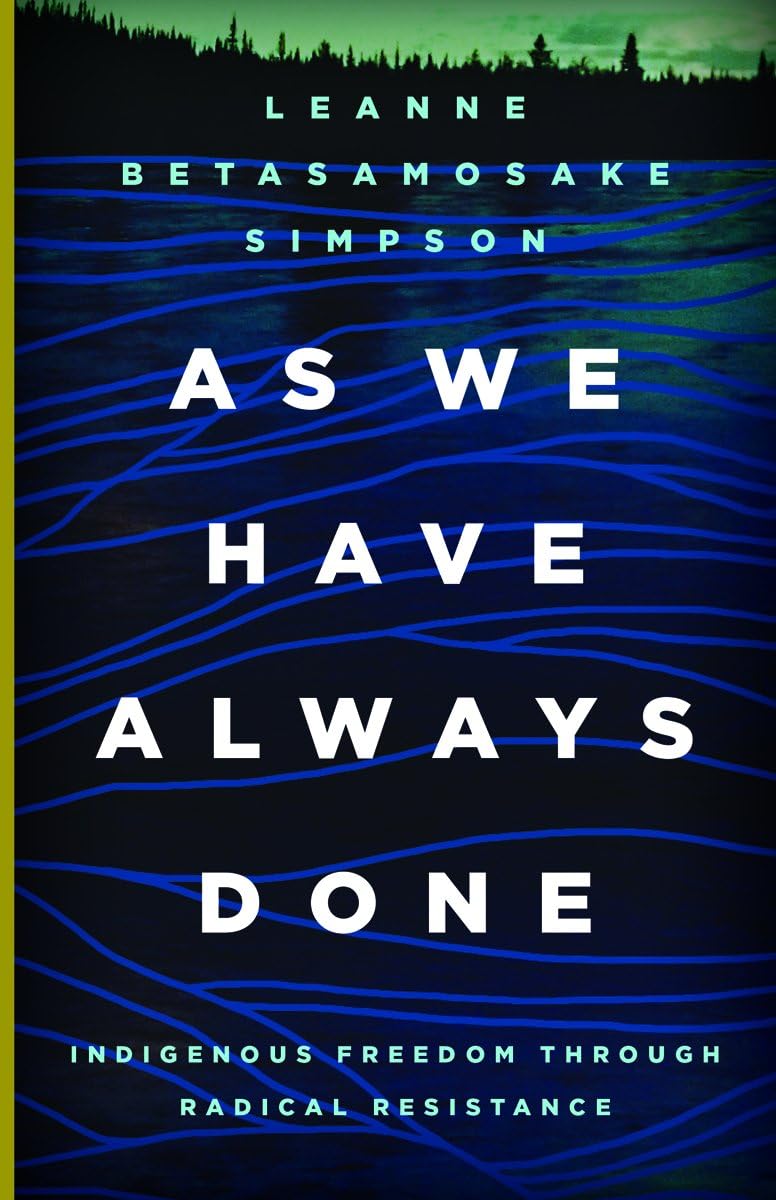
As We Have Always Done: Indigenous Freedom through Radical Resistance (Indigenous Americas)
Product ID: 63796984
Desertcart purchases this item on your behalf and handles shipping, customs, and support to USA.
Winner: Native American and Indigenous Studies Association's Best Subsequent Book 2017 Honorable Mention: Labriola Center American Indian National Book Award 2017 Across North America, Indigenous acts of resistance have in recent years opposed the removal of federal protections for forests and waterways in Indigenous lands, halted the expansion of tar sands extraction and the pipeline construction at Standing Rock, and demanded justice for murdered and missing Indigenous women. In As We Have Always Done , Leanne Betasamosake Simpson locates Indigenous political resurgence as a practice rooted in uniquely Indigenous theorizing, writing, organizing, and thinking. Indigenous resistance is a radical rejection of contemporary colonialism focused around the refusal of the dispossession of both Indigenous bodies and land. Simpson makes clear that its goal can no longer be cultural resurgence as a mechanism for inclusion in a multicultural mosaic. Instead, she calls for unapologetic, place-based Indigenous alternatives to the destructive logics of the settler colonial state, including heteropatriarchy, white supremacy, and capitalist exploitation. Review: Helped me understand - Great read and educated me a lot on indigenous values, vision and history. She is a great writer and very articulate. It is written for indigenous folks so be prepared that a lot of terms and a lot of native language is used. A lot went over my head, and I picked up 70%. It is a low percent and I read a book a week and have a masters degree. But I would recommend it and read it again Review: Powerful Guide To Understanding an Anishinaabe Worldview - I applaud Leanne for her good medicine and work in this book. I have brought it up to anyone around me who will listen, and consider it a crucial decolonial guide for Indigenous people and those in committed allyship with them. As an AfroAnishinaabe woman, this helped me to better understand things I have yet to be taught, and the stories told were much appreciated. It has helped reorient my worldview to be better connected to aki, to eldership, to 2S/Queer relatives, and I appreciated the address of anti-Blackness as an intersectional impact from settler-colonial violence that affects Black, Indigenous, and therefore, Afro-Indigenous people. A sincere chi-miigwetch for this labor of love.
| Best Sellers Rank | #677,142 in Books ( See Top 100 in Books ) #9 in Canadian Politics #25 in First Nations Canadian History #75 in Radical Political Thought |
| Customer Reviews | 4.8 out of 5 stars 223 Reviews |
Q**S
Helped me understand
Great read and educated me a lot on indigenous values, vision and history. She is a great writer and very articulate. It is written for indigenous folks so be prepared that a lot of terms and a lot of native language is used. A lot went over my head, and I picked up 70%. It is a low percent and I read a book a week and have a masters degree. But I would recommend it and read it again
M**P
Powerful Guide To Understanding an Anishinaabe Worldview
I applaud Leanne for her good medicine and work in this book. I have brought it up to anyone around me who will listen, and consider it a crucial decolonial guide for Indigenous people and those in committed allyship with them. As an AfroAnishinaabe woman, this helped me to better understand things I have yet to be taught, and the stories told were much appreciated. It has helped reorient my worldview to be better connected to aki, to eldership, to 2S/Queer relatives, and I appreciated the address of anti-Blackness as an intersectional impact from settler-colonial violence that affects Black, Indigenous, and therefore, Afro-Indigenous people. A sincere chi-miigwetch for this labor of love.
S**B
Truth not half truth
As a native blood person I value my educating myself what was never taught to me in school..and being able to fill in the gaps of traditional thought is key..this volume provides that.. I have to use my filters to internalize and use my methodology of interpretation..but that for me goes without saying on anything I am learning. I am grateful for readings as this for that reason..
B**M
Been looking forward to this
Absolutely not disappointing, enjoying quite a lot.
V**S
Read it several times!
Brilliant. Conversational and strong. Grounded and well-researched... In its own way of embodied research. Genuinely worth a slow read, then repeated.
A**E
Resistance grounded in daily practice
Leanne Simpson wants to ground Indigenous resistance to colonization outside colonial structures. She has chosen to do this through the pedagogy of the land, everyday practices “as we have always done.” This means learning from elders, through stories, through community, through ceremony, and through reciprocal relationships with land when harvesting resources. Those goals are worthy, but face contradictions in the very nature of writing a book for people outside those relationships to read. Granted, Simpson does not write for academics but in a way that her community can understand. She knows that Settlers will read the book, but she does not write for them. She also tries to write outside colonial practices, institutions, cultures, and frameworks, but that’s almost impossible for anyone to achieve – especially when writing in English. While oriented toward debates in Canada, it will resonate with people in other Settler states, especially Canada’s neighbor to the south.
A**R
Five Stars
must read!
H**E
Great!
Buy this book :)
N**H
Imagining possible futures through an understanding of Indigenous realities
This was one of those books that came just at the right time for me. It was as though I was meant to encounter it just as the world was rattled in such ways that the cracks that always surround us opened just enough for light to peer through. The light, though difficult to see in any clear way, represents an opportunity for something outside of the collapsing world we have come to know. To me, any future worth thinking about requires us to pry our way out through these cracks and to remove with great intention the structure from which they originate. Simpson writes through these cracks. In fact, she seems to position herself inside of them, showing us what lies just beyond the observable. However, I think these cracks mean more to those who have become accustomed to the structure itself; for many Indigenous and Black peoples, our lives have often existed on the periphery of white cultures. Simpson’s work reminds readers of the labor that has come with that positioning, while at the same time, being explicit about the ways Indigenous knowledges have remained present and evolved over time. As We Have Always Done is a text that clearly delineates the ways Indigenous peoples of North America have and continue to reject contemporary colonialism and seems to practice that same refusal at the same time. Simpson is not writing this text for the world; she is writing it for herself, and every Indigenous woman who has had to spend time debating the validity of their existence, or the probability of their future. For Simpson, the future is Indigenous, is queer, is radical, is multi-faceted, is something else than this. While the text itself discusses political theory and colonial history, it is always through Indigenous thought, experience, and story. Colonialism is not the default starting point but rather is positioned as a failed attempt at erasure and genocide. Indigenous thought is presented in this book in a tactful way; for Indigenous readers, there are deep teachings that bring about intergenerational understandings from within our ancestral knowledge; for non-Indigenous readers, Indigenous knowledge is carefully articulated in terms that are more universally understood. In this way, Indigenous ontologies are accurately depicted as the empirical scientific systems that we have always known them to be. Simpson ends this book on the topic of revolution, reminding us of the need for such radical rethinkings of our world. Revolution to Simpson however, is not simply an overthrowing of the colonial government, but a refusal to repeat what we have already done. It is not going back to a pre-contact romanticism; it is a reimagining of what is possible through the application of what we have come to know. In this way Simpson invites us to think of Indigenous ways of being; we need to move forward knowing our past and present but forging a new possible future, as we have always done. It is more important than ever that we consider futures that account for the diverse histories and ways of navigating the world and seek to mitigate the systemic harms that have persisted across generations. We know now that our normal was not healthy for most. We have an opportunity in this time to think of revolutionary ways to live and thrive; ways that we have not yet imagined.
D**U
Radical resurgence guidance
Well written and unapologetic, the kind of thing we have come to expect from Leanne.
S**S
Five Stars
Brilliant work as always.
Trustpilot
3 days ago
1 day ago