


Buy anything from 5,000+ international stores. One checkout price. No surprise fees. Join 2M+ shoppers on Desertcart.
Desertcart purchases this item on your behalf and handles shipping, customs, and support to USA.
🌊 Flow into the currents of history and humanity with every page!
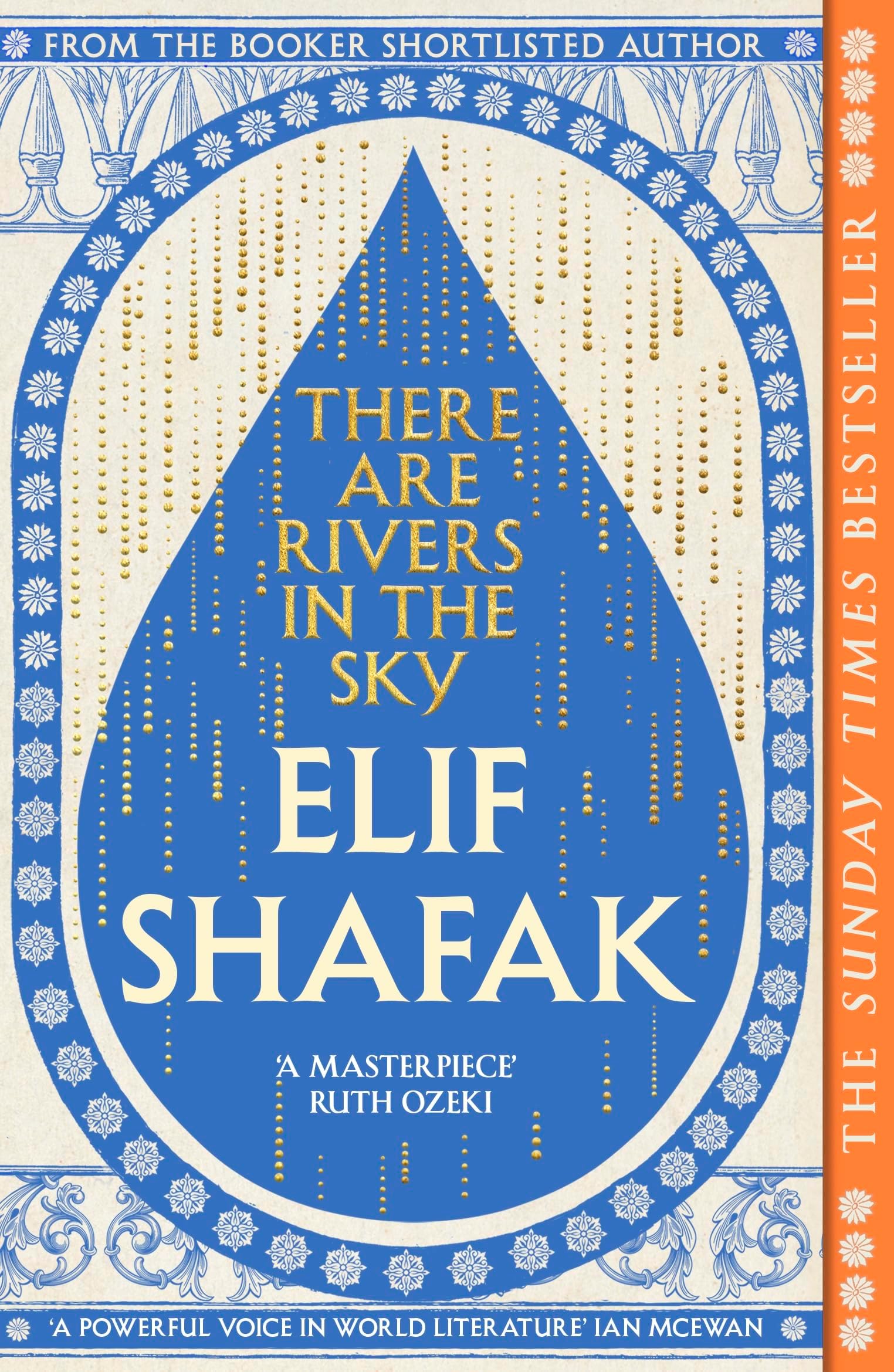
There are Rivers in the Sky is a 470-page Sunday Times bestseller by Elif Shafak, blending rich historical research with multi-perspective storytelling. Celebrated for its lush prose and cultural depth, this 2024 release explores Victorian life, Mesopotamian myths, and human connections through the lens of three main characters. With a 4.5-star rating from over 10,000 readers, it’s a must-read for those craving literary fiction that educates and enchants.


| Best Sellers Rank | 185 in Books ( See Top 100 in Books ) 4 in Cultural Heritage Fiction 24 in Literary Fiction (Books) 53 in Contemporary Fiction (Books) |
| Customer reviews | 4.5 4.5 out of 5 stars (11,907) |
| Dimensions | 12.9 x 3.1 x 19.8 cm |
| Edition | 1st |
| ISBN-10 | 0241988748 |
| ISBN-13 | 978-0241988749 |
| Item weight | 346 g |
| Language | English |
| Print length | 496 pages |
| Publication date | 3 April 2025 |
| Publisher | Penguin |
J**L
An edifying read
This is one of those books which satisfies the inner curiosity and you come away having learned something, After reading it I was prompted to find out more about the Epic of Gilgamesh which I'd heard of but didn't really know anything about. Three different timelines yet blended together into a beautifully written whole. Having grown up in London I was able to feel the environments described, the old offices and the new, the British Museum exhibits that were part of the stories and characters in different ways. A wonderful book.
A**A
History, myths and humanity - all in one stunning book!
Absolutely loved and highly recommend ‘There are rivers in the sky’. Elif Shafak is amazing - I deeply appreciate the extensive research she has done in writing this book. The three main characters- Arthur, Zaleekhah and Narin and their unique connections with water are fascinating. Before reading this book, I knew nothing about Thames toshers, water-dowsers, subterranean streams, Nineveh, Lamassu, epic of Gilgamesh, Yazidis, and more. This book made me curious to look them all up. I loved how Shafak brought characters and stories from different timelines, cultures, myths and tied them all together so beautifully! “How can anyone assume they will please the Creator by hurting His Creation” and yet the repeated inhumanity towards Yazidis in the name of a religion without a book and most recently by ISIS in 2014 - horrified me. Planning a trip to the British museum soon to appreciate how lucky we are to have safe access to historical treasures and the incredible stories behind their discoveries. “ Life is full of the unexpected, my friend. As if we are walking in a river of mud, and we dare to dip our hands every now and then, searching for a button of hope, a coin of friendship, a ring of love. We are mudlarkers, all of us.”
S**E
Interesting historical facts
Beautifully written and very descriptive- can be hard to follow as switches between characters and times but worth sticking with it . Nearly 500 pages
A**Z
One of the best novels I have read.
One of the best novels I have read. And I have read a lot over 5 decades... Multiple stories in one, that intertwine. A learning journey about Mesopotamia, Gilgamesh, water memory, lost rivers and the Yazidi.
S**S
A beautiful fascinating read.
An amazing and moving book creating world's from the ancient and modern and stitching them together skillfully. Highly recommended.
J**N
Rivers raised, rivers razed
This was a book club choice - yet again, an unusual story from outside my normal field of reference. There are three tales told in parallel: Arthur in Victorian London, Narin from Turkey in 2014, and Zaleekhah from London in 2018. Seemingly unrelated at first, the tales intertwine. Initially, there's the idea that they're linked by a single raindrop, which travels around the water cycle, crossing continents and centuries. This conceit more or less disappears once the three tales have got going, though a scientific-looking table at the end of the book tracks its journey over the millennia. There's an overarching theme of water and rivers - how we need them, how they're abused, how they're part of our physical and emotional landscape - and the author has clearly done a lot of research. Unfortunately, most of it appears to have ended up in the book (which is supposed to be a work of fiction). I was pleased to immediately recognise the significance of the trip that Arthur makes to Broad Street on p153, and to predict what was going to happen as a result of it, but felt it didn't necessarily make the character or setting more realistic. By contrast, there's a harrowing account of a contemporary event beginning on p344 which is direct, distressing and something I'd had no idea about (the author points out in an afterword that this "happened in front of the eyes of the entire world" [p478], suggesting that the world didn't pay it much attention). Whilst I felt that its exposition was admirable, I think its impact was diluted by all the other subjects (including ancient history, plundered artwork, climate change, poverty) which the author has drawn upon, and transferred into, her book. Some niggles: I don't think objects dropped into the Thames in London "will keep travelling to Oxford and beyond" [p21], since Oxford is upstream from London (and the river is only tidal up to Teddington, downstream from Oxford). I thought that the dialogue was clunky in places - for example, Arthur's mother complains on p26 "I cannot afford to keep this little 'un. I can hardly get myself enough coppers for my own food. I am starving hungry most of the time" - which looks inauthentic (why "cannot" instead of "can't", especially if "little one" has been contracted?), and when an old woman is thinking about what to name him on p28, she says, "I think it should be something rather brave and grand. Yes, that's right, a name worthy of a noble", which means he gets named - for no really clear reason - "King Arthur of the Sewers and Slums". Later on [p143], Narin's uncle, describing his exiled life as a member of the Yazidi faith in Germany says, "They think we are the descendants of Yazid, the Tyrant of Karbala [...] But we have nothing to do with any of that. Our name solely means 'descendants of God'. Our roots go all the way back to Ancient Mesopotamia". Fair enough, but he's talking to his wife, his brother and his brother's mother-in-law, all of whom are Yazidi and who have known all this for all their lives. Dialogue like this looks more like exposition; as does what Nen says to Zaleekhah on p365: "I guess what water is to you, history is to me: an enigma too vast to comprehend, something far more important than my own little life, and yet, at some level, also deeply personal. Does that make sense?" Perhaps, but it doesn't look like anything a person would say. At the other extreme, when Nen identifies her brother to Zaleekhah on p238, she says "The youngest. I have four more", Zaleekhah responds "You have five brothers?", which appears superfluous. And when Helen has good news on p398, Zaleekhah says, "Fantastic! I'm so happy for you - and all the family", and Helen replies "Oh, thank you! I'm still processing the news", which looks somewhat anodyne. There's a certain amount of overwriting - thus, the breakfast on p140 consists of "fried green peppers with yoghurt sauce, sour-cherry jam, sweet-chili marmalade, glazed halloumi and dried figs, bulgur-stuffed aubergines with tamarind, currants and pine nuts, pistachio tahini halva, hummus with flatbread, scrambled eggs with red pepper, cheese with wild garlic, and the first batch of honey from the beehive, topped with clotted cream", which seems to be a superabundance for just seven people (who don't appear to be wealthy). Whilst adding local colour, lists like this - together with the shuttling back and forth between the three tales - make this into a long book (my copy has 483 pages) and, towards the end, I began thinking it would have been more incisive if there had been a concentration on just one of the tales. Also, in contrast to the longueurs of the preceding chapters, the ending - which, naturally, tries to bring the strands together - feels abruptly forced and somewhat ludicrous, leaving (I felt) several questions unanswered about the characters. Some interesting ideas, but I thought the whole was less than the sum of its parts.
D**S
An enthralling and beautiful book
I don’t review books, but I have to make an exception for this. The layers, breadth and scope of the narrative are beautiful, the writing is concise and the story, or stories, of the various and varied, related, characters is a complete joy to read. It’s simply the best thing I’ve read in years.
L**N
Excrellent
An excellent and fascinating book, extremely well written.
L**N
There Are Rivers in the Sky by Elif Shafak is a beautifully layered novel that flows across time, memory, and geography like the rivers it evokes. Shafak gently weaves history, mythology, and the human longing for belonging, offering a rich glimpse into Middle Eastern culture, spirituality, and storytelling traditions. The characters feel deeply human, carrying the weight of history and identity. By the end, it leaves a quiet book hangover—that lingering feeling where the story stays with you, like an echo of distant waters and ancient lands. Poetic, thoughtful, and deeply immersive. 🌊📚
M**S
Oustanding book with an unforgetable story and characters.
A**I
Imperdibile!!!!
A**R
I must say , I am profoundly and forever changed by this book. If I could give it a 100 stars I would. How do I begin a review ? This book checked all boxes for me for what I adore in a story. Multiple protagonists and storylines that connect beautifully that I was deeply invested in their lives , I know I will think about their characters long after I finished the book. Extensively researched and based on true horrific events , I learnt so much new history that I embarrassingly had no idea about ; the Yazidi genocide, organ trafficking, ancient Mesopotamian culture and literature , the devastating effects of urbanization on rivers and waters of the world and the deploring plight and livelihoods of people burdened by poverty and mental illness. And what can I possibly say about the exquisite poetic incredibly lyrical writing except that if you ignore to read this book , it’s truly at your own loss. Usually I don’t read for the same author twice to be open to new reading territories but Elif Shafak is definitely an exception to this rule . Cheers
G**4
Sehr schön geschrieben und ausgezeichnet recherchiert
Trustpilot
4 days ago
3 weeks ago