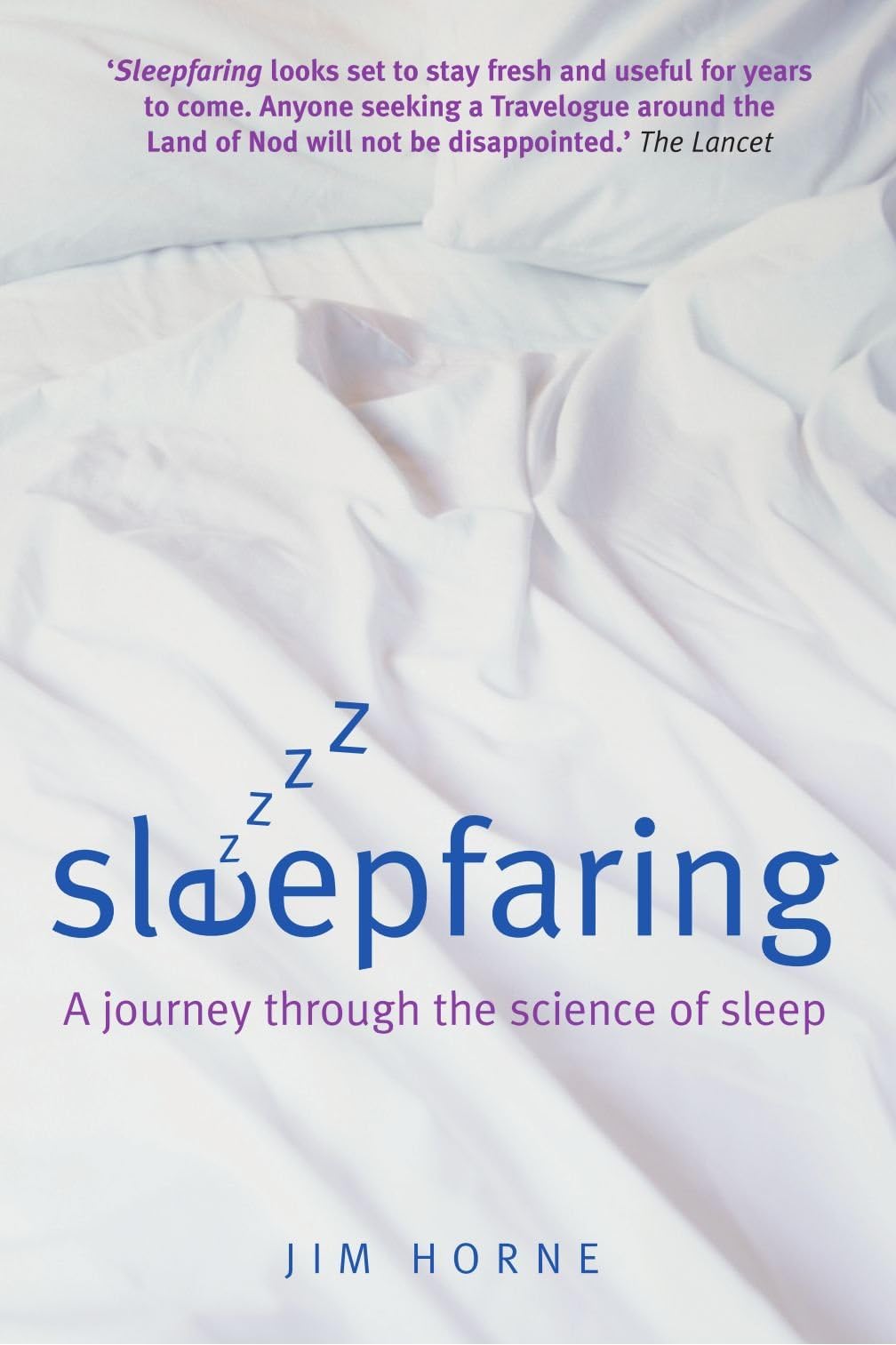
Sleepfaring: A Journey through the Science of Sleep
Product ID: 62566853
Desertcart purchases this item on your behalf and handles shipping, customs, and support to USA.
Why do we sleep? Are we sleeping enough? Do we suffer stress from "sleep debt"? Why do some of us struggle with sleep disorders? And how can we tackle sleep problems? These are the kinds of questions that make many of us toss and turn all night. Jim Horne finds answers to these questions and many more in Sleepfaring, a journey through the science and the secrets of sleep. He reveals what goes on in our brains behind the veil of sleep, looks at body clocks, the values of napping, and the controversial question of "sleep debt," and also gives some hints from the latest sleep research that may just help you get a better night's rest. In recent years, the nature of sleep, our sleeping patterns, how much sleep we need, and the dangers of lack of sleep have become increasingly important, as people work longer hours, styles of working have altered, and the separation between workplace and home has been eroded by cell phones and the internet. From drowsiness at the wheel, to stress and insomnia, this is a subject that truly matters to people. Horne draws on the latest research in brain physiology, psychology, medicine, and the many social factors that contribute to sleep problems to reveal what science has discovered about sleep, and problems related to sleep-from snoring to sleep apnea. Nor does Horne shy away from controversy, challenging, for example, the conventional wisdom on the amount of sleep we actually need. For anyone wishing to know more about the many mysterious processes that begin when we close our eyes each night, Sleepfaring offers a wealth of insight and information. Review: You Can Find It All In Here! - Absolutely brilliant! It's a thorough look at everything associated with sleep an sleep problems. Not for those that just want a quick "manual" to getting better sleep. This is more for those that want the science and the theories in addition to all the practical tips the author serves up. Highly recommended! Review: Five Stars - Thanks
| Best Sellers Rank | 1,646,477 in Books ( See Top 100 in Books ) 591 in Health Psychology 1,096 in Psychology & Hypnosis 7,159 in Popular Medicine |
| Customer Reviews | 4.4 out of 5 stars 29 Reviews |
G**N
You Can Find It All In Here!
Absolutely brilliant! It's a thorough look at everything associated with sleep an sleep problems. Not for those that just want a quick "manual" to getting better sleep. This is more for those that want the science and the theories in addition to all the practical tips the author serves up. Highly recommended!
D**T
Five Stars
Thanks
S**Y
Sleepfaring
I found this book to be very true to its title's claim: A journey through the science of sleep. The book is really easy to read and is written in quite a conversational manner. While it is clear that the author feels strongly about all the topics covered in the book, the `discussions' are non-biased in the sense that he provides thorough information on each topic without trying to tell his audience to believe in specific conclusions. It is a great introduction to the broad subject of sleep in general . This book gave me a more rounded understanding of the role sleep plays in our everyday life and also exposed some of the myths surrounding the subject of sleep, which have actually helped me sleep better as a consequence! I read the book for general interest and as a precursor to beginning my studies in sleep science, not for therapeutic reasons. Though, after reading the book, I feel that readers searching for tips on how to sleep better will definitely benefit from reading it. While the book is not a sleep science text book, I learned a lot of useful info about sleep from reading it and recommend it to others.
A**Y
This is a very good book
I read this book in 2010 during an investigation into a fatigue related rail incident. I hoped the book would improve my understanding of sleep and fatigue and help with my work - it did not disappoint. So then I recommended Sleepfaring to friends, family and people I knew that were involved in safety critical work. Those that read it found it as I did - entertaining, informative, surprising. This review comes after I first read the book because I recently re-read it and was surprised I did not leave a review at the time. So I have addressed my past omission and to conclude, if you're considering reading Sleepfaring, I commend it to you.
S**K
Most up to date book about the science of sleeping
Like most people I asked this question to myself too "Why do we sleep?" Here is a book that explains it all. I mean 1/3 of our lives spent on sleeping 10 years of every 30 years spent on sleeping. What do we do in those times? Why do we need to? Can we cut it a bit short? In these strapped for time millennia it would be huge improvement if we can get some extra spare time from anywhere. Is it possible not to sleep? What exactly happens if we don't sleep? You will be answering these and all the questions you had about sleeping as long as science knows about it in this well written easy to read book. Even science does not know much about sleeping but this book is the most up to date book that we know about the science of sleeping that an ordinary inquisitive reader can understand. Congratulations to the writer.
J**N
Good Overview of the Science of Sleep
When I saw this book, I knew I just had to get it to while away the long, dark, wee hours of the night. Although "Sleepfaring" is actually a serious look at the science of sleep, it is written with a dry wit which provides an amazing amount of material without appearing as information overload. From explaining that some animals go to sleep with half of their brain at a time (dolphins) to describing the (self-inflicted!) effects of sleep-deprivation on someone who stayed awake for 11 days (264 hours!), this book is a treasure trove for boring the pants off everyone at your next party with all sorts of weird and wonderful sleep-related trivia. Moreover, as sleep scientists discovered, quite a number of participants in sleep-deprivation experiments "passed through periods of giddiness and silly laughter, like addled drunks, when their behaviour became uninhibited" [p.80]. So, when you've had a few too many glasses of sauvignon blanc at that party, you can afterwards explain away all of your obstreperous and rambunctious conduct to manifesting the symptoms of chronic insomnia! At least, that's my new excuse and I'm sticking to it! Horne takes you through various types of sleep experiments; what REM and non-REM sleep are; what alpha, beta, theta, and delta waves really are; the effects of sleepiness on driving - i.e., don't do it!; the body clock or circadian rhythm; how to beat jetlag; dreams; how much sleep we really need and insomnia (I didn't think he was terribly sympathetic to sufferers - i.e., they're really just stress-pots, rather unfair); sleep apnoea; sleep in children and much more. The Important Stuff Disappointingly, no new wonderful insights are offered into the causes or treatment of insomnia beyond the usual suggestions: - try to deal with stress and worries during the waking day - i.e., before you go to bed; - the bedroom should be a place for relaxation and sleep only, not a workplace; - hide the alarm clock, for you only need to know when to get up, not to be worrying and fretting about how little sleep you seem to be getting and making the whole problem worse; - when you wake up/can't get over - give up, get up, and go into a different room and do a jigsaw puzzle. Apparently, this is better and more engaging for the mind than passive activities like reading or watching tv and thus more likely to make you sleepy. Repeat if necessary. This was a new suggestion to me; - Have a warm bath before bed. Apparently, our body temperature drops slightly in preparation for sleep and after a bath, our bodies overcompensate by trying to rid themselves of excess heat which aids in our preparation for bed. - The most harsh way to try to reset the body clock is through a drastic sleep restriction programme. E.g., most people sleep an average of 7-7.5 hours a night. Thus, ideally we wish to sleep between midnight and 7am. Therefore, on the first night we subtract an hour from each end of the spectrum - in other words, go to bed at 1am and get up at 6am. Even should you only get three hours sleep that night, you'll know that you'll have built up sleep pressure for the following night. Eventually, this is changed to midnight and getting up at 7am. If you rigidly stick to this program, your body clock will reset itself. Just remember, no naps during the day. Getting as much sunlight as possible during the day helps get your body acclimatized to daytime wakefulness. (I've tried this, and it wasn't exactly successful - I just ended up an exhausted wreck and zombie - maybe it'll work for you.) Anyway, if you're interested in a journey through the science of sleep, you'll enjoy this book. Well worth reading. 7/10 Originally posted at "Introspective Cogitations".
L**Y
A gem of a book
This is an excellent book. The science, research and theories are explained with a light touch that is never patronising. Reading this book felt like having a fascinating subject explained to me by an expert, good humoured, and charming friend.
P**E
Not what I expected, but still good.
Enjoyable book. Quite enjoyable. Much more of a self help book for people who have trouble sleeping, and there is a lot of very useful information about sleep in general that can help. Does not delve deep enough into other aspects of sleeping and dreaming, especially with a name like sleepfaring, but is still an enjoyable and informative read.
A**Z
An Excellent Review of What is Known
This is an excellent review of the latest sleep research and has some excellent suggestions on coping with shift (jet lag) work.
A**J
Eine gute Bett Lektüre
Schön verständlich geschrieben und die Kapitel sind eher kurz gehalten, dass man schnell mal eins zum Einschlafen lesen kann. Sehr zu empfehlen, alles was man über den Schlaf wissen muss.
K**R
popular books and journal articles
I don't work in Dr. Horne's field, but I get the sense that he is an accomplished researcher in this area. He has a thorough understanding of the history of science in this field. He also seems to be thoroughly aware of current research across the field, as one would expect from the editor of a journal that specializes in sleep research. Sleep science is a surprisingly broad field, and there are many interesting aspects of sleep which I had never thought about until I read this book. All that said, this really is not a good book. If you are interested in this topic as a layman you will be disappointed. After a few cohesive introductory chapters centered around the history of sleep research, the structure of the book falls apart. Chapters are tightly connected primarily through the material used in the binding. Even within chapters, Dr. Horne strikes out on unrelated tangents, usually to do with arcana such as quibbles about the instruments used in studies. It is true that the book is littered with interesting anecdotes and results. But I chose the word litter carefully. Not only the lack of structure, but the writing makes this book difficult to read. Here is an example of a sentence from the book: "All this might seem rather academic, but it is not, and here is an example of why, from the Second World War, many allied aircraft crashed on homeward flights, after bombing raids or 'dog fights'." Now, this may simply be a typo. A change in punctuation (e.g., switching a comma for a semicolon) would make this a readable sentence (or two). This is the kind of writing mistake all of us make. I am sure I make mistakes like this, because I catch mistakes like this every time I revise my work. And I catch this kind of mistake in my students' writing all the time as well. And when I do catch a mistake like this in a student's writing, I usually write in the margin: "if you didn't read this, why should I?" I do not think the book is rigorous enough to be used as an text in a doctoral level class in sleep research, but it might be a great companion piece, used in coordination with a reading list of journal articles. One does get the sense that Dr. Horne would teach a fun class in this material. But unless you are a doctoral student in this area, I would avoid this book.
K**A
Dry but full of information
At times hard to get through, this book contains a wealth of information. However, the information rarely comes together into knowledge or wisdom about sleep - all facts and no theory - so my main takeaway from the book was a collection of disparate facts about the lack of necessity of REM sleep, nonhuman animal sleep patterns, etc. Overall a good read for those interested in sleep.
F**S
This will put you to sleep
So, based on a Chicago Tribune article, I chose this book for our monthly book club. What a waste! The author rambles, and goes off on tangents, none of which are too interesting, and all of which are confusing. If this gives you any indication, none of the 10 folks in book club finished this book. Instead of discussing the book (other than to bemoan its awfulness), we drank wine, ate dinner, and discussed our social lives instead. Do not waste your time or money - this book is not worth it. Unless you would like to have a boring read on your nightstand for those nights of insomnia ...
Trustpilot
2 months ago
2 weeks ago