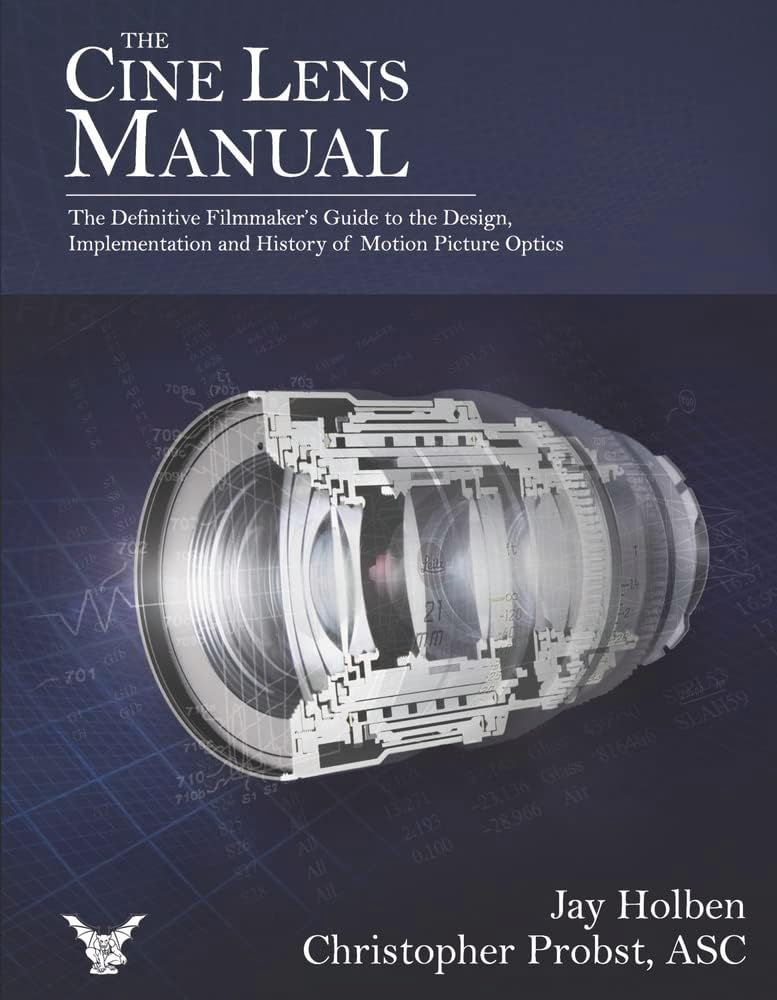
The Cine Lens Manual: The Definitive Filmmaker's Guide to Cinema Lenses
Product ID: 556775389
Desertcart purchases this item on your behalf and handles shipping, customs, and support to USA.
It is the camera that separates cinema from other art forms and the lens that allows a scene to be captured by the camera. The cinema lens, therefore, is at the heart of filmmaking. All aspects of a production are carefully crafted with the intention of being captured by the lens and camera to create a visual story. The Cine Lens Manual is a comprehensive examination of the art and science of cinema optics. Written in clear, easily-digestible language, and extensively illustrated, The Cine Lens Manual is designed for readers of all levels of experience from novice to expert. With more than 60-years of experience between them as cinematographers, technical journalists and educators, authors Holben and Probst break down the most complex concepts into easy-to-understand ideas, without requiring a mastery of calculus or physics. This manual is not just for cinematographers, but for all individuals with an interest in the lens ― directors, visual effects artists, camera assistants, animators, technical journalists, historians, students, rental house technicians ― anyone looking for a deeper understanding of cinema optics. It is unlike anything else that has ever been written on the subject. The chapters explore: •A primer on cinema lenses •Introduction to optical design •Investigation of advanced optical design and early photographic lenses •Examination of optomechanical design •Evolution of motion picture formats •History and genealogy of 140 years of purpose-built cinema lenses, detailing more than 300 series •Modifying existing lenses for use in cinema or to creatively custom-tune their performance •Testing and evaluating lenses •Care and maintenance of cinema lenses The Cine Lens Manual is a journey through the world of cinema lenses investigating every possible aspect from the formation of glass itself into today's top cinematographic optical tools. It is a must-read for all visual storytellers working in the cinematographic world. Review: All-round overview of cinema optics - This is a monumental 3 kg of a book. While it covers everything from cinema lenses design basics to history, some explanations on the working principles are flimsy and raised my eyebrow several times. For instance, the authors spend way too much time on some minute details such as 'what this setting does not mean'. On the other hand, it makes the book feel very authentic. This, nevertheless, does not outweigh the overall aim to give a thorough review of as many aspects as possible. As an optical engineer, I would have appreciated a deeper look into how exactly particular lens designs aimed to solve certain optical aberrations. In other words, I would not have shied going into a bit more technical details (with over 800 pages worth of material, additional 10 would not have made a difference). In any regard, I am very proud to have this book on my shelf, to serve as a field guide, if you may, on the subject. Review: Comprehensive, insightful, remarkable. - For anyone interested in the art of film making and the mechanics of cinematography this is the go to resource on cine style lenses. The book also includes information on photographic lenses as applied to motion picture photography. The Cine Lens Manual is a must have book that complements classics like the ASC Cinematography Manual. It includes the kind of information that is equivalent to state secrets, and privileged knowledge shared amongst the best cinematographers. There is plenty of practical information, science and the kind of insight learned by trial and error. The book is a comprehensive compendium that will serve a cinematographer well. It will save lots of time in making decisions related to lens choices, repairs and modifications. Several years ago I had the opportunity to take a few workshops with Chris Probst via the Global Cinematography Institute, he was a generous insightful instructor. As one of the top cinematographers in a competitive field Probst has a remarkable skill set that combines the technical with great art. This book is a remarkable professional contribution to the art of cinematography.
| Best Sellers Rank | #295,328 in Books ( See Top 100 in Books ) #50 in Cinematography (Books) #685 in Photograpy Equipment & Techniques |
| Customer Reviews | 4.4 out of 5 stars 20 Reviews |
K**S
All-round overview of cinema optics
This is a monumental 3 kg of a book. While it covers everything from cinema lenses design basics to history, some explanations on the working principles are flimsy and raised my eyebrow several times. For instance, the authors spend way too much time on some minute details such as 'what this setting does not mean'. On the other hand, it makes the book feel very authentic. This, nevertheless, does not outweigh the overall aim to give a thorough review of as many aspects as possible. As an optical engineer, I would have appreciated a deeper look into how exactly particular lens designs aimed to solve certain optical aberrations. In other words, I would not have shied going into a bit more technical details (with over 800 pages worth of material, additional 10 would not have made a difference). In any regard, I am very proud to have this book on my shelf, to serve as a field guide, if you may, on the subject.
R**R
Comprehensive, insightful, remarkable.
For anyone interested in the art of film making and the mechanics of cinematography this is the go to resource on cine style lenses. The book also includes information on photographic lenses as applied to motion picture photography. The Cine Lens Manual is a must have book that complements classics like the ASC Cinematography Manual. It includes the kind of information that is equivalent to state secrets, and privileged knowledge shared amongst the best cinematographers. There is plenty of practical information, science and the kind of insight learned by trial and error. The book is a comprehensive compendium that will serve a cinematographer well. It will save lots of time in making decisions related to lens choices, repairs and modifications. Several years ago I had the opportunity to take a few workshops with Chris Probst via the Global Cinematography Institute, he was a generous insightful instructor. As one of the top cinematographers in a competitive field Probst has a remarkable skill set that combines the technical with great art. This book is a remarkable professional contribution to the art of cinematography.
F**Y
Great Book, Poorly Made.
Even tho the content of the book is amazing. The pages of the book immediately became unglued from the spine of the hardcover upon opening the first page. Being that it’s so expensive makes you feel a little ripped off.
A**O
Parece un libro usado
Me llegó en pésimo estado
A**L
Incredible resource, unfortunate binding and shipping
The contents of this book is a result of an incredible research and hard work. The book itself is priceless. As a collector, professional in the field and an enthusiast I’d rather spend even more on such a book with better print quality, much better binding and most importantly better packed to be shipped. Unfortunately, I received my book in a big box with no padding. The pages were already mostly ripped from the binding and the cardboard binding was smushed on all corners. I will go ahead and tale it to a proğer binding shop. I also feel the urge to contact the publisher and ask for a pdf so that I can print my own ‘collectible’ version of this incredibly wonderful work.
J**B
Disappointed considering the price
This isn’t a review of the content of the book but of the state of how it arrived. Took a long time to arrive and when I eventually received it, the book was seriously damaged. The pages had come away from the spine. Returned immediately for refund and seems I’m not the only person who’s experienced this
Trustpilot
1 week ago
2 weeks ago