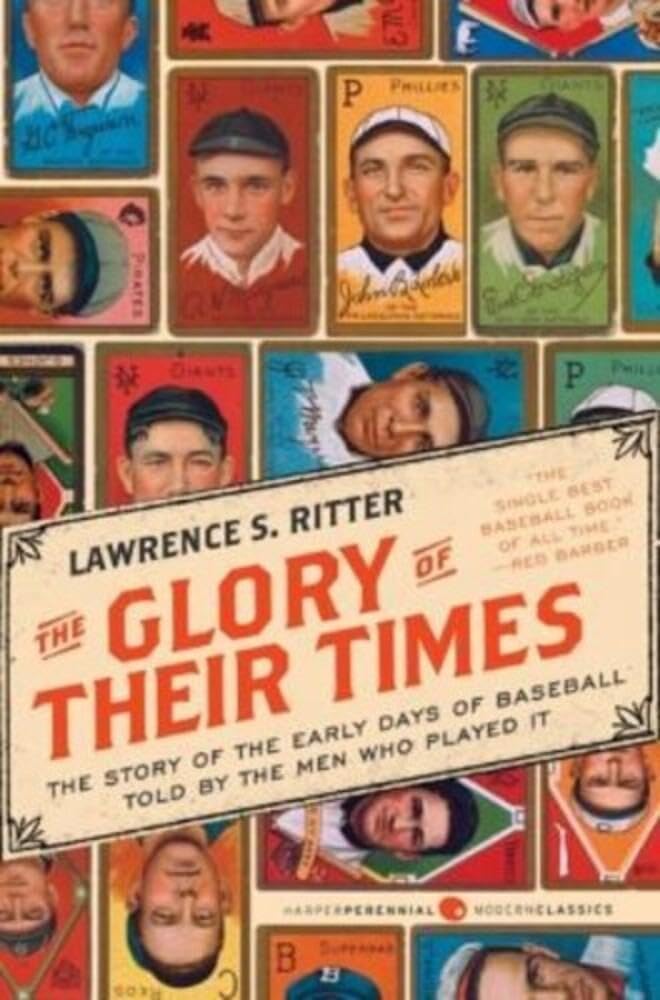
The Glory of Their Times: The Story of the Early Days of Baseball Told by the Men Who Played It (Harper Perennial Modern Classics)
Product ID: 5554196
Desertcart purchases this item on your behalf and handles shipping, customs, and support to USA.
The Glory of Their Times: The Story of the Early Days of Baseball Told by the Men Who Played It (Harper Perennial Modern Classics) [Ritter, Lawrence S.] on desertcart.com. *FREE* shipping on qualifying offers. The Glory of Their Times: The Story of the Early Days of Baseball Told by the Men Who Played It (Harper Perennial Modern Classics) Review: One Of The Best Baseball Books Ever! - With an idea birthed in 1961 after the death of Ty Cobb, "The Glory Of Their Times" is filled with first-person interviews of some of the most note-worthy baseball players of first quarter of the 20th Century Baseball (such as Stan Coveleski, Sam Crawford, Fred Merkel, Rube Marquard, Smoky Joe Wood, Fred Snodgrass, Goose Goslin - to name only a few) and several from the second quarter (such as Hank Greenberg and Paul Waner). Also included are interviews from many baseball players that you've probably NEVER heard of including Davy Jones, Bill Wambsganss, Tommy Leach, Hans Lobert, and Jimmy Austin - all great players in their own right but for whom time has largely forgot. Not only do these players talk about growing up playing baseball, their sometimes circuitous and or tortured routes to the major leagues, and their playing careers, but they also talk at length about their peers, memorable events and games, and such immortals of the game as Ty Cobb, Babe Ruth, John McGraw, Walter Johnson, Christy Mathewson, Grover Cleveland Alexander, Frank Chance, Honus Wagner, and even Jim Thorpe and the 1919 Black Sox. Recorded over a five-year span, the interviews that author Lawrence Ritter taped are both unforgettable and irreplaceable. Back when baseball was more a team sport and the men played for the love of the game and not the money, the stories in the book make for an interesting and telling comparison to many of today's players who seem to have trouble talking about anything other than themselves. Many of the stories I liked best in the book were of the "challenged player makes good" variety. Read about Smoky Joe Wood going from lights-out World Series champion starter to useful outfielder. Or Chief Meyers' & Hank Greenberg's stories about overcoming racial prejudice. Or 19 year old Paul Waner showing up at training camp with the San Francisco Seals and going from a sore-armed starter into a Hall of Fame outfielder. Or how Sam Crawford could be one of the most under-rated players in Major League history (despite being in the Hall of Fame) due to sharing the same outfield with Ty Cobb. Or how the deaf and mute "Dummy" Hoy overcame his seeming disabilities to craft a very good 14 year career. Stories like this are very seldom found in baseball books which focus on the stars of the day to the almost complete absence of everyone else. As if the book needed anything else, the pictures that are included in the book are fabulous. One of the reviewers has already mentioned a photo of Walter Johnson casually standing next to friend Clyde Milan and almost all of the interviews include at least one photo of the player in question and also included are many of the players, teams, plays, and places that these old timers describe in almost unbelievable detail 30-40 years after the fact. It's useful to read the author's notes and the forward and he illustrates the path that he took in creating the book and states that much time was spent in corroborating the stories, plays, and stats that the players seemingly threw out off the tops of their heads. The glossary at the end of the book is also useful as a reference if you want to go back to a story about a particular player or team. All put together, this book is an engrossing page turner which every baseball fan should own! Review: One of the best baseball books you will read - Believe what they say. This truly is one of the best baseball books ever produced. If you've seen Ken Burns' "Baseball" or read much of anything about baseball around the turn of the twentieth century, then you will likely notice that a fair amount of their material is drawn from this book. The book is essentially a primary source to baseball in the old days. When Ty Cobb died, Lawrence Ritter decided that someone needed to interview the ballplayers from that era before they were all gone. This book is the result of those interviews. Ritter wisely chooses to omit his questions, so each chapter, devoted to a single ballplayer, simply reads as though that particular player is giving his own reflections. There are a few places where the player repeats the question in his response, and at those moments you realize that he is being interviewed. Mostly, however, the chapters just read as though you are sitting back and listening to these gentlemen recall their glory days. Ritter's editing is well done because it is so inconspicuous in this way. His editing is also masterful, however, in how he chooses to end each chapter. No doubt the conversations did not end precisely as the book chapters do, but Ritter almost always manages to conclude the chapter in a satisfying way, with the player coming back to some fun anecdote he had mentioned earlier, or a life lesson that ties his recollections together into a meaningful whole. While the players themselves are telling the story, Ritter weaves what they have to say in a way that never feels random or boring. And, of course, just reading about the game as it was and the players as they were is more than worth the price of the book. Were the ballplayers of old better than those today? Is it the other way around? Personally, I don't think that's such a straightforward question. Today's athletes tend to be built like superheroes, but they also swing from their heels with two strikes and strike out unapologetically. The average fastball speed is probably faster now with modern mechanical and training techniques, but it is doubtful that anyone has thrown a ball harder than Walter Johnson, or Smoky Joe Wood in his prime. It was harder to hit a ball blackened by licorice and tobacco, spat on with chewed up coffee beans, given scuff marks, etc., than it is to hit a ball that is perfectly white and untouched. Whatever you decide on how different eras compare, you will certainly walk away from this book with respect for those who came before. They truly were the glory of their times.
| Customer Reviews | 4.7 out of 5 stars 1,531 Reviews |
C**K
One Of The Best Baseball Books Ever!
With an idea birthed in 1961 after the death of Ty Cobb, "The Glory Of Their Times" is filled with first-person interviews of some of the most note-worthy baseball players of first quarter of the 20th Century Baseball (such as Stan Coveleski, Sam Crawford, Fred Merkel, Rube Marquard, Smoky Joe Wood, Fred Snodgrass, Goose Goslin - to name only a few) and several from the second quarter (such as Hank Greenberg and Paul Waner). Also included are interviews from many baseball players that you've probably NEVER heard of including Davy Jones, Bill Wambsganss, Tommy Leach, Hans Lobert, and Jimmy Austin - all great players in their own right but for whom time has largely forgot. Not only do these players talk about growing up playing baseball, their sometimes circuitous and or tortured routes to the major leagues, and their playing careers, but they also talk at length about their peers, memorable events and games, and such immortals of the game as Ty Cobb, Babe Ruth, John McGraw, Walter Johnson, Christy Mathewson, Grover Cleveland Alexander, Frank Chance, Honus Wagner, and even Jim Thorpe and the 1919 Black Sox. Recorded over a five-year span, the interviews that author Lawrence Ritter taped are both unforgettable and irreplaceable. Back when baseball was more a team sport and the men played for the love of the game and not the money, the stories in the book make for an interesting and telling comparison to many of today's players who seem to have trouble talking about anything other than themselves. Many of the stories I liked best in the book were of the "challenged player makes good" variety. Read about Smoky Joe Wood going from lights-out World Series champion starter to useful outfielder. Or Chief Meyers' & Hank Greenberg's stories about overcoming racial prejudice. Or 19 year old Paul Waner showing up at training camp with the San Francisco Seals and going from a sore-armed starter into a Hall of Fame outfielder. Or how Sam Crawford could be one of the most under-rated players in Major League history (despite being in the Hall of Fame) due to sharing the same outfield with Ty Cobb. Or how the deaf and mute "Dummy" Hoy overcame his seeming disabilities to craft a very good 14 year career. Stories like this are very seldom found in baseball books which focus on the stars of the day to the almost complete absence of everyone else. As if the book needed anything else, the pictures that are included in the book are fabulous. One of the reviewers has already mentioned a photo of Walter Johnson casually standing next to friend Clyde Milan and almost all of the interviews include at least one photo of the player in question and also included are many of the players, teams, plays, and places that these old timers describe in almost unbelievable detail 30-40 years after the fact. It's useful to read the author's notes and the forward and he illustrates the path that he took in creating the book and states that much time was spent in corroborating the stories, plays, and stats that the players seemingly threw out off the tops of their heads. The glossary at the end of the book is also useful as a reference if you want to go back to a story about a particular player or team. All put together, this book is an engrossing page turner which every baseball fan should own!
D**N
One of the best baseball books you will read
Believe what they say. This truly is one of the best baseball books ever produced. If you've seen Ken Burns' "Baseball" or read much of anything about baseball around the turn of the twentieth century, then you will likely notice that a fair amount of their material is drawn from this book. The book is essentially a primary source to baseball in the old days. When Ty Cobb died, Lawrence Ritter decided that someone needed to interview the ballplayers from that era before they were all gone. This book is the result of those interviews. Ritter wisely chooses to omit his questions, so each chapter, devoted to a single ballplayer, simply reads as though that particular player is giving his own reflections. There are a few places where the player repeats the question in his response, and at those moments you realize that he is being interviewed. Mostly, however, the chapters just read as though you are sitting back and listening to these gentlemen recall their glory days. Ritter's editing is well done because it is so inconspicuous in this way. His editing is also masterful, however, in how he chooses to end each chapter. No doubt the conversations did not end precisely as the book chapters do, but Ritter almost always manages to conclude the chapter in a satisfying way, with the player coming back to some fun anecdote he had mentioned earlier, or a life lesson that ties his recollections together into a meaningful whole. While the players themselves are telling the story, Ritter weaves what they have to say in a way that never feels random or boring. And, of course, just reading about the game as it was and the players as they were is more than worth the price of the book. Were the ballplayers of old better than those today? Is it the other way around? Personally, I don't think that's such a straightforward question. Today's athletes tend to be built like superheroes, but they also swing from their heels with two strikes and strike out unapologetically. The average fastball speed is probably faster now with modern mechanical and training techniques, but it is doubtful that anyone has thrown a ball harder than Walter Johnson, or Smoky Joe Wood in his prime. It was harder to hit a ball blackened by licorice and tobacco, spat on with chewed up coffee beans, given scuff marks, etc., than it is to hit a ball that is perfectly white and untouched. Whatever you decide on how different eras compare, you will certainly walk away from this book with respect for those who came before. They truly were the glory of their times.
G**T
A fantastic book and a must read for any baseball fan
I am a huge baseball fan, and really appreciate the history of the game. I've watched Ken Burns' Baseball probably a half-dozen times. As such, I'm the exact target audience for Lawrence S. Ritter's book, The Glory of Their Times: The Story Of The Early Days Of Baseball Told By The Men Who Played It. This book was absolutely fantastic, and I wholeheartedly recommend it to anyone with any interest at all in baseball. Even if you aren't currently interested in the game's history, you will be by the time you finish The Glory of Their Times. Originally published in 1966 including interviews with 22 players from the early 20th century, and expanded in 1984 with an additional four player interviews, Ritter sets out to capture the memories of the earliest players of the game for the ages, and does so brilliantly. The book consists of a chapter for each player interviewed, and Ritter lets the player tell their own story in their own way. It's absolutely fascinating to hear these players echoing through the decades and describing the way they played the game, their careers, their teammates, their managers, the business of baseball, and even the fans of the day as seen from the player's view. One of the aspects of the book that I enjoyed most is that many of the players discuss the same events or players, including each other, and it's great getting different takes on all of that. You'll hear all about what the players of the day, including his teammates, thought of Merkle's Boner, or what it was like to play with or against Ty Cobb, or what manager John McGraw was like to play for. By the time you finish the book, you'll feel like you've gotten to know all these other players just as well as the men interviewed, who range from Hall of Famers like Sam Crawford or Paul Waner to a career utility player like Specs Torporcer. Baseball fans who, like me, have enjoyed Ken Burns' Baseball documentary should read this book. In fact, I re-watched Baseball (once again) only a couple months before reading The Glory of Their Times, and I recognized many of the stories and quotes from the early episodes of Baseball as having come straight from these interviews. So, if you enjoyed those, there's a lot more like that here for you. Another part of the book that is well done is the inclusion of many, many photographs. Ritter gives the reader pictures of all the interviewees and many of the people they talk about, and the pictures are included in the text when relevant, instead of in a glossy insert in the middle of the book, so they're very effective in helping the reader visualize the events being described. I highly recommend The Glory of Their Times. It's a magnificent book that does a wondrous job of drawing the reader into the early days of baseball.
N**R
A Collection Worth Keeping
When I was young, I wasn't interested in hearing about the `old times'. Now that I'm older, the old folks are gone and I've missed out hearing their stories forever. In a way, this book is a second chance. Lawrence Ritter has made a Herculean effort tracking down all these players and getting their stories. Baseball fans owe him many thanks for the job he's done. There are many interesting stories told between these pages, but one of the most surprising to me was that these players called the games themselves most of the time. No coaches and the managers sat back and let the players play, for the most part. I especially enjoyed the story by Rube Bressler about three players ending up on third base at the same time. This is a must have collection for baseball fans. I thought "The Greatest Baseball Stories Ever Told" by Jeff Silverman was a little more entertaining, but this collection held my interest too and is a book worth keeping.
N**R
A National Treasure
Kudos to Lawrence Ritter. This is beyond any shadow of a doubt the greatest baseball book ever written. First of all, more than one player says that Ty Cobb was not a "spike slashing demon of the basepaths with a wide streak of cruelty in his nature." At least one player says that Cobb was a hard player but not a dirty player. It talks about the good old days before 10 year $500,000,000 contracts, Nike logos on the uniforms, games played at night, Wild Card and Division series. Artificial turf, nine inning games lasting four hours, gloves that are more like fishermen's nets. One reviewer said it talked about players he'd never heard of. Duh. Neither did I. Other reviewers say how they had problems with the product or the shipment. That is not the purpose of a book review, moron. Along with Ty Cobb, Fred Merkle is vindicated for his famous "boner" that "cost" the NY Giants the 1908 pennant. None of the Giants ever blamed Merkle for it. Bill Wambsganass (unassisted triple play in the 1920 World Series), Sam Jones, Hank Greenberg, Babe Herman, Sam Crawford, Smoky Joe Wood, Goose Goslin who played with the old Washington Senators, Edd Roush who insists the Reds would have won the 1919 series even if it hadn't been fixed, Jimmy Austin who in one of baseball's most famous images ate five tons of dirt off Ty Cobb's slide into third base: what a book! Spoiler alert. In the preface, Ritter talks about how he went about finding these old ballplayers. He talks about how Sam Crawford's wife placed him within fifty miles of Crawford's location. Two days of searching proved futile. On the third day Ritter was in a laundromat and as he sat washing the clothing he asked an old man sitting next to if the old man had ever heard of Sam Crawford, the old ballplayer. "I should certainly hope so," said the old man, "bein' as I'm him."
P**H
A Delight
The names Ty Cobb, Babe Ruth and Honus Wagner don't resonate as much as they used to. As the decades go by even the old-timers among us haven't been around long enough to remember them. They've pretty much become historical, iconic figures, like the stoic-looking George Washington on a dollar bill. It's a bit of a sad reminder of the inexorable march of time, but what a great relief to know that this treasure chest of a book is around to keep their memories alive. The author got the idea for it in 1961 when he read that Ty Cobb had died. Realizing that many of Cobb's contemporaries would soon suffer the same fate, he set out to meet as many of them as he could and record--literally with a tape recorder--their stories for posterity. Twenty six of them are recounted here. Some of these guys are hall-of-famers, some of them not even close, but all of them--every single one--had a load of interesting tidbits to share. Baseball was a different game back then. America was a different place. The first great thing about the book is that you get at least several takes on the great ballplayers. One of the fellows, for example, playing Detroit, talked about being a little nervous about Cobb, whom they had all heard would sharpen his spikes. A Detroit player, however, mentioned that Cobb never sharpened his spikes. Not that they didn't discourage the other team from thinking so. Walter Johnson had an arm like a bullwhip, but he was a nice enough guy and a friend of Sam Crawford. Late in the game, if his team was ahead by enough runs, he'd toss a meatball in to Crawford and let him belt it. He never did that for Cobb, though, who he hated. Cobb could never figure out why Crawford was able to hit him. Honus Wagner is recalled by many as the best of all of them, with great quickness, great hitting and great fielding. A couple of the fellows recall that you could usually count on bits of gravel to be flung at you along with the ball he had just scooped up. Tommy Leach described him as the best fielding third-baseman, shortstop, first-baseman and outfielder in the league--he played all of them--and since he won the batting title eight times between 1900 and 1911 you couldn't really argue that he wasn't the best hitter in the league, either. For some odd reason, there aren't that many memorable gems about the great Babe Ruth, although there are at least a few. Harry Hooper (a guy I'd never heard of and a hall-of-famer) remembers Ruth in the first year he came up with Boston as a, "big, overgrown, green pea." "Nineteen years old, poorly educated, only lightly brushed by the social veneer we call civilization, he was gradually transformed into the idol of American youth and the symbol of baseball the world over . . . If somebody had predicted that back on the Boston Red Sox in 1914, he would have been thrown into the lunatic asylum." Along with these detailed sketches, including a ton of characters I haven't even mentioned--Germany Schaeffer, Rube Waddell (who didn't like to wear underwear), Lefty O'Doul, Dazzy Vance--the book is also, naturally, loaded with baseball anecdotes. Some of the more famous plays of the time, for example, are recounted in different ways and with different perceptions. Take the "Bonehead" Merkle play. For those of you who don't know, what happened was this. The Giants were tied with the Cubs for first place with one week to go in the season. In a game against each other, in the bottom of the ninth of a 1-1 game, the Giants had men on first and third with two outs. Merkle was on first. Birdwell hit a single to center, McCormack scored from third, and Merkle . . . ran to the clubhouse. Without touching second. The Cubs retrieved the ball from center field, Evers tagged second, and the run didn't count. Because of the crowd on the field the game had to be replayed on a later date. The Giants lost it, and lost the pennant. From then on and forever more, Fred Merkle became "Bonehead" Merkle. But it's actually a little more complicated than that. For one thing, Merkle was only nineteen. It was the first game he'd ever started for the Giants. And running into the clubhouse when the game was over was something all the guys did--whether touching second was necessary or not--because of the crowd pouring onto the field after the ushers opened the gates at the end of the game. The players ran off to get away from them. And Evers never did tag second base with the ball that was hit out to center because someone had heaved it into the left field stands. Fred Snodgrass doesn't think he ever tagged second with any ball at all. The umpires weren't around to know this, though; they had already left the field! Funny how the mists of history tend to simplify things. The detail in this book brings these stories back to life. And there are a ton of them recounted. Along with all of this baseball lore, you get a pretty good glimpse of America a hundred years ago, too. People were more humble, but in general confident, and much more direct. It's fascinating just to consider their nicknames: "Wee Willie" was the nickname for a short guy, "Specs" was the guy who wore glasses, "Chief," (at least two of them) were American Indians, and, "Dummy" was the guy who was deaf and dumb. Nobody meant anything by it; nobody apparently took offense. Stuff like these speaks volumes. Here's Jimmy Austin: " . . . they didn't have clubhouses in most parks, especially not for the visiting team. We'd get into uniform at the hotel and ride out to the ball park in a bus drawn by four horses. They used to call it a tally-ho in those days. We'd sit on seats along the sides and ride, in uniform, to the ballpark and back. "That ride was always a lot of fun. Kids running alongside as we went past, and rotten tomatoes once in a while. Always lots of excitement when the ball club rode by, you know." Yep. Thanks in part to this book, we know all right.
C**L
Lives Up To The Hype - The Best Baseball Book Ever
I had read where this was considered by many as "the best baseball book of all time." Well, you know how hype like that works; rarely is anything as good as it's built up. Not in this case. This really IS fantastic baseball material. It's so good that several people have copied its format since but nobody has come close to duplicating it. It's the content, though, not the form that makes this so entertaining. The "it," by the way, refers to letting former players talk into a tape recorder and write down exactly what they say. In this book, we get ballplayers who played in the wildest era in baseball history: the Deadball Era. Thus, you get some incredible stories, many of which are just jewels, things you will treasure if you're a fan and you love baseball history. If for nothing else, the story about Germany Shaefer's pinch hit home run is worth the price of the book. It is the funniest baseball anecdote I have ever heard or read. Baseball great Ted Williams said when he finished reading this book, he started over and read it again. I believe it. Lawrence Ritter recorded and wrote what has amounted to an instant classic, from the year it was published in 1966. All the hype, folks, isn't hype: it's the truth - a fabulous collection of baseball stories.
S**A
Best book on baseball I've ever read!
This is a fantastic collection of interviews of baseball players from the early 1900's. They were interviewed when they were in the 70s or 80s and their memories are clear and compelling. Truly a treasure for anyone who loves the game. Easy to read and hard to put down. This is the best book on baseball I've ever read! And I've read many.
Trustpilot
2 days ago
2 weeks ago