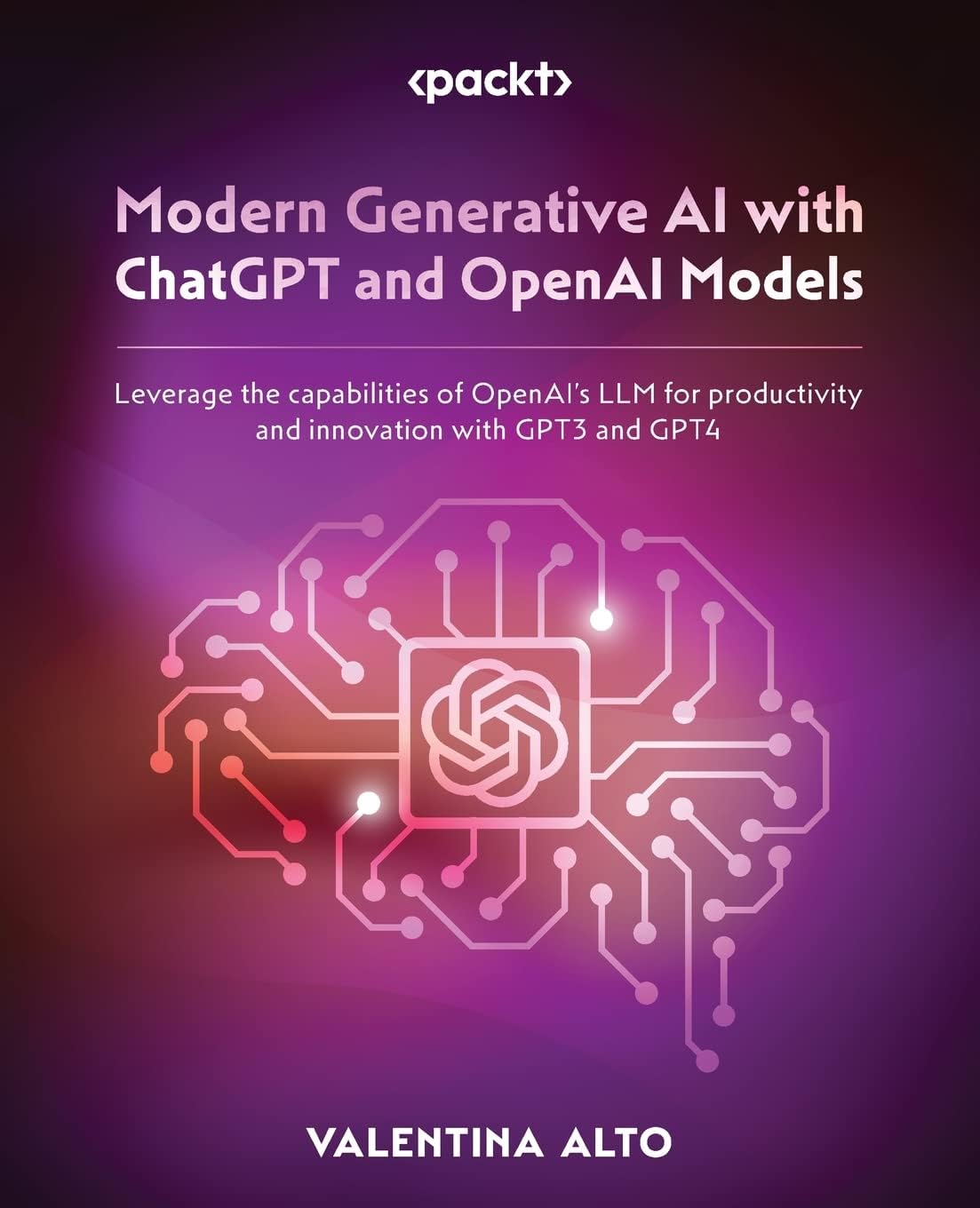
Modern Generative AI with ChatGPT and OpenAI Models: Leverage the capabilities of OpenAI's LLM for productivity and innovation with GPT3 and GPT4
Product ID: 512227090
Desertcart purchases this item on your behalf and handles shipping, customs, and support to USA.
Modern Generative AI with ChatGPT and OpenAI Models: Leverage the capabilities of OpenAI's LLM for productivity and innovation with GPT3 and GPT4 [Valentina Alto] on desertcart.com. *FREE* shipping on qualifying offers. Modern Generative AI with ChatGPT and OpenAI Models: Leverage the capabilities of OpenAI's LLM for productivity and innovation with GPT3 and GPT4 Review: HIghly recommended! - "Generative AI with ChatGPT: Building Language Models for Productivity and Applications" is a comprehensive guide that delves into the theory and practical implementation of generative AI models, with a specific focus on OpenAI's ChatGPT. Authored by experts in the field, this book offers valuable insights into the inner workings of language models and equips readers with the knowledge and skills necessary to create their own models. The book starts by introducing the concept of generative AI and provides a clear explanation of how these models are trained to generate new data. The authors effectively break down complex concepts, making them accessible even to readers with a basic understanding of Python. The gradual progression from basic to intermediate level concepts ensures a smooth learning curve. One of the book's notable strengths lies in its emphasis on real-world applications. It explores various use cases where ChatGPT can significantly boost productivity and enhance creativity across different domains such as marketing, research, and development. By showcasing practical examples and offering insights into prompt design and zero, one, and few-shot learning techniques, the book empowers readers to maximize the potential of ChatGPT in their own projects. Furthermore, the integration of OpenAI models, including both generative models like GPT-3 and embedding models like Ada, into enterprise-level scenarios is a noteworthy aspect of this book. The authors guide readers through implementing end-to-end solutions using Python, Streamlit as the frontend, and the LangChain SDK for seamless integration. This comprehensive approach ensures that readers gain a thorough understanding of how to leverage OpenAI models' APIs within their own applications. Moreover, the book addresses the importance of responsible AI and ethics in generative AI systems. By highlighting these considerations, the authors emphasize the need to develop AI models in an ethical and accountable manner, promoting a well-rounded understanding of the field. In terms of the target audience, the book caters to a wide range of readers. It appeals to individuals seeking to enhance their daily productivity, business professionals aiming to leverage AI applications within their organizations, data scientists and developers looking to optimize ML models and code, as well as marketers and researchers interested in domain-specific use cases. The inclusion of theoretical descriptions alongside practical code sections ensures that readers can grasp both the underlying concepts and their concrete applications. However, it is important to note that a basic understanding of Python is required to fully benefit from the book's content. While the authors provide explanations and code snippets, readers without prior Python knowledge may face challenges in grasping the more technical aspects. In conclusion, "Generative AI with ChatGPT: Building Language Models for Productivity and Applications" is a valuable resource for anyone interested in harnessing the power of generative AI. The book offers a comprehensive exploration of generative AI concepts, an in-depth focus on ChatGPT, and practical guidance on implementing AI models in real-world scenarios. With its clear explanations, use case examples, and ethical considerations, this book equips readers with the necessary knowledge and skills to leverage ChatGPT and OpenAI models' APIs effectively. Review: Beautiful book, but limited in coverage. - My friend Vinishka Kalra and the wizards of Packt were kind enough to share the new "Modern Generative AI with ChatGPT and OpenAI Models!" Key Features - Explore the theory behind generative AI models and the road to GPT3 and GPT4 - Become familiar with ChatGPT's applications to boost everyday productivity - Learn to embed OpenAI models into applications using lightweight frameworks like LangChain Table of Contents 1. Introduction to Generative AI 2. OpenAI and ChatGPT – Beyond the Market Hype 3. Getting Familiar with ChatGPT 4. Understanding Prompt Design 5. Boosting Day-to-Day Productivity with ChatGPT 6. Developing the Future with ChatGPT 7. Mastering Marketing with ChatGPT 8. Research Reinvented with ChatGPT 9. OpenAI and ChatGPT for Enterprises – Introducing Azure OpenAI 10. Trending Use Cases for Enterprises 11. Epilogue and Final Thoughts Book Description Generative AI models and AI language models are becoming increasingly popular due to their unparalleled capabilities. This book will provide you with insights into the inner workings of the LLMs and guide you through creating your own language models. You'll start with an introduction to the field of generative AI, helping you understand how these models are trained to generate new data. Next, you'll explore use cases where ChatGPT can boost productivity and enhance creativity. You'll learn how to get the best from your ChatGPT interactions by improving your prompt design and leveraging zero, one, and few-shots learning capabilities. The use cases are divided into clusters of marketers, researchers, and developers, which will help you apply what you learn in this book to your own challenges faster. You'll also discover enterprise-level scenarios that leverage OpenAI models' APIs available on Azure infrastructure; both generative models like GPT-3 and embedding models like Ada. For each scenario, you'll find an end-to-end implementation with Python, using Streamlit as the frontend and the LangChain SDK to facilitate models' integration into your applications. By the end of this book, you'll be well equipped to use the generative AI field and start using ChatGPT and OpenAI models' APIs in your own projects. What you will learn - Understand generative AI concepts from basic to intermediate level - Focus on the GPT architecture for generative AI models - Maximize ChatGPT's value with an effective prompt design - Explore applications and use cases of ChatGPT - Use OpenAI models and features via API calls - Build and deploy generative AI systems with Python - Leverage Azure infrastructure for enterprise-level use cases - Ensure responsible AI and ethics in generative AI systems On the downside, the book is relatively narrow in scope, focusing more on ChatGPT and OpenAI than it does on Generative AI as a whole. It also has a very heavy emphasis from a Azure point of view, which is likely to disappoint those who use it outside of that environment.




| Best Sellers Rank | #1,729,249 in Books ( See Top 100 in Books ) #180 in Cybernetics (Books) #547 in Artificial Intelligence (Books) #587 in Natural Language Processing (Books) |
| Customer Reviews | 4.0 4.0 out of 5 stars (40) |
| Dimensions | 7.5 x 0.65 x 9.25 inches |
| Edition | 1st |
| ISBN-10 | 1805123335 |
| ISBN-13 | 978-1805123330 |
| Item Weight | 1.09 pounds |
| Language | English |
| Print length | 286 pages |
| Publication date | May 26, 2023 |
| Publisher | Packt Publishing |
Y**N
HIghly recommended!
"Generative AI with ChatGPT: Building Language Models for Productivity and Applications" is a comprehensive guide that delves into the theory and practical implementation of generative AI models, with a specific focus on OpenAI's ChatGPT. Authored by experts in the field, this book offers valuable insights into the inner workings of language models and equips readers with the knowledge and skills necessary to create their own models. The book starts by introducing the concept of generative AI and provides a clear explanation of how these models are trained to generate new data. The authors effectively break down complex concepts, making them accessible even to readers with a basic understanding of Python. The gradual progression from basic to intermediate level concepts ensures a smooth learning curve. One of the book's notable strengths lies in its emphasis on real-world applications. It explores various use cases where ChatGPT can significantly boost productivity and enhance creativity across different domains such as marketing, research, and development. By showcasing practical examples and offering insights into prompt design and zero, one, and few-shot learning techniques, the book empowers readers to maximize the potential of ChatGPT in their own projects. Furthermore, the integration of OpenAI models, including both generative models like GPT-3 and embedding models like Ada, into enterprise-level scenarios is a noteworthy aspect of this book. The authors guide readers through implementing end-to-end solutions using Python, Streamlit as the frontend, and the LangChain SDK for seamless integration. This comprehensive approach ensures that readers gain a thorough understanding of how to leverage OpenAI models' APIs within their own applications. Moreover, the book addresses the importance of responsible AI and ethics in generative AI systems. By highlighting these considerations, the authors emphasize the need to develop AI models in an ethical and accountable manner, promoting a well-rounded understanding of the field. In terms of the target audience, the book caters to a wide range of readers. It appeals to individuals seeking to enhance their daily productivity, business professionals aiming to leverage AI applications within their organizations, data scientists and developers looking to optimize ML models and code, as well as marketers and researchers interested in domain-specific use cases. The inclusion of theoretical descriptions alongside practical code sections ensures that readers can grasp both the underlying concepts and their concrete applications. However, it is important to note that a basic understanding of Python is required to fully benefit from the book's content. While the authors provide explanations and code snippets, readers without prior Python knowledge may face challenges in grasping the more technical aspects. In conclusion, "Generative AI with ChatGPT: Building Language Models for Productivity and Applications" is a valuable resource for anyone interested in harnessing the power of generative AI. The book offers a comprehensive exploration of generative AI concepts, an in-depth focus on ChatGPT, and practical guidance on implementing AI models in real-world scenarios. With its clear explanations, use case examples, and ethical considerations, this book equips readers with the necessary knowledge and skills to leverage ChatGPT and OpenAI models' APIs effectively.
A**R
Beautiful book, but limited in coverage.
My friend Vinishka Kalra and the wizards of Packt were kind enough to share the new "Modern Generative AI with ChatGPT and OpenAI Models!" Key Features - Explore the theory behind generative AI models and the road to GPT3 and GPT4 - Become familiar with ChatGPT's applications to boost everyday productivity - Learn to embed OpenAI models into applications using lightweight frameworks like LangChain Table of Contents 1. Introduction to Generative AI 2. OpenAI and ChatGPT – Beyond the Market Hype 3. Getting Familiar with ChatGPT 4. Understanding Prompt Design 5. Boosting Day-to-Day Productivity with ChatGPT 6. Developing the Future with ChatGPT 7. Mastering Marketing with ChatGPT 8. Research Reinvented with ChatGPT 9. OpenAI and ChatGPT for Enterprises – Introducing Azure OpenAI 10. Trending Use Cases for Enterprises 11. Epilogue and Final Thoughts Book Description Generative AI models and AI language models are becoming increasingly popular due to their unparalleled capabilities. This book will provide you with insights into the inner workings of the LLMs and guide you through creating your own language models. You'll start with an introduction to the field of generative AI, helping you understand how these models are trained to generate new data. Next, you'll explore use cases where ChatGPT can boost productivity and enhance creativity. You'll learn how to get the best from your ChatGPT interactions by improving your prompt design and leveraging zero, one, and few-shots learning capabilities. The use cases are divided into clusters of marketers, researchers, and developers, which will help you apply what you learn in this book to your own challenges faster. You'll also discover enterprise-level scenarios that leverage OpenAI models' APIs available on Azure infrastructure; both generative models like GPT-3 and embedding models like Ada. For each scenario, you'll find an end-to-end implementation with Python, using Streamlit as the frontend and the LangChain SDK to facilitate models' integration into your applications. By the end of this book, you'll be well equipped to use the generative AI field and start using ChatGPT and OpenAI models' APIs in your own projects. What you will learn - Understand generative AI concepts from basic to intermediate level - Focus on the GPT architecture for generative AI models - Maximize ChatGPT's value with an effective prompt design - Explore applications and use cases of ChatGPT - Use OpenAI models and features via API calls - Build and deploy generative AI systems with Python - Leverage Azure infrastructure for enterprise-level use cases - Ensure responsible AI and ethics in generative AI systems On the downside, the book is relatively narrow in scope, focusing more on ChatGPT and OpenAI than it does on Generative AI as a whole. It also has a very heavy emphasis from a Azure point of view, which is likely to disappoint those who use it outside of that environment.
A**Z
Excelente libro para empezar en estos temas, trae algunos ejemplos con código, te da ideas de los problemas que pudiera resolver y herramientas que puedes usar.
A**A
Senza farvi perdere tempo sperimentando alla rinfusa, Valentina vi spiega con casi pratici come interagire con il prompt in maniera efficace e continua. Inoltre da anche un sacco di insight su quello che sta avvenendo e su cosa possiamo aspettarci nei prossimi mesi
Z**B
The book is non-technical historical overview of OpenAI and it's usage with Azure. There is an entire chapter dedicated to history of Azure and OpenAI and how the two have merged etc. Screenshots of Azure OpenAI interface is extremely small and barely readable. Everything is available on Azure OpenAI docs. Probably appropriate for anyone looking for something non-technical and who has zero knowledge of anything related to Chatgpt etc. Also the 'Generative AI' bit in the title is misleading as nothing besides the OpenAI playground dealing with ChatGPT is discussed. I wouldn't recommend this book
Trustpilot
5 days ago
2 months ago