Buy anything from 5,000+ international stores. One checkout price. No surprise fees. Join 2M+ shoppers on Desertcart.
Desertcart purchases this item on your behalf and handles shipping, customs, and support to USA.
๐ Unlock the airwaves: Your gateway to limitless radio exploration!
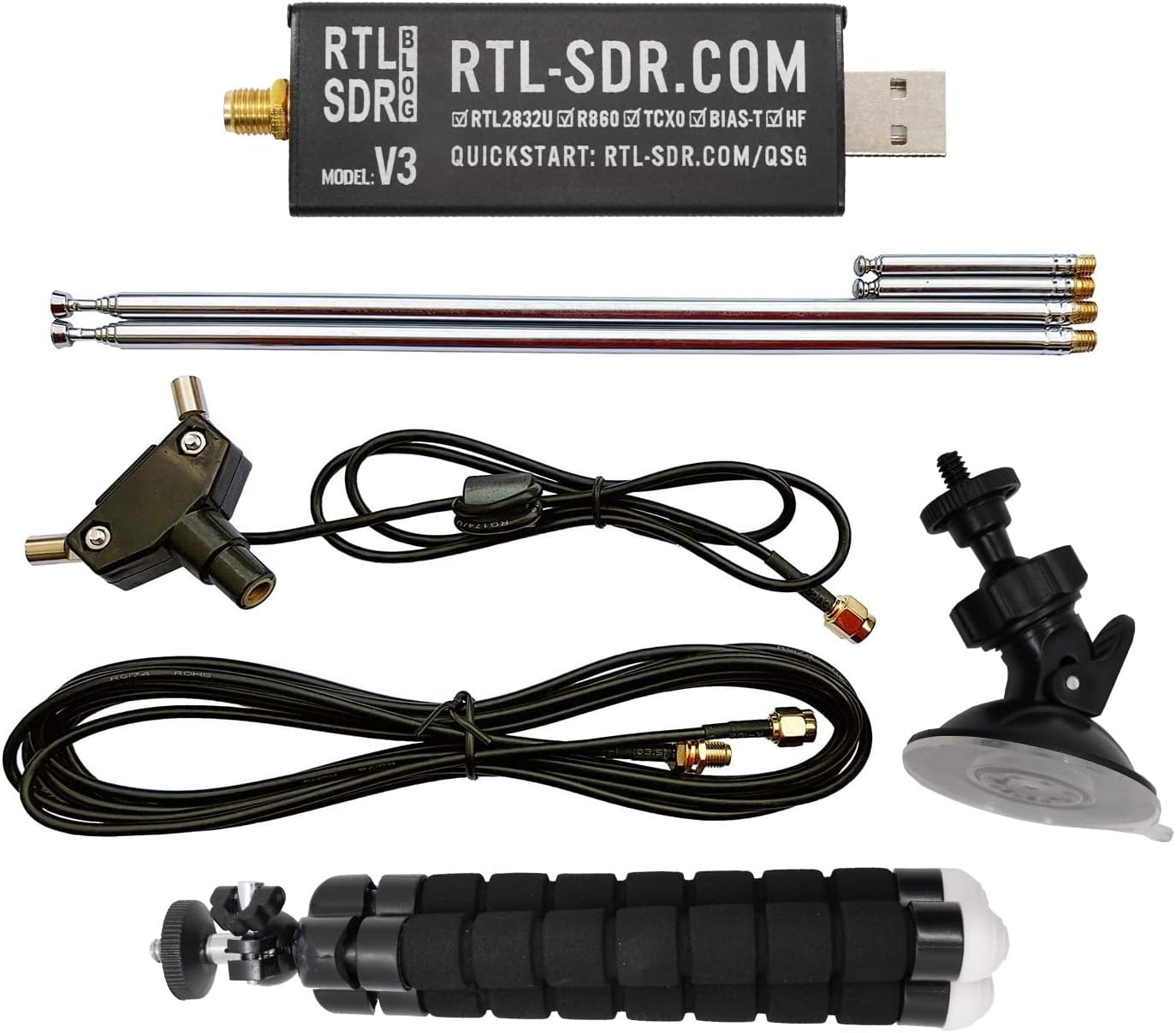
The RTL-SDR Blog V3 is a cutting-edge software defined radio receiver featuring the R860 tuner and RTL2832U ADC chip, delivering ultra-wideband coverage from 500 kHz to 1.7 GHz with up to 3.2 MHz instantaneous bandwidth. Its 1 PPM temperature-compensated oscillator ensures exceptional frequency stability, housed in a thermally optimized aluminum case with passive cooling. The included bias tee powers active antennas, while the multipurpose dipole antenna kit enables versatile terrestrial and satellite reception. Compatible with major OS platforms and popular SDR software, this bundle offers an affordable, professional-grade entry into the SDR world.
| ASIN | B0BMKB3L47 |
| Antenna | Satellite |
| AntennaDescription | Satellite |
| Best Sellers Rank | #4 in Radio Antennas |
| Brand | RTL-SDR Blog |
| Built-In Media | RTL-SDR Dongle, Antenna Set |
| Color | Black |
| Compatible Devices | Laptop, Desktop, Tablet, Smartphone |
| Connectivity Technology | USB |
| Connector Type | SMA |
| Customer Reviews | 4.4 out of 5 stars 6,467 Reviews |
| Includes Remote | No |
| Manufacturer | RTL-SDR Blog |
| Mfr Part Number | RTLSDR_AND_ANT_SILVER |
| Tuner Type | Satellite Radio |
| UPC | 783495030836 |
| Unit Count | 1.0 Count |
| Warranty Description | 2 years warranty on manufacturing defects |
B**S
Finally an Affordable Software defined Radio Dongle!
I am not new to Radios, I knew what I was getting into. I know that prior to year 2012, A Software Defined Radio (SDR) such as this one reviewed here were certainly not for general public, as they were considerably more expensive. In the last few years however there have been a ton of development activity in the field of Software Defined Radio (SDR), soon after it was discovered that a un-seemingly simple "DVB-T" dongles based on the Realtek RTL2832U can be used as a cheap SDR. Since that Realtek branded chip allowed transferring the raw "I/Q" samples to the host, which was used for DAB/DAB+/FM demodulation based on the Realtek RTL2832U chip now could also be dialed into frequencies well outside their advertised ranges. Thus, what was designed and sold as a simple device for watching "Digital TV" on your computer could now be turned into a full fledged "radio" capable of receiving frequencies anything between 64 MHz to 1700 MHz with free open source software. Fast forward few years more into development, This current RTL-SDR Blog Version [V3] R820T2, RTL2832U with 1PPM Temperature compensated crystal oscillator [TCXO] & HF Bias Tee for providing power to Low noise Amplifier, Software Defined Radio dongle can now tune from "500 kHz" (Medium Wave (MW) & Long Wave (LW) Radio) up-to 1.7 GHz and upwards. The dongle has up to 3.2 MHz of instantaneous scannable bandwidth while "2.4 MHz" being the most stable on most computers. The RTL-SDR project has become the Radio tinkerer's โfirst stepโ for someone looking to experiment with radios. Itโs cheap, itโs easy, and since the hardware is incapable of transmission, you donโt have to worry about having a HAM radio license to use it. You can however listen to, decode and scan all the frequencies (Works as an excellent frequency scanner) by pairing with capable software on most personal computers. The official software called as "SDR sharp" from "Airspy" is free and there are also several other capable SDR software one can use with the dongle (Like cross platform SDR++) which passionate developers have been making for the community. Installing the software for using RTL-SDR Blog Version [V3] USB dongle while might be relatively simple for tech savvy persons still remains mostly complicated for average user, that certainly needs to be addressed going forward. Especially the manual method of injecting the right USB drivers using a third party "Zadig" software and relying on various add-on libraries and Microsoft .NET 5.0 32-bit redistributable installed to use SDRSharp. Thankfully, there are other several developers who have taken this to next level by having the whole package preconfigured and ready to use using UBUNTU (LINUX based) .. Check out "Dragon OS". DragonOS which is a Debian Linux based operating system that comes with many open source software defined radio programs & additional decoding software pre-installed that takes all that driver installation requirements seen on windows based PCs totally seamless. Also, I found out that same DragonOS can be installed "alongside" windows if needed for a much seamless operation. Or you can just create a non-persistent "liveCD" environment using DragonOS and boot off USB stick to test it out. Bottom-line: The product reviewed here is an excellent value package, reasonably priced and has all the necessary accessories to get you started into Software Defined Radio (SDR) world. In my humble opinion it is worth more than 5 stars.. Five stars rating. Happy scanning!
G**T
An Excellent Value and Very Decent Performance on HF
I won't repeat what the other reviewers have generally said but focus on some bullet points on its HF capabilities. - Overall, very good HF reception, given its price. An inexpensive introduction to the SDR HF world and see if you want to invest more money and time in this aspect of the radio hobby. - The RTL-SDR is running just slightly warm when using it on HF - Based on using the RTL-SDR with the free program SDR#; was easy to download, install and run on my Windows 10 laptop PC. Go to the RTL-SDR web site for instructions and lots of related information. - SDR# has many options to tweak the received signals. Takes a little time to experiment and zero in on the best settings. - I'm in a typical medium sized city suburb with local AM and FM radio stations. An AMBCB filter was used to keep the local AMBCB out of much of the HF spectrum. A similar FM trap filter (which I do not have) would no doubt tame down the FM spurs that I see in the VHF signals. But the FM spurs do not show up in the HF band. - A decent HF antenna is a must .. I'm using a 40 year old HyGain trap vertical with signal strengths in the same ballpark as my Yaesu FT450D using an OCF dipole antenna. The small whip antennas included with the RTL-SDR are pretty much not worthwhile with HF signals - Tuning hams and other SSB signals is straightforward and gives good results. - For shortwave broadcaster reception, a $50 radio will give improved results. For SSB reception, a $100 radio will be better. I'm referring to general sensitivity, selectivity, audio quality and ease of use. - But the SDR-RTL does show the HF spectrum and its simple to scan around looking for various broadcast stations, hams, utilities, etc. In viewing the HF spectrum, many signals popup and then are gone. A conventional radio is more difficult to find these sporadic signals. - Lots of room to experiment. I may eventually buy a Ham It Up upconverter or an SDRPlay RSP1 or RSP2, etc. which will give improved results. - An excellent value .. recommended 5/14/17 Here is a screen shot (from the program SDR Console) of the RTL-SDR on the 40 meter Amateur Radio band on Sunday night. Lots of signals! Here I'm using the SDR as a 'panadapter' for my Yaesu FT450D ham transceiver. The program supports two way frequency synchronization with the FT450D .. meaning I can tune either the SDR or the FT450D and the other tracks the tuning. Neat!
R**A
It's a good unit to see if you like to learn more.
I have read some of the comments about RTL dongles. The main complaint is their lack of sensitivity and the heat they throw off. In both cases, this is true. The heat issue is is basically a mechanical one. There simply is not enough surface area for these dongles to radiate the heat generated by these devices. As for the sensitivity, these are $20 devices. They are good enough to see if you would interested in continuing to learn more. These are not high performance receivers. That said, even with the antenna provided, inside in a rather RF noisy environment, I was able to pick up a wide variety of signals including airplanes, FM broadcast stations (which even my entertainment receiver WITH an antenna struggled to receive), and Amateur radio operators. I bet if I strung an antenna- or basically just dropped a wire out the window, I would pick up a lot more. The only other issue I have with the device is image rejection. It is possible to find an FM broadcast in several places in the spectrum. I believe these to be spurious images produced by the digital processing of the signals by the dongle. I did drop the rating because it's an OK receiver. You will get your money's worth. It is a fun diversion. I bought it because I am getting back into amateur radio and I wanted to learn a bit more about SDR as I will need some new equipment and I may want to go the route of SDR transceivers. Since I started with this device I have picked up an SDRPlay RSP-1A unit which has more sensitivity and better image rejection. The main difference is the RTL-SDR has only 8-bit wide processing while the SDRPlay has 14. Also, it has wider frequency coverage. So, if you want to investigate what SDR is about, this is a good way to start.
D**.
Pretty cool device
I'm basically new to radio signals that operate outside the normal US AM/FM broadcast bands. I recently bought a CCrane Skywave SSB portable radio from Amazon and enjoyed using that so much I stumbled across this device in my research into shortwave information. This dongle is awesome and has been able to do everything I've wanted to do so far. I suggest if you are new to this stuff and are in America to download a copy of the "United States Frequency Allocations The Radio Spectrum" chart to see all of the amateur bands you can find. I'm using a Mac Mini M1 and Cubic SDR 0.2.5. This setup works great and required no drivers other than installing the software. The learning curve was about half a day to get used to using the software and the features. I will say that the included dipole antenna is pretty good, I can tune down to about 25 MHz pretty easily using the larger antenna pair with the antenna mounted on my balcony railing and using a feedline SMA cable into my office where my computer is. I also ordered a MLA-30+ antenna from Amazon to try and get some more SWL channels to tune in better. I find that I can moderately receive the standard US-based shortwave channels using the included dipole antenna, but the signals are pretty weak. You usage might vary because my building I'm in where I live has a pretty bad issue with signal interference since there is so much electrical equipment on the condo complex roof with the air conditioning units being up there. This dongle kit has really given me a fun project to work on and has let me tune in lots of international and interesting talk and music stations really has been fun to use and the nice thing is I don't even need to leave my comfy recliner in my office to get a clear signal. Before I got this dongle kit I was leaving the house due to the RFI to get shortwave stations and having to go down to the parking lot. With the MLA-30+ and the dongle it's been great to just be lazy at home and do some swl.
D**.
Works as advertised (HF, too) and FUN!
This is a very high value item--what it can do for the price is tough to beat. It definitely performs as advertised, but be aware that you will have to read online user guides, since no documentation comes with the unit. The website printed on the module is a great resource. For those wondering about HF reception--I can confirm that when using the Q-channel direct sampling setting, this will tune down to 500 kHz as advertised. I have successfully received AM broadcast and shortwave broadcast on the 49m, 31m and 25m bands. I haven't had as much luck with the ham bands, but that's mainly due to the fact that the included antenna is mostly inadequate for that. Given that I can receive AM and SW bands, I don't see why it wouldn't also work on the ham bands with a proper antenna arrangement. VHF/UHF works great. Weather, public safety, FM broadcast are effortless with the included antennas. I've even had limited success decoding P25 Phase 1 using DSD+ software with virtual audio device software. There's tons of Windows software available to use this module, and it is straightforward to get running using the quick start guide at rtl-sdr.com. Unfortunately, I wanted to use my Mac. There are a few Mac applications, but they are not as full-featured as the Windows applications. However, I can also confirm that it is possible to get the module to work on a Mac with the HDSDR and SDR# Windows apps (these tend to be the most popular) when you use Wine and install the correct drivers (thanks to Homebrew). This process is not for the novice, but if you know macOS, Wine and Homebrew, you should be able to figure it out. Let's just say I learned a lot in the process. Bottom line, if you even have the slightest interest in trying out SDR, you would be doing yourself a disservice to pass up a piece of hardware this cheap. It works, no question about it. UPDATE: I strung up a random wire antenna in the backyard and can now report a great deal of success receiving HF amateur activity down to the 160m band. With the right software, I can decode CW, SSB and a multitude of digital modes. Using DSD+ software, I'm decoding Project 25 and DMR on the UHF public safety bands, too. I still can't believe this is all possible with a $20 dongle!
C**E
If you want a stable well built SDR kit, with a great antenna kit, STOP! you found it, Great Seller
First, This is my 14th SDR. and 2nd time in a few years ive bought this one. Being an FCC Licensed Technician i have a bit (over 30 years) of radio knowledge. Sure, theres cheaper ones, with weak MCX connectors, placstic (ABS) enclosures and tiny mag mount antennas that may or may not actually have working internal connections. GO read the reviews, its not just the people being clueless, they are less than optimally designed and manufactured. And they run 15 to 22 bucks, with one cheap MCX antenna mag mount with a whopping 3 feet of cable. Spend the extra $8 to $12 bucks and you get a TXCO (ill explain) an aluminum housing, and an SMA Antenna connector, and obviously better internals and assembly, at least 4 collapsible antennas, and a flexi tripod stand, suction cup mount and 10 foot or so SMA extension cable. Walk into one of the HAM supply stores and i can assure you that the antenna kit alone will set you back $80.00 minimum... So you've already won purchasing this entire kit for $29.95... 1) TCXO, Temperature Compensated Crystal Oscillator SDR's have a known issue with frequency drift. On HF this is apparent when you tune lets say 3.176 LSB and the cheaper SDR's tend to start drifting sometimes a few khz and occasionally mhz off frequency. Many times the annoyance is adjustable via offset, but mostly its unpredicatble. Nothing worse than chasing an HF Morse or Voice QSO up and down the frequency and eventually losing it completely.. What these guys have done with the TXCO (In laymens terms) is make a more stable chip, and then test that chip into oblivion, figured out the temperature and drift characteristics and then made a chip with a temperature sensor, and a built in code that changes the voltage to a KNOWN differential value for the chip's temperature - Thus creating a self correcting and considerably more accurate and drift-free unit in their SDR's.. HUGE BENEFIT. 2) MCX connectors suck. they are push to fit, not locking. after a while the cheaper MCX SDR's on Amazon eventually break, usually at the MCX antenna connector, or you end up taping the antenna on it. (Guilty-i have 2) SMA Connectors are more robust, and thread down and lock on, they also have significantly less loss and are more stable overall, BUT, the other bonus is SMA is now industry standard on about 98.6% of anything hand held. So finding new and cheap antennas on Amazon or Flea_Bay to test out on ANY band WONT be a problem. 3) Aluminum Housing and Thermal management internally. Remember the Drift i mentioned above? One thing SDR's do is get really warm, even hot in many cases. THEY ALL DO. A cheap SDR in an ABS plastic cover is basically a tiny oven for that cheap SDR and its components. causing bit errors, driver issues and significantly lowering the lifespan of that unit. This RTL-SDR Blog unit has a full aluminum USER disassemblable housing, and has had thermal management engineered into it. I do have several of the cheaper SDR's that ive smashed the plastic housings off and have small fans blowing across them and a Raspberry Pi project, they work, poorly. The RTL-SDR Blog units aluminum housing is part of the thermal management, as is the thermally conductive flex block internally installed. on the pcb, Yes it makes a HUGE difference. Stability is huge below 30mhz. and these units absolutely outshine ANY OTHER SUB $100.00 SDR on Amazon. Add the Upconverter, a balun and a cheap G5RV longwire or make your own (with balun) and you will hear the WORLD as good or better than some $1500-$4500.00 HF Transcievers. Lastly, LISTEN TO THESE SELLERS. Follow their instructions by going to the SDR# Page they refer you to, and within maybe 4 or 5 minutes you will be setup and listening to the world from this fantastic kit. Besides listening to the world, you can actually use them for ADS-B and monitor air traffic radar in real time (extremely cool!) get live NOAA Weather radar, check out live International Space Station Images, Watch Television and so much more. The only limitation is the software. and its ALL out there! 100% free! *I was not compensated in any way for this review, im a BIG FAN of quality sellers and these guys are in my top 5 They answer emails and will help you every step of the way. I bought one and the antenna was broken and they answered immediately and overnighted me a whole new kit at no cost to me., MANY Amazon sellers could learn something from these guys about good customer service
D**E
Buyer Be Aware...
Disappointed in the latest batch of units...Ver 3 has traditionally been a silver case with Ver 4 in a black case. For some reason the Ver 3 are now ALSO in black cases, so if you want Ver 4 makes sure it says V4 not V3.
C**O
If you get the RTL-SDR Blog dongle I guarantee you will have fun and enjoy anything you do with it
You have the $12 dongle in your cart. You're looking at this one wondering if it's worth the extra money. I mean you don't even know if you'll use it a lot. If you get the RTL-SDR Blog dongle I guarantee you will have fun and enjoy anything you do with it. I've been in the dongle game since the first word trickled out that you can do a LOT more than watch lame TV with these things many moons ago. It was fun using the originals. They had their flaws but a SDR was still new tech and something so CHEAP was insane! But after a while the flaws began to grind the fun down. As they warm up the crystal drifts which means tuning is a pain. If you use it inside and keep your house at a constant temperature it's not too bad but if you use it mobile tuning is all over the place. Not something you want to deal with behind the wheel. This dongle uses a temperature sensor to adjust the frequency which ensures tuning is always spot on. Aside from mobile use that makes this dongle great for unattended use. Say in an attic or garage hooked to a Raspberry Pi or even in a container up on a mast to cut down on antenna cable losses. Speaking of antennas the RTL-SDR Blog dongle has an SMA connector. Big whoop! It is when experimenting. The cheaper dongles have an MCX connector. It's great for projects that are placed in a case with an adapter that has its own bulkhead connector. Definitely not for experimenting. The MCX connectors tend to lose their strength after a while. There's no easy way to repair the small components so you'll end up spending twice as much! Might as well buy this dongle right off the bat! The case for this dongle is phenomenal. Not only does it add a new level or durability but it also acts as a shield and heat sink because it's metal. Yup! Metal! Obviously you want your equipment to run as cool as possible at all times, especially things that are built in such an efficiently compact way. The dongle case does that in spades. You won't have a problem with overheating like you might have with the cheaper plastic case dongles. The cheaper dongles have very little if any shielding at all. Bad for receiving on the dongle but it's also bad if you're trying to receive something else with another radio. You don't need a little noise maker on your desk dumping static into your ears. Finally the warranty is magnificent. My first dongle developed a problem that might have been my fault. I can only believe it was since the quality of the thing is so high. What I know was my fault was the ham fisted attempt at repairs me and my buddy tried. Those failed miserably. I emailed the RTL-SDR Blog folks to see if there was any way to repair what I did. They gave some suggestions and offered to send me a replacement if I couldn't get the thing going. We tried and tried and fried and fried and thankfully I have a new dongle on the way. They didn't have to replace what I messed up but they did. Now that is supporting the SDR hobby. Hell its the best support I've had in years from anyone! Soon I'll be able to play with ADS-B, listen and not know what my smart electric meter is doing, and see what digital modes are used on repeaters before deciding what kind of radio to blow money on. Probably none. But we'll see! So that cheap dongle in your cart? Delete it and add this one. Slip it in with some household stuff so your SO might miss your new toy. ;) They won't be so angry at the purchase when you're quietly wining around accurately while switching antennas without breaking a dinky connector.
E**.
Producto revisionado pero inflado de precio
Conocรญa el producto y querรญa evaluarlo. Es el mismo producto SDR de RTL-SDR que en su versiรณn "plateada" pero revisionado, certificado y con una carcasa metรกlica en negro. De lo mejor si te quieres adentrar en el mundo del SDR. Pero no le puedo dar cinco estrellas porque el producto estรก excesivamente inflado de precio. Por la mitad del mismo se puede adquirir en otros lados incluida distribuciรณn nacional y en menos de 24 horas.
R**H
Outstanding SDR for Beginners & Enthusiasts!
The RTL-SDR Blog V3 is an incredible software-defined radio that offers amazing performance at an affordable price. Whether you're a beginner exploring SDR or an advanced user, this device delivers! What Makes It Great: โ๏ธ Wide Frequency Range โ Covers from 500 kHz to 1.7 GHz, allowing me to monitor everything from AM/FM radio to airband, ADS-B, NOAA weather, and even ham radio. โ๏ธ High Stability & Low Drift โ The 1PPM TCXO ensures stable tuning with minimal frequency drift. โ๏ธ Versatile Modes โ Supports direct sampling for HF and quadrature sampling for VHF/UHF. โ๏ธ Plug & Play with SDR Software โ Works seamlessly with SDR# (SDRSharp), HDSDR, and other popular programs. โ๏ธ Excellent Build Quality โ Solid aluminum casing helps reduce interference and improves heat dissipation. โ๏ธ Bias-T Power Option โ Great for powering active antennas or LNA directly from the dongle. Final Thoughts: This is easily the best entry-level SDR out there. Itโs incredibly flexible, easy to use, and packed with features that make it a must-have for any radio enthusiast! Highly recommended! ๐ก๐
R**N
Amazing product
Works exceptionally well, minimal configuration required to get a satisfactory result. Overall a very fun and interesting product to mess around with!
Y**Z
buen producto
entrega antes de tiempo fue muy rapido se ve de muy buena calidad
T**S
Ottimo
Ricevitore sdr consolidato. Lo uso con Sdr sharp e mi trovo veramente bene. Consigliato
Trustpilot
1 month ago
1 month ago