
Buy anything from 5,000+ international stores. One checkout price. No surprise fees. Join 2M+ shoppers on Desertcart.
Desertcart purchases this item on your behalf and handles shipping, customs, and support to USA.
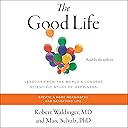
desertcart.com: The Good Life: Lessons from the World's Longest Scientific Study of Happiness (Audible Audio Edition): Robert Waldinger M.D. M.D., Marc Schulz Ph.D Ph.D, Robert Waldinger M.D. M.D., Marc Schulz Ph.D Ph.D, Simon & Schuster Audio: Books Review: Taking Stock of a Life - An important book that helps you step back and take stock of a life. In brief, a distinctive book. It is substantive but not in any way arcane and academic. Distinctive in that it draws on “both” the longitudinal Harvard Adult Development Project as well as the authors extensive clinical experience. Importantly, we get glimpses here of lived lives thru the famous longitudinal Harvard study. In fact, I would have liked the authors to have drawn more extensively on that work, go deeper, draw more on the project field notes, provide more of what anthropologists call “think descriptions”. That 84 year Harvard Adult Development Study and it’s conclusions is the connecting thread in this book. Those macro conclusions concerning “relationships” and “attention” are the must get right tasks in a life. In this book, they are well illustrated with concrete case vignettes, reflective observations, and a small number of reflection questions and tools, not abstract development theories. A book that helps us see and better understand social and intimate relationships, family, marriage, friendships, the differences and emotional tensions in relationships, and the importance of attention and the need for radical curiosity in a fully lived life. Indeed, a book to read slowly. A book to ponder. A book to dialogue with and journal with. In fact, the authors at times reflect on their own lives and we see them as fellow travelers. Simply put, a book that can help you see the coherence or lack thereof in one’s own life and, importantly, where and how to live and craft a better life, a more intentional life. Not a perfect book. Overwritten in parts vs. letting the powerful stories from the Harvard Adult Development Study speak for themselves. Also, a few more diagnostic and reflective tools in a stand alone appendix would make the book more a field guide and even more useful. Review: An important lesson from 80 years of longitudinal study of a 50s Harvard class - My Goodreads review of this book The Good Life by Robert Waldinger and Marc Schulz is based on the Grant Study, an 80-year longitudinal study of a select group of Harvard graduates from the 1950s. The Grant study has been to the study of healthy mental and social adaptation akin to what the Framingham study has been for the study of cardiovascular health and the development of cardiovascular illness. These types of studies identify people who have not yet manifested illness and follow them prospectively over time. These studies are like a photo album over the course of one’s life rather than a single photograph. The prospective study design allows one to identify risk factors for the development of cardiovascular disease in studies like Framingham. In the Grant study, factors like the use of recognized psychological defenses or adaptive behaviors can be correlated with subsequent psychological or social outcomes. The outcomes typically are discussed in terms of a range, for example happy, long-term marriage versus unhappy union with or without divorce, versus the choice to remain single. Social and cultural norms and biases influence the interpretation of many of these psychosocial outcomes. This makes the process more nuanced than medical outcomes like heart attack or stroke, which are uniformly seen as adverse. The separation of desirable from adverse psychosocial outcomes can be facilitated by using the individual’s own interpretation of satisfying versus unsatisfying or happy versus unhappy. One can look for an association between explanatory variables like the use of specific psychological defenses and different outcome variables, like a satisfying career or happy marriage. By comparing the relative strength of these associations, one can infer whether specific outcomes are more or less likely among groups with and without the different adaptive behaviors and/ or use of known defenses. The inferences are bolstered by vignettes from many individuals’ stories. The Good Life is a follow-up to the report by George Vaillant, Adaptation to Life. In my Goodreads review of Adaptation to Life, I mentioned several motifs that Dr. Vaillant advanced: • Isolated childhood traumas appeared to be less important than sustained relationships with important people in the subjects’ lives. • Lives changed over time. • The key to understanding the subjects’ psychology or psychopathology was to understand the subjects’ adaptive mechanisms or use of psychological defenses. • Human development continues throughout one’s life. • Mental health can be considered somewhat independent of moral and cultural values. These themes are developed further in Waldinger's and Schulz's book, The Good Life. It continues to emphasize the important role of close relationships in the observed subject’s physical and mental health, sense of satisfaction, and personal happiness. Critically, this book begins to generalize some of the things we readers might learn from the more, and less, adaptive members of the observed cohort. This process begins with one of the most important lessons I took away from my medical school psychiatry rotations: try to observe how we feel in the presence of our patients. Our feelings can be important clues to our patients’ psychiatric diagnoses. This insight can be applied to interpersonal dynamics with relatively healthy people including our family and friends. From this simple but fraught insight comes the acronym of this book: WISER which the authors apply to all sorts of close human relationships aiming in each case to improve the quality of those relationships. W stands for Watch as in observing our own feelings. As the psychiatry adage goes, 'Don't just do something. Sit there.' And while sitting, observe our own feelings. The I stands for Interpret, whereby we are to ponder, why am I feeling this way? The trained therapist continuously aims for greater understanding and empathy, and less judgment, in answering this question. Based upon one's answer to the previous question, we consider our options as to how to respond. The S stands for Select, whereby we choose from among the options. We then are to Engage or implement with care, meaning with awareness of the other person's feelings. The R stands for Reflect. After trying this sequence, we reflect on how it went, and what we can learn from the sequence. Much of the book consists in applying these steps to our important relationships (marriage, parenting, work), based on the data and stories of participants in the Grant Study. Part of the frustration I had with psychiatry, as a medical trainee, was the emphasis on deterministic factors (nature and nurture) over which I, as a physician had no control. My therapist-daughter and I joke about this limitation with the question, 'How many psychiatrists does it take to change a light bulb? It only takes one psychiatrist to change a light bulb, so long as the light bulb wants to change. It was no accident that I became an interventional cardiologist, a field in which some of my efforts could produce changes largely independent of my patient's compliance, at least over the short haul. For example, when I implanted a coronary stent during an acute myocardial infarction, my efforts could enhance blood flow and relieve myocardial ischemia, without depending upon the patient's desire or efforts to change. My biggest gain from reading both Adaptation to Life and The Good Life is the sense of hope for facilitating, not causing, or controlling, healthy change in my relationships with other people, including my family members, friends, and my patients. It starts with the efforts to change myself, particularly in becoming more understanding and empathic, and less judgmental.
J**N
Taking Stock of a Life
An important book that helps you step back and take stock of a life. In brief, a distinctive book. It is substantive but not in any way arcane and academic. Distinctive in that it draws on “both” the longitudinal Harvard Adult Development Project as well as the authors extensive clinical experience. Importantly, we get glimpses here of lived lives thru the famous longitudinal Harvard study. In fact, I would have liked the authors to have drawn more extensively on that work, go deeper, draw more on the project field notes, provide more of what anthropologists call “think descriptions”. That 84 year Harvard Adult Development Study and it’s conclusions is the connecting thread in this book. Those macro conclusions concerning “relationships” and “attention” are the must get right tasks in a life. In this book, they are well illustrated with concrete case vignettes, reflective observations, and a small number of reflection questions and tools, not abstract development theories. A book that helps us see and better understand social and intimate relationships, family, marriage, friendships, the differences and emotional tensions in relationships, and the importance of attention and the need for radical curiosity in a fully lived life. Indeed, a book to read slowly. A book to ponder. A book to dialogue with and journal with. In fact, the authors at times reflect on their own lives and we see them as fellow travelers. Simply put, a book that can help you see the coherence or lack thereof in one’s own life and, importantly, where and how to live and craft a better life, a more intentional life. Not a perfect book. Overwritten in parts vs. letting the powerful stories from the Harvard Adult Development Study speak for themselves. Also, a few more diagnostic and reflective tools in a stand alone appendix would make the book more a field guide and even more useful.
D**N
An important lesson from 80 years of longitudinal study of a 50s Harvard class
My Goodreads review of this book The Good Life by Robert Waldinger and Marc Schulz is based on the Grant Study, an 80-year longitudinal study of a select group of Harvard graduates from the 1950s. The Grant study has been to the study of healthy mental and social adaptation akin to what the Framingham study has been for the study of cardiovascular health and the development of cardiovascular illness. These types of studies identify people who have not yet manifested illness and follow them prospectively over time. These studies are like a photo album over the course of one’s life rather than a single photograph. The prospective study design allows one to identify risk factors for the development of cardiovascular disease in studies like Framingham. In the Grant study, factors like the use of recognized psychological defenses or adaptive behaviors can be correlated with subsequent psychological or social outcomes. The outcomes typically are discussed in terms of a range, for example happy, long-term marriage versus unhappy union with or without divorce, versus the choice to remain single. Social and cultural norms and biases influence the interpretation of many of these psychosocial outcomes. This makes the process more nuanced than medical outcomes like heart attack or stroke, which are uniformly seen as adverse. The separation of desirable from adverse psychosocial outcomes can be facilitated by using the individual’s own interpretation of satisfying versus unsatisfying or happy versus unhappy. One can look for an association between explanatory variables like the use of specific psychological defenses and different outcome variables, like a satisfying career or happy marriage. By comparing the relative strength of these associations, one can infer whether specific outcomes are more or less likely among groups with and without the different adaptive behaviors and/ or use of known defenses. The inferences are bolstered by vignettes from many individuals’ stories. The Good Life is a follow-up to the report by George Vaillant, Adaptation to Life. In my Goodreads review of Adaptation to Life, I mentioned several motifs that Dr. Vaillant advanced: • Isolated childhood traumas appeared to be less important than sustained relationships with important people in the subjects’ lives. • Lives changed over time. • The key to understanding the subjects’ psychology or psychopathology was to understand the subjects’ adaptive mechanisms or use of psychological defenses. • Human development continues throughout one’s life. • Mental health can be considered somewhat independent of moral and cultural values. These themes are developed further in Waldinger's and Schulz's book, The Good Life. It continues to emphasize the important role of close relationships in the observed subject’s physical and mental health, sense of satisfaction, and personal happiness. Critically, this book begins to generalize some of the things we readers might learn from the more, and less, adaptive members of the observed cohort. This process begins with one of the most important lessons I took away from my medical school psychiatry rotations: try to observe how we feel in the presence of our patients. Our feelings can be important clues to our patients’ psychiatric diagnoses. This insight can be applied to interpersonal dynamics with relatively healthy people including our family and friends. From this simple but fraught insight comes the acronym of this book: WISER which the authors apply to all sorts of close human relationships aiming in each case to improve the quality of those relationships. W stands for Watch as in observing our own feelings. As the psychiatry adage goes, 'Don't just do something. Sit there.' And while sitting, observe our own feelings. The I stands for Interpret, whereby we are to ponder, why am I feeling this way? The trained therapist continuously aims for greater understanding and empathy, and less judgment, in answering this question. Based upon one's answer to the previous question, we consider our options as to how to respond. The S stands for Select, whereby we choose from among the options. We then are to Engage or implement with care, meaning with awareness of the other person's feelings. The R stands for Reflect. After trying this sequence, we reflect on how it went, and what we can learn from the sequence. Much of the book consists in applying these steps to our important relationships (marriage, parenting, work), based on the data and stories of participants in the Grant Study. Part of the frustration I had with psychiatry, as a medical trainee, was the emphasis on deterministic factors (nature and nurture) over which I, as a physician had no control. My therapist-daughter and I joke about this limitation with the question, 'How many psychiatrists does it take to change a light bulb? It only takes one psychiatrist to change a light bulb, so long as the light bulb wants to change. It was no accident that I became an interventional cardiologist, a field in which some of my efforts could produce changes largely independent of my patient's compliance, at least over the short haul. For example, when I implanted a coronary stent during an acute myocardial infarction, my efforts could enhance blood flow and relieve myocardial ischemia, without depending upon the patient's desire or efforts to change. My biggest gain from reading both Adaptation to Life and The Good Life is the sense of hope for facilitating, not causing, or controlling, healthy change in my relationships with other people, including my family members, friends, and my patients. It starts with the efforts to change myself, particularly in becoming more understanding and empathic, and less judgmental.
L**.
If you read part of the book, you’ve read all the book.
A lot of the book is proving that their research is comprehensive. It is easy to read and gives some good examples. Cliff notes: focus on building good relationships. Anything else is such a distant second that it doesn’t get much attention.
M**A
He comprado el libro de tapa blanda, y ésta llegó rota y algunas de las primeras hojas están rasgadas y arrugadas. Lo devolveré.
M**A
Made me reconsider my social universe and what it takes to build great social relationships. Must read for someone going through the throes of loneliness.
A**R
A very good book on the world’s longest study into the good life. Really pleased to have read this book and thoroughly recommended
M**A
Inspiring
J**N
The Harvard longitudinal study, on which the book is based, has concluded that what matters in life are—not wealth, achievements, popularity, and the usual suspects—worthwhile relationships. Aside from giving a general view of the study, the book provides practical methods for assessing—and thereby hopefully improving—one’s relationships. Very readable for the layperson. We have all asked what is the secret to success in life. This book lets you stare it in the face. Recommended to the highest degree!
Trustpilot
2 days ago
5 days ago