
Desertcart purchases this item on your behalf and handles shipping, customs, and support to USA.
📚 Crack the code of success with Gladwell’s groundbreaking insights!
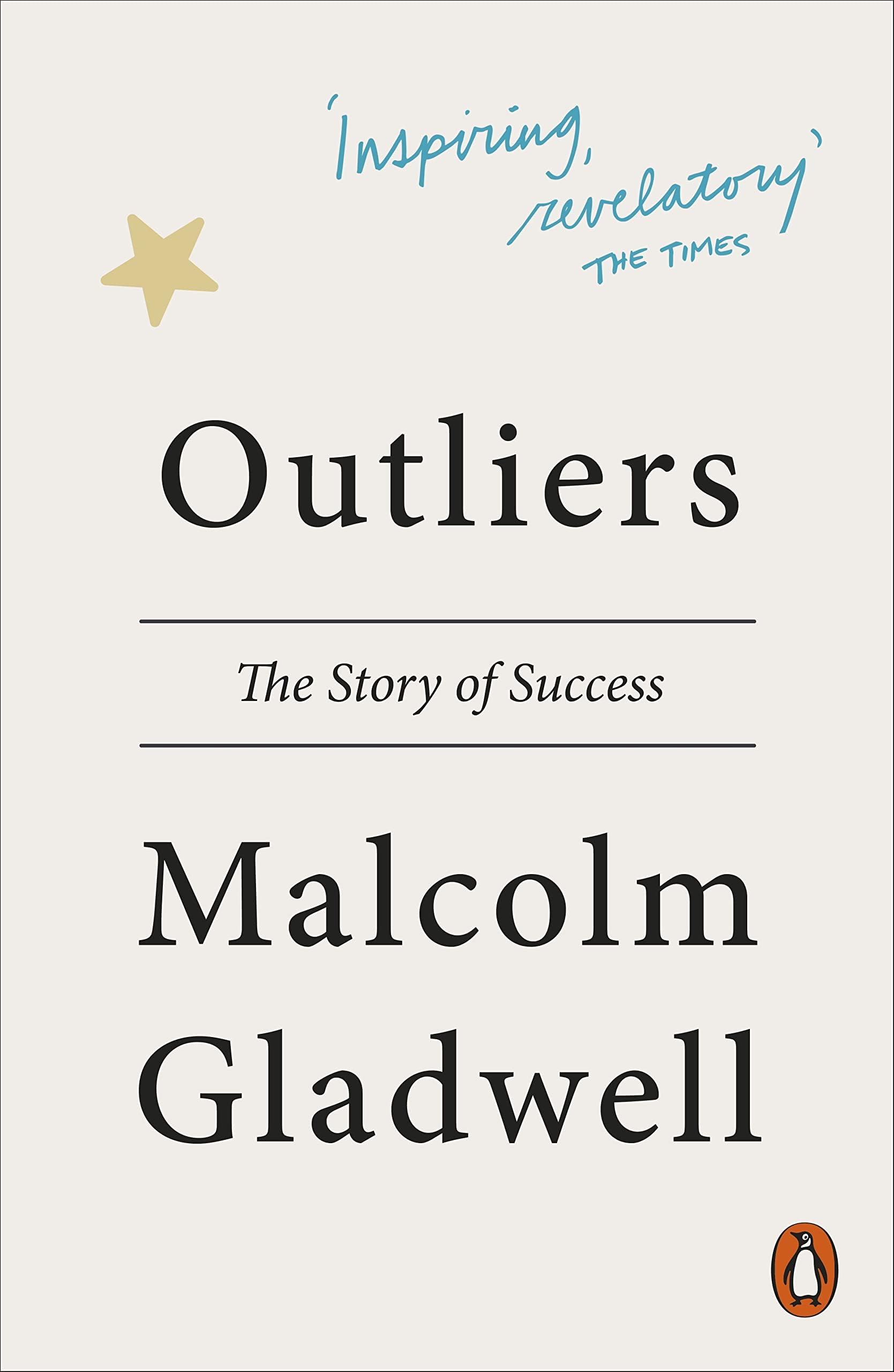
Outliers by Malcolm Gladwell is a bestselling, critically acclaimed book that redefines success by analyzing the roles of culture, opportunity, and hard work. With over 37,000 reviews and a 4.5-star rating, it’s a must-read for professionals eager to understand what sets extreme overachievers apart.


| Best Sellers Rank | 4,488 in Books ( See Top 100 in Books ) 35 in Business Life (Books) 67 in Business Careers (Books) 89 in Applied Psychology (Books) |
| Customer Reviews | 4.5 out of 5 stars 37,219 Reviews |
R**A
Timeless and well-written
I don't read often but I've been reading more ever seen finishing the Outliers. Informative book and well-written! Would recommend to my friends.
R**R
Worth a read
Malcolm Gladwell has a storytelling style that makes for compelling reading, albeit based around 'one big idea', in this instance 'grit'. Gladwell's argument, that success can be attributed to a combination of opportunity, 'right place, right time' and hard work, is underpinned by the notion that culture plays a pivotal role in the relationship between those variables and tangible success, and is woven into examples ranging from the Beatles to Bill Gates. It is pretty one-sided, as is often the case these days with non-fiction, because, as David Epstein argues in Range, for every Tiger there is also a Roger, but Gladwell is fairly open to admitting this in interviews, which is why I take his books for what they are: one side of the story, creatively written to ensure the reader enjoys what they're reading. The only real disappointment is the bizarre skew towards arguing the case for charter schools, which takes up a disproportionate section of the book, and is a little spurious in some of the observations and statistical analysis. Otherwise, an enjoyable read.
A**R
Really enjoyable and thought provoking read
The book challenge your perception (or at least I can positively say it about mine) about what makes out of ordinary success, and why one person achieves it and others do not. We often hear the stories of really successful/ influential/ famous people and how they "did it themselves " - and are under impression that their success is due to their talents and effords. While talents and effords have their super important role, this book shows, in a way of telling life stories and analysing the impact on different factors, that it is not as simple. It shows that without other "hidden" factors, even with high IQ, talent and effords, success would not be so remarkable or even possible. The hidden factors/ hidden advantages could be opportunities the person had in their life, where they live, how they are raised, cultural backgrounds, what was economics and demographic were like when they were of the certain age and even the date of birth (don't worry it is not about horoscopes). I still have a lot of questions and would like to challange some of the statements in the book, but this is why I rate it so high. It is written in a way that gives you knowledge, things to think and digest, and triggers further curiosity. It is written in a way that is easily and enjoyable to read - it has been a while since I enjoyed reading book as much as this one.
M**R
The unfairness of success -- an unexpectedly important book
In Outliers, journalist Malcolm Gladwell examines the accidents of birth date, language, heritage and culture which give particular individuals a head-start in life -- or, equally, result in catastrophic failures. Although journalistic rather than scientific in style, Gladwell makes a wide range of compelling points which become stronger the more you think about them. This is an exceptional book and -- unlike so many of the books of this type -- really does make a significant contribution to how we view our world. - I was on the point of giving up on this book after chapter three. Most books of this type seem to have just one chapter which is the book's real point, and I rather had the feeling that I had read it and was just getting more of the same. Not so! Rather than simply drawing evidence from further afield for his initial thesis that accidents of birthdate within the calendar are the biggest factor in sporting success, Gladwell goes on to look at accidents of language, of the type of economy we grew up in, of culture in the cockpit, and of shade of skin in the Caribbean. He draws out different conclusions from each one, including the surprising notion of intelligence threshold, where being clever _enough_ is more important than maximum IQ. The underlying premise, I suppose, is that success is inherently unfair. Somehow -- by going through his own family's history -- Gladwell turns this round right at the end to be something positive and life-affirming. An awful lot of the evidence in this book is 'evidence by inspection', and it sometimes comes perilously close to finding causation where there is only evidence of correlation. Nonetheless, Gladwell underpins his insights with strong argument, and in all but a couple of chapters I found myself convinced despite initial scepticism. It's very easy to criticise books like this for being more journalistic than scientific. Outliers, though, really is an idea-changing book, and it deserves the widest possible readership.
S**H
Salient and grounded
Gladwell argues that success is tightly married to opportunity and time on task. He states that it takes approximately 10,000 hours to master something and that gives me comfort. It helps me feel better about my many failures at initial attempts to master things (like glazing pottery, algebra, Salsa dancing, skiing and sewing... to name a few). I kept thinking, "I've just got to put in more hours if I want to do better." While I can see a different way of spinning the data provided to support Gladwell's argument, I didn't care. In a rare moment, I found myself not wanting to argue. : ) Instead, I found myself reflecting on things that have felt like lucky opportunities in my own life. This reflection was very humbling. Moreover, I felt the text tugging at the need for greater equity. What could all the people with limited opportunities do if given greater opportunities? Think Darfur. How many people who might have come up with the cure for pancreatic cancer been forced to spend their time standing in lines waiting for clean water or food? My own personal experience as a teacher of refugees reflects Gladwell's primary thesis. Many of my refugee students are pre-literate. They have not been given the opportunity to gain a formal education. As a result, there are many well-intended, but misinformed people who place these students in special education courses or deem their I.Q. low, diminishing their opportunities even more. The students I teach are hungry for skills and spend hours outside of class practising. They make huge gains despite earlier opportunities denied them. While many will not go on to big colleges out of high school, I feel like given enough opportunity and time they could make it there. Sadly, many have families who depend on them to work to help financially support the family. (Yet, another limited opportunity to spend time focused on developing skills.) In the past week, I have shared Gladwell's thesis with my students. We have applied the 10,000 hours to master a task to reading and writing. I remind students that if we don't get our 10,000 hours this year together, they must continue on their own. I remind them that it IS possible to move forward if they are focused and keep adding hours of work to their reading and writing. We even write on the board how many hours left before we are masters. "2 hours down, only 9,998 left to go." Friday, I had a student from Somalia smile and ask, "So it's not true that white people are smarter than black Africans? They just get more chances to read?" Imagine my pleasure when I could respond, "YES! That's correct. You are just as smart as any white kid in this school. It's just that some of them have been reading for years and you are just getting started." Thank you for your work Gladwell, it is salient in today's political conversation surrounding education (especially for our most vulnerable students who have been given the fewest opportunities).
A**R
Wonderfully written
Great read and well written. Does fall off a little in second half
M**T
Is your future already decided?
In Malcolm Gladwell's third book, Outliers he looks at why there are people who are outside the normal population, those who excel, he investigates why these people are so great. Gladwell again gives examples of successful people, and groups, to explain what he is telling us, and shows us that it is not always genius that makes these people a success, but the history of the family going back generations, the culture of the person, even that date of birth could make the difference between being a high achiever or failure, an outlier or an ordinary person. Gladwell also explains that to be an outlier we should be in the right place at the right time, and to take advantage of the opportunity. Having the above factors in-place does not mean success, to become an outlier, a person needs to become involved with the area of expertise of greatness, to DO the action, the work, for 10,000 hours. Gladwell cites examples of the Beatles, Bill Gates etc, of how the Beatles played in Hamburg nightclubs for long hours, amassing the required 10,000 hours, how Bill Gates spent hours and hours programming the early computers, again amassing the 10,000 hours before setting-up Microsoft. Gladwell looks at the birth dates of those who created the leading computer software companies, and surprise, they mostly fall within a narrow year range, and he looks at American lawyers who specialise in takeovers and litigation are mostly Jewish of a certain age. Gladwell asks, why are top basketball players birthdays mostly in the early months, January, February, March, and why pupils who achieve better exam results have their birthdays closer to the start of the academic year, than those pupils whose birthdays are nearer the end of the academic year. Simple really, the older pupil is nearly a year older and has a more developed brain, take for example a baby of one year old and compare it to a two year old child, there is a big difference in ability, understanding and behaviour. An amazing book, which gives an insight to what could make people great, an outlier.
B**R
Enjoyable read but scientifically it makes me feel uneasy
I would like to put Gladwell in the same category as Jared Diamond - he writes books that take you on an enjoyable sweep through different places and eras and whole swathes of pop-anthropology but, deep down, I have to wonder *why* he picked a story about dental statistics in 1930s Luxembourg, or the rate of unexplained bus crashes in Peru versus Chile. I can never quite rule out a suspicion of cherry-picking. Which is uncomfortable, because I really *want* to believe these neat stories that let you in on a little secret that underpins whole swathes of the modern world. Let's go back to a specific example. For instance, Gladwell points out the role of culture in airliner crashes; if aircrew come from cultures that have stronger deference to social superiors, maybe a copilot would shy away from challenging a pilot who'd made a mistake. He works through examples of Korean Airlines crashes that seem to fit this paradigm, and Korea is high up the ranking of countries by deference-to-superiors, and we hear about how Korean Airlines challenged that culture and then had fewer crashes. That's a good story to read! Problem is that we never really tackle the fact that the deadliest airline crash in history involved aircrew from a country which was at the opposite end of the ranking-of-countries. No doubt individual deference to superiors was a factor in that crash too, but CRM alone is pretty boring, people enjoy reading the different-places-different-cultures stories. I won't say it's all like this; I didn't get such a worry from the study of the backgrounds of lawyers in New York, for instance (maybe we'd see something different if somebody took on the Herculean task of expanding the study to different trades & different national backgrounds, but I don't think the main conclusion would shift much).
S**N
A Brilliant book, which bundle the art of living with greatness.
This amazing books gives some hints "Why you should challenge odds. How you should raise childs". "10000 hours, self-discipline, environment and the luck and time "
A**R
Recommend
Like other Gladwell’s books this is very insightful and interesting, inspiring and fun account of success. Recommended!
K**A
الكتاب صغير حجمه
احب الكتب المتوسطه ماتناسبني القراءة بكتاب صغير خصوصا بلغة اخرى - النسخة سليمة لكن الحجم صغير
G**3
excellent book
Malcolm Gladwell is an excellent writer. Once I started reading I have not been able to put this book down. It is telling the succes story of different people : from hockeyplayers to lawyers, Bill Gates, children from poor families in NY suburbs and explains why airplane crashes happen. Everybody can be an outlier if life 's opportunities are lined up in the right way.
A**K
A fascinating look at success
Gladwell exposes something I've long held to be true myself: great success requires great luck. It also requires great talent and effort to capitalize on that luck, but luck is just as necessary. For example, if you're not born in the first few months of the year, your chances of being a pro-hockey player are dramatically reduced. Based on your astrological sign! That's not because of astrology, its because kids are ranked by year of birth, and those born earlier in the year are bigger, faster, and more coordinated on average because they're just older. And that means they're more likely to be chosen on special teams, where they get special coaching, further emphasizing their initial difference. That continues over the years until there's a tremendous gap between them and other, later-born children. Is that fair? No. It's just luck and the way the system is currently set up. Intriguingly, Gladwell suggests that these kinds of systems essentially miss 50% of a population's talent because they shunt out all those born in the later part of the year. That's a really interesting idea- a population could increase its pool of elite athletes (or students) by breaking them into 6-month groups, rather than 1-year groups. For other kinds of success, especially financial, its often a matter of being at the right place, at the right time, with the right skills, to catch and ride an emerging trend in the financial world (e.g., railroads in 1850, clothing in 1930, software 1970, hostile take-overs 1980, etc.). Gladwell is clear that the leaders in these areas were all talented, driven people. But that doesn't change the fact that born five years earlier or later, they'd probably be nowhere near as successful as they are today. While he doesn't mention him, I like Darwin as an example. He was brilliant and hard working, but Alfred Wallace came up with (virtually) the same idea of evolution as he did. And Darwin was big enough at that time that Wallace sent him a draft copy to review. If Darwin had come along later, he would have been scooped. If he hadn't been as big as he was in biology then (thanks to non-evolutionary work), he would never have seen the manuscript. As it turned out, he gave Wallace co-credit, but that's another story. The point is that coincidental circumstance played as big a role in who published the theory of evolution by natural selection, and when it was published, as the characteristics of Darwin himself. For me, the bottom line is that hard work and talent are very important, but so is looking out for those unique trends that might allow you to catch a wave and do something extraordinary with your life. Whether or not that will happen is a function of luck, but it's certainly important to be prepared should you ever get the chance. Overall, the book is very easy to read, and full of really good ideas. I found the last couple of chapters on math to be the weakest, but it's still a great book to read. Highly recommended.
Trustpilot
1 month ago
1 month ago