
Buy anything from 5,000+ international stores. One checkout price. No surprise fees. Join 2M+ shoppers on Desertcart.
Desertcart purchases this item on your behalf and handles shipping, customs, and support to USA.
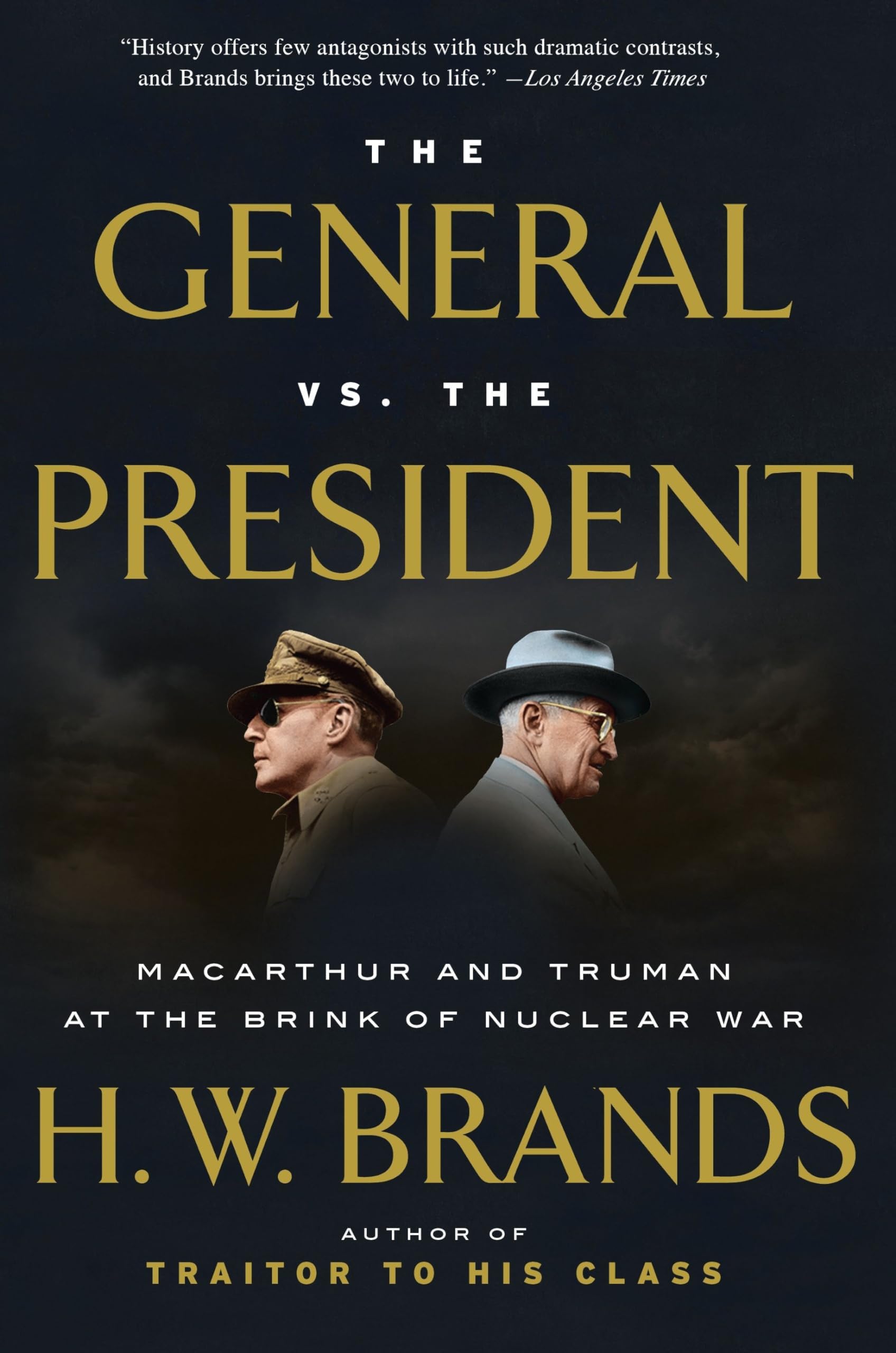
NEW YORK TIMES BESTSELLER From the two-time Pulitzer Prize finalist, bestselling historian, and author of Our First Civil War comes the riveting story of how President Harry Truman and General Douglas MacArthur squared off to decide America's future in the aftermath of World War II. "A highly readable take on the clash of two titanic figures in a period of hair-trigger nuclear tensions.... History offers few antagonists with such dramatic contrasts, and Brands brings these two to life." — Los Angeles Times At the height of the Korean War, President Harry S. Truman committed a gaffe that sent shock waves around the world, when he suggested that General Douglas MacArthur, the willful, fearless, and highly decorated commander of the American and U.N. forces, had his finger on the nuclear trigger. At a time when the Soviets, too, had the bomb, the specter of a catastrophic third World War lurked menacingly close on the horizon. A correction quickly followed, but the damage was done; two visions for America’s path forward were clearly in opposition, and one man would have to make way. The contest of wills between these two titanic characters unfolds against the turbulent backdrop of a faraway war and terrors conjured at home by Joseph McCarthy. From the drama of Stalin’s blockade of West Berlin to the daring landing of MacArthur’s forces at Inchon to the shocking entrance of China into the war, The General and the President vividly evokes the making of a new American era. Review: Great History, Great Writing, Important Test for our Constitutional System - Brands is a very good writer of history. He has David McCullough's ability to make non-fiction read like a ripping good story. The "General Vs. the President..." is an excellent case study of political maneuver, international affairs and constitutional checks and balances in one book. The author's treatment of the dance Gen. Douglas MacArthur and Harry Truman performed in trying to grapple with the Korean War and each other is a very good cautionary tale. What to do when a weak leader has a star underling who is a proven winner and both the leader, underling and other stakeholders know it? This is the situation that faced Truman when the North Koreans attacked the South and caught the US unawares and unprepared. MacArthur was a hero - the master of the Pacific in WWII. Although he was difficult to control and not willingly subordinate and provided Truman with ample reason to relieve the General, MacArthur's early success in flanking the NK at Inchon and crushing the enemy divisions as he chased them toward the Chinese border excused a lot of behavior that should have gotten him cashiered. Chinese intervention drasticly changed the nature of the war, proved MacArthur fallible, and made his maverick and insubordinate behavior intolerable. Particularly since the stakes were so high - MacArthur's statements, actions and disobedience risked a regional war igniting a larger, perhaps global, conflict - one the United States was ill prepared to see to victory and which would kill many even if we were. Truman had to fire MacArthur and right the relationship between President and military commander. (For those knowledgeable of the Civil War, this story will echo what Lincoln faced with Fremont, Butler, McClellan and Hooker among others). Truman and his Administration certainly made their share of mistakes in the run up to the North Korean invasion, and the author is honest in portraying the positive and negative of his actions as well as the good decisions MacArthur made and his laudable success in remaking Japan. But, for the sake of our Constitutional system, Truman took the only course of action he could (and arguably - even he argued to himself - should have taken earlier). Brands gives the right amount of background as he focuses on the machinations of MacArthur and Truman's response over many months as he tried to bring the hero-General to heel. It is a terrific and dramatic story with larger than life players and important issues. In Brand's hands a treasure of a book. Review: Close To The Abyss - After FDR's death in April, 1945, an unknown senator-turned-vice-president was elevated to the presidency. His name was Harry Truman. During the waning months of World War II, Truman became privy to the Manhattan Project, whose scientists had been working on the atomic bomb for several years. Truman authorized the use of the bomb against Japan, and Hiroshima and Nagasaki were subsequently destroyed. The man chosen to lead the occupation of Japan was General Douglas MacArthur. This was the beginning of the Truman/MacArthur alliance; an alliance that would be tested five years later on the Korean peninsula. In June, 1950, North Korea invaded South Korea. MacArthur was picked to lead the UN forces in the South. During the next several months, Truman and MacArthur would butt heads on several occasions. Truman, while in office, was one of the most unpopular presidents in American history. Communism was spreading, and Truman had to "learn on the job" as to how to deal with the Soviet Union. Conversely, MacArthur was the hero of the Pacific war and the person who brought Japan back from ruin to become a valuable ally. Despite his status, MacArthur still answered to Truman. Truman favored containment in Korea, while MacArthur wanted to wipe out communism in Asia by escalating the war. He had his moments, such as the highly successful Inchon invasion, but he also suffered defeats, especially when China entered the conflict. This led to a downward spiral which ultimately led to MacArthur's dismissal. "The General vs. The President" is a fine book about a relatively forgotten chapter in our history. Author H.W. Brands has written a compelling book about how close we were to World War III. The narrative is full of interesting history, and I especially liked reading about MacArthur's interviews by members of Congress. In the final analysis, Truman's policies proved to be the correct ones. Highly recommended.
| Best Sellers Rank | #364,982 in Books ( See Top 100 in Books ) #19 in Korean War History (Books) #244 in US Presidents #955 in Military Leader Biographies |
| Customer Reviews | 4.5 out of 5 stars 1,905 Reviews |
W**H
Great History, Great Writing, Important Test for our Constitutional System
Brands is a very good writer of history. He has David McCullough's ability to make non-fiction read like a ripping good story. The "General Vs. the President..." is an excellent case study of political maneuver, international affairs and constitutional checks and balances in one book. The author's treatment of the dance Gen. Douglas MacArthur and Harry Truman performed in trying to grapple with the Korean War and each other is a very good cautionary tale. What to do when a weak leader has a star underling who is a proven winner and both the leader, underling and other stakeholders know it? This is the situation that faced Truman when the North Koreans attacked the South and caught the US unawares and unprepared. MacArthur was a hero - the master of the Pacific in WWII. Although he was difficult to control and not willingly subordinate and provided Truman with ample reason to relieve the General, MacArthur's early success in flanking the NK at Inchon and crushing the enemy divisions as he chased them toward the Chinese border excused a lot of behavior that should have gotten him cashiered. Chinese intervention drasticly changed the nature of the war, proved MacArthur fallible, and made his maverick and insubordinate behavior intolerable. Particularly since the stakes were so high - MacArthur's statements, actions and disobedience risked a regional war igniting a larger, perhaps global, conflict - one the United States was ill prepared to see to victory and which would kill many even if we were. Truman had to fire MacArthur and right the relationship between President and military commander. (For those knowledgeable of the Civil War, this story will echo what Lincoln faced with Fremont, Butler, McClellan and Hooker among others). Truman and his Administration certainly made their share of mistakes in the run up to the North Korean invasion, and the author is honest in portraying the positive and negative of his actions as well as the good decisions MacArthur made and his laudable success in remaking Japan. But, for the sake of our Constitutional system, Truman took the only course of action he could (and arguably - even he argued to himself - should have taken earlier). Brands gives the right amount of background as he focuses on the machinations of MacArthur and Truman's response over many months as he tried to bring the hero-General to heel. It is a terrific and dramatic story with larger than life players and important issues. In Brand's hands a treasure of a book.
J**N
Close To The Abyss
After FDR's death in April, 1945, an unknown senator-turned-vice-president was elevated to the presidency. His name was Harry Truman. During the waning months of World War II, Truman became privy to the Manhattan Project, whose scientists had been working on the atomic bomb for several years. Truman authorized the use of the bomb against Japan, and Hiroshima and Nagasaki were subsequently destroyed. The man chosen to lead the occupation of Japan was General Douglas MacArthur. This was the beginning of the Truman/MacArthur alliance; an alliance that would be tested five years later on the Korean peninsula. In June, 1950, North Korea invaded South Korea. MacArthur was picked to lead the UN forces in the South. During the next several months, Truman and MacArthur would butt heads on several occasions. Truman, while in office, was one of the most unpopular presidents in American history. Communism was spreading, and Truman had to "learn on the job" as to how to deal with the Soviet Union. Conversely, MacArthur was the hero of the Pacific war and the person who brought Japan back from ruin to become a valuable ally. Despite his status, MacArthur still answered to Truman. Truman favored containment in Korea, while MacArthur wanted to wipe out communism in Asia by escalating the war. He had his moments, such as the highly successful Inchon invasion, but he also suffered defeats, especially when China entered the conflict. This led to a downward spiral which ultimately led to MacArthur's dismissal. "The General vs. The President" is a fine book about a relatively forgotten chapter in our history. Author H.W. Brands has written a compelling book about how close we were to World War III. The narrative is full of interesting history, and I especially liked reading about MacArthur's interviews by members of Congress. In the final analysis, Truman's policies proved to be the correct ones. Highly recommended.
D**I
Politicial decisions overide military judgment
I lean towards MacArthur as a veteran which I'm sure most veterans do likewise. This historical account is even handed and you can draw your own conclusions based on the historical analysis presented by the author. I agree with Truman's decision to relieve MacArthur. But he did not have the fortitude to tell him to his face that he was being fired and why. MacArthur had to hear it from his wife who was told by a staffer who heard it on the radio. Like the FBI Director finding out he was fired by Trump via television. Compare thatt o Obama who called Gen. McCrystal from Afghanistan to the White House to tell him to his face he was being relieved forthwith. And McCrystal was fired for stupid remarks to a second rate magazine reported by his subordinates; certainly not for "high crimes and misdemeanors" like MacArthur. I appreciate the summary of the committee hearings which appears to have been the downfall of MacArthur. The testimony from Truman's adminstrative heavy weights seemed to carry more weight than MacArthur's. History proves MacArthur was right and the Truman team wrong. For exampleBradley states to the committee that Red China is not the powerful nation seeking to dominate the world (page 362). MaCarthur had the opposite view. Guess what, China owns us now. Truman's team testifies that they did not want to use the atom bomb against China for fear of bringing the Soviet Union into the war and starting WWIII. All this testimony from "credible" politicians opposite of MacArthur's military prowess as the commander in the field diminished MacArthur's status big time. However, on page 394 it is reported that Eisenhower threatened to use nuclear weapons on the Chinese in 1953 which allegedly broke the deadlock in the peace negotiations. As stated by the author, MacArthur could have felt a certain vindication at the disclosure. What really galls me is reading the same political decision that occured in Vietnam. That is, the U.S. Air Force could not give hot pursuit to MIGs that flew back across the Yalu. This was the same frustration of our military as they had to stop at the border as NVA fled back into Cambodia in the Vietnam era. It really stung to read about the bomber crews flying in to hit the bridges and watching the MIGs crusing on their side of the Yalu safely then attacking the bombers right before the moment of the bomb drop. Any veteran can relate to the seriously wounded bomber crewman asking Macarthur, "whose side is the government on anyway?" (I paraphrased this comment). A good historical account. I recommend it to get a well balanced and researched account of this clash of wits that is relevant today as it was back in 1951.
M**N
Great read! I couldn't put this one down
Great read! I couldn't put this one down. Read it in about four days, which is super fast for me! This book is is a thorough history of the first ten months of the Korean War & Truman's eventual firing of General Douglas MacArthur. It's hard for Americans born after WWII who live in a 24 hour news cycle, to understand just how people who lived during WWII viewed popular Generals like Eisenhower or MacArthur. These were the guys who had won WWII (at least for the Americans). They were almost godlike figures. Not only had MacArthur emerged as one of the most celebrated Americans of WWII, but his record in occupied Japan and the changes he made in that country were only slightly less Olympian. Couple these two achievements with his brilliant move at Inchon and you have (whatever your opinion of him), one of the greatest military figures in American history. And then it all unraveled. The Chinese enter in to the War & everything changes. MacArthur an advocate for total war, increasingly encourages not only bombing Communist China, but even the Soviet Union. He advocates "seeding" atomic material in a chain across Communist supply lines in North Korea. The most interesting side of this story to me was the timidity of the Joint Chiefs of Staff, themselves giants of WWII. Men like Omar Bradley, J. Lawton Collins, Admiral Radford, and former Secretary of state George C. Marshall, who hesitated to confront MacArthur until they finally had no choice. The other interesting aspect of the book was it's revelation of just how vulnerable the American military was in 1950.Not to mention most of the American peoples obliviousness to the fact that by mid 1951, the American armed services, which had swept all before it just 5 years before was dangerously over stretched in Korea, & the JCS were aware of this fact. The tension builds & the President & JCS finally have to make a decision. Very good read! My only problem with this book was the author's seemingly more sympathetic view to Truman (however it's hard not to be).
H**T
A fascinating look at the megalomaniac general and the everyman president
This book is an engaging narrative of the battle between General Douglas MacArthur and President Harry S Truman during the Korean War. Brand uses quotes from original sources to bring the story alive. Omar Bradley said "he [MacArthur] was awesomely brilliant; but as a leader he had several major flaws: an obsession for self-glorification, almost no consideration for other men with whom he served, and a contempt for the judgment of his superiors. Like Patton and Monty' - British field marshal Bernard Montgomery - ' MacArthur was a megalomaniac." [Loc 1374]. President Roosevelt "kept a close eye on MacArthur, whom he considered a threat to democracy."[Loc 1599] and considered him the most dangerous man in America (the second most dangerous being Huey Long). [Loc 1374"] Most history students know the broad sweep of the Korean War. North Korea invades South Korea in a surprise attack and pushes forces deep into the south. MacArthur develops a brilliant plan to counter attack through a difficult landing and deployment in Inchon. The tide changes and the allies - under the unifying factor of the United Nations - push the North Koreans back up toward the border with China. China sees that as an existential threat and pushes the allied forces back south of Seoul. General Matthew Ridgeway anchors the allies and pushes back toward the 38th parallel where a stalemate occurs until much later a truce is agreed to. Through it all MacArthur was lobbying (and actually taking steps) to extend the war into China because of course the Chinese wouldn't come into the war. Wrong! This book focuses on the Korean battlefield to the extent that it highlights the schism between MacArthur and the administration, including the President, the Secretary of State (Dean Acheson), the Secretary of Defense (George Marshall for most of the time) and the Joint Chiefs of Staff (led by General Omar Bradley). MacArthur complained bitterly about not being able to take the battle into China. His view was that the battle against communism would take place in Asia while the administration knew that the real trouble spot was Europe where the USSR was waiting to pounce; the CIA warned that "'The Soviet Union may seize upon the present crisis to precipitate general war with the United States'" [Loc 4196] Meanwhile MacArthur confounded the diplomacy of the administration when he offered a cease fire to the North Koreans by threatening nuclear annihilation of China. He also wrote an inflammatory letter to a Republican congressman which contradicted his superiors and the Commander in Chief. These actions ultimately brought about his firing. Truman came under withering attack from the Republicans after MacArthur's firing. At first MacArthur was hailed as a hero at the hearings but over the later days of testimony from experts the tide turned against him. H.W. Brand does a fantastic job sourcing the now unclassified portions of the hearings to demonstrate how dangerous MacArthur was. MacArthur decried the administrations limits on attacking China saying his hands were tied behind his back. George Marshall wasn't having it: "the limitations on fighting in Korea, so loudly assailed by MacArthur and his supporters, in fact favored the American side."[Loc 6181] It was through this detailed hearing that Congress finally understood what America was facing globally. For all the furor of the era, when Truman was vilified, time showed that his vision was correct. "Yet it was the American victory in the Cold War that made Truman a genuine folk hero. Americans concluded, after all, that the everyman-president, in crafting the policy of containment, had known better than his critics what defeating communism required: firmness and patience, in balanced measure. Truman hadn't yielded to communist aggression in Korea, but neither had he panicked and let himself be stampeded into World War III, by Douglas MacArthur or others."[Loc 6648] This is the second book by H.W. Brand I've read - the first being American Colossus: The Triumph of Capitalism 1865-1900. Both are excellent histories. The strength of this book is its bringing meeting minutes, phone call notes, and then-classified testimony to life. The chapters are short and cover the topic at hand briskly yet definitively. Don't look at this summary of events as a spoiler. The beauty of the story is the riveting day-by-day evolution of strategy and battle between MacArthur and his superiors.
J**N
An excellent bood - best one I've read on the subject
I'm old enough to remember the events described in this book. I was a Junior in High school in the spring of 1951, when Truman fired MacArthur. I remember the "buzz" it created - we got our news on radio broadcasts and newspapers - some folks had TV then, but my family didn't. I remember going in to school the morning after the news had come out, and when I went in to my American History class, the teacher told us "I know what everyone is thinking about, so we'll skip the lesson that had been scheduled for today and I'll explain how our system works". Before that class I had been 100% for MacArthur and against Truman. After that class I wasn't 100% pro-Truman - my Father was a staunch Republican, and Truman was pretty unpopular before the MacArthur incident - but I had a whole different understanding of the matter. I enlisted in the Marine Corps on my 18th birthday and served in Korea (18 year olds aren't particularly smart, at least the ones I've known, and I'm no exception!), and having an interest in the Korean War I've read many books on the subject. This one is the best I've read on the subject of the Truman-MacArther controversy; it includes many extensive quotes from statements by MacArthur, Truman, and others concerned, and is, in my opinion, very well written; I haven't read any other books by the author, but will probably do so, when I've made a dent in the pile of books I have that I haven't read yet.
H**N
For a student of history, read it!
This is a history book that reads like a mystery. It tells the history of the Korean conflict, sometimes called the "forgotten war." Obviously as the name would indicate it centers around two strong personalities, our understanding that the military is subservient to civilian rule and how close we came to losing that concept.. I started this book several days before the election and was midway through on election day. One could not help but be thankful that at that time in our history when we came so close to another world war, the seat in the oval office was occupied by a man, vilified at the time, who history has enshrined as one of our great presidents. He was a man who knew policy, who had a sense of position and who made the tough decisions. A man who "gave'em hell" while not embarrassing, denigrating or personally insulting those who disagreed. Oh could we use this now. The book itself is difficult to put down, extremely well written and although not exactly neutral between Gen. MacArthur and Pres. Truman it nevertheless presents a portion of our history in a most entertaining manner. It's truly a must read, not only for history buffs but anyone who wants an insight into such an important phase of our history and the men who lived it.
S**Y
Very Narrowly Focused and Well Presented
I’ve read several histories of the Korean War along with many accounts of the Pacific Theater of World War II and David McCollough’s magnificent biography of Harry Truman. Each of these works dealt tangentially with the primary subject matter of this nice, narrowly focused book, namely the conflict between President Truman and the most highly decorated and beloved (with the exception of George Washington, and possibly U. S. Grant) military figure in American history, Douglas MacArthur. All of that to say, this is not a history of the Korean War or a detailed biography of either Truman or MacArthur. While it certainly contains aspects of each of those things, there are many, more detailed works if that is what you are looking for. The author of this book provides a very balanced treatment of the issues which created the numerous clashes and near crises which developed as a result. As I said, I’ve read numerous works on this and other Cold War conflicts of the era. I must say, however, that until reading this book, I was unaware of the knife’s edge that Truman and his foreign policy team had to straddle in the face of a potentially atomic World War III; this in the face of a rogue General whose very actions worked at cross purposes to that of the civilian American leadership. MacArthur’s primary goal was to win the Korean War, at all costs; Truman’s was to avoid an exchange of nuclear missiles or a Soviet invasion of Western Europe, a real threat at the time. Again, this is a very narrowly focused book, with just enough historical detail to tell the story for which it was written. Prior to reading this book, I would read others on the Korean War (Halberstam’s The Coldest Winter is excellent) and McCollugh’s Truman biography, in order to provide a historical basis from which to better appreciate this work.
R**L
The General vs. the President and Truman at the Brink of Nuclear War
Very interesting book about two completely different personalities with completely different backgrounds.
M**B
Evidently there was no love no love between MacArthur and Ike Eisenhower so Mac ...
History does repeat itself: U.S, Russia, China, North Korea (the same actors that were there in 1950-53) are ready for a nuke war again. Trump plays the role of MacArthur, Putin plays Stalin, Xi plays Mao, and Won Dum plays the role of his grandfather - all ready to go at it. It would seem that Truman's pacifism merely delayed WW III. Evidently there was no love no love between MacArthur and Ike Eisenhower so Mac would have been gone in late 1952 anyway. Dr. Brands details the conflict between MacArthur and Truman (and the Joint Chiefs of Staff). I found the book to be interesting and easy reading. It was particularly interesting because of the recent Winter Olympic Games in South Korea.
J**S
Brands does it again - a very good picture of a complex time
Brands writes lucidly and this book provides an in depth appraisal of the Korean War and how it caused the undoing of one of America's boldest generals. Brands is particularly good at summarizing MacArthur and Truman's careers as well as the rise of Eisenhower but you'll need to look elsewhere e.g. Manchester and McCullough for a fuller picture of each man.
D**B
Five Stars
Excellent read
C**N
MacArthur vs Truman
Excelente narrativa da Guerra da Coreia e de duas das personalidades mais importantes do século XX. Um general popular contra um presidente impopular e seus desdobramentos. Vale a leitura!
Trustpilot
2 weeks ago
3 days ago