
Desertcart purchases this item on your behalf and handles shipping, customs, and support to USA.
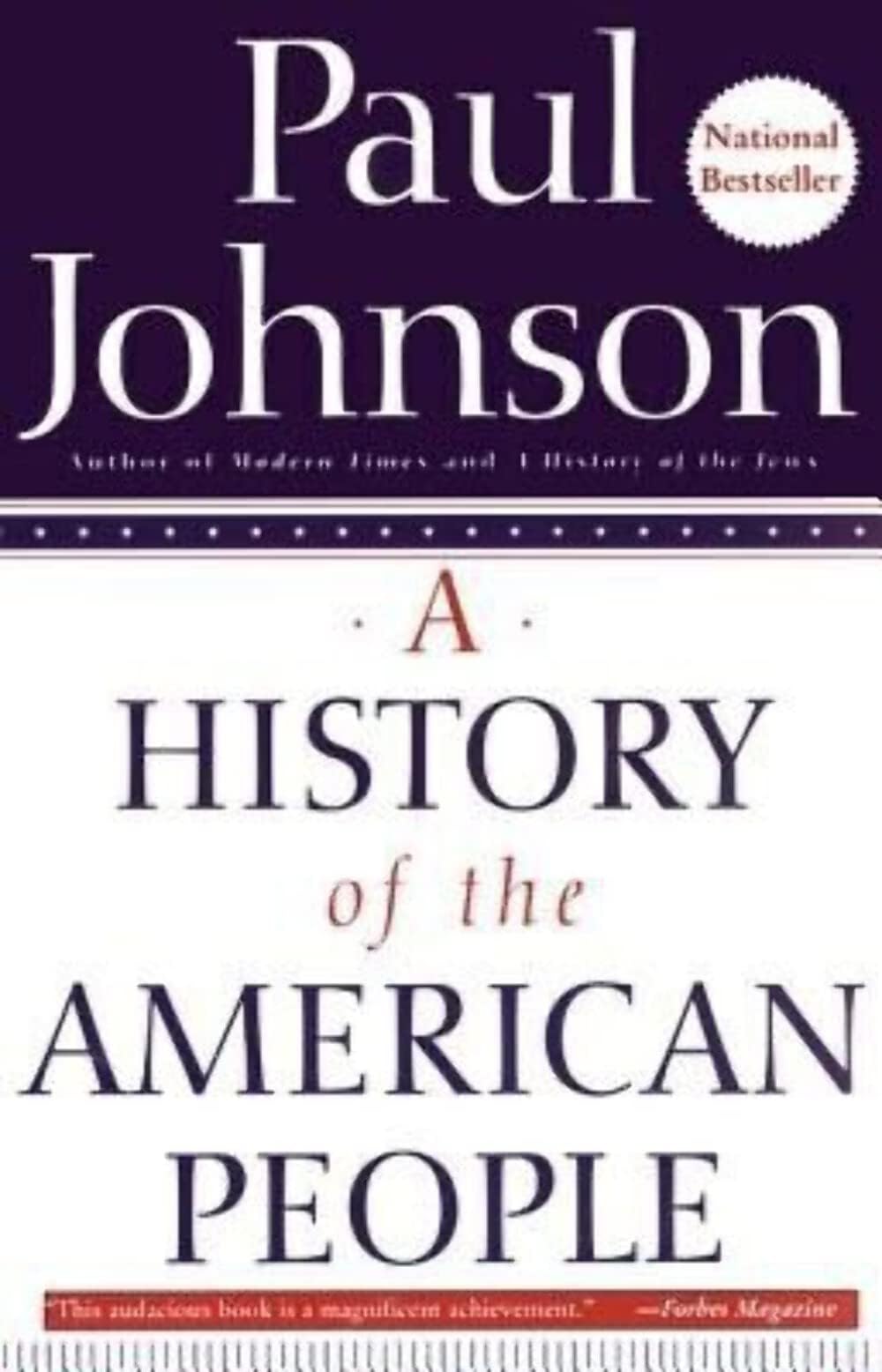
"As majestic in its scope as the country it celebrates. [Johnson's] theme is the men and women, prominent and unknown, whose energy, vision, courage and confidence shaped a great nation. It is a compelling antidote to those who regard the future with pessimism."— Henry A. Kissinger Paul Johnson's prize-winning classic, A History of the American People , is an in-depth portrait of the American people and a landmark of narrative U.S. history, covering every aspect of the nation—from politics to the arts. "The creation of the United States of America is the greatest of all human adventures," begins Paul Johnson's remarkable work. "No other national story holds such tremendous lessons, for the American people themselves and for the rest of mankind." In A History of the American People , historian Johnson presents an in-depth portrait of United States history from the first colonial settlements to the Clinton administration. This is the story of the men and women who shaped and led the nation and the ordinary people who collectively created its unique character. Littered with letters, diaries, and recorded conversations, this comprehensive history details the origins of their struggles for independence and nationhood, their heroic efforts and sacrifices to deal with the 'organic sin’ of slavery and the preservation of the Union to its explosive economic growth and emergence as a world power. Johnson discusses contemporary topics such as the politics of racism, education, the power of the press, political correctness, the growth of litigation, and the influence of women throughout history. Sometimes controversial and always provocative, A History of the American People is one author’s challenging and unique interpretation of the complete American story. Johnson’s views of individuals, events, themes, and issues are original, critical, and in the end admiring, for he is, above all, a strong believer in the history and the destiny of the American people. This comprehensive history offers a challenging and unique interpretation of the American story, exploring: A Sweeping Narrative: Follow the journey of the American people from the first colonial settlements to the modern era, told through the letters, diaries, and conversations of those who lived it. From Colony to Superpower: Chart the nation’s struggles for independence, its grappling with the ‘organic sin’ of slavery, and its explosive economic growth to become a world power. The People's Story: Meet the men and women, both prominent and unknown, whose vision, courage, and confidence collectively created the unique character of the nation. Provocative Analysis: Delve into a challenging and unique interpretation of America’s past, tackling controversial topics like racism, political correctness, and the power of the press. Review: An English perspective on American history: overflowing with rich and deep insights - This is my first book to read by Paul Johnson. It exceeded every expectation I had. Having just finished “A short history of the United States“ by Robert V. Remini, and knowing that Johnson‘s book was three times the length, I waded in. It was not long before I recognized a genius at work. Johnson approaches American history from several perspectives. First, the book is a history of the US presidents. I’ve read several lengthy presidential biographies, and was amazed at how complete Johnson‘s descriptions and insights were as he treated each of our chief executives. If you simply read his summaries of each of the presidents, it would be a fabulous book. He found positive things in presidents who have historically received low ratings, and pointed out the flaws in those presidents who have received the best ratings. (Only exception: Abraham Lincoln, who is described in glowing terms exclusively.) Second, he uses statistics, which can be boring, to paint and fill out a holistic picture of every major time period. He explains developments in economics, employment, warfare, politics, etc. with page after page of statistics. Somehow, this helped to make the story come even more alive. Third, he writes history as a cohesive story. The book may be history in a strict sense, but it is narrative at its best. He connects the major threads of the American story from chapter to chapter, forward and backward. I got so hooked that I read hours at a time and simply could not stop. “Truth is stranger than fiction.” In the first 2/3 of the book, Johnson does not reveal his own political stance or cultural worldview. But by the time he gets to the late 20th century, however, his political conservatism becomes clear. Although I’m a bit more progressive than he is, I couldn’t argue with the statistics and facts he presented to make his case. He is a thinker’s conservative, without being an intellectual snob – one of the traits he hates most in East Coast newspapers and private schools. Bottom line: Paul Johnson is an Englishman who treasures the history of the United States, who tells the story of America with generous appreciation and appropriate criticism, and whose insights are rich and deep — even if you disagree with some of his interpretive conclusions. Review: Great corrective to what's out there - While I wouldn't recommend that my students read only Paul Johnson's work on US History, I would definitely recommend that they read it in accompaniment to their texts. Johnson is rightly to be credited for providing a more balanced and optimistic view of the American people/government than is prevalent in the majority of publishing firms today. He does not shy away from criticism where it is due, but neither is he afraid to assert honor where honor is due--even if it means offending some politically correct ears. While I agree that he can be classified as a conservative, I would also note that this is not a "conservative's conservative" book. By that I mean that people who are unabashedly Republican, Religious Right, etc., will not find unscrutinized support for their revisionist accounts of history. While Johnson does overlap with certain conservative appraisals of historical events and figures, he does so on a case-by-case basis, always aiming to support his evaluations with fact. In many instances, these facts are not widely known because they have been cut out from liberal textbooks. They are not, however, smelling of the party line. Indeed, Johnson's book is fascinating for his historical scholarship, research, and deep analysis. His coverage of "forgotten" spans of time (i.e. Grant, Arthur, Hayes, Garfield) is welcome, as is his deft treatment of figures who are normally expansive in coverage (i.e. Lincoln, JFK). I found the 1860-1900 chapters to be personally most enlightening. Johnson is especially great at noticing overarching themes in government and economic life. He is not a social or sociological commentator, which will relieve some of his more liberal readers. And in fact, I believe most people--liberal or conservatve--would gain an awful lot from his research and presentation if they read with an open mind.
| Best Sellers Rank | #29,216 in Books ( See Top 100 in Books ) #21 in History Encyclopedias #28 in Cultural Anthropology (Books) #103 in U.S. Revolution & Founding History |
| Customer Reviews | 4.6 out of 5 stars 988 Reviews |
P**N
An English perspective on American history: overflowing with rich and deep insights
This is my first book to read by Paul Johnson. It exceeded every expectation I had. Having just finished “A short history of the United States“ by Robert V. Remini, and knowing that Johnson‘s book was three times the length, I waded in. It was not long before I recognized a genius at work. Johnson approaches American history from several perspectives. First, the book is a history of the US presidents. I’ve read several lengthy presidential biographies, and was amazed at how complete Johnson‘s descriptions and insights were as he treated each of our chief executives. If you simply read his summaries of each of the presidents, it would be a fabulous book. He found positive things in presidents who have historically received low ratings, and pointed out the flaws in those presidents who have received the best ratings. (Only exception: Abraham Lincoln, who is described in glowing terms exclusively.) Second, he uses statistics, which can be boring, to paint and fill out a holistic picture of every major time period. He explains developments in economics, employment, warfare, politics, etc. with page after page of statistics. Somehow, this helped to make the story come even more alive. Third, he writes history as a cohesive story. The book may be history in a strict sense, but it is narrative at its best. He connects the major threads of the American story from chapter to chapter, forward and backward. I got so hooked that I read hours at a time and simply could not stop. “Truth is stranger than fiction.” In the first 2/3 of the book, Johnson does not reveal his own political stance or cultural worldview. But by the time he gets to the late 20th century, however, his political conservatism becomes clear. Although I’m a bit more progressive than he is, I couldn’t argue with the statistics and facts he presented to make his case. He is a thinker’s conservative, without being an intellectual snob – one of the traits he hates most in East Coast newspapers and private schools. Bottom line: Paul Johnson is an Englishman who treasures the history of the United States, who tells the story of America with generous appreciation and appropriate criticism, and whose insights are rich and deep — even if you disagree with some of his interpretive conclusions.
W**E
Great corrective to what's out there
While I wouldn't recommend that my students read only Paul Johnson's work on US History, I would definitely recommend that they read it in accompaniment to their texts. Johnson is rightly to be credited for providing a more balanced and optimistic view of the American people/government than is prevalent in the majority of publishing firms today. He does not shy away from criticism where it is due, but neither is he afraid to assert honor where honor is due--even if it means offending some politically correct ears. While I agree that he can be classified as a conservative, I would also note that this is not a "conservative's conservative" book. By that I mean that people who are unabashedly Republican, Religious Right, etc., will not find unscrutinized support for their revisionist accounts of history. While Johnson does overlap with certain conservative appraisals of historical events and figures, he does so on a case-by-case basis, always aiming to support his evaluations with fact. In many instances, these facts are not widely known because they have been cut out from liberal textbooks. They are not, however, smelling of the party line. Indeed, Johnson's book is fascinating for his historical scholarship, research, and deep analysis. His coverage of "forgotten" spans of time (i.e. Grant, Arthur, Hayes, Garfield) is welcome, as is his deft treatment of figures who are normally expansive in coverage (i.e. Lincoln, JFK). I found the 1860-1900 chapters to be personally most enlightening. Johnson is especially great at noticing overarching themes in government and economic life. He is not a social or sociological commentator, which will relieve some of his more liberal readers. And in fact, I believe most people--liberal or conservatve--would gain an awful lot from his research and presentation if they read with an open mind.
T**K
A broad, and different, perspective on American history
Recommended for two types of readers: 1) The person who wants to get an overview of U.S. history in one easy-to-read (but large) volume; and 2) those who, like myself, have read many American biographies and histories. We can benefit in at least two respects. First, we get to share a history of our nation as seen from an outsider's perspective. Second, we learn factual history that somehow never made it into the books we have read, perhaps because we, collectively, were not much interested. My comment avoids political controversy, so I'll stick with the earlier portion of the book. First, the beginnings of American slavery were brand new to me, and fascinating. Second -- and as a Philadelphian news to me -- was Johnson's view of the northern colonies/States' support of slavery. Quakers in Barbados, rich from slave trading, moving to North America! news to me. Especially appreciated was Johnson's discussion of the "thousand years of political traditions, inherited from England," which formed the basis of our Founding Fathers' political actions. Johnson attributes to Madison's famous "We, the people" Lincoln's rationale for not permitting States to leave the Union. And more, much more. Buy it. Enjoy it! One word of warning: read cautiously; Johnson has some blunders, the funniest of which is calling Horatio Gates "Horatio Alger."
J**A
Strengths and Weaknesses
Paul Johnson's "A History of the American People" is a comprehensive and ambitious work that attempts to cover the entirety of American history from colonial times to the late 20th century. Here are some critical points about the book: Strengths: Comprehensive Scope : Johnson covers a vast timeline, providing readers with a broad overview of American history. This makes it a useful resource for those looking for a single-volume history. Engaging Narrative : Johnson is known for his narrative style, which can make historical events more accessible and engaging for general readers. His ability to weave together anecdotes and broader historical trends helps maintain interest. Cultural and Social Insights : The book often delves into cultural and social aspects of American life, offering insights beyond just political and military history. This multidimensional approach enriches the reader’s understanding of different eras. Controversial Perspectives : Johnson is not afraid to offer strong opinions, which can provoke thought and discussion. His conservative viewpoint provides an alternative perspective to more liberal historical narratives. Weaknesses: Bias and Subjectivity : One of the most significant criticisms of Johnson's work is his evident bias. As a conservative historian, he tends to emphasize themes like individualism, entrepreneurship, and the dangers of big government, sometimes at the expense of other important factors. This can lead to an imbalanced view of certain historical events and figures. Oversimplification : Given the vast scope of the book, some critics argue that Johnson oversimplifies complex issues and events. Important nuances and details can be lost in the attempt to cover so much ground. Selective Emphasis : Johnson often focuses on themes and periods that align with his ideological views. For example, he spends considerable time discussing the American Revolution and the Founding Fathers, but may gloss over other significant periods or movements that don’t fit as neatly into his narrative. Lack of Academic Rigor : Some academic historians have criticized the book for lacking the depth and rigor expected in scholarly works. Johnson relies heavily on secondary sources and doesn't always engage deeply with primary documents or recent historiography. Eurocentric Perspective : Like many older historical works, Johnson’s book has been critiqued for its Eurocentric focus, often sidelining the experiences and contributions of Native Americans, African Americans, and other minority groups. Conclusion: While "A History of the American People" offers a readable and sweeping narrative of American history, it is important to approach it with an awareness of its biases and limitations. It serves well as an introductory text or as a counterpoint to more progressive interpretations of American history, but readers should complement it with other sources that provide a more balanced and nuanced perspective. For those interested in a more academic or diverse understanding of American history, supplementary readings would be essential.
B**T
Soft like a virgin.
I am so excited to read this book!
T**M
A great history of the U.S., by an English historian
I'm three-fifths through this. I've read Page Smith five volumes, but I also appreciate this history by Paul Johnson. Love his style and he includes many anecdote I was not previously aware of. I did not catch an bias as is often found in U.S. histories. Recommended. Update: I have now completed it. Wow. Terrific. Just finished this U.S. history book. Highly recommended. Unlike most of today's histories, I found this, written by an Englishman to be unbiased. Very informative and interesting. I learned a lot I didn't know before. If you don't have time to read it all, read the last half, if not that, read the last quarter, and if not that, at least the last few chapters. This should be in every school and library. There are abundant source notes and an index.
M**R
British scolar's view of American History
This is a British scholar's exhaustive coverage of American history from a European point of view. Details about the political and military environment surrounding the Revolutionary War is fascinating. I've never found such thorough scholarship in the many histories of America I've read.
W**E
Well Done.
I've now read this and Schweikart's Patriot's History of the US. It was inevitable as I read that I would compare the two. They are in many ways very similar. I enjoyed Schweikart and felt it was very easy to read. At the beginning I struggled with Johnson. I was reading 50 - 100 pages at a clip in Schweikart where at the beginning of Johnson I was struggling to get through 20 at a time. I'm not sure why that was... but as I got further into the book it got easier. It's 976 pages, so it's a fairly long book, but having finished it I am glad I read it. It is different than Patriot's History, but I don't see that as a good thing or a bad thing. As a side note, I found it interesting that Paul Johnson (author) is British. I found it interesting to see an Englishman's thoughts on our progress and that he seemed positive about a great deal of the things we have done, even things that were counter to England's interests. On the whole a good book, well worth my efforts in reading. Hope you enjoy as well.
G**E
Interesting!
That's a very interesting book to read. The author takes and rather unusual path to describe the history of the United States. But I found it very good to gain a better understanding of the roots of the present US society.
E**R
Indispensável
Importante fonte para a compreensão da história do povo Americano!
I**M
Un hallazgo
Lo había buscando muchísimo y lo encontré a un excelente precio. Un libro impresionante de Paul Johnson
J**Y
Brilliant
This is quite an old but really excellent history of the people of the United States by a top historian who used to write reviews for the Spectator magazine in the UK
S**M
.
Delighted with product and great service.
Trustpilot
1 month ago
1 month ago