Buy anything from 5,000+ international stores. One checkout price. No surprise fees. Join 2M+ shoppers on Desertcart.
Desertcart purchases this item on your behalf and handles shipping, customs, and support to USA.
🚀 Locate like a pro, save like a boss!
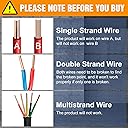
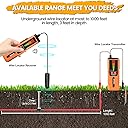
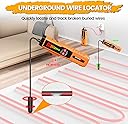
The VXSCAN F04 Underground Cable Locator is a battery-powered, professional-grade tool designed to detect and trace single or double-strand underground cables up to 1000 feet long and 3 feet deep. Equipped with noise-isolating earphones and adjustable signal controls, it enables precise location of cable breaks, irrigation wires, pet fences, and pipeline cables, empowering users to perform efficient repairs and maintenance independently.


| ASIN | B09W8TTQ3C |
| Best Sellers Rank | #108,093 in Industrial & Scientific ( See Top 100 in Industrial & Scientific ) #223 in Network & Cable Testers |
| Brand | VXSCAN |
| Brand Name | VXSCAN |
| Color | Orange |
| Compatible Devices | Devices with 3.5 mm audio output jack, 3.5 mm to USB adapter, and 9V battery compatible devices |
| Country Of Origin | China |
| Customer Reviews | 3.8 out of 5 stars 656 Reviews |
| Included Components | Transmitter Receiver headphone Storage bag User manual |
| Item Weight | 16 ounces |
| Manufacturer | VXSCAN |
| Measurement Type | feet or meters |
| Min. Operating Voltage | 9 Volts |
| Minimum Operating Voltage | 9 Volts |
| Model | F04 |
| Part Number | F04-1 |
| Power Source | Battery Powered |
| Specification Met | CE, UL |
| Style | Circuit Testers |
| Style Name | Circuit Testers |
| UPC | 889327054312 |
| Unit Count | 1.0 Count |
J**.
Works great (but not for finding my worx boundary wire break)
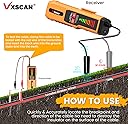
The instructions aren't entirely clear as some other reviewers have pointed out, but it's not overly complicated. First, turn on the Listener (the unit with the dangling antenna) and see if you pick up any noise when near your wire. It should be silent, otherwise there may be interference that affects the next steps. (Note, I could pick up some static from my lawnmowers base station... Unplugging the boundary wire eliminated that) Second, connect the red clip of the transmitter unit to the end of the wire, and the black clip to something metal you can stick in the ground (I used an 8" screwdriver, not sure if it has to be that long). Turn on the transmitter, then push the find button (magnifying glass icon). Now a signal is being sent along your wire, which you should be able to easily pick up with the receiver unit. It sounds like a toy police car ("wee-ooo-wee-ooo"). Very obvious. You should easily be able to trace the underground wire/metal/conductor by waving the antenna around to find the noise. This was definitely true for my lawnmower guide wire that was buried up to 3 inches. If at any point you lose the noise, your break is nearby (maybe not right there, but within a foot or two. Digging up the wire should be easy, since you know where it is (be safe if it's buried deep!) This worked for one of my wire breaks (when I dug up the wire it was clear there was a clean break), but not the other. But the second break was likely an incomplete break (I couldn't feel it or see it... But a multimeter confirmed a high resistance segment). I suspect the transmitter is a little too powerful for my use case, and overcame the partial break. Still, this device did a great job locating my wire and one break, so worth the cost!
L**T
Works perfectly for locating buried cables!
Needed to find a buried power junction box between house and pool light. After digging several “well it ought to be right here holes” I ordered this device. I isolated the location, and found it in 3 minutes. Incredible and so easy to use. I will have several uses for this device. Thank you for a great product.
J**B
Not useful in my situation. Maybe not in yours either.
I'm a EE and I know how to use test equipment and I know how this unit (is supposed to ) works. I was trying to locate a wire feeding a lamp post lamp. I know that the wires were buried 12-14" . I spent 3 hours trying to use this in order to located a break in the wires . I knew roughly where the break should be (there was trencher work there just prior to the lamp failing) . At no time was I able to detect the underground AC feed. This unit DID do a good job of detecting the radiated signal from the wires in the lamp post, but failed to find any trace of the underground wire. I took a random 20' length of wire and stretched it out on the surface of the lawn. I was able to detect the presence of that wire from about 3' to the side of the wire, so I know that the unit is somewhat alive. Unfortunately finding a wire on the surface of the ground is not very useful. The instructions are written in some pretty thickly accented Chenglish but are adequate with some patience. I really needed this to work, but such is life.
K**A
Works really well but feels cheap.
As a cable contractor this has helped me find cut underground cable reliably. But four stars due to it feeling cheap in the hand. I'm also worried about the detector wire wearing out from swinging so I use my fingers to support it where it connects to the unit.
H**B
Works great
Helped us detect the break in our dog fence and we were able to repair it ourselves. Definitely worth the cost.
J**7
Sprinkler Valve Locating
This product works but it's a bit fiddly and cheaply made. The unit I received did not seem to work at first but I finally found that by moving the signal strength potentiometers on both units back and forth I could find a spot where they worked, they didn't work at many spots throughout the range. If you get it working you will get the tone when you're within a couple of feet of the wire and there will be a small dead spot, no tone, directly over the wire. The included instructions are almost useless. Tips: If your valves are all located together this device should work without a problem because your wire signal will end near the valve box. If your valves are not located together, mine were not, then you may have a more difficult time depending on how the valves were wired. The wire bundle will most likely run from one valve to the next and if they terminated the wire at the corresponding valve, which I would think would be the correct way to install them, the signal will stop near each valve when you're connected to the corresponding wire. A little probing around the area should find the valve. For me, whoever installed my system did not terminate the wire at each corresponding valve. They tapped each valve into it's wire but let the signal continue on to the last valve box for every wire. This meant it was easy to find the last box but the signal did not stop on the corresponding wire at each valve in between. If you run into this situation then I would say to probe around anywhere the wire makes a turn or anywhere that the signal seems to be unusually large and confused, this is how I eventually found mine.
T**Y
I found my missing Sprinkler valves!
Ok folks, this thing does work pretty well. Some key points to find a sprinkler valve, it took me a bit and my neighbor came over and helped and once we figured out the main points, found the valve relatively quickly. 1) make sure you hook up the ground. The instructions say to drip something in the ground and hook to that, in my case I just hooked it to a ground in the sprinkler control box and that worked fine. 2) unhook the wire to the sprinkler controller and hook the red clip. 3) "turn on" the sound on the transmitter. At first I didn't realize this was the procedure because when you turn it on the lights flash on the transmitter and it gets pretty loud. 4) there are no lights on the receiver, that is just a sticker.... 5) You don't need the earbuds unless it is really loud around. 6) drag the sensor on the ground "across" the wire you are hunting for. Listen for when the sound starts, peaks and ends. The middle should be roughly where the wire is located. Then move a few feet in the direction you think the wire is going and repeat. Keep doing this until you find the end of the wire. 7) with distance from the transmitter, and with distance from the wire, the strength does decline. You have to learn to interpret this. 8) My wiring was about 12" below the ground, and this thing had no issue picking it up. Bottom line: it does work, but it will take some time and some interpretation to find the valve.
P**.
Nearly nonfunctional because of the garbage earpiece.
This generally works OK. It is finicky, but will work. The problem is the earpiece it comes with is probably the worst earpiece I have ever seen or had the displeasure to try and use. Hard plastic that doesn’t stay in your ear, thin garbage cable, and a 2.5mm (?) connector, so you can’t even use a normal pair of headphones you might have on hand. In fact, it is hard to even find anything better as a replacement. On top of that, there is no speaker, so you are forced to use these garbage earpieces. This is the third time I have used this device and am ready to throw it in the trash and buy a different brand that doesn’t hate their customers so much. Strong recommendation to get something else besides this product.
P**L
Worked for me
I have a Husqvarna automower with boundary and homing wires. Disconnection at the charging station and at the homing wire remote connection point and use of a multimeter showed one section of the boundary wire was fine, and the other two sections both had breaks and earth leakage. In both cases the audio output of the detector dropped off significantly around 1.5metres short of the actual break which must have been because of the effect of the earth leakage. Regardless, the detector did what It’s designed to do and the breaks easily found. The breaks were fixed and the mower is mowing again.
Trustpilot
1 month ago
2 weeks ago