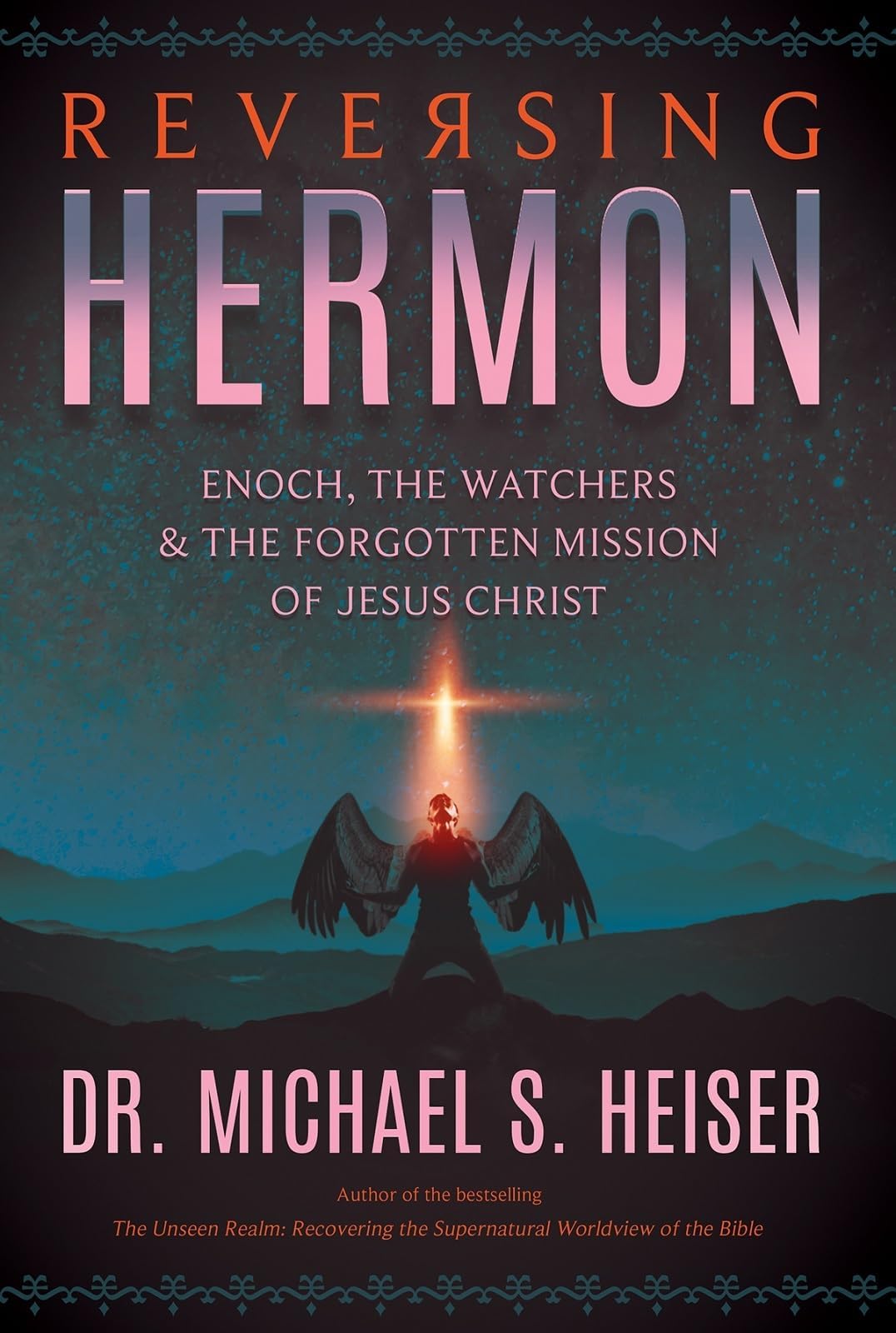
Reversing Hermon: Enoch, the Watchers, and the Forgotten Mission of Jesus Christ
Product ID: 40848552
Desertcart purchases this item on your behalf and handles shipping, customs, and support to USA.
Reversing Hermon is a groundbreaking work. It unveils what most in the modern Church have never heard regarding how the story of the sin of the Watchers in 1 Enoch 6-16 helped frame the mission of Jesus, the messiah. Jews of the first century expected the messiah to reverse the impact of the Watchers’ transgression. For Jews of Jesus’ day, the Watchers were part of the explanation for why the world was so profoundly depraved. The messiah would not just revoke the claim of Satan on human souls and estrangement from God, solving the predicament of the Fall. He would also not only bring the nations back into relationship with the true God by defeating the principalities and powers that governed them. Jews also believed that the messiah would rescue humanity from self-destruction, the catalyst for which was the sin of the Watchers and the influence of what they had taught humankind. The role of Enoch’s retelling of Genesis 6:1-4 in how New Testament writers wrote of Jesus and the cross has been largely lost to a modern audience. Reversing Hermon rectifies that situation. Topics include: • Understanding Genesis 6:1-4 and the Sin of the Watchers in Their Original Context: How the ancient Mesopotamian story of the apkallu aligns with Gen 6:1-4, was preserved in 1 Enoch, and sets the stage for the theme of reversing the evil of the Watchers • How the theme of reversing the transgression of the Watchers colors the gospel accounts of the birth of Jesus, his genealogy, and his ministry. • How the writings of Peter and Paul allude to the sin of the Watchers and present Jesus as overturning the disastrous effects of their sins against humanity. • How the descriptions of the antichrist, the end-times Day of the Lord, and the final judgment connect to Genesis 6 and the nephilim. Though every topic addressed in Reversing Hermon can be found in scholarly academic literature, Reversing Hermon is the first book to gather this information and make it accessible to Bible students everywhere. The book also includes lengthy appendices on the ancient debate on the inspiration of the book of 1 Enoch, New Testament allusions to the book, and academic resources for studying 1 Enoch and the Book of Giants from the Dead Sea Scrolls. Review: A Fantastic Follow-Up to 'The Unseen Realm' - It all started a few months ago. A pastor friend of mine told me about someone in his congregation who believes the earth is flat. Then he sent me a link to a video by Rob Skiva defending his view by quoting Dr. Michael Heiser. I looked Michael Heiser up and realized that he worked for Logos Bible Software. So I started reading some of his stuff. And I was intrigued. Now, to be clear, Heiser doesn't believe the earth is flat but he does believe that the ancient Israelites believed the earth was flat. But that wasn't the intriguing part. The intriguing part was what he said about angels, demons, and the supernatural world in general. He explained passages of scripture that I'd heard explained away all my life. And he did it in a way that was biblical and consistent. He also opened my eyes to the fact that there are verses and even whole chapters of Scripture that have been misunderstood - and dare I say it, mistranslated - for generations (I'm looking at you, Psalm 82). And though I had disagreements with Heiser's interpretations here and there, I've come to believe that he's largely on the right track. Too many Christians have downplayed and explained away the really difficult passages in Scripture to make them more palatable. We've removed all of the supernatural elements that aren't absolutely necessary. And that is unacceptable if we're going to be faithful to God's revelation. In The Unseen Realm, Heiser upends nearly all of the traditional ideas about the supernatural world. In Heiser's understanding of scripture, God has a council of lesser divine beings that rule alongside of him. At first glance you may think, 'That's crazy! And certainly not in the Bible!' but I'd encourage you to read The Unseen Realm for yourself. Heiser isn't pulling stuff out of thin air or arbitrarily making arguments. Everything he claims is backed up by scripture. And once you see it, it's hard to unsee it. It requires a paradigm shift; but once your paradigm is shifted, everything falls into place. Even passages that always seemed like they'd never fit anywhere (I'm looking at you, 1 Cor 11:11-15). And though I still want to do a proper review of The Unseen Realm, I got Heiser's new book Reversing Hermon yesterday and figured I'd go ahead and write about it since it's fresh on my mind. Reversing Hermon: Enoch, the Watchers & the Forgotten Mission of Jesus Christ is a book that deals extensively (and not surprisingly) with 1 Enoch. In case you're unaware, 1 Enoch is a book written a couple of centuries before Jesus was born that was quite popular among many Jews of Jesus' day and is quoted in Jude 14-15. It's part of a collections of writings known today as Pseudepigrapha. Several early church fathers considered it canonical and the Ethiopian Orthodox church included it in their Bibles. In short, it's a collection of stories, sayings, parables, and apocalypses that were supposedly recorded by Enoch, Noah's great-grandfather. Though no serious scholar believes Enoch actually wrote these things - Heiser included - there's no doubt that it gives valuable background to the way Jews of Jesus' day understood things. The quotation in Jude - as well as allusions elsewhere in the New Testament - testify to this fact. None of this means that 1 Enoch is scripture or that it should be included in our Bibles. But it does mean that 1 Enoch might shed some light on the worldview of the New Testament authors. Heiser's main argument in the book can be boiled down to this: the Pseudepigrapha in general, and 1 Enoch in particular, serve as a valuable backdrop to the New Testament world and writings. He isn't saying that scripture isn't sufficient for salvation. Neither is he arguing - like some kind of modern gnostic - that if we're going to be really spiritual, then we'll have to consult certain 'hidden' writings. He's simply pointing out the fact that if we're going to understand the New Testament properly, we need to understand the culture in which it was written. This should be pretty basic stuff. So, how does using 1 Enoch as a backdrop for the New Testament affect our understanding? To answer that question, I probably ought to summarize the most important parts (for our purposes) of the book. 1 Enoch retells the story of Genesis 6:1-4. This is a passage of scripture that has puzzled interpreters for generations and which has been understood in a variety of rather creative ways. Here it is in its entirety: Now it came about, when men began to multiply on the face of the land, and daughters were born to them, that the sons of God saw that the daughters of men were beautiful; and they took wives for themselves, whomever they chose. Then the LORD said, “My Spirit shall not strive with man forever, because he also is flesh; nevertheless his days shall be one hundred and twenty years.” The Nephilim were on the earth in those days, and also afterward, when the sons of God came in to the daughters of men, and they bore children to them. Those were the mighty men who were of old, men of renown. Heiser briefly examines the ways this passage has been understood throughout Christian history and then begins laying a foundation for his own view by referencing 2 Peter 2:1-10 and Jude 5-7. And this leads to his discussion of 1 Enoch. 1 Enoch's account of Genesis 6:1-4 isn't vague at all. It's incredibly descriptive. And it's also hard for most modern people to swallow. According to Enoch, this story is about supernatural beings - Watchers - who leave their proper abode and bring secret knowledge to humankind. They also have sexual relations with human women. The offspring of these unions are giants known as Nephilim (among other names). God punishes the Watchers by sealing them away in Tartarus (see 2 Peter 2:4). When the Nephilim - giants - died, their spirits were released and became what we would call demons. This is the basic story of Genesis 6:1-4 as 1 Enoch understands it. And for most people today, it understandably raises a lot of questions. And I'm among those people. There are a lot of things about this description that seem strange to me. And yet, most of my objections are logical, cultural, or emotional...not scriptural. I'm not going to lie. This whole thing makes me uncomfortable. But the explanation of the text makes far more sense than any other explanation I've heard. In other words, if this wasn't the Bible - if someone handed me a storybook and it had Genesis 6:1-4 in it, I'd probably understand it the same way 1 Enoch does. What makes me feel uncomfortable with this explanation is not that it doesn't match the text. It's that I have a hard time wrapping my mind around the possibility that it could be true. And yet, I believe Jesus was born of a virgin. I believe he performed miracles. I believe he was raised from the dead. Yes. I feel myself succumbing to the same temptation almost all Christians do. Let's sweep all of the unnecessary supernatural elements of scripture under the rug and only display the ones that are acceptable to most people - and absolutely necessary to the faith. Heiser spends the first part of Reversing Hermon describing the connections between Genesis 6, 1 Enoch, and the Mesopotamian versions of the same story. He lays an important foundation in these chapters for understanding the rest of the book - especially for those who are unacquainted with the story told in 1 Enoch. Everything he mentions here will come up in later chapters - sometimes in unexpected ways. I ought to note two important things at this point. First, Heiser isn't pulling stuff out of thin air. Everything he writes is based on scripture and backed up by solid scholarship. The notes at the end of the book are evidence of that, taking up nearly 60 pages. Second, Heiser isn't the first person who has said this stuff. Many of the earliest church fathers claimed the exact same things Heiser claims. And he's not afraid to note that fact. Irenaeus is mentioned frequently, with good reason. He's well-respected, he wrote early, and he taught along similar lines to Heiser regarding 1 Enoch's understanding of Genesis 6. In Part two, Heiser discusses how 1 Enoch's version of events underlies some of the sayings and events of Jesus' life. Let me just say that chapter 4 is phenomenal. In it, he argues that Revelation 12 is a piece of astral prophecy (in this chapter, he draws heavily from Malina's commentary on Revelation. I read it last year and, like Heiser, found it to be a stretch at times but it did include some fascinating insights). If read this way, Revelation 12 is giving us the birthday of Jesus. This may sound outlandish or crazy but again, I'd encourage you to read what he writes before you pass judgment. It left me with my mouth hanging open. Chapter 5 is a little less monumental. It relies heavily on the scholarly work of Amy Richter to argue that the women included in Jesus' genealogy are there because they are all connected to the sins of the Watchers (see Matthew 1:1-17). I found this chapter less convincing than most of the rest of the book but it's worth reading and considering. And it's also worth noting that I haven't heard any better explanations for why those particular women are mentioned and none others. Chapter 6 focuses on Jesus' ministry and, in particular, the events of Jesus' life that take place near Mount Hermon/Bashan/Caesarea Philippi. This chapter is the reason the book received the subtitle it did. It's really the only chapter in the book that discusses - at any length - the "forgotten mission of Jesus Christ." And what is that forgotten mission, you ask? "When Jesus chose to go to Mount Hermon to be transfigured, He was claiming it for the Kingdom of God." According to Heiser's reading, Jesus was reversing the damage done by the Watchers when they came to the same mountain and made a pact to sin against God together. In the third part, Heiser hones in on three problematic passages/ideas in the New Testament epistles and explains how having the Enochic background helps understand what's going on there. First, he deals with the issue of human sinfulness. He argues that for first century Jews, the ubiquity of human sinfulness is not only owing to Adam's sin but also to the Watchers' sin in Genesis 6:1-4. Then, he discusses Paul's exhortation regarding women and head-coverings in 1 Corinthians 11. This chapter is important because it makes sense of an otherwise incredibly confusing passage. Finally, he discusses Peter's summary of baptism in 1 Peter 3:18-22. In my opinion, this section of the book is the strongest and best argued. It makes sense of verses that I've seen fumbled and mishandled all of my life. To put it bluntly, it just makes more sense of what the text says. The final part of Reversing Hermon focuses on the book of Revelation. In particular, he addresses the issue of the Antichrist, the identification of Gog, and the origins of the lake of fire. My views on Revelation are different from Heiser's so I found myself disagreeing the most in these chapters - though even here, there's much to glean. I especially appreciated the discussion on Gog. After the meat of the book is over, you get five appendices for dessert. Though these range in value. First up is a good - albeit short - summary of the early church's views on 1 Enoch. Second, there's a quick summary of the dating/manuscript evidence for the book. Third is a list of scholarly works on 1 Enoch. Fifth is a quick essay that I didn't particularly care for entitled The Ancient Antichrist Profile: Jew or Gentile? And fourth (yes, I know I didn't order those correctly), he includes a list of allusions to the Pseudepigrapha. This was - in my opinion - something of a mixed bag. Heiser opens this appendix by noting that "what constitutes an allusion varies in the opinions of scholars." It's obvious from this statement that Heiser recognizes the tenuous nature of some of the connections made in this list. For example, Luke 21:18 is said to be a possible allusion to 1 Enoch 51:2. But look at them: 1 Enoch 51:2 - "And he shall choose the righteous and the holy ones from among the risen dead, for the day when they shall be selected and saved has arrived." Luke 21:28 - "Now when these things begin to take place, stand up and raise your heads, because your redemption is drawing near." Personally, I don't see even a slight allusion here. Naturally, when you have two people talking about similar things, there may be a little overlap but it seems to me that many of the allusions included in this list are a stretch. Likewise, some may not be an example of New Testament authors alluding to the Pseudepigrapha but rather of both the NT authors and the Pseudepigrapha alluding to the Old Testament (1 Enoch 5:7 and Matthew 5:5 could both be alluding to Psalm 37:11). With that said, the New Testament definitely includes some genuine allusions to the Pseudepigrapha that are worth noting. These allusions take up a huge amount of space too. The list is a full 54 pages (out of a 326 page book). What else can I say? Heiser will challenge everything you think you know about the way the world works. His is a call to stretch ourselves beyond what we're used to. It's paradigm shifting at its finest. This was true of The Unseen Realm and it's true of Reversing Hermon. And though I can't say that I'm fully onboard with everything Heiser argues, I do believe that he takes the text of scripture - especially the 'problematic' verses - more seriously than just about anyone I've read. And even if he doesn't change your mind, he will challenge you to think through your own interpretations and beliefs. And that's always a good thing. May we seek to be ever more faithful to the text of scripture - and thus, to its Author. Review: Reversing Hermon in Matthew 1 - I have to admit this is the first book I’ve read by Dr. Michael Heiser and I wasn’t sure what to expect. Frankly, I wasn’t sure I even wanted to read this book, that is, until pursuing C.C. Fenn’s review on desertcart. For sure one of the best reviews I’ve read in a long time. In any case, I purchased Reversing Hermon: Enoch, The Watchers & the Forgotten Mission of Jesus Christ and really appreciated seeing the subject through Dr. Heiser’s eyes. In this book Dr. Heiser elevated the discussion of Genesis 6 from the oft sensationalist speculation to a historical and Biblical grounding which provides answers to several of the Bible’s more challenging passages. More importantly Dr. Heiser looked at the subject in light of the Spirit of Prophecy, that is, as it relates to YHWH’s redemptive plan through Yeshua (YHWH’s Salvation). In short Dr. Heiser makes the case that Yeshua’s messianic mission included not only the rectification of Adam and Eve’s sin, but also the evil wrought by those of the angelic host who left their intended estate and sowed their rebellious evil on this earth. In terms of scholarship Dr. Heiser did something in this book which is rather rare today. Dr. Heiser looked at this complex subject in light of its 2nd temple era context. The 2nd temple era and it influence on Biblical history and Bible prophecy (in my opinion) is far too often ignored when trying to understand some of the Bible’s most important prophetic passages. The book is organized into four parts: • PART I – Genesis 6:1-4 in its Original Ancient Contexts • Chapter 1 – The Sons of God and Nephilim • Chapter 2 – The Sin of the Watchers in 1 Enoch and Other Enochian Tests • Chapter 3 – The Mesopotamian Apkallu, the Watchers, and the Nephilim • PART II – Reversing Hermon in the Gospels • Chapter 4 – The Sin of the Watchers and the Birth of Jesus • Chapter 5 – The Sin of the Watchers and the Genealogy of Jesus • Chapter 6 – The Sin of the Watchers and the Ministry of Jesus • PART III – Reversing Hermon in the Epistles • Chapter 7 – The Sin of the Watchers and Human Depravity • Chapter 8 – The Sin of the Watchers and the Head Covering of 1 Corrintians 11 • Chapter 9 – The Sin of the Watchers and Baptism • PART IV – Reversing Hermon in the Book of Revelation • Chapter 10 – The Sin of the Watchers, the Nephilim, and the Antichrist • Chapter 11 – The Sin of the Watchers and the Apocalypse Of these chapters 2, 5, 7, 9 really stood to me. I especially appreciated learning about the congruency of the Enochian narrative in Biblical and the historical record. I frankly had no idea the subject was as well testified to in ancient history. Dr. Heisers discussion of the Mosaic law in Chapter 7 was especially interesting. It provided a new and intriguing angle from which to view the Torah and its purpose. This subject provided me with much food for future thought and reflection. - - - - - - - - - - - - - The weakest part of the book, in my opinion, were the authors speculation regarding Revelation 12 as an astronomical sign which dates the birth of Yeshua to the 1st of Tishri in 3 BC. I admit up front I don’t know enough about astronomical signs to test Dr. Heiser’s theory but Biblical and historically speaking Tishri 1 3 BC as the birth of the Messiah is problematic for several reasons. First, the prophecy of Daniel 9 dates the coming of the Messiah to 5-4 BC. A 4 BC date for the Birth of Yeshua also best fits the chronological evidence of Matthew, Luke and Josephus. The most unsettling aspect of the book was the Dr. Heiser’s exploration of 1 Cor. 11 and the subject of a woman’s head covering and its 2nd temple historical context. Not that it couldn’t be true but it is certainly outside my comfort zone. - - - - - - - - - - - - - By far my favorite part of the book was the Dr. Heiser’s exploration of the lineage of Jesus in Matthew 1. Dr. Heiser opens Chapter 5 with the following quote: “Admit it. You think genealogies are boring. While I wouldn’t claim that all biblical genealogies are filled with theological insights, I can promise you that the genealogy of Jesus is different. As we’ll see, it has some amazing features that link it with the expectation of a messianic reversal of the sin of the Watchers.” You have to admit that this is a pretty bold statement. But Dr. Heiser goes on to explain, based upon the work of New Testament scholar Amy Richter, that the four women mentioned or implied in Matthew 1 are connected to Yeshua redemptive purpose as it relates to reversing the evil brought into this world by the fallen angelic host. He further explains that these women by their inclusion, would emphasis in the Jewish readers mind the events of Genesis 6, events and their implications which are only understood within the context of the 2nd temple era Jewish reader. This Enochian angle of Yeshua lineage did indeed seem a bit farfetched to me at first glance but after some reflection I realized Dr. Heiser may have more of a point than even he may realize. This relates to a statement Dr. Heiser made earlier in chapter 4 regarding “astral prophecy”. I quote, “In briefest terms, and with respect to a biblical perspective ( as opposed to pagan polytheism’s conception), astral theology was the idea that the One who made the celestial objects in the heavens (sun, moon, stars) to be for “signs and seasons” and to mark time (Genesis 1:14) could use those object to communicate.” You see as Dr. Heiser notes repeatedly in this book, the New Testament must be understood with the context of the 2nd temple. No place in the Bible better illustrates this fact than the lineage of Yeshua in Matthew 1. Indeed Matthew’s genealogy of Yeshua is far from boring. I’ll get back to the four women in Yeshua lineage in a moment but to really understand their importance you must see the lineage of Yeshua from a 2nd temple perspective that the Jewish reader would have intuitively grasp. First, if you list the names as given by Matthew you will find there are 41 generation between Abraham and Yeshua. Now arrange them into the three generation groupings described by Matthew in verse 17. What you will find is that while Matthew implied that Yeshua was the 14th generation he is actually the 13th as given. Matthew cleverly shows that Yeshua is both the 13th and 14th generation. To a Jewish reader they would have immediately made the connection to the Bible’s calendar as described in Gen. 1:14. You see the lunar side of the Biblical calendar, which orders the divine appointment or “signs and seasons” of Genesis 1:14 as described by Dr. Heiser, are governed by two internal lunar cycles of 13 or 14 days of waxing and waning light each month. Further, during the 7 sacred Biblical festival’s each year 13 or 14 sacrifices are commanded to be offered. That the apostle Paul understood this messianic symbolism is shown in Ephesian’s 2:13-14 where he describes the middle wall of partition between Jews and Gentiles which Yeshua’s death and resurrection abolished. This wall during the 2nd temple era which prevented Gentiles from accessing the temple proper (and by implication the presence of YHWH) was accessed by 14 steps and entry to the temple granted by one of 13 gates. What this demonstrates is that indeed Matthew had a redemptive message woven into the lineage of Yeshua in Matthew 1 which supports in a fascinating way Dr. Heiser position that the women of Matthew 1, may also fit into this redemptive “matrix”. Further to Dr. Heiser’s point is the fact that the 41 generations between Abraham and Yeshua and the 3 generational groupings of Yeshua’s ancestors has a larger chronological context that some of his Jewish readers would have likely understood. You see, a reasonable case could be made that there were 41 jubilee cycles between Abraham and Yeshua (as represent by the 41 generations). But more importantly, using the chronology of the MT text of the Old Testament there were in fact 41 jubilee cycles between Adam and Abraham. (For those who appreciate a bit of irony its worth noting that we are living in the 41st jubilee from Yeshua.) So Matthew, by arranging Yeshua’s lineage into 41 generations (he left out four kings to do this) linked the Messianic redemptive symbolism of the sacrificial system with the Old Testament chronology between Adam and Abraham. But here is the intriguing part which I hadn’t realized until reading Dr. Heiser’s book. If we take the three generational groupings of Yeshua’s ancestors as representative of the 3 Biblical ages of 41 jubilee cycles each, you’ll find that the offspring of the women mentioned in Matthew 1 have a direct connection to the Enochian events and thus prove beyond reasonable doubt that there is a connection between these women and the events Enoch, the fallen angel’s and YHWH’s redemptive plan. The four offspring of the women mentioned in Matthew 1 are as follows: • Phares the 5th generation • Booz (Boaz) the 11th generation • Obed the 12th generation • Solomon the 15th generation (1st of the 2nd generational grouping) If each of the three 14 generational groupings represent 41 jubilee cycles in a larger chronological context then the each generation in the three groups (of 14) is equal to 2.928 jubilee cycles. • Pares falls in the 5th generation which represents the 12th, 13th and 14th jubilee cycle from Adam. It was during the 13th jubilee cycle from Adam (the 623rd yr.) that Enoch was taken to heaven. • Boaz was the 11th generation representing the 29th, 30th and 31st jubilee cycles from Adam. It was during the 29th jubilee cycle form Adam, in the 365th year of Noah’s life that Jared died. As Dr. Heiser explains according to the book of Enoch it was during the days of Jared that the fallen angel’s (on Mt. Hermon) made their agreement to defile the women of earth. • Obed was the 12th generation representing the 33rd, 34th and 35 jubilee cycles from Adam. It was during this period of time that Shem was born during the 32nd jubilee cycle form Adam. It was through Shem, the son of Noah that YHWH’s would work out His redemptive plan for mankind by bringing forth Yeshua, the promised righteous seed. Then during the 34th jubilee in the 600th year of Abraham’s life the Deluge took place cleansing the earth of evil which the fallen angles had wrought. • Solomon was the 15th generation from Abraham or the 1st generation in Matthew 2nd grouping of 14. This 15th generation represented the 42nd, 43rd, and 44th jubilee cycle from Adam. It was during this period of time that YHWH made all of His covenants with Abraham which promised that through his “seed” all nations of the earth would be blessed. Further it was in the 100th year of Abraham’s life exactly on the 43rd jubilee cycle from Adam that Isaac was born. It was also during the 44th jubilee cycle from Adam that YHWH honored Abraham’s faith (in his willingness to sacrifice his son Isaac) by swearing (shaba) the first oath He, the living God of the Bible, swore with any man in the Bible. It was this oath that Moses mentions in Due. 7:9, Daniel mentions in Daniel 9:4, and Zechariah mentions in Luke 1. So there you have it. As Amy Richter and Dr. Heiser claim, and incredible as their claims may sound, Matthew did indeed have the story of the Enoch, the fallen angels, the flood, and YHWH’s redemptive plan of Reversing Hermon in mind when he penned that inspired list nearly two thousand years ago. Who said genealogies were boring? - - - - - - - - - - - This review has gone on far too long but in closing for those who would like to see confirmation for another one of Dr. Heiser’s points in Chapter 9 regarding Baptism, its redemptive context and its relationship to the events of Flood, you’ll find it in Daniel 9:26 where it describes the Messiah as “cut off”. This cutting off or “karath” would have harkened the Jewish reader back to the first occurrence of this word where it is used to described the waters of the flood which karath mankind from the face of the earth. Thus one again showing that it was the promised messiah the seed of Adam, Shem and Abraham that reversed the effects of not only the sin of Adam and Even but also the corrupting evil wrought by the fallen angelic hoard in the days leading up to the flood. - - - - - - - - - - - In summary I can’t say that I agree with all of Dr. Heiser’s points but he sure has given me food for thought. I started the book skeptical but finished it convinced that there is far more to the Genesis 6 than I ever understood. Dr. Heiser has made a compelling case that part of Yeshua’s redemptive purpose was in fact to combat the angelic evil which has been corrupting mankind since the flood. After you read this book I’d encourage you to open your Bible’s and see if these things be so. Maranatha!

| Best Sellers Rank | #16,796 in Books ( See Top 100 in Books ) #3 in Messianic Judaism (Books) #11 in Demonology & Satanism (Books) #29 in Christian Angelology & Demonology |
| Customer Reviews | 4.8 out of 5 stars 2,432 Reviews |
C**N
A Fantastic Follow-Up to 'The Unseen Realm'
It all started a few months ago. A pastor friend of mine told me about someone in his congregation who believes the earth is flat. Then he sent me a link to a video by Rob Skiva defending his view by quoting Dr. Michael Heiser. I looked Michael Heiser up and realized that he worked for Logos Bible Software. So I started reading some of his stuff. And I was intrigued. Now, to be clear, Heiser doesn't believe the earth is flat but he does believe that the ancient Israelites believed the earth was flat. But that wasn't the intriguing part. The intriguing part was what he said about angels, demons, and the supernatural world in general. He explained passages of scripture that I'd heard explained away all my life. And he did it in a way that was biblical and consistent. He also opened my eyes to the fact that there are verses and even whole chapters of Scripture that have been misunderstood - and dare I say it, mistranslated - for generations (I'm looking at you, Psalm 82). And though I had disagreements with Heiser's interpretations here and there, I've come to believe that he's largely on the right track. Too many Christians have downplayed and explained away the really difficult passages in Scripture to make them more palatable. We've removed all of the supernatural elements that aren't absolutely necessary. And that is unacceptable if we're going to be faithful to God's revelation. In The Unseen Realm, Heiser upends nearly all of the traditional ideas about the supernatural world. In Heiser's understanding of scripture, God has a council of lesser divine beings that rule alongside of him. At first glance you may think, 'That's crazy! And certainly not in the Bible!' but I'd encourage you to read The Unseen Realm for yourself. Heiser isn't pulling stuff out of thin air or arbitrarily making arguments. Everything he claims is backed up by scripture. And once you see it, it's hard to unsee it. It requires a paradigm shift; but once your paradigm is shifted, everything falls into place. Even passages that always seemed like they'd never fit anywhere (I'm looking at you, 1 Cor 11:11-15). And though I still want to do a proper review of The Unseen Realm, I got Heiser's new book Reversing Hermon yesterday and figured I'd go ahead and write about it since it's fresh on my mind. Reversing Hermon: Enoch, the Watchers & the Forgotten Mission of Jesus Christ is a book that deals extensively (and not surprisingly) with 1 Enoch. In case you're unaware, 1 Enoch is a book written a couple of centuries before Jesus was born that was quite popular among many Jews of Jesus' day and is quoted in Jude 14-15. It's part of a collections of writings known today as Pseudepigrapha. Several early church fathers considered it canonical and the Ethiopian Orthodox church included it in their Bibles. In short, it's a collection of stories, sayings, parables, and apocalypses that were supposedly recorded by Enoch, Noah's great-grandfather. Though no serious scholar believes Enoch actually wrote these things - Heiser included - there's no doubt that it gives valuable background to the way Jews of Jesus' day understood things. The quotation in Jude - as well as allusions elsewhere in the New Testament - testify to this fact. None of this means that 1 Enoch is scripture or that it should be included in our Bibles. But it does mean that 1 Enoch might shed some light on the worldview of the New Testament authors. Heiser's main argument in the book can be boiled down to this: the Pseudepigrapha in general, and 1 Enoch in particular, serve as a valuable backdrop to the New Testament world and writings. He isn't saying that scripture isn't sufficient for salvation. Neither is he arguing - like some kind of modern gnostic - that if we're going to be really spiritual, then we'll have to consult certain 'hidden' writings. He's simply pointing out the fact that if we're going to understand the New Testament properly, we need to understand the culture in which it was written. This should be pretty basic stuff. So, how does using 1 Enoch as a backdrop for the New Testament affect our understanding? To answer that question, I probably ought to summarize the most important parts (for our purposes) of the book. 1 Enoch retells the story of Genesis 6:1-4. This is a passage of scripture that has puzzled interpreters for generations and which has been understood in a variety of rather creative ways. Here it is in its entirety: Now it came about, when men began to multiply on the face of the land, and daughters were born to them, that the sons of God saw that the daughters of men were beautiful; and they took wives for themselves, whomever they chose. Then the LORD said, “My Spirit shall not strive with man forever, because he also is flesh; nevertheless his days shall be one hundred and twenty years.” The Nephilim were on the earth in those days, and also afterward, when the sons of God came in to the daughters of men, and they bore children to them. Those were the mighty men who were of old, men of renown. Heiser briefly examines the ways this passage has been understood throughout Christian history and then begins laying a foundation for his own view by referencing 2 Peter 2:1-10 and Jude 5-7. And this leads to his discussion of 1 Enoch. 1 Enoch's account of Genesis 6:1-4 isn't vague at all. It's incredibly descriptive. And it's also hard for most modern people to swallow. According to Enoch, this story is about supernatural beings - Watchers - who leave their proper abode and bring secret knowledge to humankind. They also have sexual relations with human women. The offspring of these unions are giants known as Nephilim (among other names). God punishes the Watchers by sealing them away in Tartarus (see 2 Peter 2:4). When the Nephilim - giants - died, their spirits were released and became what we would call demons. This is the basic story of Genesis 6:1-4 as 1 Enoch understands it. And for most people today, it understandably raises a lot of questions. And I'm among those people. There are a lot of things about this description that seem strange to me. And yet, most of my objections are logical, cultural, or emotional...not scriptural. I'm not going to lie. This whole thing makes me uncomfortable. But the explanation of the text makes far more sense than any other explanation I've heard. In other words, if this wasn't the Bible - if someone handed me a storybook and it had Genesis 6:1-4 in it, I'd probably understand it the same way 1 Enoch does. What makes me feel uncomfortable with this explanation is not that it doesn't match the text. It's that I have a hard time wrapping my mind around the possibility that it could be true. And yet, I believe Jesus was born of a virgin. I believe he performed miracles. I believe he was raised from the dead. Yes. I feel myself succumbing to the same temptation almost all Christians do. Let's sweep all of the unnecessary supernatural elements of scripture under the rug and only display the ones that are acceptable to most people - and absolutely necessary to the faith. Heiser spends the first part of Reversing Hermon describing the connections between Genesis 6, 1 Enoch, and the Mesopotamian versions of the same story. He lays an important foundation in these chapters for understanding the rest of the book - especially for those who are unacquainted with the story told in 1 Enoch. Everything he mentions here will come up in later chapters - sometimes in unexpected ways. I ought to note two important things at this point. First, Heiser isn't pulling stuff out of thin air. Everything he writes is based on scripture and backed up by solid scholarship. The notes at the end of the book are evidence of that, taking up nearly 60 pages. Second, Heiser isn't the first person who has said this stuff. Many of the earliest church fathers claimed the exact same things Heiser claims. And he's not afraid to note that fact. Irenaeus is mentioned frequently, with good reason. He's well-respected, he wrote early, and he taught along similar lines to Heiser regarding 1 Enoch's understanding of Genesis 6. In Part two, Heiser discusses how 1 Enoch's version of events underlies some of the sayings and events of Jesus' life. Let me just say that chapter 4 is phenomenal. In it, he argues that Revelation 12 is a piece of astral prophecy (in this chapter, he draws heavily from Malina's commentary on Revelation. I read it last year and, like Heiser, found it to be a stretch at times but it did include some fascinating insights). If read this way, Revelation 12 is giving us the birthday of Jesus. This may sound outlandish or crazy but again, I'd encourage you to read what he writes before you pass judgment. It left me with my mouth hanging open. Chapter 5 is a little less monumental. It relies heavily on the scholarly work of Amy Richter to argue that the women included in Jesus' genealogy are there because they are all connected to the sins of the Watchers (see Matthew 1:1-17). I found this chapter less convincing than most of the rest of the book but it's worth reading and considering. And it's also worth noting that I haven't heard any better explanations for why those particular women are mentioned and none others. Chapter 6 focuses on Jesus' ministry and, in particular, the events of Jesus' life that take place near Mount Hermon/Bashan/Caesarea Philippi. This chapter is the reason the book received the subtitle it did. It's really the only chapter in the book that discusses - at any length - the "forgotten mission of Jesus Christ." And what is that forgotten mission, you ask? "When Jesus chose to go to Mount Hermon to be transfigured, He was claiming it for the Kingdom of God." According to Heiser's reading, Jesus was reversing the damage done by the Watchers when they came to the same mountain and made a pact to sin against God together. In the third part, Heiser hones in on three problematic passages/ideas in the New Testament epistles and explains how having the Enochic background helps understand what's going on there. First, he deals with the issue of human sinfulness. He argues that for first century Jews, the ubiquity of human sinfulness is not only owing to Adam's sin but also to the Watchers' sin in Genesis 6:1-4. Then, he discusses Paul's exhortation regarding women and head-coverings in 1 Corinthians 11. This chapter is important because it makes sense of an otherwise incredibly confusing passage. Finally, he discusses Peter's summary of baptism in 1 Peter 3:18-22. In my opinion, this section of the book is the strongest and best argued. It makes sense of verses that I've seen fumbled and mishandled all of my life. To put it bluntly, it just makes more sense of what the text says. The final part of Reversing Hermon focuses on the book of Revelation. In particular, he addresses the issue of the Antichrist, the identification of Gog, and the origins of the lake of fire. My views on Revelation are different from Heiser's so I found myself disagreeing the most in these chapters - though even here, there's much to glean. I especially appreciated the discussion on Gog. After the meat of the book is over, you get five appendices for dessert. Though these range in value. First up is a good - albeit short - summary of the early church's views on 1 Enoch. Second, there's a quick summary of the dating/manuscript evidence for the book. Third is a list of scholarly works on 1 Enoch. Fifth is a quick essay that I didn't particularly care for entitled The Ancient Antichrist Profile: Jew or Gentile? And fourth (yes, I know I didn't order those correctly), he includes a list of allusions to the Pseudepigrapha. This was - in my opinion - something of a mixed bag. Heiser opens this appendix by noting that "what constitutes an allusion varies in the opinions of scholars." It's obvious from this statement that Heiser recognizes the tenuous nature of some of the connections made in this list. For example, Luke 21:18 is said to be a possible allusion to 1 Enoch 51:2. But look at them: 1 Enoch 51:2 - "And he shall choose the righteous and the holy ones from among the risen dead, for the day when they shall be selected and saved has arrived." Luke 21:28 - "Now when these things begin to take place, stand up and raise your heads, because your redemption is drawing near." Personally, I don't see even a slight allusion here. Naturally, when you have two people talking about similar things, there may be a little overlap but it seems to me that many of the allusions included in this list are a stretch. Likewise, some may not be an example of New Testament authors alluding to the Pseudepigrapha but rather of both the NT authors and the Pseudepigrapha alluding to the Old Testament (1 Enoch 5:7 and Matthew 5:5 could both be alluding to Psalm 37:11). With that said, the New Testament definitely includes some genuine allusions to the Pseudepigrapha that are worth noting. These allusions take up a huge amount of space too. The list is a full 54 pages (out of a 326 page book). What else can I say? Heiser will challenge everything you think you know about the way the world works. His is a call to stretch ourselves beyond what we're used to. It's paradigm shifting at its finest. This was true of The Unseen Realm and it's true of Reversing Hermon. And though I can't say that I'm fully onboard with everything Heiser argues, I do believe that he takes the text of scripture - especially the 'problematic' verses - more seriously than just about anyone I've read. And even if he doesn't change your mind, he will challenge you to think through your own interpretations and beliefs. And that's always a good thing. May we seek to be ever more faithful to the text of scripture - and thus, to its Author.
W**E
Reversing Hermon in Matthew 1
I have to admit this is the first book I’ve read by Dr. Michael Heiser and I wasn’t sure what to expect. Frankly, I wasn’t sure I even wanted to read this book, that is, until pursuing C.C. Fenn’s review on Amazon. For sure one of the best reviews I’ve read in a long time. In any case, I purchased Reversing Hermon: Enoch, The Watchers & the Forgotten Mission of Jesus Christ and really appreciated seeing the subject through Dr. Heiser’s eyes. In this book Dr. Heiser elevated the discussion of Genesis 6 from the oft sensationalist speculation to a historical and Biblical grounding which provides answers to several of the Bible’s more challenging passages. More importantly Dr. Heiser looked at the subject in light of the Spirit of Prophecy, that is, as it relates to YHWH’s redemptive plan through Yeshua (YHWH’s Salvation). In short Dr. Heiser makes the case that Yeshua’s messianic mission included not only the rectification of Adam and Eve’s sin, but also the evil wrought by those of the angelic host who left their intended estate and sowed their rebellious evil on this earth. In terms of scholarship Dr. Heiser did something in this book which is rather rare today. Dr. Heiser looked at this complex subject in light of its 2nd temple era context. The 2nd temple era and it influence on Biblical history and Bible prophecy (in my opinion) is far too often ignored when trying to understand some of the Bible’s most important prophetic passages. The book is organized into four parts: • PART I – Genesis 6:1-4 in its Original Ancient Contexts • Chapter 1 – The Sons of God and Nephilim • Chapter 2 – The Sin of the Watchers in 1 Enoch and Other Enochian Tests • Chapter 3 – The Mesopotamian Apkallu, the Watchers, and the Nephilim • PART II – Reversing Hermon in the Gospels • Chapter 4 – The Sin of the Watchers and the Birth of Jesus • Chapter 5 – The Sin of the Watchers and the Genealogy of Jesus • Chapter 6 – The Sin of the Watchers and the Ministry of Jesus • PART III – Reversing Hermon in the Epistles • Chapter 7 – The Sin of the Watchers and Human Depravity • Chapter 8 – The Sin of the Watchers and the Head Covering of 1 Corrintians 11 • Chapter 9 – The Sin of the Watchers and Baptism • PART IV – Reversing Hermon in the Book of Revelation • Chapter 10 – The Sin of the Watchers, the Nephilim, and the Antichrist • Chapter 11 – The Sin of the Watchers and the Apocalypse Of these chapters 2, 5, 7, 9 really stood to me. I especially appreciated learning about the congruency of the Enochian narrative in Biblical and the historical record. I frankly had no idea the subject was as well testified to in ancient history. Dr. Heisers discussion of the Mosaic law in Chapter 7 was especially interesting. It provided a new and intriguing angle from which to view the Torah and its purpose. This subject provided me with much food for future thought and reflection. - - - - - - - - - - - - - The weakest part of the book, in my opinion, were the authors speculation regarding Revelation 12 as an astronomical sign which dates the birth of Yeshua to the 1st of Tishri in 3 BC. I admit up front I don’t know enough about astronomical signs to test Dr. Heiser’s theory but Biblical and historically speaking Tishri 1 3 BC as the birth of the Messiah is problematic for several reasons. First, the prophecy of Daniel 9 dates the coming of the Messiah to 5-4 BC. A 4 BC date for the Birth of Yeshua also best fits the chronological evidence of Matthew, Luke and Josephus. The most unsettling aspect of the book was the Dr. Heiser’s exploration of 1 Cor. 11 and the subject of a woman’s head covering and its 2nd temple historical context. Not that it couldn’t be true but it is certainly outside my comfort zone. - - - - - - - - - - - - - By far my favorite part of the book was the Dr. Heiser’s exploration of the lineage of Jesus in Matthew 1. Dr. Heiser opens Chapter 5 with the following quote: “Admit it. You think genealogies are boring. While I wouldn’t claim that all biblical genealogies are filled with theological insights, I can promise you that the genealogy of Jesus is different. As we’ll see, it has some amazing features that link it with the expectation of a messianic reversal of the sin of the Watchers.” You have to admit that this is a pretty bold statement. But Dr. Heiser goes on to explain, based upon the work of New Testament scholar Amy Richter, that the four women mentioned or implied in Matthew 1 are connected to Yeshua redemptive purpose as it relates to reversing the evil brought into this world by the fallen angelic host. He further explains that these women by their inclusion, would emphasis in the Jewish readers mind the events of Genesis 6, events and their implications which are only understood within the context of the 2nd temple era Jewish reader. This Enochian angle of Yeshua lineage did indeed seem a bit farfetched to me at first glance but after some reflection I realized Dr. Heiser may have more of a point than even he may realize. This relates to a statement Dr. Heiser made earlier in chapter 4 regarding “astral prophecy”. I quote, “In briefest terms, and with respect to a biblical perspective ( as opposed to pagan polytheism’s conception), astral theology was the idea that the One who made the celestial objects in the heavens (sun, moon, stars) to be for “signs and seasons” and to mark time (Genesis 1:14) could use those object to communicate.” You see as Dr. Heiser notes repeatedly in this book, the New Testament must be understood with the context of the 2nd temple. No place in the Bible better illustrates this fact than the lineage of Yeshua in Matthew 1. Indeed Matthew’s genealogy of Yeshua is far from boring. I’ll get back to the four women in Yeshua lineage in a moment but to really understand their importance you must see the lineage of Yeshua from a 2nd temple perspective that the Jewish reader would have intuitively grasp. First, if you list the names as given by Matthew you will find there are 41 generation between Abraham and Yeshua. Now arrange them into the three generation groupings described by Matthew in verse 17. What you will find is that while Matthew implied that Yeshua was the 14th generation he is actually the 13th as given. Matthew cleverly shows that Yeshua is both the 13th and 14th generation. To a Jewish reader they would have immediately made the connection to the Bible’s calendar as described in Gen. 1:14. You see the lunar side of the Biblical calendar, which orders the divine appointment or “signs and seasons” of Genesis 1:14 as described by Dr. Heiser, are governed by two internal lunar cycles of 13 or 14 days of waxing and waning light each month. Further, during the 7 sacred Biblical festival’s each year 13 or 14 sacrifices are commanded to be offered. That the apostle Paul understood this messianic symbolism is shown in Ephesian’s 2:13-14 where he describes the middle wall of partition between Jews and Gentiles which Yeshua’s death and resurrection abolished. This wall during the 2nd temple era which prevented Gentiles from accessing the temple proper (and by implication the presence of YHWH) was accessed by 14 steps and entry to the temple granted by one of 13 gates. What this demonstrates is that indeed Matthew had a redemptive message woven into the lineage of Yeshua in Matthew 1 which supports in a fascinating way Dr. Heiser position that the women of Matthew 1, may also fit into this redemptive “matrix”. Further to Dr. Heiser’s point is the fact that the 41 generations between Abraham and Yeshua and the 3 generational groupings of Yeshua’s ancestors has a larger chronological context that some of his Jewish readers would have likely understood. You see, a reasonable case could be made that there were 41 jubilee cycles between Abraham and Yeshua (as represent by the 41 generations). But more importantly, using the chronology of the MT text of the Old Testament there were in fact 41 jubilee cycles between Adam and Abraham. (For those who appreciate a bit of irony its worth noting that we are living in the 41st jubilee from Yeshua.) So Matthew, by arranging Yeshua’s lineage into 41 generations (he left out four kings to do this) linked the Messianic redemptive symbolism of the sacrificial system with the Old Testament chronology between Adam and Abraham. But here is the intriguing part which I hadn’t realized until reading Dr. Heiser’s book. If we take the three generational groupings of Yeshua’s ancestors as representative of the 3 Biblical ages of 41 jubilee cycles each, you’ll find that the offspring of the women mentioned in Matthew 1 have a direct connection to the Enochian events and thus prove beyond reasonable doubt that there is a connection between these women and the events Enoch, the fallen angel’s and YHWH’s redemptive plan. The four offspring of the women mentioned in Matthew 1 are as follows: • Phares the 5th generation • Booz (Boaz) the 11th generation • Obed the 12th generation • Solomon the 15th generation (1st of the 2nd generational grouping) If each of the three 14 generational groupings represent 41 jubilee cycles in a larger chronological context then the each generation in the three groups (of 14) is equal to 2.928 jubilee cycles. • Pares falls in the 5th generation which represents the 12th, 13th and 14th jubilee cycle from Adam. It was during the 13th jubilee cycle from Adam (the 623rd yr.) that Enoch was taken to heaven. • Boaz was the 11th generation representing the 29th, 30th and 31st jubilee cycles from Adam. It was during the 29th jubilee cycle form Adam, in the 365th year of Noah’s life that Jared died. As Dr. Heiser explains according to the book of Enoch it was during the days of Jared that the fallen angel’s (on Mt. Hermon) made their agreement to defile the women of earth. • Obed was the 12th generation representing the 33rd, 34th and 35 jubilee cycles from Adam. It was during this period of time that Shem was born during the 32nd jubilee cycle form Adam. It was through Shem, the son of Noah that YHWH’s would work out His redemptive plan for mankind by bringing forth Yeshua, the promised righteous seed. Then during the 34th jubilee in the 600th year of Abraham’s life the Deluge took place cleansing the earth of evil which the fallen angles had wrought. • Solomon was the 15th generation from Abraham or the 1st generation in Matthew 2nd grouping of 14. This 15th generation represented the 42nd, 43rd, and 44th jubilee cycle from Adam. It was during this period of time that YHWH made all of His covenants with Abraham which promised that through his “seed” all nations of the earth would be blessed. Further it was in the 100th year of Abraham’s life exactly on the 43rd jubilee cycle from Adam that Isaac was born. It was also during the 44th jubilee cycle from Adam that YHWH honored Abraham’s faith (in his willingness to sacrifice his son Isaac) by swearing (shaba) the first oath He, the living God of the Bible, swore with any man in the Bible. It was this oath that Moses mentions in Due. 7:9, Daniel mentions in Daniel 9:4, and Zechariah mentions in Luke 1. So there you have it. As Amy Richter and Dr. Heiser claim, and incredible as their claims may sound, Matthew did indeed have the story of the Enoch, the fallen angels, the flood, and YHWH’s redemptive plan of Reversing Hermon in mind when he penned that inspired list nearly two thousand years ago. Who said genealogies were boring? - - - - - - - - - - - This review has gone on far too long but in closing for those who would like to see confirmation for another one of Dr. Heiser’s points in Chapter 9 regarding Baptism, its redemptive context and its relationship to the events of Flood, you’ll find it in Daniel 9:26 where it describes the Messiah as “cut off”. This cutting off or “karath” would have harkened the Jewish reader back to the first occurrence of this word where it is used to described the waters of the flood which karath mankind from the face of the earth. Thus one again showing that it was the promised messiah the seed of Adam, Shem and Abraham that reversed the effects of not only the sin of Adam and Even but also the corrupting evil wrought by the fallen angelic hoard in the days leading up to the flood. - - - - - - - - - - - In summary I can’t say that I agree with all of Dr. Heiser’s points but he sure has given me food for thought. I started the book skeptical but finished it convinced that there is far more to the Genesis 6 than I ever understood. Dr. Heiser has made a compelling case that part of Yeshua’s redemptive purpose was in fact to combat the angelic evil which has been corrupting mankind since the flood. After you read this book I’d encourage you to open your Bible’s and see if these things be so. Maranatha!
J**T
Biblical context
I feel like a Michael Heiser initiate at this point. Another book that doesn't disappoint. This too will change your perspective on the Bible and its interpretation. Much shorter than Unseen Realm, it is a great introduction to what MH calls the Biblical context. Read only if you are ready for many of your pet notions about the Bible to be challenged. But you may just feel like you have a new, real insight into the scriptures.
J**N
Enlightening
This book is mentioned frequently by many theologians so I ordered the book and it is very well researched and documented thoroughly. It is very informative and interesting. A very good read.
S**S
A very revealing and helpful book!
Reversing Hermon is a very revealing book about the background of spiritual warfare that accompanies the commentary that began in Genesis. The background of Peter’s confession of the Christ in Caesarea Philippi and the follow-up of the Transfiguration on the mountain are particularly revealing. It would benefit Christians to understand this “backstory” as it would help them to realize that sin has multiple sources (both our own sin nature and temptation from demonic entities and others). Understanding this should cause us to be emboldened to fight sin more strongly than ever in ourselves, knowing that we can have victory through Jesus Christ. I agree with the basic premise of the book, though I have a few questions and concerns: (1) As Heiser speaks to the parallels of Hermon and the “sons of God”, it makes me wonder, were the so-called gods that capricious (as he refers to the book of Enoch and the agreement among them)? Perhaps they were, but it also makes me wonder more about story that, in the end, may be a mystery. (2) I found Heiser’s explanation for women and head-coverings and the back-drop of the angels in 1 Corinthians to be unconvincing. Interesting and worthy of further thought, yes, but I’m not sure it was a satisfactory explanation. (3) Heiser doesn’t really address the “what should we do about it” aspect of the story. It may not have been his purpose for writing the book, but we are left to make our own conclusions. I’m not sure that’s healthy because, especially for this kind of topic, it’s very easy to make the wrong conclusions. Essentially, we are told that Hermon has been reversed through Christ’s work, which is a fantastic story that we need to understand. But how are we to live in light of that reality and understanding the work of the “sons of god?” That is not explained.
T**S
Recommended Highly
This is another great book from Dr. Heiser. I wish all thoughtful Christians would read it, especially if they aren’t going to read this literature for themselves. For me, apocalyptic literature is a bit of an avocation. Dr. Heiser provides real insight on difficulty questions with sophisticated exegesis, all from a believer who defends the supernatural inspiration and inerrancy of the Bible. While I do not want to be overly critical, after finishing this book, I was left to beg many questions, first among them being “what are we to do with this?” What is its “cash value” (N.T Wright)? How do we “demythologize” it (Bultmann)? It is well enough to recover the Bible’s supernatural worldview, but how do we recover the supernatural worldview of modern man? Since I don’t think any of us have actually had any experience seeing or dealing with divine beings, what are we to do with the stories in the Book of Enoch, referenced in the New Testament, about the “sons of God” laying with the daughters of men and giving birth to giants? In a long footnote, Dr. Heiser discusses the lack of evidence in the archeological record for any abnormally large race of men in the ancient Near East. So if Enoch is not history, what is it? Myth and legend? Religious allegory? Like Jesus and his disciples, should we expect to encounter demons in our daily lives, the disembodied souls of the dead nephillim? Was Calvin right when he concluded that these demons no longer trouble men following the victory of Christ? The Roman Catholic Church still has exorcists, but they are few and far between. Your local parish priest is not permitted to conduct a major exorcism. This would seem to be fallout from bad press attending high profile cases. Should we think of demons as the (more or less) natural spirits of evil inhabiting the souls of men, a metaphor for the forces that gave birth to Hitler, Stalin, Mao and Pol Pot? Or should we think of them as Pannenberg’s forces of nature? Or Barth’s “das Nichtige”? How would “nothingness” make us afraid anyway, never mind how nothingness could be born of the physical union of an angel and a human? These are difficult questions, and Dr. Heiser does not provide answers to them. The academics he surveys aren’t interested in them either. For example, John Collins is a liberal Catholic, so I am pretty sure he doesn’t think apocalyptic literature discusses anything “real,” any more than the endless Hollywood superhero movies describe anything outside of the imagination of their creators. An idea that occurs to me is related to the intensely sexual nature of the material, not only the Watchers themselves, but other incidents from the Old Testament. The sin of Tamar is just one of many stories in the Hebrew scriptures that are pretty unpleasant and why you can’t just give kids a copy of the Bible to read. In the contemporary world, sexual sin continues to have a power and destructiveness that is difficult to explain on natural terms, and it may be helpful to Christians to see sexual sin as the work of supernatural beings. But if you are the typical modern person with a more or less scientific naturalist view of the world, what is going to convince you of the reality of the Watchers? I know from extensive interaction with Dr. Heiser’s blog and podcast that he is far from an ivory tower intellectual. He is very much concerned with contemporary events, most importantly the intersection between apostasy and the paranormal we might call the “New Age.” Still the questions above linger . . .
I**S
Deconstructing the Meaning and Aftermath of the Genesis 6:4 Sin of the Watchers
Dr. Michael S. Heiser points out insightful and factual tidbits concerning the mysterious Genesis 6:4 scripture about the Nephilim (giants). I’d never thought about “there were no Jews and Gentiles” at this time. Go had not yet called Abram out of Ur. Plus, even though I’d read 1 Enoch (considered by most as part of the Pseudepigrapha) and knew more about the “Watchers” (divine sons of God) mentioned in the Old Testament book of Daniel—I did not know 1 Enoch was originally written in Aramaic and was discovered with other Dead Sea Scrolls. The book wasn’t considered canonical (only in the Ethiopian Church) and didn’t make it in the Bible. However, in the New Testament, both Peter and Jude embraced the content of 1Enoch. But many will argue that no one is married in heaven, so how can angels—if they do not procreate in heaven — have offspring by the daughters of men? (Matthew 22:23-33) Heiser writes, “The text does not say angels cannot have sexual intercourse; it says they don’t.” If angels come to earth as men and eat as men (Genesis 18:1-8) and can be physical as when they pulled Lot back into his house to avoid harm in Sodom, and when Jacob wrestled with a “man” (Genesis 32:22-31) whom the text describes as Elohim (God or mal’ak—angel) and this wrestling match caused Jacob to be injured, then in my mind it stands to reason angels could also procreate in their human bodies while on earth. Before the flood and afterwards. Something to think about. When I recalled David battled against Goliath and Biblical King Og was a giant I also remembered skeletons have been uncovered in many locations, especially America. (From my research: There were several discoveries recorded in newspaper articles from the 1800’s. After the giant remains were sent to the Smithsonian museums, they never saw the light of day again. None were put on display. That would upset the thinking of Darwinism. And prove the Bible right.) Because of this continual sinning of the angels, and because God said He would never destroy the earth again by flood, Dr. Heiser puts forth what he calls “Reversing Hermon” (where the angels first descended and made a pact with each other to sin with earthly women or the daughters of men) and how Jesus’ appearance paved a way to reverse the transgression of the Watchers, “overturning the disastrous effects of their sins against humanity.” Dr. Heiser also writes about how the descriptions of the antichrist to come, the end-times Day of the Lord, and the final judgment connect to Genesis and the nephilim. This is a book I’ll reread and keep. There’s so much in this tome to take in and mull over. Definitely a five star rating.
L**A
Awesome Book!
This book opened my eyes to so many things. Especially the minor things in Christianity that different denominations tend to fight over. Simple answers that honestly you wouldn't think of had he not put you in the mindset to read the material from the mindset of an ancient Israelite.
M**I
VERY EYE OPENING
BRILLIANT BOOK TAKES YOU TO PLACES MOST OTHER BOOKS CAN ONLY DRAEM OF
A**R
Very interesting, really made me think
I will be going back to read it again. There is so much to take in. Excellent for those who want to understand who the nephelim were.
C**N
Read the Unseem Real, then this one
The Son of Men came to fulfill all the covenants that men had with God, but sistematically failed to honor. The price of sin is death, and He died, so that through His sinless death, mankind could legally stand before God as though it has never sinned. This is the basic that Christians should know. What is less known is that Christ incarnation also addressed other issues beyond the human transgression. The Bible reports that along Satan, a third of the angels also rebelled. Hints of this rebellion and its consequences are given throughout the Bible. This book addresses a particularly important but seriously misunderstood passage in Gen. 6:1-2. Here some angels left their original abode and came down to earth to cohabit and breed decendants with the daughters of man. This angelic transgression had severe consequences and God had no alternative but to press the reset button, saving no one except Noah and his family, for this was the last man "perfect in his generations". Meaning, not corrupted by the angelic genetic experiment. Unless God saved this last undefiled seed of Adam, the messianic prophecy of Gen. 3-15 would not be fulfilled and humanity would be doomed for good. But Jesus did come, and His genealogy goes all the way back to Adam, the son of God. Jesus fulfilled all the profecies, smashed the head of the old serpent and took away its power. But He did more than that. During His ministry, Jesus was never just rambling around. Every place He went was for a purpose, and mount Hermon was no exception. This was the site where the rebel angels of Gen 6 landed on earth to get some chicks. Jesus went there and did something amazing to reverse the consequences of the angelic rebellion. What was it? Read the book.
A**R
Loved this book
Michael Heiser was great learned a lot from his book Worth buying and definitely a part of my home library
C**N
Food for Faith!
Faith blowing, Mind boggling! Suddenly, « weird » and « obscure » NT passages start making real sense! 1Cor. 11:10? Jude 6, 14&15? Praise God for Dr. M. Heiser’s commitment to the texts only. Sola fide sola Scriptura!
Trustpilot
5 days ago
2 days ago