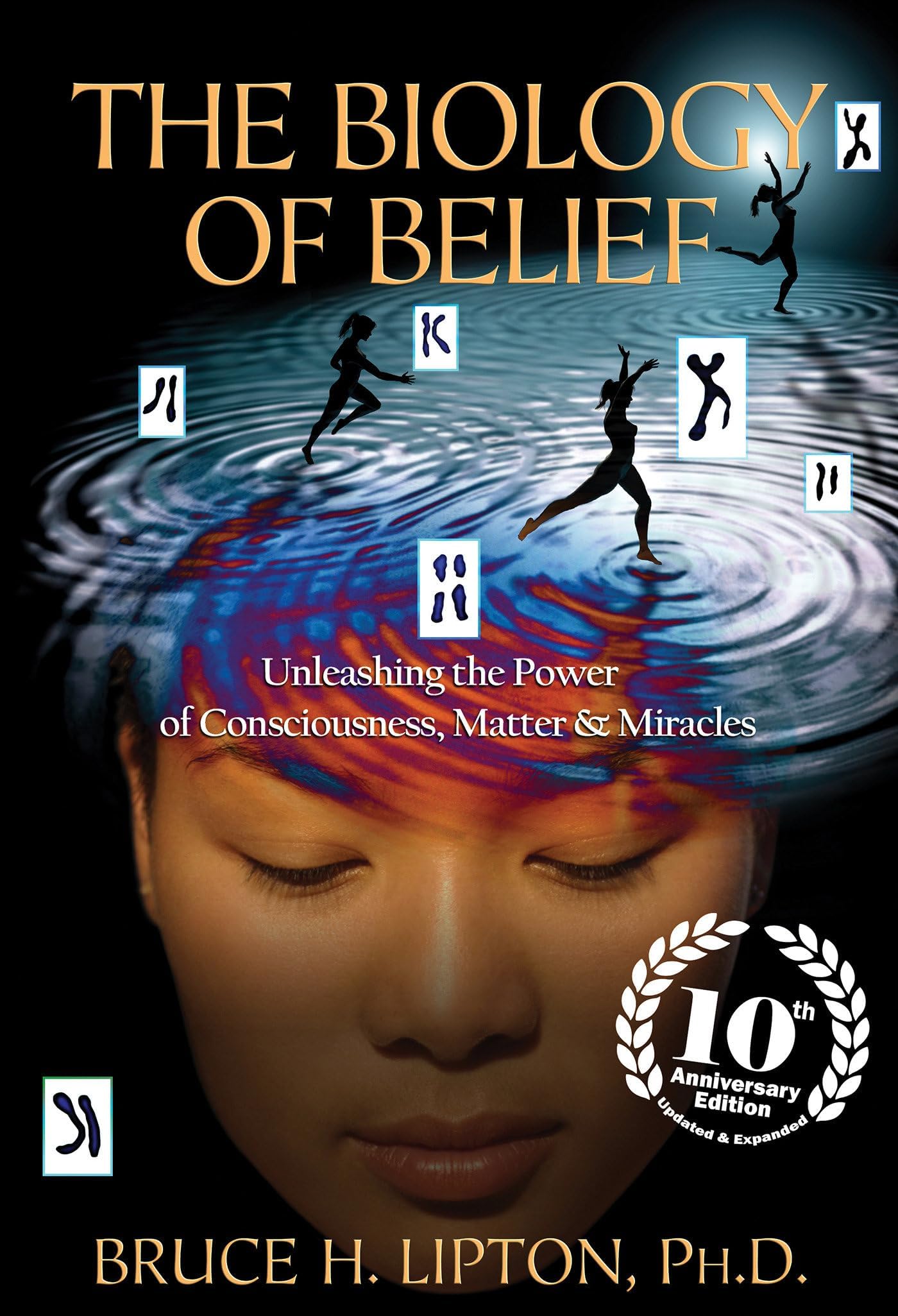
The Biology of Belief 10th Anniversary Edition: Unleashing the Power of Consciousness, Matter & Miracles
Product ID: 34948942
✨Transformative practices
📚300+ pages of insights
🧠Mind-expanding concepts
Desertcart purchases this item on your behalf and handles shipping, customs, and support to USA.
🌟 Transform Your Mind, Transform Your Life!
The Biology of Belief is a groundbreaking book by Dr. Bruce Lipton that explores the intersection of consciousness, biology, and the power of belief. With over 300 pages of research-backed insights, it reveals how our thoughts and beliefs can influence our physical health and overall well-being, offering practical strategies for personal transformation.


| Best Sellers Rank | #6,500 in Books ( See Top 100 in Books ) #2 in Fractal Mathematics #2 in Biology of Mammals #17 in New Thought |
| Customer Reviews | 4.6 out of 5 stars 9,810 Reviews |
N**I
For Many Aspects, It's Really the Book That Could Change Your Perception of the World
I was particularly careful in choosing the words for the title. Writing "it changed my life" might have been something people would have regarded as another review from a guy looking for a direction in life. While we all may be looking for the right direction, one way or the other, there are books that deliver way beyond the expectations you developed after reading the first few pages. After reading Dispenza's "Breaking the Habit of Being Yourself," which largely mentions this book, I felt almost an obligation to buy it. And when I started reading it I thought: "Oh geez, so slow, almost boring, things I have heard many times, here's another waste of time and money." Oh my, was I wrong. So totally wrong! Bruce Lipton has the absolute capacity to really intrigue you while telling a story or explaining a concept that makes total sense, is scientifically accurate and more. The moment we read about his epiphany, it's like being there, with this still young professor, half a world away, struck by the light! But you may be tricked by this review. You may read it like I am saying I like the way this man writes. Which is also true, I do. But the treasure of this book is what it says. It is the ultimate message that focusing your attention on details is absolutely horrifying if it makes you lose the big picture. Explaining we should stop blaming (and cursing) our genes for what we are. And don't even think about surrendering and give up to our laziness is the final message. A message you get after reading this book. Because you need to read it all. Because nowhere in this book you will read "stop blaming your genes and look at the big picture." The book is a journey into the big picture. A journey made out of solid science. A book that will teach you how clever our body is. And how stubborn and stupid it can be if we let it run on autopilot. It is an invitation to tapping into this vast potential, learn how to redirect our attention and our ultimate direction. An invitation to throw away the navigator in your mobile phone and look for the destination using an old style map. Why should we use a map in the gps area? Because whenever you set the destination, the gps will choose for you! It may be useful for a road trip. But not for your life. Read this book. Read it again, and again if you like. Dive into it. Absorb it. It may be the single and most important thing that will change your perception of the world. And, what's most important, of yourself. And the life you want. I will always be grateful to Bruce Lipton for this.
K**R
An Enlightening Read Covering Science & Spirit
As I read Dr. Bruce Lipton’s book The Biology of Belief, I kept asking myself why I hadn’t discovered it sooner. In fact, I wanted to have read this 2005 book way before it was written. I wanted the biology part when I took high school biology in the late ‘70s or even when I took college biology a few years later. I would have wanted to read it again before I decided to get pregnant with my first child. In fact, this is a book that I would have had on my book shelf for frequent reference, so amazing is its message. Cell biologist and medical school professor Dr. Lipton is a crusader, putting into words what has taken him years of experience, study, and assimilation to understand himself. One Amazon reviewer, himself a physician, captures the essence of Dr. Lipton’s message when he wrote, “You can always tell the pioneers---they're the ones with arrows in their backs.” The bone of contention? Lipton’s suggestion (based on science) that the single cell is controlled by its environment not its genetic programming and the medium which controls its environment is the brain. “The mind’s energy (or thoughts) directly influence how the physical brain controls the body’s physiology.” If beliefs are just thoughts that we’ve had over and over, then our beliefs control our biology (whether or not these beliefs are true). Our thoughts produce the chemicals that influence the environment, therefore, our thoughts influence our health and happiness. What I most enjoyed: There are too many aspects of Lipton’s book to pick just one thing. For example, I was delighted to read science-based work that resonated with what I’ve believed for years. Positive thoughts have a healthy impact on our lives. Negative thoughts lead to negative feelings, increased sadness, depression, apathy, and disease. The biology was fascinating, unveiling that the membrane of the cell is the control center and not the nucleus. I love the attention he gave to universal energy and the concept that, “The universe is one indivisible, dynamic whole in which every and mater are so deeply entangled it is impossible to consider them as independent elements.” And, I appreciated his focus on conscious parenting and how important it is that parents teach their children patterns of thinking that will help them discover and grow, versus protective or critical patterns of thinking that will hinder their development and future success. How much did I learn from reading The Biology of Belief? Well, I took 12 pages of notes while reading my Kindle version, and I plan to buy a print copy for a permanent place on my bookshelf.
L**H
Powerful Words. A Must Read.
I think this is one of the best books out there for addressing how important it is for the doctor to get to know what his patient believes about his health. I gave it to my own doctor as a retirement gift. This will make sense to him now that he has finished a long successful career. I think he knew this all along but this wonderful book will validate it. Helpful for providers and patients alike.
C**S
Positive Thinking on a Cellular Level
This book is a fascinating look into biology and teaches the lay person about cells and living organisms. A lot of the information is unorthodox in that it does not follow Newton principles which are the principles which most scientists follow. Dr. Lipton describes how a cell can flourish given its environment, and not just on the basis of its cellular embodiment. He then connects this to human beings and explains to us that humans are not a product of genetics as so much they are a product of their environment and how they react to their environment. This ties into positive thinking, and how what your thoughts say you are, is actually what you are. Dr. Lipton is very intelligent and he does a good job of breaking down extremely diffult topics such as organic chemistry. He explains how a membrane can be taken away from a cell, which is considered to be the brain of a cell, and the proteins of the cell can ensure that the cell can live on. Dr. Lipton speaks about astrophysics and explains how not everything that the scientific community agrees upon actually has a concept at this point in time, and how astrophysics can put names to concepts that we do not yet have. He speaks about positive thinking in these terms. There are many interesting concepts in this book. I did not give this book a full five stars because honestly there were some parts of the book which were difficult for me to follow. Science has never been my strong suit, and while Dr. Lipton breaks down cellular biology well, I wish he could have used more analogies as I felt those worked well for me. However, I truly respect Dr. Lipton for taking positive thinking and making it feel as if it should be respected scientifically. This book made me feel as if it should be read by all, and this is why I rated it a four. This book is for those what are truly open minded, or who have an interest in cellular science.
M**E
Reminds me of "The New PsychoCybernetics"
This is a good book. It reminds me a lot of Maltz's book "The New PsychoCybernetics ". In in one way this is a better book than Maltz's, Lipton provides updated resources that contribute to the text that are different from what were in his text from ten years earlier. Maltz's book was first published in 1960. The editors of the recent editions have added some updated resources, but the texts also continue to refer to articles from the 1950s from popular magazines. Maltz has been dead for some time and so it isn't his fault . I have thought all along that references to the old articles should be replaced with contemporary resources that confirm the claims of the earlier ones. It is an advantage for Lipton to be able to update his own book. With that said, in some ways I like the PsychoCybernetics books better than this one because they provide exercises for making the changes in programming that Maltz describes. Lipton does a great job of describing the mechanisms of our problems and assures us that physical healing and personal change is possible, but he doesn't go that far into how to change the programming. He does say that simply relying on will power and positive thinking won't usually work. But he doesn't provide well developed alternatives in his book. Instead, he provides a link to resources and to someone else's web page. At that point the book looks like a sales pitch. "The Biology of Belief" is a worthwhile book for someone interested in ideas complimentary to the works of authors such as Wayne Dyer or Owen Barfield. It is good to have a reputable scientist to present ideas similar to Maltz's in his own words because it shows that the earlier works can still be considered seriously, even if Lipton is something of a lone voice or minority view in the medical establishment.
N**H
Wow!
Excellent read! I find the science around our minds fascinating and this book was no disappointment. In fact it is one I have highly recommended to others and now keep in my lending library.
W**Y
Important ideas which will hopefully be taken seriously by "legitimate" scientists
The central tenet of Dr. Lipton’s new theory of biology is that the character of our lives is determined by our responses to the environmental signals that propel life, not by our genetic code. This means that the brain of each cell is not the DNA, but the cell wall. When I first heard a friend of mine propose this idea, my immediate thought was that, yes, it’s the cell wall that must respond to the environment, just as it is our skin and other peripheral sensory organs that must respond to the environment, but it is the DNA that programs our sensory organs, as well as our brain that makes sense of them. Since single cells have no brain, but just the sensing mechanisms of the membrane, so in that sense it is the brain of the cell. On the other hand, even single cells are capable of learning. The DNA cannot react until triggered by something in the environment, and it is the membranes that determine what gets through to trigger gene activity. When a cell has once learned something, it is able to pass that knowledge on to its offspring, as a child that has once had measles is now immune to that disease. This does put Lamarck in a new light. Schrödinger -- in WHAT IS LIFE? -- points out that as the behavior of an organism changes in response to a change in its physical structure, that will in turn affect a change in behavior will affect the genetic code in a way that mimics Lamarckian evolution. So genes store memories, and it is now recognize that genes can even be passed on between different species. The genes of GMOs can therefore alter the character of bacteria in our intestines – upon which our physical and psychological well-being are now known to be dependent -- as well as the wild organisms that these artificially created genes will spread to. In a SCIENTIFIC AMERICAN article I read some time ago, it is because genes spread so easily between species that we need not worry about them spreading into the surrounding communities, as this happens naturally all the time. There is, however, a big difference between acquired and imposed characteristics. It was the failure to acknowledge this important distinction that lead to Lamarck’s theory of adaptive evolution being ridiculed and discredited. Traditional, Darwinian biology denies that consciousness exists intrinsically. Dawkins, in his various books, spends much time convincing us of how blind evolution can lead to such wonders as eyes and wings, but pretty much ignores the complexity of the information that must form in the DNA. Mathematically, it is easy to demonstrate that forming a specific protein, and specificity is critical is astronomically improbable within the lifetime of the universe. When I was in high school I was taught, as an analogy of how such complex molecules could be created by mere chance, that if a horde of monkeys pecked away on typewriters for millions of years they would eventually produce the works of Shakespeare. Any high school kid with a computer can prove easily prove that this is a fallacy. The following two stanzas of one of Shakespeare’s sonnets consists of 82 letters, spaces, and punctuation marks: When in disgrace with fortune and men’s eyes, I all alone beweep my outcast state. Taking repeating characters into account -- there are 14 spaces, e appears 11 times, a appears 6 times, and so on -- the number of permutations can be calculated: 82!/(14!x11!x6!x6!x6!x5!x4!x3!x3!x2!x2!x2!x2!) = 2.2 x 1089 The age of the universe is 13 billion years. Converted into seconds that is 4.1 x 10¹⁷. A trillion monkeys armed with special typewriters able to type one 82-character permutation per second would be able to type 1 x 1012 x 4.1 x 1017 = 4.1 x 1029 permutations since the moment of the Big Bang. So the probability that these trillion monkeys could have typed the correct permutation -- 2.2 x 1089 / 4.1 x 1029 = 5.4 x 1059 -- is one in 5.4 x 1059. In short, information does not come easily. Can we all agree that life, the sort of life capable of writing like Shakespeare, is infinitely more complex than two lines of one of his sonnets? I have had this idea childishly ridiculed a number of times; no one has ever yet responded to it with a mature, intelligent refutation. If conscience has only epiphenomenal existence, then it is not as important as matter. Since life arose haphazardly it can have no purpose. Inevitably, our notion of the nature of life, a perpetual violent struggle in which the riches go to the most violent, forms the basis of our ethical and economic systems. Humans are easily manipulated. Beliefs implanted into us while we are still children form our future concept of ourselves and determine much of our behavior. Our “free will” can only function within these parameters. Impressive evidence of the importance of our beliefs is provided by the placebo effect. Faith in the effectiveness of medicine can cure a disease without the medicine. Unfortunately, we do not know how to control or change unconscious beliefs. Dr. Lipton enthusiastically points to new developments in “energy psychology,” which I know nothing about so cannot comment upon them. But not implanting fallacious conceptions of ourselves in the first place is clearly the better idea.
P**R
Very insightful!
This book provides background and insight into how our beliefs influence our physical nature and circumstances. I’m not a biologist, but Dr. Lipton makes the concepts easy to understand. Additionally, I appreciate the book’s emphasis on what quantum physics is, and what it suggests about the world we live in. The explanations cut against the traditions of mainstream biology; however, Dr. Lipton sheds light upon the breakthroughs in biology that go back to the 1960s and explains why mainstream scientists dismiss them to remain in their comfort zones. I’m open-minded and seek the truth in understanding or our world, so for me this book is a great read that I’ve recommended to friends and colleagues.
M**M
Perfect as described
Perfect as described
H**L
"Empowering Insights into the Mind-Body Connection: A Review of 'The Biology of Belief'"
The Biology of Belief" by Dr. Bruce Lipton is a groundbreaking exploration into the relationship between mind, body, and belief. Lipton challenges the conventional belief that our genes determine our biological destiny, proposing instead that our perceptions and beliefs are powerful influencers of our health and well-being. Drawing on his extensive research in cell biology, he presents a compelling argument for the role of consciousness in shaping our physiology and even our genetic expression. What makes this book truly transformative is its empowering message that we have the ability to change our beliefs and, consequently, our lives. Lipton provides readers with practical tools and techniques to reprogram their subconscious mind and create positive change. His insights into the power of positive thinking, mindfulness, and the mind-body connection offer a refreshing and empowering perspective on health and healing. "The Biology of Belief" is a must-read for anyone interested in understanding the profound impact of belief systems on our health, happiness, and overall quality of life. It is a revolutionary guide that empowers readers to take control of their own health and well-being through the transformative power of belief.
L**A
is very good and easy to read
is very good and easy to read
D**O
Magnífico!
Me fascina este libro. Súper bien escrito y fundamentado.
B**X
Scientific foundation for esoteric beliefs
For quite some time I have been reading about quantum medicine and such and also went to a healer for the first time. But still I am very critical towards these issues. The book offers a good scientific foundation to a lot of these beliefs and the author leaves it up to you what you want to believe in. There is no religion of any sort behind it and a lot of statements he makes make much sense to me.
Trustpilot
1 month ago
3 days ago