

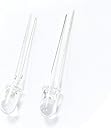


HiLetgo 20pcs 5MM Photo Transistor Phototransistor PT334-6C Photo Transistor Phototransistor Round F5 3V
Product ID: 337018099
⚡1.3-1.5V operating voltage
📏5mm compact size
🔆400-1000nm light sensitivity
Desertcart purchases this item on your behalf and handles shipping, customs, and support to USA.
🔍 Illuminate your projects with precision and power!
The HiLetgo 20pcs 5MM PT334-6C phototransistors offer a reliable, low-voltage solution for light sensing across a wide 400-1000nm range. Compact and clear, these 5mm sensors come in a convenient pack of 20, ideal for engineers and makers aiming to prototype or scale light-sensitive electronics effortlessly.
| ASIN | B00M1PMHO4 |
| Age Range Description | Kid |
| Brand Name | HiLetgo |
| Color | Clear |
| Customer Reviews | 4.4 out of 5 stars 128 Reviews |
| Educational Objective | Color Recognition |
| Indoor Outdoor Usage | Indoor |
| Is Assembly Required | No |
| Item Dimensions | 8.9 x 5.8 x 1 centimeters |
| Item Weight | 18 g |
| Manufacturer | HiLetgo |
| Manufacturer Part Number | 3-01-0591 |
| Manufacturer recommended age | 0 - 12 years |
| Material Type | Plastic Metal |
| Model Number | 3-01-0591 |
| Number of Packs | 1 |
| Operation Mode | Manual |
| Power Source | battery |
| Set Name | 20pcs |
| Size | S |
| Supported Battery Types | Batteries required (type not specified) |
| Theme | Silver |
| UPC | 702082657393 |
| Unit Count | 20.0 Count |
M**N
Keine Photodiode sondern Transistor
Ich habe auf die Schnelle eine 5-mm-Photodiode gesucht, und dachte ich wäre fündig geworden. Aber nach Erhalt war auf der Tüte Phototransistor aufgedruckt. Erstmal versucht den genauen Hersteller raus zu finden. Es ist ein EVERLIGHT PT334-6C. Für 'nen Helligkeitsschalter brauchbar aber nicht für einen Helligkeitssensor(transmitter) .
D**D
100% défectueux
Sur 20 LED, 20 défectueux ! Retour .
K**N
Great for Arduino Light Sensor
These work great. I make a voltage divider type circuit with these and a 10K resistor. I chose these over photoresistors for ambient light sensors for 2 reasons. The first is that since these are the shape of standard 5mm leds, they can be mounted in an enclosure using 5mm led holders which makes them easy to mount in enclosures. The second is that these are sensitive to a wide range of wavelengths from infrared to ultraviolet. Now ideally for an ambient light sensor, you only want to measure visible light, but I wanted to be able to use these on other projects like with infrared lasers, so I needed them to detect infrared too. When using touch screens in the car, the sun can hit at such an angle that it’s not really hitting the light sensor dead on, but is casting at an angle on the screen and washing the picture out. So I was hoping with the extra infrared light that the sun puts out compared to indoor lighting, that the arduino could overcompensate and increase the brightness. Overall these work well, mount cleanly, and have a wide range of sensitive wavelengths so these are great little sensors.
A**E
Sono FOTODIODI, non sono "fototransistor" ne, tantomeno, LED.
Sono fotodiodi, esattamente come da titolo della pagina Amazon. Io stesso avevo dubbi prima d'acquistarli, perché la pagina è a dir poco fuorviante se non inesatta. NON vi aspettate che emettano luce, naturalmente. I fotodiodi, al contrario, RILEVANO luce. Vengono impiegati in tutte le applicazioni in cui servano le cosiddette (obsolete) "fotocellule", fotoresistenze. Il loro comportamento è semplice: se la polarizzazione è diretta la resistenza è bassissima (si comportano come consueti, normalissimi diodi), se invece sono connessi con polarizzazione inversa la loro resistenza varia proporzionalmente alla ricezione di luce, e va da circa mezzo megaOhm al buio completo a qualche centinaio di Ohm quando esposti a luce intensa, quindi nei circuiti si utilizzano architetture in cui sono generalmente connessi in polarità invertita rispetto ai normali diodi. Possono essere anche impiegati in applicazioni in cui si rilevi la debole corrente prodotta: i fotodiodi quando colpiti da luce emettono corrente rilevabile da appositi circuiti. Funzionano egregiamente, lo spettro di luce rilevato è ampio e centrato su luce bianca (NON sono fotodiodi sensibili all'infrarosso). Appena arrivati li ho immediatamente montati su circuiti di mia produzione e ho già rilevato comportamento assolutamente corretto e omogeneo (resistenza praticamente quasi identica tra tutti i fotodiodi del pacchetto nei miei dispositivi con luce LED fissa, di rilevamento materiali e logica contapezzi. 5 stelle meritate.
D**K
NOT a photodiode but a phototransistor
A photodiode generates a voltage even when not externally biased: if you just put the leads of a voltmeter on it and shine light on the device you will see a few tenths of a volt. It is like a miniature solar battery. Not so with these guys, which require a bias of a volt or so to put out a photocurrent. The attached I-V curve is typical of a photo transistor under illumination. Given that, the devices do work well as light sensors as long as you bias them. And the price is right!
Trustpilot
1 month ago
1 month ago