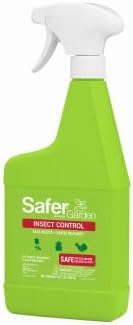


Safer Brand 5110-6 Insect Killing Soap, 32 oz.
Product ID: 331883615
Details
- BrandSafer Brand
- ScentFresh
- Item volume32 Fluid
- Material featuresOrganic
- Item formSpray
🌿OMRI-listed organic formula
♻️Breaks down in 7-10 days
🛡️Targets 15+ common pests
🌱 Defend your garden organically—because your plants deserve the best!
Safer Brand 5110-6 Insect Killing Soap is a 32 oz. OMRI-listed organic insecticide that targets over 15 common garden pests without harming beneficial insects. Its potassium salt formula breaks down naturally within 7-10 days, making it safe for use on indoor, hydroponic, and outdoor plants, even up to the day of harvest. Ideal for professional gardeners seeking an eco-friendly, effective pest control solution.


| ASIN | B000BQL8UY |
| Best Sellers Rank | #128,660 in Beauty ( See Top 100 in Beauty ) #1,204 in Hand Wash |
| Brand | Safer Brand |
| Brand Name | Safer Brand |
| Customer Reviews | 4.2 out of 5 stars 2,871 Reviews |
| Global Trade Identification Number | 00024654551107, 10024654551104 |
| Item Form | Spray |
| Item Weight | 1.3 Ounces |
| Item form | Spray |
| Item weight | 1.3 Ounces |
| Liquid Volume | 32 Fluid Ounces |
| Liquid volume | 32 Fluid Ounces |
| Model Number | 5110-6 |
| Part Number | 5110-6 |
| Special Features | scented |
| Target Species | Insects |
| Target species | Insects |
| UPC | 024654551107 038241917207 024654550025 |
| Unit Count | 32.0 Milliliters |
| Unit count | 32.0 Milliliters |
T**R
SAVED MY SUCCULENTS FROM MEALY BUGS!
This review is specially written for Cactus and Succulent lovers everywhere who have watched helplessly as their echiveria and aloes were devastated by the scurge of Mealy Bugs. I was desperate when I saw my favorite Aloe infested with the marshmallowy-cotton candy like-toothpaste goo that is the telltale sign of a MEALY BUG INFESTATION. I was amazed that no traditional off-the-shelf pesticide even mentions mealy bugs, let alone kills them. So when I found this product on Amazon I read every review, but didn't find many of them helpful. The product label says it works on half a dozen insects on a variety of plants, so when a reviewer simply says, "It works!" without saying what it worked on, I still wasn't sure if it would help me in my particular situation. Taking a leap of faith, I purchased Safer Brands Insect Killing Soap, prayed to the Cactus Gods and baptized my beloved aloe with its cleansing concoction. And I can say without equivocation that it absolutely works without harming the succulent leaves. I waited 4 long months before writing this review to make sure my succulent survived the summer. Succulent collectors are not like other plant lovers. And succulents are not like other plants. Their leaves do not stick out from the stem by a thin shaft like the leaves of a tree. The fleshy leaves of an aloe actually envelop the shaft of the stem itself, winding their way up and around the stem like a spiral staircase - only much more dense. Making matters worse, mealy bugs don't just attach themselves to the surface of the leaf - they burrow deep inside, all the way back where the leaf wraps around the stem, destroying it from the inside out. So when it comes to succulents, by the time the first fleshy leaf starts to wither and die a lot of damage has already occurred. And by the time I got on top of my infestation, many of the leaves were already too far gone, dying from the bottom up - level after level turning black, shriveling and then falling away. I would like to share my method of applying the product, in the hope you learn from my mistakes. The first thing I did was to remove as many of the mealy bugs with water. For a serious infestation, I didn't want to simply spray on the soap if I could actively remove the larger gobs of mealy bug goo myself. So I painstakingly sprayed almost every leaf with the water nozzle, dislodging most of the visible mealy bugs. I then waited for it to dry and then sprayed the Insect Killing Soap everywhere - making sure to separate the dense thick leaves to spray between them all the way back to the stem. After two days I once again used the hose and sprayed it clean again, discovering more pockets of mealy bug resistance. After it dried, I once again applied the Soap. When I could no longer see any mealy bugs I sprayed it lightly every other day for a week. And then began the long waiting game - hoping that the upward spiral of dying leaves would stop. After several weeks, the leaves were still dying even though I couldn't see a single mealy bug. I thought this would continue until all the leaves were gone, but after the 3rd ring of aloe leaves shriveled up, the dying finally stopped. The aloe stabilized and thrived for the rest of the summer. As it enters its winter dormand phase, it still looks great without a single additional dead leaf. After much contemplation, I think I figured out why I lost several more layers of leaves even after the infestation was eradicated. In my desire to dislodge as many mealy bugs as possible with the hose, I think I sprayed the water with too much force. In my zeal to blast away the sticky goo, I may have partially dislodged several rows of healthy aloe leaves by aiming the nozzle directly at the stem with too much force. I was just so scared the product wouldn't work or that I'd miss a hidden patch of mealy bugs that I over did it. So now that you know with certainty that you can trust this product, use the hose or water bottle gently and help your beloved succulent thrive for years to come. Good luck to you all. Now go save your succulents! *SPECIAL NOTE FOR BLUE ECHEVERIA (e.g. Echeveria imbricata) On select species of echeveria, you will notice what appears to be a thin translucent waxy film that gives them their bluish tint. This is called pruinescence. When spraying Safer Brand Insect Killing Soap on such plants, you will inevitably wash away this powdery film turning the once blue echeveria a pale green. From my experience, this color change is permanent but will not otherwise harm the succulent. Unfortunately, they lose some of their beauty when this happens (in my opinion), but the only alternative is a dead blue succulent. The only solution is to catch the infestation early and apply the product sparingly to the stem and beneath the petals to preserve the color. If I find any alternatives I shall update this post. UPDATE REGARDING CONCENTRATION OF ACTIVE INGREDIENT BETWEEN PREMIXED 32oz BOTTLE AND CONCENTRATE Amazon also sells a concentrated form of this soap that is significantly cheaper by volume. In looking at the two products, I noticed a significant difference in the concentration of the active ingredient. In short, the ready-to-spray bottle has 2% of the active ingredient, but if you follow the instructions on the concentrate bottle, you will end up with a 1% solution. Several reviewers say that the soap killed their plants, so if you have sensitive plants or are concerned about the effect of this soap on them, you can dilute this premixed product with an equal part of water and still get results. I contacted the company and got a response back. The following is my question and afterwards will be the response from Safer Brands. QUESTION: Dear Safer Brands, There seems to be a big difference between the dilution ratio of the concentrate when compared to the ready-to-spray bottle. The premixed 32 oz. bottle says it contains 2% of the active ingredient (potassium salts of fatty acids) by weight. So for every 98 oz. of water, you would need 2 oz. of the PURE active ingredient. BUT, the concentrate is NOT 100% pure active ingredient. It is 50% active ingredient. So in reality, for every 96 oz. of water, you would have to add 4 oz. of this concentrate to get the same 2% ratio of active ingredient as the premixed bottle. But you instructions recommend adding 2 oz. of the concentrate for every 100 oz. of water, giving you a 1% ratio. I received the following response from Safer Brands: Thank you for contacting Safer® Brand. We are happy to provide more information on our products. Your calculations are correct that the Ready-to-Use has 2% active ingredients while the concentrate has 1%. We did efficacy testing when creating the concentrate and found that a 1% active ingredient is very comparable and has the added benefit of being more gentle to plant species that are more sensitive.
M**W
I'd recommend it to anyone with spider mite issues!
The good: I had a pretty serious infestation of spider mites on my MOSO Bamboo plant in the house. Spider webs and mites could be seen on all the leaves. I neglected the plant for a few months thinking I could take care of it with rubbing alcohol and dish soap spray. Since using this product, 5 applications, I have yet to see any alive spider mites. My plant is damaged quite a bit with spotty leaves but from what I see, this stuff knocked it right out! I'm sure I'll have to use this product repeated times to fully eliminate my spider mite issue but from what I've seen so far, I'm very impressed. The bad: Smells. I'm not sure if people have a stuffy nose or something when they use this product but it does give off an odor. It's not terrible but it's definitely noticeable. If you use it indoors I suggest using it in a bathtub or garage where your over-spray won't get on important things. It will leave a residue on surfaces. Also, I used this product indoors in an apartment. It will cause some minor respiratory irritation. I suggest wearing a mask if you intend to spray in a confined area. Don't be surprised if you feel a burning sensation in your nose when using this product. The Bottom Line: I'd purchase this product again if I had another bug issue on my plant. Don't be afraid to use the product very liberally since it will kill on contact, if you don't spray enough, it won't work.
D**O
Kills lubbers
I have been looking for something pet-friendly to kill these damn grasshopper lubbers. This product works. It doesn’t work immediately, so initially I thought it wasn’t working, but after a few minutes the product took effect and they died. My only critique is I expected the sprayer to have the traditional two settings with a direct spray (missing) in addition to the wide spray. With these lubbers, you really have to saturate them so this made it a little harder. This is the reason for the four stars but the product itself gets five.
M**E
Does the job and smells nice too!
I bought this after my wife noticed some Japanese Beetles on one of our Oak Leaf Hydrangeas. They were actually living in the flowers so I needed something to get rid of them. Most of them were caught by the traps that I have on my property but there was still a number of them inhabiting the plant. I don't like using harsh chemicals so I gave this a try. So far it seems to be working well. I sprayed the Hydrangea on Monday and by Thursday I noticed the population of beetles was significantly lowered. And I don't believe that this affects any pollinators but I could be incorrect so make sure to ask an expert or research online. I also like this better than neem oil because it has a pleasant smell. Sometimes neem oil can be overpowering and it kills pollinators as well. One drawback is that you'll need a good amount of this stuff if you have a lot of plants so if you plan on controlling a large infestation I would recommend purchasing more than one bottle. Overall a great product that has worked well for me so far.
R**T
some of my plants died
It seemed to work as we got rid of a lot of grasshoppers, They slowed down but did not die. We had to catch them, put them in a plastic bag and throw them away. They die if you cut them in half but very hard to do. Some of my plants did not make it
Trustpilot
2 weeks ago
2 weeks ago