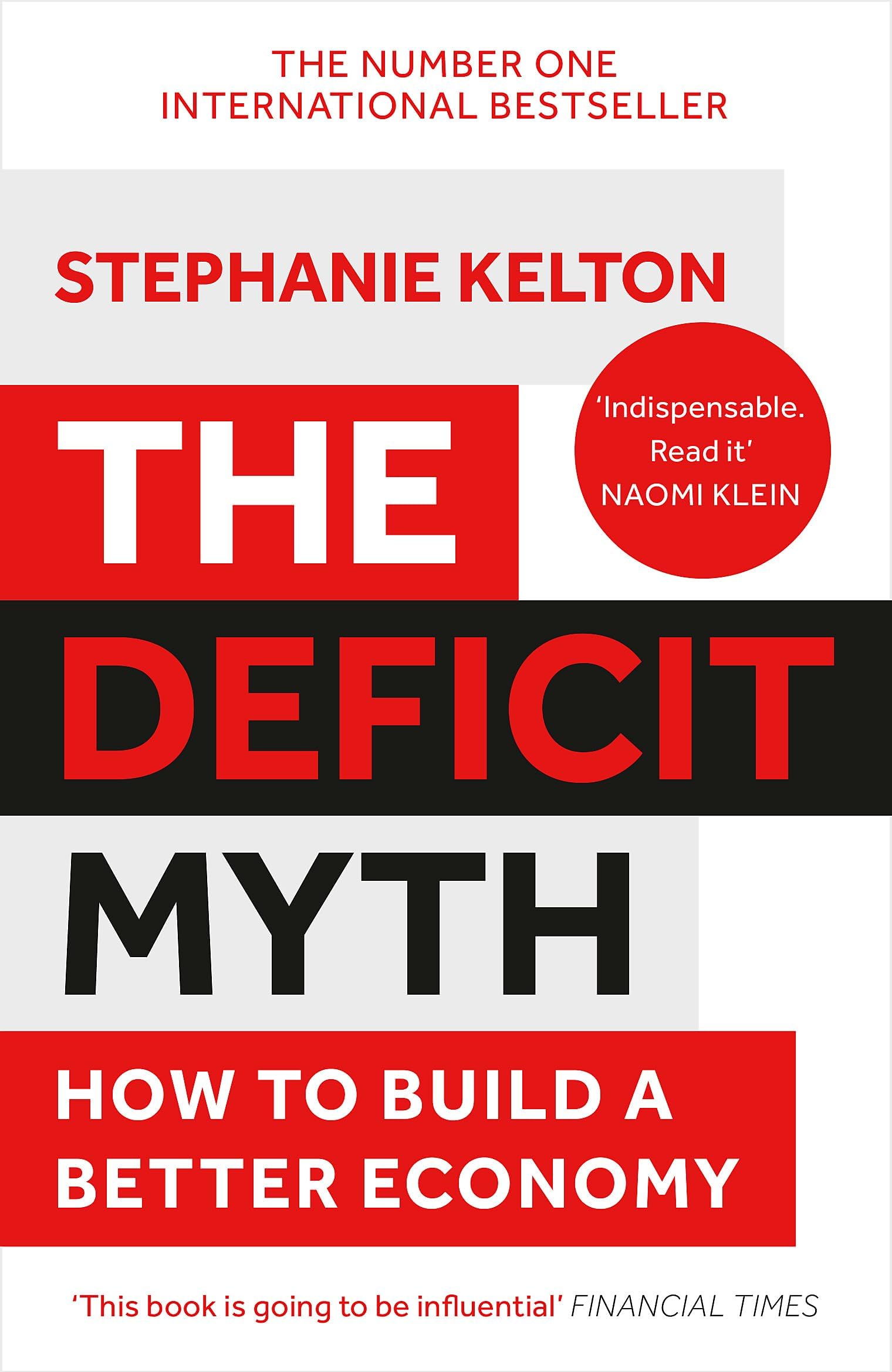
John Murray Publishers Ltd The Deficit Myth: Modern Monetary Theory And How To Build A Better Economy
Product ID: 331064959
Desertcart purchases this item on your behalf and handles shipping, customs, and support to USA.
Buy John Murray Publishers Ltd The Deficit Myth: Modern Monetary Theory And How To Build A Better Economy by ستيفاني كيلتون online on desertcart.ae at best prices. ✓ Fast and free shipping ✓ free returns ✓ cash on delivery available on eligible purchase. Review: Edit added Oct 2023: I want to temper my previous remarks with regard to Warren Mosler's role in the development of MMT economics and raise my rating of Kelton's marvelous book to five stars.. Mosler is a very important contributor and influencer. After considerable research I believe now that he was perhaps a key person in the unraveling and understanding of opaque Central Bank-Treasury operations that can be boiled down to facts expressed as identities that underlie MMT. I'm now confident that Warren Mosler's fully belongs to be included in the list of important contributors to MMT economics and remains among the most important influences. I therefor wish to apologize to both Author Kelton and to Warren Mosler for carrying on a bit too much regarding what I thought at the time was an excessive focus on Warren. It was not. MMT economics is the most important development in economics since Keynes invented macroeconmics. It will have profound influence, for the better, in all our lives. It is just a matter of time until older economists see the light and recognize that they were all wrong. I want to caution any reader of few of negative reviews in this book. Theses reviews include critical mis-statements: e.g., reviewer "Yeah Yeah, wrote, " Miss Kelton makes the mistake of equating currency issuance with the creation of money. In advanced modern-day economies, they are not one and the same." Indeed they are not, and any representation that Author Kelton thinks they are is a misrepresentation! She understands well that new money is created by deficit spending and keystrokes. This has nothing to do with "currency" which is simply an alternative form of money supplied freely to banks on order in exchange for debiting their reserve accounts.. There is no money creation or destruction in this, just a change of form from digital to tangible... Several reviewers did not understand, and therefore confused, "inside money" created when banks make loans, with "outside" money created by the Fed when it prevents a Treasury check from bouncing. MMT economists do not confuse inside and outside money. These mistaken reviewer's knew banks create most of what we call M2 Money supply by making loans, but did not read carefully enough to realize when Kelton was referring to the money government creates through deficit spending. In any case, it is those reviewers who are confused, not Kelton. And she was so clear in her presentation that their is no reason for the reader to be confused. This is a beautifully written book that has the potential to bring correct understanding of government finances to millions who have no background in economics. Sadly there is one misstep that needs correction in subsequent additions. I am myself a serious student of economics, I am also a Ph.D. in another field. Correct attribution is critical to all engaged at intellectual boundaries. On, or about page 23, Kelton says plainly that Warren Mosler "is considered the father of MMT because he brought these ideas to a handful of us in the 1990s." It may have been Mosler who first put three capital letters together to form "MMT," and it may have been Mosler who first opened the eyes of a young Kelton, but that does not make him "the father of MMT." The danger here is that some careless reader from the media will paraphrase, and report Mosler as "the father of MMT." This could do a horrible disservice to Lerner, Minsky, Wray, Mitchell, and all those others who, before Mosler was born, laid the foundation, and others who came later and together with Mosler worked out every detail of what we now refer to as Modern Money Theory. I am a strong proponent of correct attribution. It disturbs me no end to hear Mosler described as "the father of Modern Money Theory." A correct attribution would in no way subtract from Mosler's important contributions. Would that author Kelton had written instead , " [We] considered him." Nevertheless, Stephanie Kelton's book is a magnificent accomplishment in that it is readable by the non-economist, and makes the truth clear. A country such as the United States, does not borrow and has no national debt. It has deficits, and these can be too big, to small, or just right. What appears to be borrowing , e.g., the auction of Treasury Bonds by the Treasury, is simply the exchange of one kind of Treasury obligation, money, for another kind of Treasury obligation,i.e., the promise to pay money, plus interest, in the future. The money itself is a creation of government, its value derives from public trust, the public's tax obligations, and economic productivity. Review: great book and written in a very accessible way. I wish every politician would read it.
| Best Sellers Rank | #11,089 in Books ( See Top 100 in Books ) #6 in Business Infrastructure #8 in Macroeconomics #14 in Money & Monetary Policy |
| Customer reviews | 4.6 4.6 out of 5 stars (2,059) |
| Dimensions | 12.8 x 3.2 x 19.8 cm |
| Edition | 1st |
| ISBN-10 | 1529352568 |
| ISBN-13 | 978-1529352566 |
| Item weight | 246 g |
| Language | English |
| Print length | 350 pages |
| Publication date | 1 January 2021 |
| Publisher | John Murray Publishers Ltd |
C**G
Edit added Oct 2023: I want to temper my previous remarks with regard to Warren Mosler's role in the development of MMT economics and raise my rating of Kelton's marvelous book to five stars.. Mosler is a very important contributor and influencer. After considerable research I believe now that he was perhaps a key person in the unraveling and understanding of opaque Central Bank-Treasury operations that can be boiled down to facts expressed as identities that underlie MMT. I'm now confident that Warren Mosler's fully belongs to be included in the list of important contributors to MMT economics and remains among the most important influences. I therefor wish to apologize to both Author Kelton and to Warren Mosler for carrying on a bit too much regarding what I thought at the time was an excessive focus on Warren. It was not. MMT economics is the most important development in economics since Keynes invented macroeconmics. It will have profound influence, for the better, in all our lives. It is just a matter of time until older economists see the light and recognize that they were all wrong. I want to caution any reader of few of negative reviews in this book. Theses reviews include critical mis-statements: e.g., reviewer "Yeah Yeah, wrote, " Miss Kelton makes the mistake of equating currency issuance with the creation of money. In advanced modern-day economies, they are not one and the same." Indeed they are not, and any representation that Author Kelton thinks they are is a misrepresentation! She understands well that new money is created by deficit spending and keystrokes. This has nothing to do with "currency" which is simply an alternative form of money supplied freely to banks on order in exchange for debiting their reserve accounts.. There is no money creation or destruction in this, just a change of form from digital to tangible... Several reviewers did not understand, and therefore confused, "inside money" created when banks make loans, with "outside" money created by the Fed when it prevents a Treasury check from bouncing. MMT economists do not confuse inside and outside money. These mistaken reviewer's knew banks create most of what we call M2 Money supply by making loans, but did not read carefully enough to realize when Kelton was referring to the money government creates through deficit spending. In any case, it is those reviewers who are confused, not Kelton. And she was so clear in her presentation that their is no reason for the reader to be confused. This is a beautifully written book that has the potential to bring correct understanding of government finances to millions who have no background in economics. Sadly there is one misstep that needs correction in subsequent additions. I am myself a serious student of economics, I am also a Ph.D. in another field. Correct attribution is critical to all engaged at intellectual boundaries. On, or about page 23, Kelton says plainly that Warren Mosler "is considered the father of MMT because he brought these ideas to a handful of us in the 1990s." It may have been Mosler who first put three capital letters together to form "MMT," and it may have been Mosler who first opened the eyes of a young Kelton, but that does not make him "the father of MMT." The danger here is that some careless reader from the media will paraphrase, and report Mosler as "the father of MMT." This could do a horrible disservice to Lerner, Minsky, Wray, Mitchell, and all those others who, before Mosler was born, laid the foundation, and others who came later and together with Mosler worked out every detail of what we now refer to as Modern Money Theory. I am a strong proponent of correct attribution. It disturbs me no end to hear Mosler described as "the father of Modern Money Theory." A correct attribution would in no way subtract from Mosler's important contributions. Would that author Kelton had written instead , " [We] considered him." Nevertheless, Stephanie Kelton's book is a magnificent accomplishment in that it is readable by the non-economist, and makes the truth clear. A country such as the United States, does not borrow and has no national debt. It has deficits, and these can be too big, to small, or just right. What appears to be borrowing , e.g., the auction of Treasury Bonds by the Treasury, is simply the exchange of one kind of Treasury obligation, money, for another kind of Treasury obligation,i.e., the promise to pay money, plus interest, in the future. The money itself is a creation of government, its value derives from public trust, the public's tax obligations, and economic productivity.
R**R
great book and written in a very accessible way. I wish every politician would read it.
R**Y
O tema é polêmico e importante. O livro é dos mais relevantes nesta linha de pensamento. Mas parece propaganda. Eu esperava um texto mais técnico. Difícil de ler se você já não concordava antes de começar.
M**S
According to MMT, the sky is green
W**U
This is a good book
Trustpilot
2 weeks ago
3 weeks ago