Buy anything from 5,000+ international stores. One checkout price. No surprise fees. Join 2M+ shoppers on Desertcart.
Desertcart purchases this item on your behalf and handles shipping, customs, and support to USA.
๐โโ๏ธ Elevate every stepโyour ultimate GPS running companion!
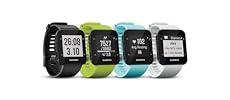
The Garmin Forerunner 35 is a sleek, easy-to-use GPS running watch featuring wrist-based heart rate monitoring, smart Bluetooth connectivity, and up to 9 days of battery life. Designed for runners and active professionals, it offers accurate distance tracking, smart notifications, water resistance, and seamless integration with Garmin Connect for community challenges and progress sharing.


| ASIN | B01KPUHBK6 |
| Additional Features | Bluetooth |
| Are Batteries Included | Yes |
| Audio Output Mode | Digital |
| Battery Average Life | 9 days |
| Best Sellers Rank | #33,048 in Electronics ( See Top 100 in Electronics ) #19 in Running GPS Units #287 in Activity & Fitness Trackers |
| Brand | Garmin |
| Built-In Media | Charging/data clip, Forerunner 35, Manual |
| Compatible Devices | Smartphone |
| Compatible with Vehicle Type | Bicycle |
| Connectivity Protocol | Bluetooth |
| Connectivity Technology | Bluetooth, GPS |
| Control Method | Touch |
| Customer Reviews | 4.5 out of 5 stars 15,033 Reviews |
| Display Type | 128 x 128 pixels, Digital Display |
| Human-Interface Input | Buttons |
| Item Dimensions L x W x H | 1.4"L x 0.5"W x 1.6"H |
| Item Type Name | Running watch |
| Item Weight | 0.04 Kilograms |
| Manufacturer | Garmin |
| Map Types | Worldwide |
| Memory Storage Capacity | 1 GB |
| Mfr Part Number | 010-01689-00 |
| Model Name | 010-01689-00 |
| Model Number | 010-01689-00 |
| Model Year | 2016 |
| Mounting Type | Wrist Mount |
| Operating System | Android, iOS |
| Resolution | 128 x 128 |
| Screen Size | 1 Inches |
| Special Feature | Bluetooth |
| Sport Type | Running |
| Supported Satellite Navigation System | GPS |
| Touch Screen Type | Capacitive |
| UPC | 753759161927 |
| Unit Count | 1.0 Count |
| Vehicle Service Type | Bicycle |
| Warranty Description | 1 year limited warranty |
M**R
Excellent overall with better than average wrist HRM. Great for walking!
While I was in the military from 1895 till 2005 I was in excellent shape. I was doing about 4 hrs of progressive weight training/week and getting 7.5 hrs/week of very high intensity cardio. When I retired, I was probably in the best physical condition of my life, at 6% body fat. I was 51, then. After I retired, for the first few of years, I maintained a gym membership and kept up my training. By 2010, I was working in my consulting business, and I began teaching part time at a local university. More time on my ass and less time in the gym. In 2013, I began teaching full time, and I became almost totally sedentary. About the only exercise I was getting was walking across campus between classes. Just before Christmas, I calculated my body fat percentage using the Navy method. At 5'8" and 178 lbs I found myself to be 29% body fat and obese! That did it for me. I realized I had to start to get back into shape, and I realized that it would be a lot harder now at 65 than it was when I was in my 20s. I have never been much of a distance runner/jogger. In the Navy, I ran my 3 miles a year for my two physical readiness tests, and that was about all the running I actually did (even though I was a sprinter in college). It also occurred to me that I probably just couldn't jump on a Stairmaster, and workout at 175 bpm heart rate for 90 min, either. So, with the recommendation of my internist, I decided to start increasing my activity by walking. We live in a subdivision on a street that is an oval of exactly 1/2 mile in length (I drove around it eight times and it really is exactly 1/2 mile). I started walking around my street on Dec 26. I started going around twice (i mile), then I increased the distance by a lap a day, until I was up to 10 laps on Jan 3 (I took Jan 1 off). Since then I had been walking between 8 and 10 laps daily, trying to increase my pace as I went. Somehow, I knew I wasn't getting enough feedback from just the mileage/time calculations. Back when I was working out in gyms, I always wore a chest strap, with one of the more advanced Polar watches. Now that it is over 10 years later, I explored more modern technology, in the age of FitBit and Apple Watches. Actual review starts here: One of the first decisions I made about getting an exercise watch, was that it would need to have GPS, since I have resigned myself to a walking regimen until I get my weight under control, and I regain some of my cardiovascular endurance. I also wanted a watch that used ANT + as its transmission system, because I knew that at some time I would want to add a chest strap for more accurate heart rate measurements (I purchased a Powr Labs strap that arrived today, more about that coming up). I also wanted the watch to be water resistant enough to allow me to swim (This is south Florida, and in the summer, it is a lot easier to do laps in a pool than it is to even walk, and by Summer, I will probably need to change to an activity that will allow me to increase my heart rate above the aerobic zone). The final thing was that the watch needed to be easy to read in a number of different lighting conditions. As I was purusing the various devices here at Amazon, I was immediately struck by the Garmin watch. Ergonomically it appeared to fit exactly the way I would want a watch to fit (I haven't worn a watch in over 20 years), and the way the contrast is set to make the LCD display easier to read with more intense light, it appeared to be perfect for outdoor use in Florida. After reading a number of reviews, that suggested it was a good watch (but not great) at $200, I figured that for under $100 it was probably more than enough to satisfy my needs. The watch came the other day, and I spent about two hours reading the manual and playing with the features. I took the watch outside, selected the "Walk" activity and the watch set the time and date through the GPS signal (None of the Polars I had previously owned did anything like that, and the most annoying thing about those watches was setting date and time). Yesterday was my first day actually using the watch. Before I left for school, I did four laps around my street, and sure enough, the watch registered 4.1 miles ( I stopped it after walking up my driveway). It also had my HR average at 122 bpm, which seemed reasonable to me. At school, the class I taught yesterday was in the library, which is about a half mile from the building in which I have an office. Since "walking" is to be my fitness thing, I walked to and from class from my office building. After I got home, I walked another two laps around my street. After dinner, I synched the watch to my iPhone. After the synch, all of the activities I did since I began wearing the watch were displayed. I guess I'm still fascinated by the GPS thing, and when I tapped each of the saved exercises, I was treated to a GPS map of my actual walking path. The repeated oval around my street wasn't too interesting, but at school I took two different paths to and from the library, and it was very cool to see them clearly defined on the map display. Today is my day off from school, so this morning I set out walk my 10 laps around my street oval. Just before I left the house, the Amazon Prime truck arrived dropping off Powr Labs ANT + chest strap. I took some time to synch the strap to the watch, and then set out on my walk. I walked eight laps, then paused to remove the strap so that I could proceed with just the watch measuring my HR, so I could make some "in the ballpark" comparisons. After two more laps, I went into the house and synched the watch to the iPhone. Of course, I got the same boring GPS map of the "circle" on which I live, but the thing I was most interested in was how close the average HR measurements were between the watch and the chest strap. For the chest strap, the eight lap HR average was 130 bpm (I try to walk at a little over 3.5 mph pace), and the two lap average for the watch alone was 132 bpm. As far as I can tell, the physiological variables were probably more noisy than the actual differences between the measurements, and, at least for my wrist physiology, the watch is probably "close enough for Government work". So, in conclusion, all I can say is that I really love this watch. It does way more than I really need it to, and things I need it to do it does exceptionally well. If you are a competing tri-athlete, you may need something more powerful and complicated, but for me, and I'm sure the many people who want to invest in a product that will help get them off there asses, for the cost, there really isn't a lot that competes well with the Garmin Forerunner 35.
B**K
Great watch for the price.
Synopsis: Overall, this is a good, basic running/ fitness watch that makes a nod at also being a smart watch. There is nothing flashy here. The watch doesn't do color, just back and silver/white on the display. For those who have used or who remember the traditional Kindles, this is actually pretty nice in terms of contrast as it is easy to ready in low light and high light conditions. In the dark, you still need the light from the lighting button. Unless you are a pro/ elite level runner who will use the advanced features of the higher end watch offerings from Garmin or their competitors, or are someone who doesn't mind paying an absurd amount for a the latest tech gadget, this watch is more than adequate when paired with external sensors such as the HRM Run. As you read this, please bear in mind that I haven't had the opportunity to run the higher end models, so my only points of comparison are the spec sheets and the price points. I will try to avoid providing second hand anecdotal evidence for or against them. What's Good: -- The weight. This watch is very light. Unlike my dive watches and other larger, necessarily robust watches, this guy is light enough that I don't feel a need to take it off to type or when doing wood work (both activities that involve repetitive motions that become annoying with larger watches on. For those who mind having something heavy on your wrist during a run, that won't be an issue with this watch. -- The Band. The silicon band that comes with the watch seems to be robust and is stretchy and comfortable. I have had sport watches in the past that became uncomfortable in hot conditions after a while as moisture built up under the bands making them itchy or painful. To date, I have had no such problems with this watch. I also like the securing ring on the band which has a tooth on the inside to lock it into one of the fitment holes. The stretchiness is important as you need the watch snug/tight to adequately place the optical heart rate monitor. -- The Smartwatch functions. I don't own an apple watch (which wouldn't work with my phone anyway) or a Gear S3, so I don't have a basis for first hand comparison. However, I have observed the frustration of my friends and family with such devices when trying to use them for input tasks (two way communications with the cellular device.) This watch passes on notifications from your phone, but you have no ability to respond with it. For me, this is the best of both worlds. I get to keep situational awareness while avoiding getting caught up in the minutia of responding with a yet smaller computer interface. This is a personal preference, but I do like the way it works. It is also nice that notifications turn off during a run. -- The interface. The UI (User Interface) is menu driven. It took me only a few minutes to get used to it, so it has to be fairly simple. Overall, it is intuitive once you absorb the designer's logic, you just have to be patient. It does not have a touch screen, so you have to use the buttons. This isn't a problem for me. -- The GPS. Because this is a lower end offering, the watch only uses the GPS constellation and not the GLONASS constellation (Russian GPS). As a result link up times are a little slower and accuracy can be degraded as the US places a mandatory limit on how accurate civilian GPS instruments can be (its a strategic thing.) Overall, this watch isn't too bad. At the end of my recent runs, the watch is generally off by about .03 to .05 miles from my phone which uses both locating systems and you can see the differences in the map. Part of this is, I am sure, due to the frequency of updates which is not user changeable unlike on the higher end devices (I would love to minimize the time between fixes.) -- External Sensors. You can still use external sensors with this watch. I love this feature as I prefer the HRM Run over the watch which has its own accelerometer. This becomes very nice when I'm pushing my daughter in a running stroller. For bikers, you could also use a cadence sensor. -- Movement Tracker. I like to track steps. As a teacher though, I take everything out of my pockets when I get in front of a class so I don't fidget with it, so its nice that the phone will continue tracking for me. Its also nice that it will tell me if I've been sitting too long. This is good for two reasons. Research shows that you start to lose focus and effectiveness after about 50 minutes of continuous concentration, so its a reminder to take a break (the movement bar seems to ping after about 45 to 50 minutes). Its also a great reminder to remain active instead of just sitting there like a lump on a log. -- Battery life. The phone is advertised as having up to a 13 day battery life. I haven't seen it. However, it does seem to last about 5 days with workouts which draw significantly more power than standard operation. -- Charging. The charging of this device is impressive. My first forerunner, the venerable F405, had to charge on a cradle that was poorly designed and didn't positively engage the device. Over time, the connections would degrade and eventually stop working. The new version uses a clip that actively clamps onto the watch. Even with oxidation, it should last a long time. The other part of the equation is the speed of charging. In this aspect, the watch charges very quickly. My personal experience is that a full charge takes less than 1 hour. So if I'm at my desk and notice that my watch is low, I can put it on to charge and have it back on my wrist in time for my next break. What's not? -- User control. The sacrifice you make to get a robust watch is that you sacrifice control. You can still adjust view fields on the exercise screens, but can't change how often the watch takes position fixes which would affect accuracy. There are some other little niggly bits of control that are sacrificed as well, but they are well hidden. Now, that having been said, how much control does the average user really need? If you ask the fruit company, they will tell you not much. -- Accuracy. As mentioned with the pros, the watch is not quite as accurate as I have come to expect from my phone. However, it is within the tolerance of the system so really, how much are you missing? -- User feedback. The watch does not provide the same level of feedback as the higher level watches. Such esoteric values as VO2, Lactate threshold, expected recover time, and foot contact time simply are not measured. Now, here's the thing. If you are an elite level athlete or a professional, or have a personal coach that actually cares about this stuff, you might care. If you are an every day runner or biker out for fitness and fun or a weekend warrior out to train for your local half, do you really need that extra information and will it be of benefit to you? This is a question you have to ask yourself. My answer was clearly no. Now that having been said, the higher end watches all rely on the chest strap sensor to develop those metrics. Would it be possible for Garmin to move the calculation muscle to your paired analysis device (computer or smart phone)? Well, the answer is that there is nothing technically in the way, so clearly it is a selling point for their higher end lines. Will it show up on Garmin Connect in the future? Who knows. -- Limited activities. The watch has limited workout options: Run outdoor, Run indoor, Bike, Cardio, and Walk. If you are looking for something that will track your cross fit WOD, this may not be your baby. Nor is it really designed to track golf, basketball, Frisbee golf, ultimate Frisbee or weight lifting as separate activities. Of course, most of the devices that are built around that desired capability are not reported to work well in that application. If you really want something that has specialized tracking capabilities for a wide variety of sports, by all means, pay for the higher end models. -- Garmin Connect. Perhaps I'm just getting used to it, but Garmin Connect has some issues in the way that it appears on my phone. It tends to be difficult to navigate and can be hard to get it to sync. -- Only two potential watch faces. There are two built in watch faces and there are no options to be able to create your own. This would be worse if I cared more, but I personally like the simple, in your face faces that are standard with the watch. The higher end watches have infinitely adjustable faces. Wrap up. Over all, I am very happy with this watch. It is the rare blend of having most of the features that I wanted and all of the capabilities that I need, while maintaining a reasonable price point without having to turn to the factory reconditioned items that may have been a lemon to begin with. I highly recommend this watch/ fitness tracker. If you don't believe me, check out the consumer reports review of this watch.
A**Y
My accountability buddy
I have been casual about exercise until recently, and I bought the Forerunner 35 to track my progress as Iโve begun to set and achieve fitness goals. I didnโt want a smart watch with all the gadgets and frills, just something that can track my mileage, pace, and heart rate. I love the simplicity of this watch! I can easily access the data on my watch during workouts, and I donโt smear the screen with sweat since there are analog buttons instead of touchscreen features. The Connect app tracks and explains vitals and stats, keeping me motivated. Fantastic battery lifeโI charge it once every 10 days days, but thatโs only because I donโt like dipping too close to a dead battery. The watch screen is like paper white from Kindleโsuper helpful in the sunโbut can be backlit with the touch of a buttonโsuper helpful in the fading light. The watch has alert features that you can customizeโI get a little buzz and notification when I complete my โlapโ of a mile or my steps goal or my calorie goal. The Bluetooth connection to my phone is surprisingly nice, tooโthe watch buzzes only twice when a callโs coming in and gives a notification with the caller name/number, then falls still. Itโs the same with any other notification Iโd receive on my phone. This has helped me if Iโm exercising on call or if Iโm with a client to know if I need to whip my phone out of my belt/bag instead of keeping the ringer on and being paranoid. I also really appreciate that the watch tracks my daily activity even when I havenโt โstartedโ an activity to logโI am still forgetful about starting activities when I begin a workout and the auto tracking helps me at least that same day to look back at my heart rate, pace, mileage. And, even if I havenโt logged an activity, the calendar in Connect app logs my daily steps and heart rate. Anyway, to sum it all up, Garmin Forerunner 35 has become a daily necessity to a woman who has worn an analog watch every day for 10 years and LOVES those analog watches. Itโs become my accountability buddy!
N**T
Decent running watch with a few flaws that you may or may not care about.
After extensive research about different running watch and fitness tracker manufacturers and models, I wore the Garmin Forerunner 35 and the Fitbit Charge 3 on the same wrist for several days and conducted a detailed comparative analysis of their data (think spreadsheets with multiple tabs and graphs). The metrics I looked at included daily resting heart rate, steps, calories, distance, and sleep. I also examined activity data, i.e., distance, average heart rate, average pace, and calories during my runs and dog walks. At the end of the day, the two fitness trackers gave fairly consistent data, with variance usually at or below 5%, an acceptable margin all things considered. However, after this experience, and despite LOVING the Forerunner 35's built-in GPS (which the Charge 3 lacks), I chose to go with the Fitbit for three reasons: 1) The Fitbit has more frequent heart rate sampling -- the sensors measure it every 5 seconds while resting, compared to what appeared to be measurements every minute(?) for the Garmin. I realized this because I noticed that the Fitbit's green LEDs were always on, but they were frequently off (not flashing) on the Garmin and would only come on periodically. Presumably this is to save battery life on the Forerunner. Practically speaking, this meant that stats over a longer period of time (such as average heart rate during a 45-minute run, or resting heart rate for the day) were fairly comparable between the two. But if I wanted to get my current heart rate at a glance, the Fitbit was usually spot on as soon as I looked at the device, whereas the Garmin was sometimes 30 bpm too high or too low. (I am fairly in tune with my resting heart rate so know the Fitbit was accurate in these cases and the Garmin was off -- especially because once the Garmin told me it was 42 bpm, and I know my resting heart rate is more in the high 50s.) Once the Forerunner realized I was trying to look at heart rate data, it would start flashing its LEDs and the number would then either decrease or increase to pretty much match what the Fitbit was showing me from the get-go. This is a minor issue that wouldn't compromise the integrity of heart rate data in the long run -- after all, relative trends over time are what these sorts of devices are best for -- but I got annoyed by seeing incorrect numbers and having to wait 10-15 seconds for the Forerunner to adjust. 2) The Forerunner's sleep tracking wasn't as accurate as the Fitbit. I think this comes down to an issue of sensor sensitivity and/or how algorithms interpret the sensor data on the back end. Basically, the Forerunner was consistently telling me that I was getting anywhere from 20-45 minutes more sleep than the Fitbit every night. I have a good sense of knowing how I feel with N hours of sleep, and I think the Forerunner was overestimating. Further evidence for this hypothesis is that one night, I got up around 4 a.m. to go to the bathroom and check on my dog. The next morning, this few minutes of "awake" time and the steps I took were reflected in my Fitbit data, but not the Garmin data. Basically, the Forerunner somehow missed that I woke up, got out of bed and walked to the bathroom down the hall, walked to the living room, and walked back to bed. The missing steps are not important to me, but how did the device not catch on to the fact that I was awake? Surely it should've picked up on that based on my heart rate and movement. 3) The Garminโs step counting was overzealous. The Forerunner 35 consistently told me I was doing more steps per day than the Charge 3, sometimes only by 200-300 steps but other times by 800-900 steps. Thatโs an almost 10% margin if youโre aiming for 10,000 steps per day. Iโm guessing one reason for this is that the Fitbit allows you to adjust settings in the app for wear on your dominant vs. non-dominant wrist, the former resulting in algorithms that err on the side of excluding movements that may not be steps. Garminโs devices do not appear to have this setting, meaning they are probably overcounting by interpreting some non-step movements as steps. 4) I'm a fairly petite person (5'2", 120 lbs) and the Forerunner 35 was a bit too big for my taste. The screen's length pretty much occupied the entirety of my wrist width, and it was pretty thick too. I occasionally had trouble pulling my sleeves up if my clothes were fitted, such as with long-sleeved base layers -- which I would wear while running, precisely when I wanted to see the watch. Obviously an issue of preference, but I found it mildly annoying. In conclusion, I would say that none of these is a deal breaker if what you really want out of the Forerunner is a decent GPS running watch. Its built-in GPS is truly wonderful, the auto-lap feature is super convenient, and the customizable data fields for workouts are fantastically brilliant. It's uber functional without any superfluous or overly complicated frills, and I especially love that it has the day of the week and date shown on its always-on display. Battery life is competitive, especially for a GPS watch. However, when push comes to shove, I personally prefer more reliable data. I couldn't keep using it and raising an eyebrow every time the information the device gave me didn't match what I know about my own body.
F**H
is a really nice feature. It's quicker to set an alarm
I had a Fitbit Charge HR for two years, actually two of them because the first one fell apart and so did the second one, so I was looking for something that was more durable (and staying away from Fitbit due to their tendency to fall apart). After scouring the internet and reading many reviews, I decided to try the Garmin Forerunner 35. As I've only had it for a week, I cannot speak to its long-term durability, but I've outlined comparisons of many features of the forerunner to the charge hr. Comfort: The Fitbit was cumbersome and often times uncomfortable, especially under long sleeves. I was surprised at how soft and supple the band of the forerunner was and how I nearly forgot I was wearing it. Bluetooth connection: I've found that the bluetooth connection for the forerunner is stronger than the charge hr. It syncs way faster than the fitbit. Alarm: being able to set the alarm right on the forerunner, as opposed to using the app to set the alarm and than sync it for the charge hr, is a really nice feature. It's quicker to set an alarm. GPS: I really love this feature on the forerunner. I have found that it is pretty accurate and it doesn't take too long to locate the GPS. Charge hr doesn't have this feature, which I found frustrating (especially considering similar price points), when I'm trying to gauge an accurate distance for running. I've gone on three runs since I got the forerunner less than a week ago and I feel as though it is accurate in regards to this. Battery life: the Charge HR lasted on average 3 days until it needed to be charged. I got the forerunner last Saturday, only charged it to three bars (out of four), and it is now Friday (6 days later) and I've used the GPS 5 times for short 15-50 minute intervals, and the forerunner still has 2 bars of battery life. This feature is so amazing. I hated having to charge the fitbit so often. Garmin connect vs. Fitbit app: I feel like the garmin app has so many more features than Fitbit. Overall: I am super impressed with the forerunner 35. It seems superior to fitbit charge hr, especially since it is in a similar price point range. The forerunner 35 is perfect for a person who casually runs and wants other fitness data. A more avid runner may want some more features to better track their runner. But forerunner does the job for me (run roughly 2 to 3 times per week and work out 3 to 4 times per week). I haven't checked the waterproofness of the forerunner, but one of my runs was in the rain and it held up great.
P**E
Great watch for basic fitness and great website exercise tracking support
I bought my first FR35 in January 2020 and it lasted about 2 years before I was having to charge it every 48 hours. If you use the GPS a lot it will deplete the battery a bit quicker. When I am just using the treadmill and working out indoors it was still lasting four days. I am now on my 2nd FR35, and just bought its replacement (see reason below). What I really like: It is pretty simple to use and the Garmin Connect website is great to help you see your results and plan your workout. It syncs with MyFitnessPal, which is excellent for meal planning. I use it to plan my Keto friendly meals. And it is a WATCH. I grew up wearing watches and never adjusted to using my phone as a watch. I just automatically look to my wrist when I want to know the time. If you are planning some serious and specific training process and want a lot of stats this may not be your watch, but for most of us it is going to cover your needs. The connect website provides personal records, badges and challenges that help keep me motivated. About the only thing that I don't love is the sleep monitoring. The auto feature is very basic and it will not track naps. If you sleep outside of an 8 hour period during the night, you will need to manually record those hours (if you care). I don't really care that much so it is a little annoying but not a deal breaker. Update Oct. 2024. I bought a replacement Forerunner 35 about two years after the first in 2020. My crystal cracked recently on the replacement but it appears to still be water tight and while noticeable from a side angle, the crack does not really impact viewing. I just bought a 2nd replacement if and when the current one either becomes a charging problem or does go kaput because of water. I tried the Forerunner 55 but it was way too complicated to operate and for whatever reason, was giving wildly low estimates of my distance. I was losing a quarter of a mile in a 20 minute run on a treadmill. Actually reporting I did less distance than the treadmill indicated. The display font is also much smaller so not recommended if you have old eyes like me. So I returned that one. It was $10 cheaper but the complication of using it and accuracy problems led me back to the FR 35. That is the best thing about the FR35 watch IMO, it just keeps track for you and does not become a nuisance.
K**R
Needed to write this review because I can't believe all the negative ones I read before buying this
Before I bought this watch, I researched for months many different running watches before I made my decision. I kept coming back to this watch, but was delaying due to the negative reviews. Let me tell you who this watch is/isn't for. Sidenote I've had an Apple Watch before and I absolutely hated it. People think when they get the watch they will use it to call/text but come on, the screen is so small anyways, I'd get irritated and never use it for those features. The one feature I did like, the sleep tracker, I never used because the watch would die like every day and I'd have to charge it at night in order to use it the next day! Super irritating. Also, mileage was ALWAYS off when running. Like, off by a lot and I could probably have fixed this, but was too lazy to and felt like that shouldn't happen with an Apple Watch. The Garmin watch is meant for a runner. If you aren't such a serious runner maybe running 1-2 miles then I'm sure you can get away with something else but the main reason I needed a watch was to track my mileage and timing ONLY during my daily runs and races. I average around 30 miles per week and so holding my phone while running just wasn't cutting it. I am a millennial and like my technology but I didn't need a damn watch to do all these special features that I had at my disposal before but never used. This was one of the negative comments I kept seeing- how this watch was simple. Well, I just need it to tell me my distance accurately so that's what it's for. Bonus points that it also gives HR continuously and tracks your sleep so to me it's amazing. Also without a touchscreen I don't have to worry about accidentally hitting a button. It's easy and that's all I need. ALSO I only have to charge it like weekly not even that if I actually waited for it to die which I never do. That is huge for me especially after having the Apple Watch. It is GPS acquired and I've run with it on a track and multiple races so I know it's definitely accurate. Had this watch since January and have had no issues. Love when you're done running you can sync the phone easily to come up in the app so you can see everything even in more details. One thing I will address is the pacing. People say the average pace pr mile is slow and takes a while to catch up. While this may be the case, this does not bother me one bit because i've been running for so long I have my pacing down. I'm looking at the time like oh, at 2:00 minutes I am hitting .2, at 3 I should be at .3, for example. I always know what my mile time is going to be around and it's always at that time so this doesn't bother me at all. In summary, while the watch screen may not be like super fancy looking, I've been over the Apple Watch since I got it and this watch literally does what it's supposed to- accurately give you your running distance and time.
J**T
Reliable old standby! Same as it ever was.
This is my 4th Forerunner in 20 yearsโฆthe last one bit the dust during a bike crash. I considered upgrading to a fancier model, with music and an auto pause maybe, and just decided that simpler is better for me. This watch is idiot proof. Youโre only using 4 buttons (and really only 2 mostly). Itโs super easy to start, does a great job of tracking mileage and routes and you can easily view your workouts afterwards. Love the breakdown of HR zones and ESPECIALLY love than an accurate HR is viewable with one touch of a button throughout my day. I always encourage my personal training clients to buy a Garmin versus an Apple Watch when specifically needing a FITNESS watch. No unnecessary junk. I find it comfortable enough to wear at night, but it took a few days initially to get used to. Very accurate on runs and bike rides but I find itโs not QUITE as accurate in the โCardioโ mode if Iโm on the stair master, for example. Other than that, highly recommend!
B**N
Great for weekend warrior types (like myself)
I had a lot of questions about how this watch connects to an ANT heart rate monitor. In case anyone is wondering, it's an automatic connection that usually happens after selecting an activity, but before starting that activity. The screen will flash briefly "HR monitor connected". The optical HR sensor built into the watch stays active before starting the activity and several seconds after the activity starts. When it stops shining green, but you're still collecting HR data, then the ANT HR monitor is connected (there is no icon that shows which HR monitor data is being taken from, this is the only method I've found that lets me know which HR monitor is being used). Pros: * Very consistent daily calorie expenditure (my watch always estimates ~500 calories under how many I should be eating, took a few weeks of weight and calorie counting to get that number) * Tracks all my metrics for my activities and I can view them in Garmin's app / website. * Amazing battery life, usually charge it once a week for an hour. * Great "smart" watch functions. vibrates when I get calls, texts, and emails. Cons: * Randomly, the watch will vibrate and display "GOAL". It does this every day and I have no idea what its talking about. Towards the end of a week it will start displaying things like "GOAL x7". * Very difficult to extract metrics from an activity into a .csv or excel spreadsheet. Need to download third party software that processes a .fit file. The .fit file contains all the data from a specific activity. It's tricky to find the link in Garmin's web page to download this. * I don't trust the step count. It increments when I'm on the bus or driving. Use go up by a lot when I first got the watch. Fast forward three months and it usually counts 1 step for every 5 seconds of motion in a bus/car. * The information on sleeping is a cute, but useless function. Impossible to characterize a person's sleep pattern based on wrist motion, especially if there is more than one person in their bed. Overall: Amazing watch for tracking work outs, counting daily energy expenditure, and notifying you about phones, calls, texts, etc.
M**E
The FONT is huge!
I have gone through about 7 watches and returned them all because when you try to read a message you cant see it. My eyes are good and if I cant see it, no one can! But this watch is awesome, the font is large and the display is a very beautiful smoke grey digital look that is easy on the eyes. This watch keeps me in shape and beeps when I need to get up and start moving to keep those calories off. It receives all notifications from text to whatsapp to phone calls, etc. The app is the best part of this phone as it keeps track of everything and is well designed and professional. If you are a health nut or a jock, this watch is for you. There are a ton of things this watch can be used for but for now, I am just happy getting the notifications. Also, I prefer this not being a touch screen. The screen stays clean and isn't covered with my finger prints and swiping isn't necessary. We do it enough on our phones already. Its awesome!
D**S
รณtimo CxB
UM dos melhores custo beneficio. Marca tudo que voce precisa saber em um treino de bike/esteira/corrida ...e com uma excelente eficacia!
R**H
Difficult to operate.. needs more smooth functioning.
Difficult to operate..needs more smooth functioning.
K**I
Good basic watch for beginner runners
Just started to pick up running 2 months ago and wanted a basic watch to track GPS and pace as my iPhone was not able to track distance accurately. Bought this because of it's price and also compatibility with Nike Run Club app. Works well for me and I'm quite pleased with it.
Trustpilot
1 week ago
2 weeks ago