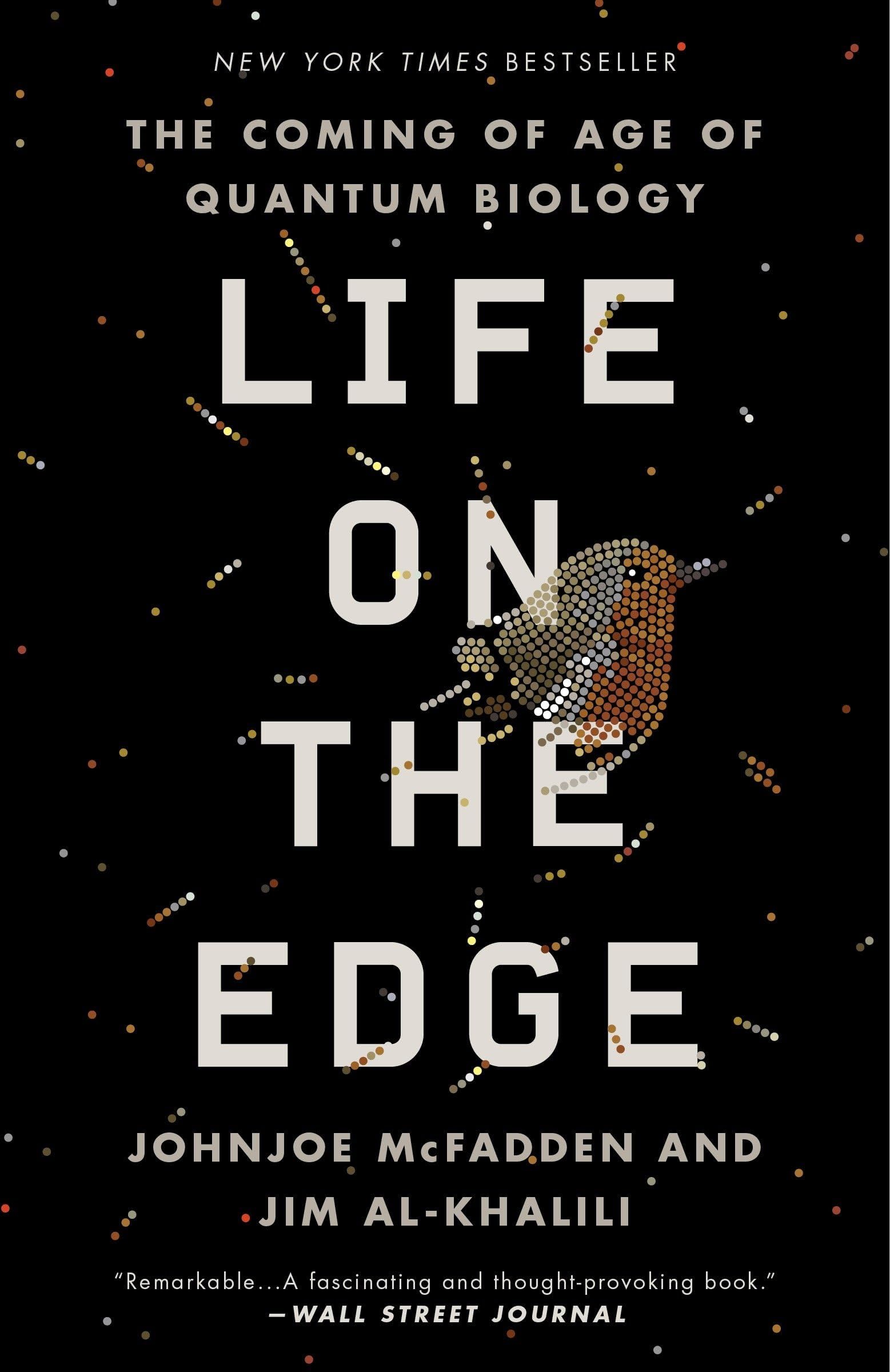
Life on the Edge: The Coming of Age of Quantum Biology
Product ID: 31840094
Desertcart purchases this item on your behalf and handles shipping, customs, and support to USA.
New York Times bestseller • Life on the Edge alters our understanding of our world's fundamental dynamics through the use of quantum mechanics. Life is the most extraordinary phenomenon in the known universe; but how did it come to be? Even in an age of cloning and artificial biology, the remarkable truth remains: nobody has ever made anything living entirely out of dead material. Life remains the only way to make life. Are we still missing a vital ingredient in its creation? Using first-hand experience at the cutting edge of science, Jim Al-Khalili and Johnjoe Macfadden reveal that missing ingredient to be quantum mechanics. Drawing on recent ground-breaking experiments around the world, each chapter in Life on the Edge illustrates one of life's puzzles: How do migrating birds know where to go? How do we really smell the scent of a rose? How do our genes copy themselves with such precision? Life on the Edge accessibly reveals how quantum mechanics can answer these probing questions of the universe. Guiding the reader through the rapidly unfolding discoveries of the last few years, Al-Khalili and McFadden describe the explosive new field of quantum biology and its potentially revolutionary applications, while offering insights into the biggest puzzle of all: what is life? As they brilliantly demonstrate in these groundbreaking pages, life exists on the quantum edge. Winner, Stephen Hawking Medal for Science Communication Review: Fascinating topic, terrific explanations and science writing - "Life on the Edge" is not a reference to "Survivor," but to the authors' argument that an understanding of what life is and how it works may be found at the "edge" between classical/thermodynamic systems and quantum mechanics. In making their case (to borrow from the dust jacket), they bring together "first-hand experience at the cutting edge of science with unparalleled gifts of explanation." In short: A fascinating topic, a lively writing style, and exceptional explanatory skill makes for very good science writing. Prospective readers are presumably as curious as I am about the possible application of quantum ideas to understanding of biological/living systems. The authors' make a clear argument for the significance of quantum biology as the next and essential step in understanding biologic life. They draw on both underlying theory and contemporary research (some of it their own) to show how the quantum world is critical to our understanding of our larger, classical world, and specifically to critical biological processes. Some arguments pertain to increasingly recognized relevance of quantum mechanics to such critical functions as enzymes and photosynthesis; other chapters (e.g., "Mind" and consciousness) are more preliminary and speculative. But even while advocating for the significance of quantum theory, the authors' treatment is balanced, and allows the reader to appreciate what is more solid or more speculative. Overall, an illuminating account of work being done in this area. But what makes the book not just worthwhile but terrific is its outstanding explanation of the underlying quantum "weirdness" that is key to understanding their argument. The authors' skillful use of imaginative and lucid analogies is delightful and effective. As I suspect will be true of many readers, I have read dozens of explanations and considered even more examples of quantum theory and phenomena. This book provides the best (non-mathematical) explanations of quantum theory and its relation to classical and thermodynamic systems that I have read. This is not trivial. Most scientific concepts (even as those in literature and art) are founded on metaphor and analogy: It is simply the way most humans (including the most clever) think most of the time. Before we quantify or translate into provable theorems, mathematical or otherwise, we typically conceive of and fundamentally grasp ideas through imaginative comparison with other phenomena or ideas. The analogies and metaphors employed by the authors are exceptionally cogent and effective, which not only strengthens their arguments in the present case, but are likely to stick with many readers whenever they wrestle with quantum "weirdness." A great service by itself. Review: Very interesting introduction to quantum mechanics in biology - Life on the Edge is an account of the growing field of quantum biology. The subject is to a certain extent in its academic infancy and no doubt will be an increasing focus for academics in the coming decades. In the book the authors outline certain mechanisms that seem to be a consequence of quantum mechanical phenomenon that various species take advantage of but also discuss broadly how quantum mechanics could intertwine with biology. The authors mix their time with familiarizing the reader with the unintuitive aspects of quantum mechanics and using those analogies to discuss how biology might use them. In the process of reading the book the reader will learn about the wave particle duality of nature as well as coherence and the collapse of the wave function. The authors spend time discussing how the messy and dense environment in the cell is an unintuitive arena for wave functions to propagate as most quantum phenomenon that we know of only retain their wave behavior when they are in isolated environments. At the core of the discussion of the likelihood of quantum biology is a high level perspective on how that might happen and the authors discuss how their might be a quantum resonance at the biological level which enhances wave propagation rather than opposes it. The details of this are much beyond the scope of this book and I am quite sure not worked out in any detail by the authors either as they are fairly radical. The authors discuss the criticisms of quantum biology and the reductionist response that inevitably some aspects of biology will be a function of quantum mechanics as Newtonian mechanics is quantum mechanics in the law of large numbers. Some of their response is convincing and some of it is not. In particular the authors discuss how the magnetic compass in birds that are used for navigation have quantum mechanical origin but then in the full discussion it becomes less and less clear that the mechanism is a fact at all. Other aspects of their discoveries seem quite remarkable; in particular the authors discuss how photosynthesis is catalyzed by a quantum walk by the incoming photon and that the speed by which the catalyst works can only be explained by the photon taking multiple paths. The idea of biology using quantum computation is the most interesting idea in the book and it is used in several places. The authors spend some time on DNA replication and how quantum mechanics might have a roll their in frequency resonance but this is a bit vague as it becomes clear there are many different phenomenon at work. The book effectively is a collection of examples of which all of them are at best partially worked out but in reading the chapters the reader gets a sense of what people are working on and the directions they are taking to attempt to provide solutions to biological mysteries. Life on the Edge gives a new perspective to the interested reader on quantum mechanics in biology. It is a new field that will take time to develop and evolve but in reading the book one gets a sense that there is promise in this research and some of the proposed solutions could offer fascinating solutions to how life allows us to speed up combinatorial dynamics that drive evolution. Very interesting book.


| Best Sellers Rank | #176,194 in Books ( See Top 100 in Books ) #2 in Biophysics (Books) #15 in Molecular Biology (Books) #85 in Quantum Theory (Books) |
| Customer Reviews | 4.4 out of 5 stars 1,756 Reviews |
M**E
Fascinating topic, terrific explanations and science writing
"Life on the Edge" is not a reference to "Survivor," but to the authors' argument that an understanding of what life is and how it works may be found at the "edge" between classical/thermodynamic systems and quantum mechanics. In making their case (to borrow from the dust jacket), they bring together "first-hand experience at the cutting edge of science with unparalleled gifts of explanation." In short: A fascinating topic, a lively writing style, and exceptional explanatory skill makes for very good science writing. Prospective readers are presumably as curious as I am about the possible application of quantum ideas to understanding of biological/living systems. The authors' make a clear argument for the significance of quantum biology as the next and essential step in understanding biologic life. They draw on both underlying theory and contemporary research (some of it their own) to show how the quantum world is critical to our understanding of our larger, classical world, and specifically to critical biological processes. Some arguments pertain to increasingly recognized relevance of quantum mechanics to such critical functions as enzymes and photosynthesis; other chapters (e.g., "Mind" and consciousness) are more preliminary and speculative. But even while advocating for the significance of quantum theory, the authors' treatment is balanced, and allows the reader to appreciate what is more solid or more speculative. Overall, an illuminating account of work being done in this area. But what makes the book not just worthwhile but terrific is its outstanding explanation of the underlying quantum "weirdness" that is key to understanding their argument. The authors' skillful use of imaginative and lucid analogies is delightful and effective. As I suspect will be true of many readers, I have read dozens of explanations and considered even more examples of quantum theory and phenomena. This book provides the best (non-mathematical) explanations of quantum theory and its relation to classical and thermodynamic systems that I have read. This is not trivial. Most scientific concepts (even as those in literature and art) are founded on metaphor and analogy: It is simply the way most humans (including the most clever) think most of the time. Before we quantify or translate into provable theorems, mathematical or otherwise, we typically conceive of and fundamentally grasp ideas through imaginative comparison with other phenomena or ideas. The analogies and metaphors employed by the authors are exceptionally cogent and effective, which not only strengthens their arguments in the present case, but are likely to stick with many readers whenever they wrestle with quantum "weirdness." A great service by itself.
A**N
Very interesting introduction to quantum mechanics in biology
Life on the Edge is an account of the growing field of quantum biology. The subject is to a certain extent in its academic infancy and no doubt will be an increasing focus for academics in the coming decades. In the book the authors outline certain mechanisms that seem to be a consequence of quantum mechanical phenomenon that various species take advantage of but also discuss broadly how quantum mechanics could intertwine with biology. The authors mix their time with familiarizing the reader with the unintuitive aspects of quantum mechanics and using those analogies to discuss how biology might use them. In the process of reading the book the reader will learn about the wave particle duality of nature as well as coherence and the collapse of the wave function. The authors spend time discussing how the messy and dense environment in the cell is an unintuitive arena for wave functions to propagate as most quantum phenomenon that we know of only retain their wave behavior when they are in isolated environments. At the core of the discussion of the likelihood of quantum biology is a high level perspective on how that might happen and the authors discuss how their might be a quantum resonance at the biological level which enhances wave propagation rather than opposes it. The details of this are much beyond the scope of this book and I am quite sure not worked out in any detail by the authors either as they are fairly radical. The authors discuss the criticisms of quantum biology and the reductionist response that inevitably some aspects of biology will be a function of quantum mechanics as Newtonian mechanics is quantum mechanics in the law of large numbers. Some of their response is convincing and some of it is not. In particular the authors discuss how the magnetic compass in birds that are used for navigation have quantum mechanical origin but then in the full discussion it becomes less and less clear that the mechanism is a fact at all. Other aspects of their discoveries seem quite remarkable; in particular the authors discuss how photosynthesis is catalyzed by a quantum walk by the incoming photon and that the speed by which the catalyst works can only be explained by the photon taking multiple paths. The idea of biology using quantum computation is the most interesting idea in the book and it is used in several places. The authors spend some time on DNA replication and how quantum mechanics might have a roll their in frequency resonance but this is a bit vague as it becomes clear there are many different phenomenon at work. The book effectively is a collection of examples of which all of them are at best partially worked out but in reading the chapters the reader gets a sense of what people are working on and the directions they are taking to attempt to provide solutions to biological mysteries. Life on the Edge gives a new perspective to the interested reader on quantum mechanics in biology. It is a new field that will take time to develop and evolve but in reading the book one gets a sense that there is promise in this research and some of the proposed solutions could offer fascinating solutions to how life allows us to speed up combinatorial dynamics that drive evolution. Very interesting book.
T**N
Quantum Biology and Preventing Decoherence
This is one of the most interesting books that I’ve read. It describes how quantum phenomena such as quantum tunneling and quantum entanglement have been shown to be essential to the workings of enzymes, respiration (the respiratory chains), photo synthesis, olfactory neurons, magneto reception in birds and butterflies (and likely other animals), and it plays a role on the functionality of DNA. The authors also speculate that quantum phenomena may one day be able to explain consciousness and the origin of life. The book gives a good layman’s overview of quantum mechanics, the two slit experiment, coherence and decoherence. How quantum waves collapse just by being “observed” can be a mystery even to beginning physics students (been there). For example, why does an electron stop to act like a wave and become a particle when someone attempt to observe it? Well, the wave collapse doesn’t happen because a conscious being decides to take a look. It’s because the act of measurement introduces other items, atoms and particles, into the system in order to perform the observation, and the introduced noise collapses the wave. This is decoherence. However, the quantum systems in biological systems are surrounded by molecules and thus a lot of noise and it seems they shouldn’t be able to maintain their wave characteristics (coherence), but amazingly they do, and the book explains how. All of this is explained gallantly and it is truly fascinating. I have a few minor complaints. On page 185 they write in regards to quantum entanglement “This bizarre feature of the quantum world seems not to respect Einstein’s cosmic speed limit,…”. “Seems” is the keyword. The fact is it doesn’t violate “cosmic speed limit” and they could have added that for clarity and perhaps also explained why that is. They state that “particles can be in two places at the same time”, which is misleading. Quantum mechanics describe the probabilities of finding a particle at specified locations, and these probabilities (arising from quantum waves) are spread out. Well they say that too, but why use the misleading statement? The paragraph on Greenland and the Vikings was misleading since it implied that Greenland was much warmer during the so called “medieval warm period”, and it wasn’t. It was cold when the Vikings got there and it was cold when they left. I should add that the book was written in 2014 and this may not have been well known back then. However, my minor complaints are not enough to take away any stars. It is a great book. They also added a lot of interesting stories about people, animals, and events between all the technical details and explanations, which made the book less dense. The book was very well written and I think it was a lot of fun to read. I highly recommend this book.
A**S
A wonderful book describing wonderful things.
Science is not my strongest area in learning, but this book makes clear an opaque, to me, part of physics which usually is understood through mathematics and specialized scientific equipment able to view or measure particles of atoms. As a book written for the general reader, it does not have a lot of math, and it includes drawings which add clarity to the subject addressed in each chapter. The chapters each cover a single main subject which illuminates how plant and animal molecular biology has been discovered performing vital life-sustaining functions with quantum physics. Each chapter builds on the previous information described earlier in the book, which allowed this reader to keep up. But I recommend a consistent progression, revisiting the book every day to read a chapter if you are not a science geek. If the book is picked up days later from the last time one may have read it, the reader might need to start over, re-reading again earlier chapters. I was astounded that the authors were able to describe such subjects as photosynthesis and the electrical activity of neurons in such a clear, yet simple, manner that someone not very scientific can understand these important new discoveries. The last chapters are speculative, but never irrationally so. Instead, I am as excited as the authors are to see if future quantum-biology research will uncover about why we are alive and why rocks are not. These discoveries are new to me because I graduated from college several decades ago. I am very excited about being able to understand the quantum world a touch better through the examples given in each chapter. I recommend ' The Coming Age of Quantum Biology' to those familiar with the slightly more difficult science magazines and articles. The material is made simple as possible, but it is not dumbed down.
B**.
Fascinating and enjoyable
Life on the Edge is an excellent book. It's very well written and extremely readable. The authors demonstrate a good sense of humor, and they also provide usage analogies to simplify complex ideas. I've read various books that cover quantum mechanics, and Life of the Edge does the best job of explaining things (to the extent that quantum mechanics can be explained!). Quantum biology was new to be, and I found the details to be a little bit more complicated. Overall, Life on the Edge is excellent. It's a worthwhile read for anyone interested in physics or biology.
J**D
Missing a few things surprisingly!
Ideas are interesting and scientific references give them weight incredibity. Quantum physics is literally made of magic. What I find spooky is the understanding that we think we can dig into mother nature’s plan an edit genes. I think the state of the world has clearly shown us that we can’t outsmart Mother Nature with our technology and it’s time for us to work with her under her systems. You truly can’t fix or repair something until you understand how it works know why I broke down in the first place. I think we have a long way to go. I greatly appreciated this frame of reference it open my eyes to a world of scientists who are literally dabbling in gibberish. I think our focus should be a little more reality oriented but I did appreciate his journey into the wacky world of magic!
M**K
Middle of the Road
A single semester of college chemistry is all that is needed to understand the presented concepts. And of course it helps to have an interest in Science, however broad. The setup stories for each concept are interesting and engaging, the history of the scientists and their discoveries enlightening, and, as an added bonus, the book is well researched, written and edited. Some of the theories are on point with common sense, such as the theory of adaptive evolution (though the most powerful of quantum forces, entanglement, is never considered here). And likewise, they get points for describing the overwhelming obstacles concerning the beginning of life evolution as a set of highly unlikely random chemical interactions in a classic, non intelligent design. There must be a shortcut. However, while the quantum world is weird, and the development of life is weird, there is no compelling evidence to suggest the presence of quantum forces represents a definitive place in the specialty that is life. Even the authors recognize this, as the reader is left with a waffling perspective where the author constantly flips from one view point to the other on this topic (classical to quantum), and not sure themselves if quantum functions, if they exist in biology, matter enough in the overall design. If the structure of life represents a chemical machine, even with or without quantum shortcuts, one cannot accurately explain the function of computer software by looking solely at the hardware and it's electrical impulses. The author unfortunately adopts this approach, and therefore assumes the combination of hardware impulses themselves represent a combined intelligence within the machine. Likewise with vision and smell, quantum explanations don't help a blind man see the rainbow, or the deaf man on the tracks hear the approaching train. Some things are not meant to be understood. And so it may be of life. As a writer, I understand the great sacrifice and hard work required to produce a book. And the position of theoretical scientists is a tough road, where few receive rewards for ideas until those, who do the actual work, prove it one way or the other - generally long after the presenter has passed beyond life into the quantum chaos. My suggestion for these non fiction authors is to stick strictly to the facts in the future, reduce the price of the book to a more reasonable cost to the purchaser, and do the work to verify their own theories. There is no shame in getting your hands dirty.
D**R
Fascinating World of Quantum Biology
I got interested in the authors' work after I watched JA's TED talk on quantum biology. The book did not disappoint me. For anyone that desires biological applications of QM -- this is it. I read the book 5 times because in each chapter there were different ideas that pic'd my interest. I am a career science teacher having spent most of my teaching years at the high school level and undergraduate college level. I cannot tell you how many times my subject matter preparation instructors introduced QM only to leave the topic with confusion, vagueness, etc. The authors work hard to introduce QM applications like tunneling, superposition and spooky action by using examples in the real world. I especially love their utilization of the scientific method, experimental design and expected outcomes as appropriate. The authors approach QM from a conceptual direction -- not an understanding of partial differential equations embedded in Schroedinger's wave equation. Their distinction and overlap of the 3 levels of physical reality -- classical, thermodynamic and quantum effects -- is outstanding. In this review I could delve into each and every chapter for tidbits to report. There is no need. If you have prepared yourself to learn and understand quantum effects and do not mind going slow through the material, you will learn a lot about quantum applications in the biological world. Considering that there are new discoveries being made regularly in quantum biology, this will put you at a level so that you can understand them. I highly recommend this book and cannot wait to read what comes next.
L**D
Tema, autor, reseña
Muy. Interesante. Figuras de baja calidad
P**M
An excellent primer for this fascinating subject - highly recommended.
Jim Al-Khalili and Johnjoe McFadden reveal in “Life on the Edge” that actions and experiences of living things are rooted in quantum mechanics, and tackle this challenging subject with extraordinary clarity and occasional humour. They offer many fascinating and excellent insights - from the odd fact that the mirror image of a limonene molecule smells not of oranges, but turpentine, to the idea that a plant’s leaf behaves like a quantum computer. And I thoroughly enjoyed and appreciated the careful and precise detailed explanation that followed each fact. The authors explain that while everything in the universe is made up of electrons, protons and other particles that obey the bizarre rules of quantum mechanics including the probability of particles being in two places at once, the collisions and vibrations that occur at a macroscopic level normally prevent such weird behaviour affecting the whole object. They make clear that “The weird quantum stuff that happens at the level of the very small doesn’t usually make a difference to the big stuff like cars or toasters that we see and use every day.” But life is different. For example, the internal compass that assists female robins’ winter migration relies on the curious ability known as magnetoreception. A chemical in the robin’s eye moves electrons through quantum tunnelling when it absorbs light, resulting in superposition – two places at once, each leading to a different outcome in the reaction that follows. Which outcome is more likely is influenced by the angle of the Earth’s magnetic field, so the robin can detect if it is heading towards the equator or away from it. And it seems humans also harness quantum effects, such as the action of our enzymes in speeding up chemical reactions that would otherwise take thousands of years. The implications of the role of quantum mechanics in living creatures, plants, microbes and bacteria has become a new science – and this book is an excellent primer for this fascinating subject. The authors have shown an outstanding ability to explain this complex subject in wonderful clarity. Right down to the basic principles of quantum mechanics, which I have read again and again in many books – but is so clearly described in Life on the Edge. (No I still don’t understand it – but then nobody does, so that’s OK!)
K**F
A very interesting hybrid of biology and physics - it will expose you to some exciting new ideas.
The author explores fascinating connections between biology and quantum mechanics. The book reveals, that while some of the ideas have been proposed in the more distant past, research in the past twenty years has provided a lot of additional supporting data that indicates a need to look at the quantum level effects in order to explain a number processes in living organisms: magnetic field detection, photosynthesis, a sense of smell. Many of the explanations of aspects of quantum theory are among the clearest and easiest to understand that I have come across. (No math required.) I highly recommend this book to high school graduates with an interest in the sciences. You may not need to choose between a future in biology or physics.
L**O
Leitura recomendada.
Ótimo livro, excelente leitura! Texto com foco e bem entrelaçado. Conceitos trabalhados de modo muito didático e aprazível. Recomendo.
M**S
量子生物学の最前線
量子生物学という分野では急速に論文数が増えている.その最近までの状況をわかりやすくしかもかなりリアルに解説している. (a) 伝書鳩やヨーロッパ・ロビンなどの鳥類が磁石をもっているらしいということは知っていても,地磁気をどのように知覚するのかは知らない人が多いのではないか.簡単にいうと目で見るのだが,量子もつれを使った磁力線の傾斜がわかるからこそ南北を間違えないのである. (b) 光合成は光のエネルギーを使ってH2Oを分解するわけだが,そのプロセスの効率はカルノー・リミットを20%も超えている.量子論的ランダム・ウォークによって複数の経路からのエネルギーを反応中枢に効率的に運ぶと同時に,カラーノイズと同調するような振動数を使っているという. (c) 嗅覚とはどのようなメカニズムで数百のレセプターで数万の香を識別するのだろうか.これらのメカニズムは確かに量子力学の分析がなくてもある程度まではわかる.しかし,最後の詰めのところで,量子もつれと状態の重ね合わせの機構がなければわからない.このような分野でも学術的貢献を2014年の直近の成果までまじえて一般向けに解説してある. このほかにも,生命を合成する場合にも量子効果があるのではないかと考えられていて,いままさに実験が進行中である.いつか合成生命が実験的に作られる日もくるのではないか. もちろん,量子力学の説明や,DNAなどの説明でよく知られていることの解説もある.すでに知っている人にはおなじみの感がないではないが,まったく知らない人にもわかりやすく書かれている.この分野を将来目指してみたい高校生や大学生にぜひ読んでもらいたいような本である.参考文献は専門的な論文だが,ダウンロードしてみてもらいたい.世界の研究者たちがどれだけ苦労して,そして工夫に工夫を重ねて,一見理解したかのように見える現象でも,量子力学的なメカニズムがなければ,本当に解明したことにはならないことを知るのである.R.P.ファインマンの「作れなければ,理解したとは言えない」ということばを信条にして書かれていると著者たちはいう. 昨今の虚偽論文の横行や単なる統計的検定を満たすだけで効果があるというような安易な推論は,この本のなかには現れる余地がない.もちろん,最先端であるからスペキュレーティブなところもあるが,それははっきりそう書いてある.つまり,つぎの世代の研究者への挑戦として投げかけられているのである.生命の理解には,人工生命の合成が不可欠であるが,それが生物学の目的ではない.そこから先,まさに可能性の満ちた将来がある.The Edgeのところで勝負している研究者たちの迫力が感じられる.
Trustpilot
2 months ago
3 days ago