Buy anything from 5,000+ international stores. One checkout price. No surprise fees. Join 2M+ shoppers on Desertcart.
Desertcart purchases this item on your behalf and handles shipping, customs, and support to USA.
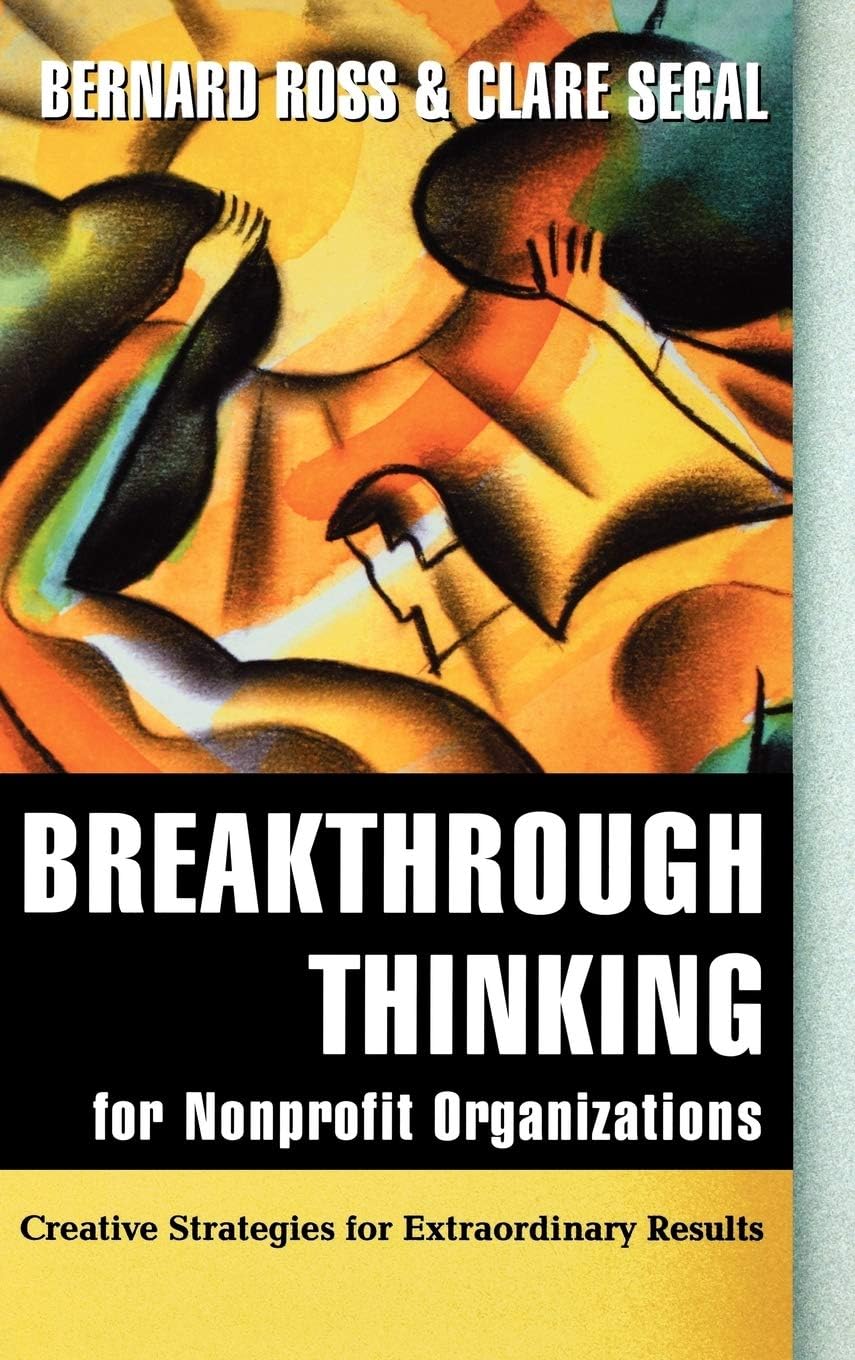
This groundbreaking book will help nonprofit managers think in newand creative ways about how they define and meet the challengesthey face--and how to rise above standard practices to lift theirorganizations to greater performance levels. Using examples of bestpractices from innovative organizations in both the corporate andnonprofit worlds, Breakthrough Thinking for NonprofitOrganizations offers a mix of "how-to" advice and case studiesthat will guide readers on a new road to creativity. This book willfundamentally change the way nonprofit professionals think abouthow they do their work--and usher in a new era fornonprofits. 2003 Terry McAdam Book Award Winner http://www.allianceonline.org/publications/mcadam_past_winners_1.page Review: BREAKTHROUGH THINKING 4 NGOs - I took about 5 books out of the library. this was after about 5 years of reading about grassroots NGOs. 'Breakthrough' was so good that I returned the other books, renewed this one and finally bought it from desertcart. I could use it myself, share with board members and even pass some ideas onto donors. It's a keeper. Review: For everyone connected with a noprofit - Good performance is no longer enough for nonprofits; nonprofits must set and achieve breakthrough goals. Managers and board members need to think in new and creative ways about how they define and meet the challenges they face and the strategies and techniques required to achieve extraordinary performance in fundraising, service delivery and overall results. Almost all nonprofits are affected to some extent by nine change drivers. There are five internal change drivers: organizations need a new mission or vision or they will run out of steam; the speed of business requires more decisions made faster; rising costs require new ways to deliver service from a distance; high profile service failure may require drastic measures such as clearing out top management to win back public confidence; new technology may make a nonprofit redundant or may offer opportunities to improve ways of doing business. There are also four external drivers of change: changes in public perception may result in being dropped from people's consciousness or require 24/7 availability; rapid public awareness of disasters quickly changes priorities; competition for funds has increased as distinctions between nonprofits, the public sector and the private sector has blurred; technology change can make old solutions redundant. Nonprofits that fail to answer two fundamental questions: where do we want to go? and how do we get there? may find themselves wandering in a fog, not knowing how they got into their current situation and wondering what is the right way to go. The decision to go for breakthrough is a strategic one involving risk and asking questions such as 'what is the worst thing that can happen if breakthrough goes wrong?' and 'how likely is it that the worst thing will happen?' and 'what can we do to minimize the risk of the worst thing happening?' and 'should we have a Plan B to cope with problems?' After appraising the risks and challenges and adopting a strategy you still need to decide on the approach required to encourage the people and innovation needed and the leadership required. Even then you need to ask 'to what extent do the improvements and changes made match up to what is needed?' Once an organization has decided to transform its performance to have an impact on the need/performance gap or to achieve its potential, plotting the position on a life cycle chart can be very helpful. Organizations decide to change at various points in their life cycle and for different reasons. The challenge with the most common change point - just past the peak - is that the organization has to break out of its comfort zones and one way is to think about a dramatically improved level of performance. To drive that change a vision of the new performance level has to be agreed together with positive and negative drivers to provide pleasure and avoid pain. Two words have proved exceptionally useful in setting new goals - kaizen and horshin - because they describe not only the nature of the goals but the change process. Kaizen is slow, incremental change that leads, over time to significant improvement in performance. After the second world war Japan applied kaizen to a whole range of activities, including their car industry by setting a long-term world class performance goal and breaking it down into small, achievable chunks. Horshin is about sudden, exponential, discontinuous and radical change that leads to dramatically improved performance in a relatively short period of time. This process resulted in Sony's Walkman becoming one of the most widely used personal electronic devices on the planet. It was used by the National Trust in raising $7.5 in 200 days to save Mt. Snowdon in Wales for public use. In practice most organizations need a mixture of both kaizen and horshin as some areas of work need the stability and methodical progress of kaizen while others need the drive, transformation and vision implicit in horshin. An organization could have ten goals as part of a three-year strategic plan of which six might be kaizen and four horshin. Balance is important as you cannot transform everything overnight and you need to focus and emphasize a small number of key areas to transform quickly. Engaging a horshin goal can be very stimulating such as Kennedy's "This nation should commit itself to achieving the goal, before this decade is out, of landing a man on the moon and returning him safely to earth" or Fords " My vision is to build a motor car for the great multitude. It will be at so low a price that no man making a good salary will be unable to own one". Many nonprofits build on Martin Luther King's "I have a dream" to express mission as an overarching, simple, concrete horshin goal while others are more specific such as "To become a world-class center for research of childhood diseases and to radically reduce their incidence." To achieve breakthrough, language is important as it helps people to shift into a different mindset, distinguish breakthrough goals from ordinary goals and to think creatively about 'how to' as well as 'what'. The remaining eight chapters of 'Breakthrough Thinking for Nonprofit Organizations' deal with unlocking potential, releasing creativity, creating a smart organization, mapping the possibilities, balancing creativity and innovation, challenging mind sets, driving change and working in a breakthrough organization. It is difficult to imagine than anyone connected with a nonprofit could not profit from this book.
| Best Sellers Rank | #4,005,000 in Books ( See Top 100 in Books ) #1,542 in Nonprofit Organizations & Charities (Books) #30,904 in Business & Finance |
| Customer Reviews | 4.5 out of 5 stars 15 Reviews |
S**E
BREAKTHROUGH THINKING 4 NGOs
I took about 5 books out of the library. this was after about 5 years of reading about grassroots NGOs. 'Breakthrough' was so good that I returned the other books, renewed this one and finally bought it from Amazon. I could use it myself, share with board members and even pass some ideas onto donors. It's a keeper.
D**S
For everyone connected with a noprofit
Good performance is no longer enough for nonprofits; nonprofits must set and achieve breakthrough goals. Managers and board members need to think in new and creative ways about how they define and meet the challenges they face and the strategies and techniques required to achieve extraordinary performance in fundraising, service delivery and overall results. Almost all nonprofits are affected to some extent by nine change drivers. There are five internal change drivers: organizations need a new mission or vision or they will run out of steam; the speed of business requires more decisions made faster; rising costs require new ways to deliver service from a distance; high profile service failure may require drastic measures such as clearing out top management to win back public confidence; new technology may make a nonprofit redundant or may offer opportunities to improve ways of doing business. There are also four external drivers of change: changes in public perception may result in being dropped from people's consciousness or require 24/7 availability; rapid public awareness of disasters quickly changes priorities; competition for funds has increased as distinctions between nonprofits, the public sector and the private sector has blurred; technology change can make old solutions redundant. Nonprofits that fail to answer two fundamental questions: where do we want to go? and how do we get there? may find themselves wandering in a fog, not knowing how they got into their current situation and wondering what is the right way to go. The decision to go for breakthrough is a strategic one involving risk and asking questions such as 'what is the worst thing that can happen if breakthrough goes wrong?' and 'how likely is it that the worst thing will happen?' and 'what can we do to minimize the risk of the worst thing happening?' and 'should we have a Plan B to cope with problems?' After appraising the risks and challenges and adopting a strategy you still need to decide on the approach required to encourage the people and innovation needed and the leadership required. Even then you need to ask 'to what extent do the improvements and changes made match up to what is needed?' Once an organization has decided to transform its performance to have an impact on the need/performance gap or to achieve its potential, plotting the position on a life cycle chart can be very helpful. Organizations decide to change at various points in their life cycle and for different reasons. The challenge with the most common change point - just past the peak - is that the organization has to break out of its comfort zones and one way is to think about a dramatically improved level of performance. To drive that change a vision of the new performance level has to be agreed together with positive and negative drivers to provide pleasure and avoid pain. Two words have proved exceptionally useful in setting new goals - kaizen and horshin - because they describe not only the nature of the goals but the change process. Kaizen is slow, incremental change that leads, over time to significant improvement in performance. After the second world war Japan applied kaizen to a whole range of activities, including their car industry by setting a long-term world class performance goal and breaking it down into small, achievable chunks. Horshin is about sudden, exponential, discontinuous and radical change that leads to dramatically improved performance in a relatively short period of time. This process resulted in Sony's Walkman becoming one of the most widely used personal electronic devices on the planet. It was used by the National Trust in raising $7.5 in 200 days to save Mt. Snowdon in Wales for public use. In practice most organizations need a mixture of both kaizen and horshin as some areas of work need the stability and methodical progress of kaizen while others need the drive, transformation and vision implicit in horshin. An organization could have ten goals as part of a three-year strategic plan of which six might be kaizen and four horshin. Balance is important as you cannot transform everything overnight and you need to focus and emphasize a small number of key areas to transform quickly. Engaging a horshin goal can be very stimulating such as Kennedy's "This nation should commit itself to achieving the goal, before this decade is out, of landing a man on the moon and returning him safely to earth" or Fords " My vision is to build a motor car for the great multitude. It will be at so low a price that no man making a good salary will be unable to own one". Many nonprofits build on Martin Luther King's "I have a dream" to express mission as an overarching, simple, concrete horshin goal while others are more specific such as "To become a world-class center for research of childhood diseases and to radically reduce their incidence." To achieve breakthrough, language is important as it helps people to shift into a different mindset, distinguish breakthrough goals from ordinary goals and to think creatively about 'how to' as well as 'what'. The remaining eight chapters of 'Breakthrough Thinking for Nonprofit Organizations' deal with unlocking potential, releasing creativity, creating a smart organization, mapping the possibilities, balancing creativity and innovation, challenging mind sets, driving change and working in a breakthrough organization. It is difficult to imagine than anyone connected with a nonprofit could not profit from this book.
J**T
When "change drivers" hit your NPO, give this book a look.
Good book. I liked it! It was easy to read. Each chapter had a summary section so I could read the summaries before tackling the book as a whole. If you are managing a not-for-profit, or sitting as a board member to a nonprofit, and you believe your nonprofit could be doing things better, then consider getting a copy of this book and give it a read. Back in July I read and reviewed "Managing Business Change for Dummies," by Beth Evard (ISBN: 0764553321), which focused on how managers successfully deal with employees who resist change in an organization. This book on the other hand focuses on how YOU, the manager, must deal with YOUR resistance to change so you can improve your organization's performance in the process. The author lists nine "change drivers:" 1. New Mission or Vision 2. Speed of Business 3. Cost Reduction 4. Service Failure 5. New Technology 6. Change in Public Perception 7. Change in Priorities 8. Competition for Funds and Resources 9. Change in Technology When your organization is hit by one or more of the above events you are going to have to implement change at your organization. This book provides examples of best practices as to how to do this. Also, the authors include exercises from their workshops on this subject. Both the best practices and exercises are very helpful to help us grasp what the authors are talking about. If you are like me you can examine the Table of Contents for this book online and after doing so you will probably say: Wow, what is this book really about. The chapter titles are kind of weak is what I'm really trying to say. It's the chapter summaries, best practices examples, and exercises that make the book a worthwhile investment of your time. I would have liked the book much better if the authors had organized it so it did not feel like just another book put together by a management consulting group. Yeah, it felt like one of "those" to me. And after you read 2 of them, they all start to sound the same. But since this book is informative, well written, and not too long I'm inclined to give it 5 stars.
A**T
This book should be on the best seller list for charities
I wish that two decades ago when I was leading the initiative to establish the Canadian Centre for Philanthropy there had been a book available like Breakthrough Thinking. It would have been helpful in shortening the gestation period. Some of our clients have already benefited from our application of tools described by Ross and Segal, particularly regarding fundraising Ross/Segal are well qualified to address Breakthrough. The book benefits from their experience in working with charities in the United States, Europe, Canada, Africa and South America through their UK based Management Centre. The book is peppered with examples of the application of the tools they discuss by named organizations on different continents. They even have the refreshing temerity to identify failures. Ross's presentations in North America have led to recognition of what Europeans and others already know - he is one of a handful of truly outstanding international thinkers and presenters in the charity field. Participant evaluations testify to the fact that Ross's seminars/workshops are both brilliant and entertaining. Neither of these characteristics are lost in the book. Ross/Segal are very effective at adapting new business management theories and tools for use by the charitable sector. To give but one example, using the metaphor of the "Wild West" they identify the seven character roles required to successfully implement change. Acknowledging this to be a modification of management consultant Rennie Fritchie's five roles they identify the attributes required by the pioneer, wagon train leader, scout, sheriff, homesteader, medicine man or woman, hired gun. This greatly facilitates the reader's understanding and remembering the special requirements for each of these roles to achieve a successful "breakthrough journey." As they point out, "the roles idea is simply a metaphor to help cluster the skills, competencies, knowledge, and qualities needed." In their preface Ross/Segal state that their mission in writing the book was "to inspire managers and board members in non-governmental organizations (NGOs) to believe they can achieve extraordinary results, and to give them practical strategies and techniques for achieving such results." Ross /Segal do indeed deliver on the mission. They provide us with a toolbox of approaches and ideas to achieve "extraordinary results." As they point out - a toolbox provides a variety of tools for tasks and some are easier to use than others. We get better with our usage of them! It is difficult to imagine a CEO, Board member, fundraiser, consultant and others desiring significant increased or dramatic new goals for their organization, in whatever area, who would not gain from applying some of the very practical and tested tools described in the book. My business partner has found mindmapping an invaluable tool for working with groups to help them organize their thinking, let alone her own. One of my many favourites from the book is how to get rid of creativity and innovation killers. Maybe you want to foster greater innovation and creativity in your organization; fight "the tyranny of incrementalism" and establish new breakthrough goals; put in place an organization that makes sustained breakthroughs; ensure that the necessary people are on board to support your breakthrough idea - you will find the tools for each of these and many others in the book. While Ross/Segal state that they are not seeking to provide, "a step by step, how to guide to achieving breakthrough," it is difficult to imagine there could be a better guide to helping your organization "breakthrough." Already in high demand as presenters internationally Ross/Segal should expect to have to pack their bags more often as a result of this groundbreaking book.
P**N
Breakthrough Thinking Book Review
Are you tired of business as usual? Clare Segal and Bernard Ross help you explore where your business is related to your mission and then guide you to an action plan for better results. If you know what you want to accomplish but your staff isn't with you, Chapter 9 & 10 help you change mindsets and focus your energy. The authors offer you questions to ask yourself that will bring you clarity and better chances for a favorable outcome. If your performance improves for a while, then tapers off, Chapter 2 & 3 will help you stretch your goals and rise to the next level. If you have a lot of ideas, but trouble following through with them, Chapters 7 & 8 help you sort through your ideas with mind-mapping exercises to sort through them and develop a plan. Chapter 4 & 5 are the chapters to read when you know you need a change, but just can't seem to find the springboard idea to launch it. Page 70 is my favorite page in "Breakthrough Thinking for Nonprofit Organizations." Clare and Bernard suggest employing a jester based on an ancient and well-established medieval tradition of the fool or jester. This role is to help people challenge their own assumptions. The jester has the right to challenge the king or members of the court. From my training with Improvisation and Theater, I've come to appreciate the wisdom of the fool more and more. I applaud them for encouraging nonprofit organizations to try it. They offer guidelines to help make your experiment a success. If you feel any area of your organization is stuck, this book will help you think in new ways, solve problems quicker and be a helping hand in making your vision a reality.
J**N
A Great Book to help with Change
I heard one of the authors speak at a Public Broadcasting Service conference a couple of months ago and was excited enough to buy the book. This has proved really helpful to me as a development professional trying to change the way the people here at my college think about their potential. It offered me some really powerful and simple frameworks to analyze our current work, to establish what a breakthrough might be, and finally how to implement a change programme. Ther are some useful ideas on how to set up and sustain an innovation programme that are really provocative. There are also some very useful checklists and a really neat framework for working out your own role in any breakthrough. I found this exceptionally useful in deciding what I could do by myself and what I needed to ask other people to do. Chapter 5 is good on this. Finally it's good that lots of the examples are from outside the US. That gives the book a wider perspective.
"**"
Breakthrough thinking made easy
This is an excellent read - it's a combination of textbook, manual, map and story book. It describes the route to exceptional organisational and personal peformance in a way which makes it possible for all of us. It's written in a particularly readable style. Each chapter is self-sufficient so it's easy to pick up and put down. Theories are illustrated visually with diagrams and tables, supplemented by case studies drawn from the authors' work around the world. This gives the text a sense of recency and freshness that adds to its accessibility. Best of all Breakthrough Thinking explodes myths about creativity making it something that we can all achieve. All we have to do is open our minds and just do it.
A**A
GOOD GLOBAL PERSPECTIVE
Refreshing perpective about the non profit world. A truly global book. I enjoyed very much!
J**M
great book
this book gives you clues to make the breaktrough in your organization.is essential to reed the if you want to be a food fundraiser.
L**Y
More Basic than Breakthrough
Whilst there is some useful stuff in this book I wouldn't recommend it to anyone with basic business knowledge and knowledge of change processes. I realise many non-profits are small and can be unsophisticated at times in their approach, but so many are the opposite and I'm not sure how well this would serve them. Certainly has some approaches worth trying - but, for me, I found the tone patronising and therefore irritating to read. Like a teacher that knows their stuff but you just can't bear to listen to.
Trustpilot
3 weeks ago
2 months ago