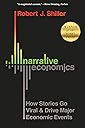
Narrative Economics: How Stories Go Viral and Drive Major Economic Events
Product ID: 296641873
📈Predictive economic narratives
📊Data-driven insights
📚Nobel-winning expertise
Desertcart purchases this item on your behalf and handles shipping, customs, and support to USA.
📈 Decode the stories that move markets and stay ahead of the economic curve!
Narrative Economics by Nobel Prize winner Robert Shiller reveals how viral stories influence major economic events, offering a groundbreaking framework to predict and manage financial crises by integrating behavioral insights with traditional economics.

| Best Sellers Rank | #35,290 in Books ( See Top 100 in Books ) #29 in Macroeconomics #109 in Social Psychology & Interactions #299 in Marketing & Sales |
| Customer Reviews | 4.6 out of 5 stars 573 Reviews |
A**S
Geschichten aus dem Paulanergarten
Spaß beiseite! Dieses Buch ist ein weiteres Meisterwerk von Robert Shiller, bei seiner Forschung zur Behavioral Finance und Spekulationsblasen. Verständlich führt er uns dabei durch seine Erkenntnisse und gibt weitreichende Eindrücke wie Geschichten unser Urteilsvermögen beeinflussen. Ich bin wieder einmal hochbeeindruckt und habe mich das ein oder andere Mal ertappt. Tolles Buch, super Autor und fairer Preis! Was will man mehr?!
K**L
Great buy
Fun read. Slow start but it becomes more interesting as you move along.
E**M
Narratives matter
How narratives spread and mutate over the time (as virus) it is worth a reading. Frequent quotation used to illustrate how ideas evolve through time but it reinforces the idea of the author to move economic thinking from quantitative (models, assumptions,) to qualitative (social mood, behavioural economics,)
R**B
Essencial para desmistificar o mito da racionalidade econômica.
Uma vez mais, Shiller nos brinda com a chance de entender como narrativas ajudam a formar a opinião das pessoas e a dirigir o seu comportamento, ao longo da história. O vencedor do Nobel mostra como crenças podem ser muito mais fortes que a racionalidade na hora de definir como as pessoas se comportam no mercado.
F**R
He emphasizes the influences of the narratives people tell about the economy.
Schiller is a Nobel prize winning economist and best-selling author. He also gives frequent interviews to the financial press providing his latest views on the economy and investing. In this work he has emphasized psychological aspects in the form of the stories or narratives people tell about the economy and investing. He takes an historical approach using huge databases especially from Google that show that people picked up certain narratives or stories and these stories affected the way they thought and acted when investing. Research has shown that consistent brain regions are wired to respond to stories that lead to thinking in analogies. Models of the future trajectory of disease epidemics can be used to explain the spread of narratives. The spread of epidemic pathogens and the spread of narratives through time are very similar. He sees major moves happening in world affairs because of seemingly irrelevant mutations in narratives. The narratives themselves can BE BASED ON quite a few different facts and combine with other narratives to have big effects. Before World War I there was a narrative that the country who attacked another first would have an advantage. The story became very popular and helped lead to World War I. The idea was eventually proven to be wrong but not in time to stop the war. The story spread much faster and effectively than the proof that it was wrong. Recent research has shown that people are more likely to share novel information and the new story correcting the original novel story may very well not be as contagious as the first incorrect story. The result is that the false narrative can have a major effect on economic activity long after it has been corrected. For example the Martin Luther King's “I Have a Dream” speech which eventually developed into the backbone of a powerful narrative that continues to grow by contagion for decades afterward. A bigger narrative the American Dream justifies people desiring to purchase expensive cars, extravagant homes, and generally justifies conspicuous consumption. Another interesting example was the biography of Steve Jobs by Walter Isaacson. The publisher put it into the market just weeks after Job's death. Jobs, a very interesting person with many human frailties, founded his company. Subsequently h was forced out perhaps because of his eccentricities. When Apple started going downhill he was called back and helped create the powerhouse that now exists. Apparently a lot of people like the story because it shows that someone like Jobs with many weaknesses could still become very, very successful. Another example is the crash of 1929. A lot of people think it occurred basically in a few days in October, 1929. In reality the drop continued till 1932 almost 3 years and the total loss was 86%. Even today when people talk about the stock market crash they are most likely referencing this particular crash at least as in example. Stories and legends from the past are scripts for the next boom or crash. The term boycott actually comes from what happened to Charles Boycott around 1880 as a land manager in Ireland. He had disagreements with the tenants who united against him making it almost impossible to do his job. He was boycotted. This became a very effective weapon for unionism. The US economy had problems during the early 1920s and 1930s. It was easier during the 1920s to convince people that they should lower their wage expectations than in the 1930s. In the 1930s people blamed businessmen for all of their economic woes. Apparently another factor was that during the 1920-21 depression prices dropped considerably and it was worth waiting to make purchases. This did not help the economy. Schiller points out that household decisions were made primarily by women and their thinking at the time has not been studied very much. Estimates are that women were responsible for about 85% of the spending of incomes in the United States. If they thought prices were unfair and were willing to boycott particular items or categories that were thought to be especially unfair. This put a lot of people in these areas out of work. Schiller makes some suggestions on databases that could be kept in the future that would facilitate tracing narratives and their affect on the economy, politics, etc. He goes further to suggest that the leaders could use counter narratives to correct misleading narratives that could harm our country.
Trustpilot
2 weeks ago
2 weeks ago