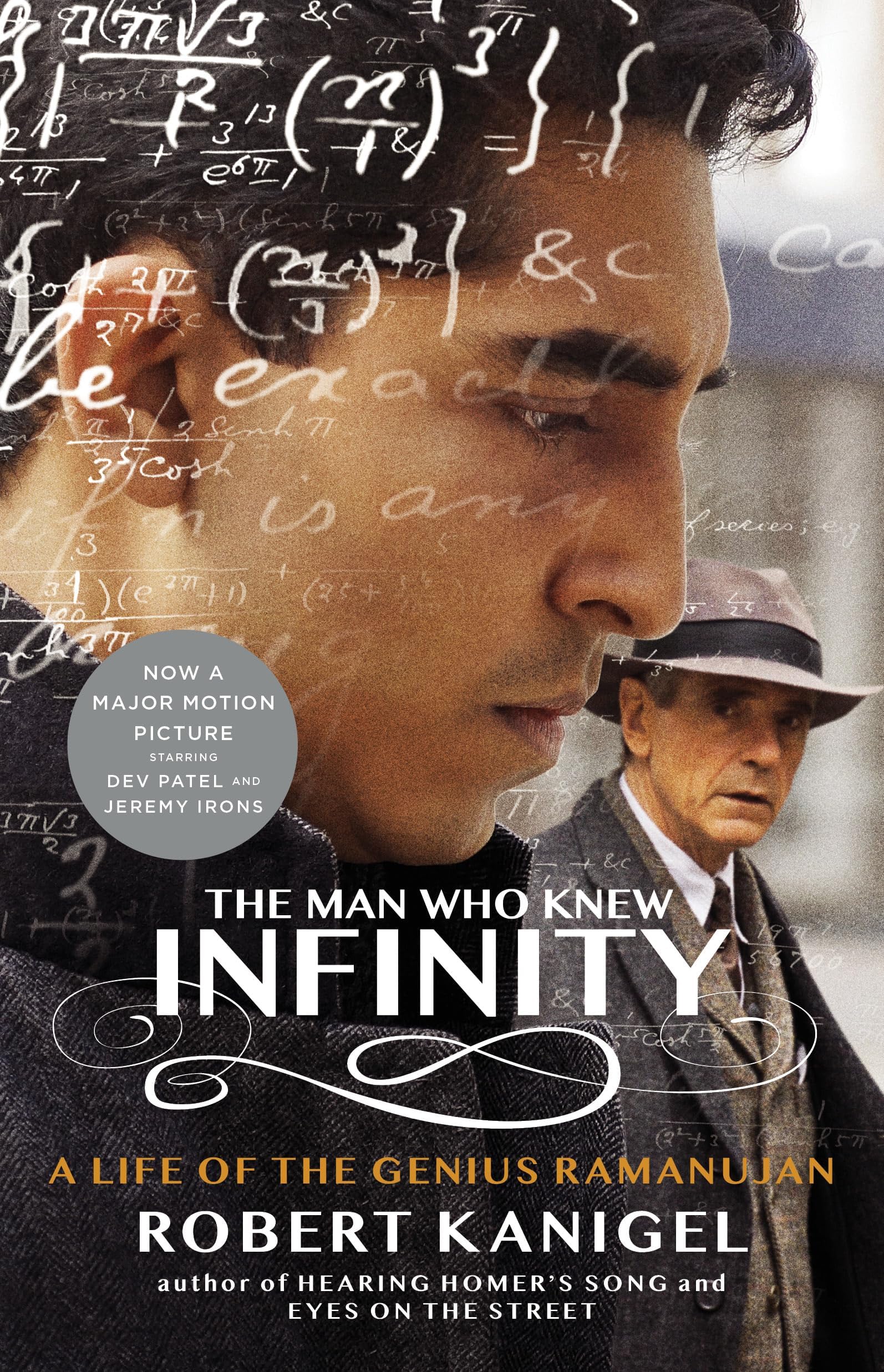
The Man Who Knew Infinity: A Life of the Genius Ramanujan
Product ID: 28232964
Desertcart purchases this item on your behalf and handles shipping, customs, and support to USA.
NOW A MAJOR MOTION PICTURE STARRING JEREMY IRONS AND DEV PATEL! A moving and enlightening look at the unbelievable true story of how gifted prodigy Ramanujan stunned the scholars of Cambridge University and revolutionized mathematics. In 1913, a young unschooled Indian clerk wrote a letter to G H Hardy, begging the preeminent English mathematician's opinion on several ideas he had about numbers. Realizing the letter was the work of a genius, Hardy arranged for Srinivasa Ramanujan to come to England. Thus began one of the most improbable and productive collaborations ever chronicled. With a passion for rich and evocative detail, Robert Kanigel takes us from the temples and slums of Madras to the courts and chapels of Cambridge University, where the devout Hindu Ramanujan, "the Prince of Intuition," tested his brilliant theories alongside the sophisticated and eccentric Hardy, "the Apostle of Proof." In time, Ramanujan's creative intensity took its toll: he died at the age of thirty-two, but left behind a magical and inspired legacy that is still being plumbed for its secrets today. Review: Wonderful and Insightful Read - This is a spell introduction to one of the more creative minds of twentieth century mathematics. If you have seen the movie you owe it to yourself to read this book which was the basis for the movie. Kanigel does am amazing job of converting the two different cultures, India and England, the caste system in India, and the mathematics. This is a very insightful read and i highly recommend it. Review: As much of a human story as a mathematical one - I had read Kanigel's book on Ramanujan way back in college and therefore, to refresh my memory after watching the recent movie and to get a more mature understanding of the story, I read it again. The book achieves the rare distinction of being an evocative picture of both early 20th century southern India and Cambridge, as well as a marvelous exposition of the pursuit of pure mathematics at its highest level by two of its most exalted practitioners. I found it remarkable that Kanigel manages to explain concepts like partitions, modular forms and generating functions in a book that assumes literally no knowledge of math. Ramanujan's cultural, religious and family background is described with empathy and in detail. So much of his success was due to sheer chance; he was recognized by the right people at the right time even after many others had ignored him, and his caste made up for his poverty and lack of connections. Slide the needle of destiny a little to the right or left, and he might have languished in obscurity forever. G. H. Hardy's background and the the culture of Tripos examinations, public school and Cambridge elites is similarly described in vivid terms. Hardy was a singular thinker who enjoyed pure math precisely because of his uselessness (his book "A Mathematician's Apology" is eminently readable for the pride it takes in the pursuit of useless but beautiful ideas). The contrast between the two worlds and the two men could not be more stark, and yet somehow mathematics bridged the very unlikely gap between them; the book is thus even more of a human story than a mathematical one. Even today it's impossible to understand how Ramanujan could derive and prove everything that he did, but it's clear that obsessive hard work combined with a fearless creative streak played an important role in his discoveries. Kanigel also talks about how these discoveries have kept entire schools of mathematicians busy for decades. Ultimately Ramanujan's story is that of a blazing comet which burned bright and quick, guided by the gravitational pull exerted by his own intellect and Hardy's kinship. More than anything else, the story makes the expedience of making sure that other Ramanujans in remote places don't fall through the cracks woefully clear.
| Best Sellers Rank | #119,828 in Books ( See Top 100 in Books ) #10 in Historical India & South Asia Biographies #59 in Mathematics History #60 in Educator Biographies |
| Customer Reviews | 4.4 out of 5 stars 1,380 Reviews |
D**G
Wonderful and Insightful Read
This is a spell introduction to one of the more creative minds of twentieth century mathematics. If you have seen the movie you owe it to yourself to read this book which was the basis for the movie. Kanigel does am amazing job of converting the two different cultures, India and England, the caste system in India, and the mathematics. This is a very insightful read and i highly recommend it.
A**R
As much of a human story as a mathematical one
I had read Kanigel's book on Ramanujan way back in college and therefore, to refresh my memory after watching the recent movie and to get a more mature understanding of the story, I read it again. The book achieves the rare distinction of being an evocative picture of both early 20th century southern India and Cambridge, as well as a marvelous exposition of the pursuit of pure mathematics at its highest level by two of its most exalted practitioners. I found it remarkable that Kanigel manages to explain concepts like partitions, modular forms and generating functions in a book that assumes literally no knowledge of math. Ramanujan's cultural, religious and family background is described with empathy and in detail. So much of his success was due to sheer chance; he was recognized by the right people at the right time even after many others had ignored him, and his caste made up for his poverty and lack of connections. Slide the needle of destiny a little to the right or left, and he might have languished in obscurity forever. G. H. Hardy's background and the the culture of Tripos examinations, public school and Cambridge elites is similarly described in vivid terms. Hardy was a singular thinker who enjoyed pure math precisely because of his uselessness (his book "A Mathematician's Apology" is eminently readable for the pride it takes in the pursuit of useless but beautiful ideas). The contrast between the two worlds and the two men could not be more stark, and yet somehow mathematics bridged the very unlikely gap between them; the book is thus even more of a human story than a mathematical one. Even today it's impossible to understand how Ramanujan could derive and prove everything that he did, but it's clear that obsessive hard work combined with a fearless creative streak played an important role in his discoveries. Kanigel also talks about how these discoveries have kept entire schools of mathematicians busy for decades. Ultimately Ramanujan's story is that of a blazing comet which burned bright and quick, guided by the gravitational pull exerted by his own intellect and Hardy's kinship. More than anything else, the story makes the expedience of making sure that other Ramanujans in remote places don't fall through the cracks woefully clear.
Y**R
CHALLENGING THE IDEA OF SUPER-INTELLIGENT ROBOTS
For Rulers: Priming Political Leaders for Saving Humanity from Itself This is a fascinating book, as recognized by the many reviews. But I suggest a different perspective, namely the challenge posed by the mind of Srinivasa RAMANUJAN to the idea of “super-intelligent robots” which is at the core of what is appropriately called by Ray Kurzweil “Spiritual Machines” and “Singularity.” Ramanujan was more that one of the few persons recognized as “geniuses.” He was a super-genius, “a man who grew up praying to stone deities; who for most of his life took counsel from a family goddess, declaring it was she to whom his mathematical insights were owed; whose theorems would, at intellectually backbreaking cost, be proved true—yet leave mathematicians baffled that anyone could divine them in the first place” (p. 4). All mathematical creativity depends on inspiration and imagination, followed by strict proof. However the mental processes resulting in the radical breakthroughs of Ramanujan, despite his social circumstances and lack of minimal education, are on an unequalled level. This outstanding biography does not even try to explain them, nor do the top mathematicians with whom Ramanujan worked at Cambridge and who continue to draw radically novel ideas from his handwritten notebooks. This brings me to current efforts to spawn robots with artificial general intelligence and, beyond them, robots with super-intelligence. But the phenomenon of Ramanujan (and a few other geniuses) is not only beyond the scales of intelligence, but above the concept of “intelligence” itself. No enhancement of human intelligence opens a door to becoming a Ramanujan; and no algorithm is likely to produce robots with the abilities of Ramanujan. This would require more than super-intelligence namely a quantum leap into what we do not understand and cannot even conceptualize. Artificial intelligence experts will probably respond that progress will be in steps: a somewhat super-intelligence entity will develop a more super-intelligent entity and so on, till “minds” of the quality of Ramanujan are understood, achieved and surpassed. But this is a weak hypothesis as long as the mind of Ramanujan remains totally a black box. Thus Ramanujan posed a critical riddle to the idea of super-intelligent robots, whether with biological or mechanical substrata. Therefore, studying this book and pondering the challenge its subject presents is strongly recommended to philosophers, scientists and technologists working on advanced artificial intelligence and the Singularity hypothesis as a whole. Professor Yehezkel Dror The Hebrew University of Jerusalem
P**T
Great read!
Highly recommended. Plan on a second read this summer. I read a lot of books and this one is one of the best. About history, culture and one of the most remarkable minds of all time.
A**V
Too much Mathematics in the last 100 pages.
A Mathematician Would Enjoy This Book. A good read. A sad read. It gives a detailed life history, the struggles of Srinivasa Ramanujam to be socially acceptable, to prove his genius. Apart from Ramanujam, the character i loved are: G.H.Hardy : Born and brought not with a golden spoon. He loves his family. He loves cricket. And he loves mathematics. Ramanujam had the talent. Had the brains. Had the insight. Had the intuition. But G.H.Hardy found Ramanujam. G.H.Hardy showed Ramanujam to the world. And the genuine struggles he took in bringing Ramanujam to England. A compassionate human being. Neville: The guy who first saw Ramanujam as a genius. Read the book to find out why he travelled to India in the first place. Am sure everyone would be impressed as I am. Littlewood: A cute guy who competed with Ramanujam with regard to prime numbers. But the first guy who so untiringly went through all of Ramanujam's papers to give a positive impression of Ramanujam to the skeptic mind of G.H.Hardy. Sir Francis Spring: Wow....A Not An Indian Guy....who recognized Ramanujam's talent when Ramanujam was working as a clerk in the Madras Port. Ramanujam: He now is a genius. But before that....A brahmin guy. A Vaishnavite. A boy who flunked all his exams except Maths. A boy who loves food. A mother's boy who loved the brinjal curry. A college student who never made it to the board exams. A married man who didn't know if he is doing the right thing in pursing maths. A simple man. A humble man. A Man who saw god in every equation he wrote. Of all qualities, A guy who wrote to his parents, family, wife, friends 3 or 4 times a month from England giving them up-to-date information about his mathematical progress, how he held to his vegetarianism.... My mom once said that, "Man is a Social Being....He/She cannot be alone". When writing this, I ponder of how true this is. Ramanujam was a genius...But took so many people outside his family to bring him to light. But in most cases the friends, family that helped them are never ever mentioned...But the author did a great job in going over the minute details of each and every single person who made Ramanujam as the person we see him today. Hats off to Robert Kanigel. The happiest moments of Ramanujam's life must have been the ones he stayed in Cambridge along with G.H.Hardy going after his leisure activity, "Mathematics" (as Ramanujam put it). I love the book..In the last pages of the book there is too much mathematics which I didnt enjoy reading much as I didn't understand them (probably thatz why 3 Stars). Am impressed with the amount of information the author collected in trying to know why a particular place is named, "Triplicane", "Rameshwaram", "Nammakal". A Big Wow : in the first 2 decades of 20th century..... The ticket price from Kumbakonam to Madras by train : Rs.3 The ticket price from Madras to Cambridge by ship : Rs.400 AV.
R**T
A must read for any book enthusiast!
Being from India, I have long known the name of Ramanujan, but only now got down to reading this comprehensive biography of this great mathematician. Simply put, this is a keeper for life and I have already recommended this to most of my friends. Being from the South of India, it was absorbing to see how well Robert has captured the day to day cultural details along with the family squabbles that were commonplace. Robert Kanigel has done a wonderful job in researching books, publications and interviews and then building a most compelling tale of a true born genius. He gives the readers a delightfully detailed view of Hardy's and Ramanujan's upbringing overlaid with the overall geopolitical context. The then phenomenally vibrant work that they did together follows and finally ends with the tragically early death (at 32!) of Ramanujan. In conclusion, he asks some very telling questions on why did this have to happen this way and how things could have been different? What is the future of mathematicians in India today? Do not mistake this to be a mathematical book by any stretch, as it is simply one of the most brilliant biographies of a true gift of god to mankind. It will give you a new perspective on things we take for granted. Cheers, SVKR
M**F
A good review.
This review was appropriate.
K**R
Genius Discovered
Robert Kanigel's biography of Ramanujan is a well researched and well written book about the all-too short life of a man who remains largely unknown outside of the world of mathematics. Ramanujan was born of poor parents in Southern India in the late 1880s. His only interest outside of his religion was mathematics and he was unable to complete a formal university education. After several attempts to attract the attention of prominent British mathematicians he finally became the protégé of G.H. Hardy, a prominent mathematician at Cambridge. Hardy brought Ramanujan to Cambridge based on some of his preliminary work and was surprised to find that his protégé's thinking was far in advance of the then, and possibly current, state of mathematics. Publication of many joint papers resulted in Ramanujan's election to the Royal Society. Unfortunately he had by this time contracted tuberculosis and he died in 1920 shortly after his return to India. Even today Ramanujan's theorems are still being studied and he is ranked among the world's greatest mathematical thinkers hence the book's subtitle. This book not only provides a valuable insight into a great mind but it also gives us a penetrating glimpse of the culture of Southern India in the early 20th century. The contrast between Hardy's British public(i.e. private) school background and Ramanujan's Indian schooling makes the collaboration between the two even more interesting. This is a fascinating read that leads one to speculate how many more similar sparks of genius remain undiscovered.
M**D
A Cambridge Don discovers an Indian Maths Genius
As a Glasgow University Honours Maths graduate I was very familiar with the background to the discovery of Ramanujan by G.H. Hardy. In fact my Maths professor R. A. Rankin studied under Hardy for his PhD at Cambridge & was co-author of a book detailing all the surviving letters & correpondence between Hardy,Ramanujan,J.E. Littlewood et. all. The author of "The Man Who Knew Infinity"-Robert Kanigel has indeed done justice to this extraordinary piece of Mathematics history & his research & attention to the detailed background & historical accuracy are truly impressive if at times somewhat verbose. A splendid read whether you are into Maths or not.
L**.
Libro che mi ha appassionato alla Matematica
Una delle più affascinanti storie della Matematica, un libro che potrebbe motivarti a studiare matematica!
A**N
Histoire d'un genie indien en mathematiques
Toute la vie d'un génie en mathématiques, hindouiste qui était en relation avec les divinités qui lui inspiraient ses recherches. Les équations qu'il a trouvée sont pratiquement toutes exactes. D'autres n'ont pas été encore démontrées mais sont vérifiées exactes par les ordinateurs.
T**O
Vida de um matemático
Ótimo livro sobre a vida de um grande matemático.
O**1
ラマヌジャンの精緻な伝記
不思議に人を引きつける天才数学者ラマヌジャン。その生い立ちから詳しく記載されており、19世紀末の南インドの特殊な条件下でしか、このような天才が生まれえなかったことを納得させられる。巻末の文献リストの多さにも驚かされる。作者(R.Kanigel)のラマヌジャンに対する思い入れがひしひしと伝わって来る。
Trustpilot
2 days ago
2 weeks ago