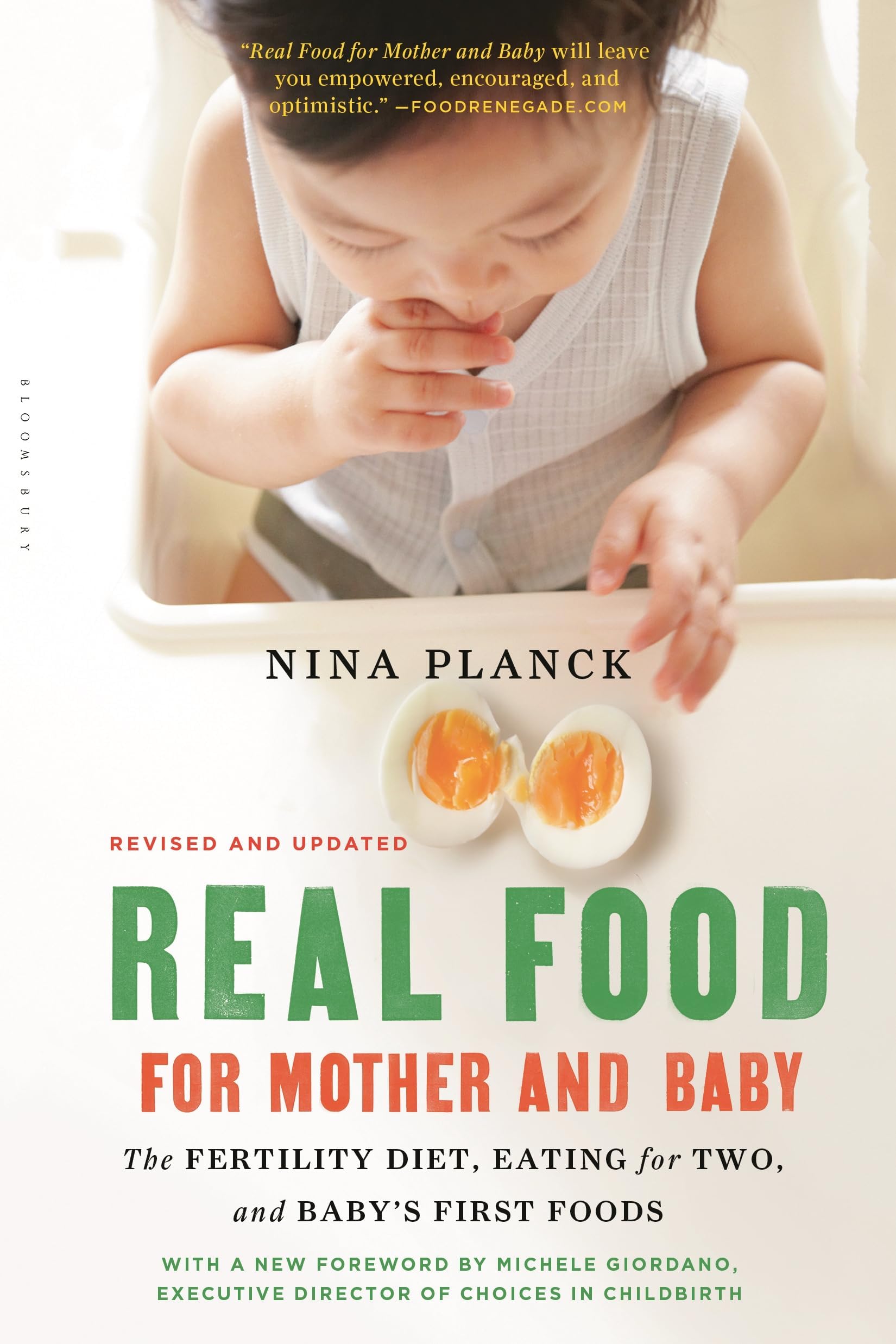
Real Food for Mother and Baby: The Fertility Diet, Eating for Two, and Baby's First Foods
Product ID: 27930991
Desertcart purchases this item on your behalf and handles shipping, customs, and support to USA.
Ten years ago, Nina Planck changed the way we think about what we eat with the groundbreaking Real Food . And when Nina became pregnant, she took the same hard look at the nutritional advice for pregnancy and newborns, finding a tangle of often contradictory guidelines that seemed at odds with her own common sense. In Real Food for Mother and Baby , Nina explains why some commonly held ideas about pregnancy and infant nutrition are wrongheaded--and why real food is good for growing minds and bodies. While her general concept isn't surprising, some of the details might be. For expecting mothers and babies up to two years old, the body's overwhelming requirements are fat and protein, not vegetables and low-fat dairy--which is why, for example, cereals aren't right for babies, but meat and egg yolks are excellent. Nina shares tips and advice like a trusted friend, and in this updated edition, her afterword presents the latest findings and some newly won wisdom from watching her three children grow on real food. Review: Real Food made a Real Impression - I ordered this book because my husband and I are going to start trying to get pregnant in the next year, and I wanted to eat right to up my chances. We already are good eaters (lots of grilled fish/chicken/veggies), but I have fallen victim to the non-fat/low-fat craze in the last decade, especially when it comes to dairy products and bread products. After reading the first section of this book (I am saving the chapters on Eating for Two and Baby's First Foods for when I am actually pregnant) I also bought Michael Pollan's "In Defense of Food" which Nina Planck refereneces a few times in this book. Since then, I have cleaned my kitchen out of all our "fake foods" and have gotten back to the basics, and we are once again eating Real Food. I am not pregnant yet, but we aren't trying for a few more months, so I can't be a testament to the Fertility Diet in the book...yet! My best friend found out she was pregnant about 3 days after I finished up the fertility section of the book and I've lent it to her to read the chapters concerning pregnany and baby's first foods, and she is also a fan, and is following suit with cleaning the kitchen out of her chemically enhanced "fat-free!!!" junk. I am a regular person with an interest in the health of myself, my family and friends. I really recommend this book to anyone that wants to make over their eating habits and start eating real food again. Getting rid of all my low-carb bread (which tastes like cardboard anyway, and comes in tiny slices), fat-free mayo (which is disgusting but I forced myself to use it because it was "better for me"), and all that kind of stuff has been liberating, honestly. I am enjoying meal-time again, not eating as much because my food actually tastes good and I am satisfied with less, and feeling better already. I forgot what I was missing. I am currently adding in the foods recommended for fertility, and it's nice to have a natural approach to upping my chances. I also look forward to being pregnant and not being a stereotype of the pregnant lady (eating a whole carton of ice cream, sending my husband out for fast food in the middle of the night) and hope that the guidelines put forth in this book will help me through pregnancy in the healthiest way possible. And of course I plan on feeding my baby nothing but the best. I was not brought up on canned baby food, and I've never planned on going that route, but I am glad to have some guidelines (and I know there are a ton of reference books out there) on what is going to be the best for my baby's health...real food, of course. Review: Required reading for ANY woman who is pregnant or trying to conceive - This book could not have shown up in my life at a better time. Devastated by the loss of my first pregnancy, I was diagnosed with PCOS and set out to discover what I could do to make sure I did everything in my power to have a healthy, full term baby on my next go round. After searching through many versions of rigid, impossible to follow "PCOS diets", Real Food for Mother and Baby was a God send. Finally, real, common sense advice and solid research to help me fight off my insulin resistance issues (which have led to PCOS). To top it off, it's in extremely readable form. Everyone knows that we should eat real food, not fake food, right? But what I didn't know was just how fake most of what is to be found in the supermarket really is. One example: Even basic skim milk, a commonly accepted staple of a 'healthy diet', is extremely processed and damaged by the time it reaches our shopping carts. The result of this newfound information resulted in my introduction to raw milk- so delicious it serves as my dessert most nights! And it's packed full of nutrients cooked out of most store bought milk. You will find endless tidbits of information and detailed explanations of the various nutrients your body needs to conceive and carry a baby, and it is all fascinating stuff. But the best part of the book is that in the end, everything is quite simple and easy to remember. Planck even breaks down the most basic needs for each trimester, making the complicated pregnancy-eating mind game as reassuringly easy as a refrigerator chart. I am endlessly grateful for this, as when I found out I was pregnant the first time, I was terrified to eat at all. Worried about eating too little, too much, the wrong thing, the right thing at the wrong time... suffice to say, I am relieved beyond measure to have this new basic understanding of what my baby needs at different stages of development. And it's not necessarily what your OB or the FDA will tell you! As a side note, woven in with all of the great nutrition information is the story of Planck's own pregnancy, birth, and the first two years of her son's life- making her instantly relatable and interesting. I am feeling great since changing my focus to eating only real food, and am very optimistic that I will get pregnant again soon and carry to term. Thank you Nina Planck, for writing such a user friendly, common sense guide to eating well not just for pregnancy, but for life!
| Best Sellers Rank | #266,345 in Books ( See Top 100 in Books ) #78 in Baby Food Cooking #440 in Pregnancy & Childbirth (Books) #492 in Natural Food Cooking |
| Customer Reviews | 4.3 out of 5 stars 177 Reviews |
H**L
Real Food made a Real Impression
I ordered this book because my husband and I are going to start trying to get pregnant in the next year, and I wanted to eat right to up my chances. We already are good eaters (lots of grilled fish/chicken/veggies), but I have fallen victim to the non-fat/low-fat craze in the last decade, especially when it comes to dairy products and bread products. After reading the first section of this book (I am saving the chapters on Eating for Two and Baby's First Foods for when I am actually pregnant) I also bought Michael Pollan's "In Defense of Food" which Nina Planck refereneces a few times in this book. Since then, I have cleaned my kitchen out of all our "fake foods" and have gotten back to the basics, and we are once again eating Real Food. I am not pregnant yet, but we aren't trying for a few more months, so I can't be a testament to the Fertility Diet in the book...yet! My best friend found out she was pregnant about 3 days after I finished up the fertility section of the book and I've lent it to her to read the chapters concerning pregnany and baby's first foods, and she is also a fan, and is following suit with cleaning the kitchen out of her chemically enhanced "fat-free!!!" junk. I am a regular person with an interest in the health of myself, my family and friends. I really recommend this book to anyone that wants to make over their eating habits and start eating real food again. Getting rid of all my low-carb bread (which tastes like cardboard anyway, and comes in tiny slices), fat-free mayo (which is disgusting but I forced myself to use it because it was "better for me"), and all that kind of stuff has been liberating, honestly. I am enjoying meal-time again, not eating as much because my food actually tastes good and I am satisfied with less, and feeling better already. I forgot what I was missing. I am currently adding in the foods recommended for fertility, and it's nice to have a natural approach to upping my chances. I also look forward to being pregnant and not being a stereotype of the pregnant lady (eating a whole carton of ice cream, sending my husband out for fast food in the middle of the night) and hope that the guidelines put forth in this book will help me through pregnancy in the healthiest way possible. And of course I plan on feeding my baby nothing but the best. I was not brought up on canned baby food, and I've never planned on going that route, but I am glad to have some guidelines (and I know there are a ton of reference books out there) on what is going to be the best for my baby's health...real food, of course.
M**E
Required reading for ANY woman who is pregnant or trying to conceive
This book could not have shown up in my life at a better time. Devastated by the loss of my first pregnancy, I was diagnosed with PCOS and set out to discover what I could do to make sure I did everything in my power to have a healthy, full term baby on my next go round. After searching through many versions of rigid, impossible to follow "PCOS diets", Real Food for Mother and Baby was a God send. Finally, real, common sense advice and solid research to help me fight off my insulin resistance issues (which have led to PCOS). To top it off, it's in extremely readable form. Everyone knows that we should eat real food, not fake food, right? But what I didn't know was just how fake most of what is to be found in the supermarket really is. One example: Even basic skim milk, a commonly accepted staple of a 'healthy diet', is extremely processed and damaged by the time it reaches our shopping carts. The result of this newfound information resulted in my introduction to raw milk- so delicious it serves as my dessert most nights! And it's packed full of nutrients cooked out of most store bought milk. You will find endless tidbits of information and detailed explanations of the various nutrients your body needs to conceive and carry a baby, and it is all fascinating stuff. But the best part of the book is that in the end, everything is quite simple and easy to remember. Planck even breaks down the most basic needs for each trimester, making the complicated pregnancy-eating mind game as reassuringly easy as a refrigerator chart. I am endlessly grateful for this, as when I found out I was pregnant the first time, I was terrified to eat at all. Worried about eating too little, too much, the wrong thing, the right thing at the wrong time... suffice to say, I am relieved beyond measure to have this new basic understanding of what my baby needs at different stages of development. And it's not necessarily what your OB or the FDA will tell you! As a side note, woven in with all of the great nutrition information is the story of Planck's own pregnancy, birth, and the first two years of her son's life- making her instantly relatable and interesting. I am feeling great since changing my focus to eating only real food, and am very optimistic that I will get pregnant again soon and carry to term. Thank you Nina Planck, for writing such a user friendly, common sense guide to eating well not just for pregnancy, but for life!
E**A
Some very good info, but...
This book has some excellent information on nutrition and diet, as well as the history of foods and why they are good to eat. It has some very interesting information that I had never heard before, and I consider myself very well informed about such topics. I loved reading it, because I was always waiting for what interesting new fact I would learn next! The bit of criticism I would offer in regards to this book was that first, I thought it focused on alcohol a little bit too much. To mention it's safety in moderation once in the pregnancy section and once in the nursing section would have been ok, but it mentioned it a lot more than that, and I felt it unnecessary. It was almost as if it were encouraging drinking in moderation, which is entirely unnecessary obviously. I was also disappointed that no mention was made of OTHER traditionally fermented beverages such as (real, homemade) kefir and kombucha. They are Very minimally alcoholic, but I feel as if the author was too focused on the one fermented beverage (alcohol) of her choice to mention the truely beneficial and much safer ones! Also, store bought alcohol contains high levels of BPA due to the BPA lined vats they are fermented in, so should entirely be avoided unless you confirm with the manufacturer that their fermenting vessels are not BPA-lined. Personally there is one wine brand that is made locally that uses organic fruit, no sulfites and does not use BPA lined vats that I will consume (not while pregnant however!), and I don't trust any other brand. Know the producer, or make your own! I think focus would have been better served on something more important like the dangers of GMO food, or aspartame or something, rather than alcohol and its safety in pregnancy. Who cares! Only one place in the book does it mention that grains are not such a good thing, and if they are to be consumed, they should be properly prepared- soaked, fermented or sprouted. However, many places in the book it mentions that eating whole grains is beneficial, so it somewhat contradicts itself. I'm sure that when she mentions grains being beneficial, she assumes that you know to soak or sprout them, but had I not known any better from being a long time follower of the Weston A Price Foundation, I probably would not have assumed what she was intending. In the fertility/trying to conceive section, there is no mention of Red Raspberry Leaf tea (or in the pregnancy section for that matter!), Or Maca! Both of which can help regulate and support the female cycle. Yes the focus is on what you eat as your main diet which is great and can be the cure, but at least mention RRL tea for pregnancy, if nothing more than to support the womans health and help tone her uterus (especially important if this is her 2nd, 3rd, etc pregnancy). I feel that she made too many exceptions in her diet and was not concerned enough about the environment. I don't eat imported grapes or other fruits or vegetables that are not in season in the US even if they are organic, because there is no need for me to get grapes transported all the way from Chile in the middle of winter! I can get apples grown in the USA, frozen blueberries and other fruits, etc, and I can grow my own sprouts (also not mentioned in the book) all winter long! At least recommend recycling the plastic that all of your imported produce comes from :/ As far as the exceptions to her diet, she was willing to drink pasturized milk, eat/buy/support non-organic produce(even when there was an organic version available) and buy grain finished meat which would be completely unacceptable for a person truely dedicated to real food! There ARE studies showing the dangers of drinking homogenized milk, but apparently the author was unable to locate these?? Come on Nina, you honestly thought cloth diapers were too hard?? You will make other parents think they are too hard too, which they are NOT! There are so many options, maybe you tried one that didnt work for you, but there are many types, please try out many before saying negative things about them. Lastly, you NEVER fry food in extra-virgin olive oil! That just makes it go rancid and destroys everything good about it, and oxidizes the fats, making them unhealthy! You only use EVOO in cold applications such as a salad dressing. The only vegetable oil you can safely heat is coconut oil, and that should be kept under 350 degrees, otherwise for cooking oils you use animal fats such as ghee and lard. I also would have loved to see mention and promotion of eating traditionally fermented vegetables!! It's so easy to do, and so good for you! A good read as long as you recognize the few mistakes when you see them, and know about the few things she does not mention.
C**S
My favorite "pregnancy" book
I understand how this book and the author's recommendations can be divisive. People get upset when someone challenges what they know. I don't plan to do everything Ms. Planck says, but I wouldn't blindly follow anyone's advice (incl. doctors or my own mother, let alone a writer I have never met). But what she says in this book speaks to me. It tells me to relax and to eat, and enjoy, good foods. I love her writing style and enjoy reading her writing on vitamins, minerals, vegetables, meats, butter, nuts, good oils, just to name a few. I don't plan to drink any milk (personal choice), I don't plan to drink alcohol (personal choice), I don't plan to eat cheese (personal choice), and I don't plan to eat whole grains (personal choice). Do I feel offended or threatened by this author's differing viewpoint on these things? Of course not. I consider it information worth knowing. As with ALL BOOKS, consider the message and decide what makes the most sense for you. It is better to have information and make decisions than to allow someone to tell you what to do without your own thought and input. I will say: I read this book after my first daughter was born when I was weaning her from nursing, and I read it again when I was trying to conceive my second. I am reading it yet again now that I am pregnant with my second. Her writing is smart, reassuring, and a good reminder to chill out. Set yourself free from what mothers should and shouldn't do, and just eat good food.
J**E
Great principles but lacking authority on the subject
I hesitated to write this review only because I love the content of the book, the nutritional perspective, and the overall recommendations. A diet based on sound traditional eating, raw milk, quality animal products and produce, and Weston Price principles are all things that are fantastic and history has proven them to stand the test of nutritional time- opposed to the frankenfood of American life, veganism, or just plain weird fad diets. But my qualm with this book is that it is a childrearing book on food very much written from her experience as a mother. Which is of course, valuable!! However, as a mom of 3 kids myself, if I were to write a book about kid eating after my first kid, I would write a completely different one after my second kid, and third kid, etc. Though I really liked the feeding tips, meal ideas, and pregnancy guidelines, I felt the book lacked authority on the subject. I have a hard time recommending this book to friends because of that reason. We have been eating the "Weston price way" for many years and our newest baby just will NOT touch all the food we put in front of him! All amazing home cooked bounty, but no interest at all. Anyway, all that to say. This is a very "one child perspective" or "My kid did it this way and he's a great eater so your kid should too." And, in my opinion, just lacked authority on the subject of child eating and thus, included very little on "what if my kid won't eat salmon roe!?" So, I applaud the author on writing this book which I'm sure took a ton of time!! But, I can't even really recommend it to friends without a major disclaimer- she writes a child eating book from a very personal - one child perspective - which lacks a lot of authority. I feel bad even writing a critique but I appreciate honest reviews... So hopefully someone else does too.
M**Y
What to Expect When You're Expecting is collecting dust since I discovered this!
I love this book. Nina's narrative is not only funny, heartwarming, and easy to relate to - it is extremely informative, full or fascinating and useful nutritional information backed up by well documented research. Most pregnancy books focus on one of a million things that could theoretically go wrong with your pregnancy rather than emphasizing the one thing that you CAN control - your nutrition. That's right - plain old food. Nina explains why your pre-conception, pregnancy, and lactation eating habits can determine if your child has straight or crooked teeth, needs to wear glasses, is prone to asthma and allergies or even his mental abilities. The author teaches without being preachy and relates her own pregnancy story revealing her fears and failings making the story easy and fun to read. Real food, Folks...like your great grandparents ate (back when asthma, heart disease, obesity, diabetes, and autism were scarce) and good nutritional advice based on what Nina calls her three guiding priciples, "science, tradition, and a pinch of common sense."
K**D
So Insightful
I just finished this book. I read it cover to cover. Loved EVERY word. It was so readable, not at all like a science/foodie kind of book. It was like I was sitting in her kitchen and she was explaining all her knowledge and experience over a cup of coffee. I bought the book to become more informed on how to change my diet since I have a 9month old and want to get pregnant and nurse again. Plus it helped me know how to feed him better too. Also I'm pretty sure that my first nursing experience completely failed because of my poor diet. My son became failure to thrive, even though we started out great, it went downhill fast. He is now on formula, ugh, but we are quickly switching him to as much REAL food as possible. And he is Thriving! Thank you Nina!!
K**M
Interesting read, but an overly traditionalist & expensive approach.
An engaging, anecdotal writing style and foodie-friendly approach make this book a worthwhile purchase, as long as you are able to take the author's advice with a huge grain of sea salt. Planck is a bundle of contradictions. In the beginning she comes off as advocating a relaxed, non-neurotic, non-consumerist and intuitive attitude to nutrition and prenatal preparation, which is quite refreshing. The book includes a sweet description of attending a Kinks tribute show after finding out she was pregnant, and the author doesn't buy any baby gear until the end of her pregnancy, saying there's plenty of time for all that. She's also permissive about the odd glass of wine and advocates lots of butter and cream to aid absorption of nutrients, which is fun. The eating plan is simple & achievable, focusing mostly on vitamin-rich foods in first trimester, protein & calcium in 2nd trimester, and fish or fish oil in third trimester. When it comes time to wean, I also like the approach of giving your baby a wide range of foods with olive oil and lots of flavour, not bothering with bland purees and pre-packaged stuff. The argument against cereals as a first food is convincing. As you progress further through the book though, Planck unfortunately loses her easygoing approach and becomes more didactic - sometimes veering toward the lunatic fringe, which leaves a bad taste in the mouth. At times the author seems disturbingly neurotic about aspects of nutrition (for example, her distrust of doctors and supplementation). Meanwhile her blasé attitude towards the possible bacteria in raw beef and raw milk seems too much based on anecdotal evidence. I am someone who has eaten a little raw milk cheese and sushi during pregnancy, but given that unborn children can contract listeria from these foods, I wouldn't actively advocate it to other people without thoroughly detailing the risks. Just because Planck grew up on a farm drinking raw milk, doesn't mean it is going to be a safe course of action for city dwellers from all walks of life. When it comes to religion, nutrition or baby-raising creeds, I think many people are turned off by dogmatism, and unfortunately Planck comes off like a raw milk evangelist, although she lists meat broth as a viable alternative. Also, her obsession with old traditional foods feels overly sentimental. She plainly explains that advances in infant formulas have decreased infant mortality rates, then instead advocates a mixture that includes cream, nutritional yeast and cod liver oil over commercial baby formula. For me, the Luddite fascination with dietary advice from magazines from the '30s is hard to relate to, and I can't believe that baby formula is so detrimental to development that one would need to resort to a wet nurse (which is also just not an option for most of the population). Her attitude to vitamin supplementation seems overly paranoid. In fact there are holistic nutritionists, like Patrick Holford, who strongly advocate certain forms of supplementation. If you buy this book, just make sure you read up on nutrition on a variety of sources and do what feels intuitively best for you. I am sure your baby will turn out fine as long as you are eating reasonably well - and if you are the type of person to buy a book called Real Food For Mother And Baby, you probably already are. I am an ethical omnivore, but I do find Planck's obsession with meat-eating to be over the top. Many nutritionists say that a couple of servings of meat a week will provide you with plenty of iron, and Planck herself says that a slight iron deficiency can actually be helpful during pregnancy. As regards protein, I'm finding that it's actually very easy to achieve 80g of protein a day during pregnancy if you include a small tub each of quark and cottage cheese as snacks plus something extra - be it meat, tofu, eggs, cheese or beans/pulses. Planck describes stuffing herself with steak, lamb and canned fish every single day to the point where she got sick of it. She comes off as a girl who was an over-achiever at school, who has transferred this need to be top of the class to the amount of high quality produce she puts in her mouth. She eventually feeds her baby red meat every single day too. When she writes that "the king's kids eat meat, fish and ice cream" and writes about ordering grass fed milk from the opposite side of the country, to me it was quite revolting. This blithe emphasis on expensive foods reminds me of the tale of "an ancient Chinese emperor who, being told that his subjects didn't have enough rice to eat, replied, 'Why don't they eat meat?'" Her daily consumption of wild salmon, and advice that keeping your fridge stocked with vegetables is best even if you have to constantly throw out the surplus that goes to waste, do not resonate well. You don't have to be an obsessed environmentalist to know that this jars with recent academic research on the sustainability of fisheries and the real carbon-footprint of food waste. In fact there are many ecological & ethical concerns that indicate people in developed nations should reduce their reliance on meat & fish. No need to list those here. It is plainly ridiculous to say that "babies are made of fish", when many millions of humans have grown up healthily without access to the bounty of the coastline. This is a book obsessed with real food, but it is not really practical for real people. I spend a high percentage of my income on quality organic ingredients even though I am not rich, but eating grass-fed beef and organic chicken every single day is not affordable for me, nor necessary for most people. I wish that she had kept the easygoing tone from the start of the book. Lastly, on the mistrust of science tip, she does not get a sonogram throughout her pregnancy. That seems sad to me. Why miss out on this magical and harmless experience? In summary, I think this book is worth buying, and contains quite a few useful nuggets of advice (with useful resources at the back of the book for further reading), but Planck's overall approach will be too hardline traditionalist and reliant on expensive products for many people to relate to. Do make sure that you also consult other sources to gain a balanced perspective on pregnancy/motherhood and nutrition.
C**N
hands down best pregnancy and baby nutrition book
opened my eyes. every TTC or preggie mom needs to read this book for the health of her child. Extremely eye opening and informative. cannot stress this enough. read this book.
M**N
Why buy new.
Love this.
P**F
Must read for pre, during and post pregnancy
As a health professor, I recommend this book to family, friends and students, and women who are having fertility issues
H**Z
not essential
I enjoyed reading this book and appreciated learning about particular nutrients and their role in reproductive health. However, I don't find it to be comprehensive enough to act as a sole resource for feeding your baby. I would recommend reading it, but in hindsight I would rather have borrowed it from the library or bought used.
R**N
Baby led weaning: let the baby feed himself
A waste of ten bucks. The baby led weaning part of the book (the reason we downloaded it) boils down to this: put what the adults are eating in separate piles on the baby's tray, let him decide what to eat and how much. I have saved you ten dollars. The book doesn't include strategies for introducing this concept to your baby, or even troubleshooting strategies if the baby doesn't take to it. The vast majority of the book is Planck's manifesto on breastfeeding. If you're breastfeeding, it will confirm your conviction to do so. If you're not, it will enrage you. But Planck is hardly adding any new information to the debate.
Trustpilot
2 weeks ago
1 month ago